努力小農
本文尚無譯文。
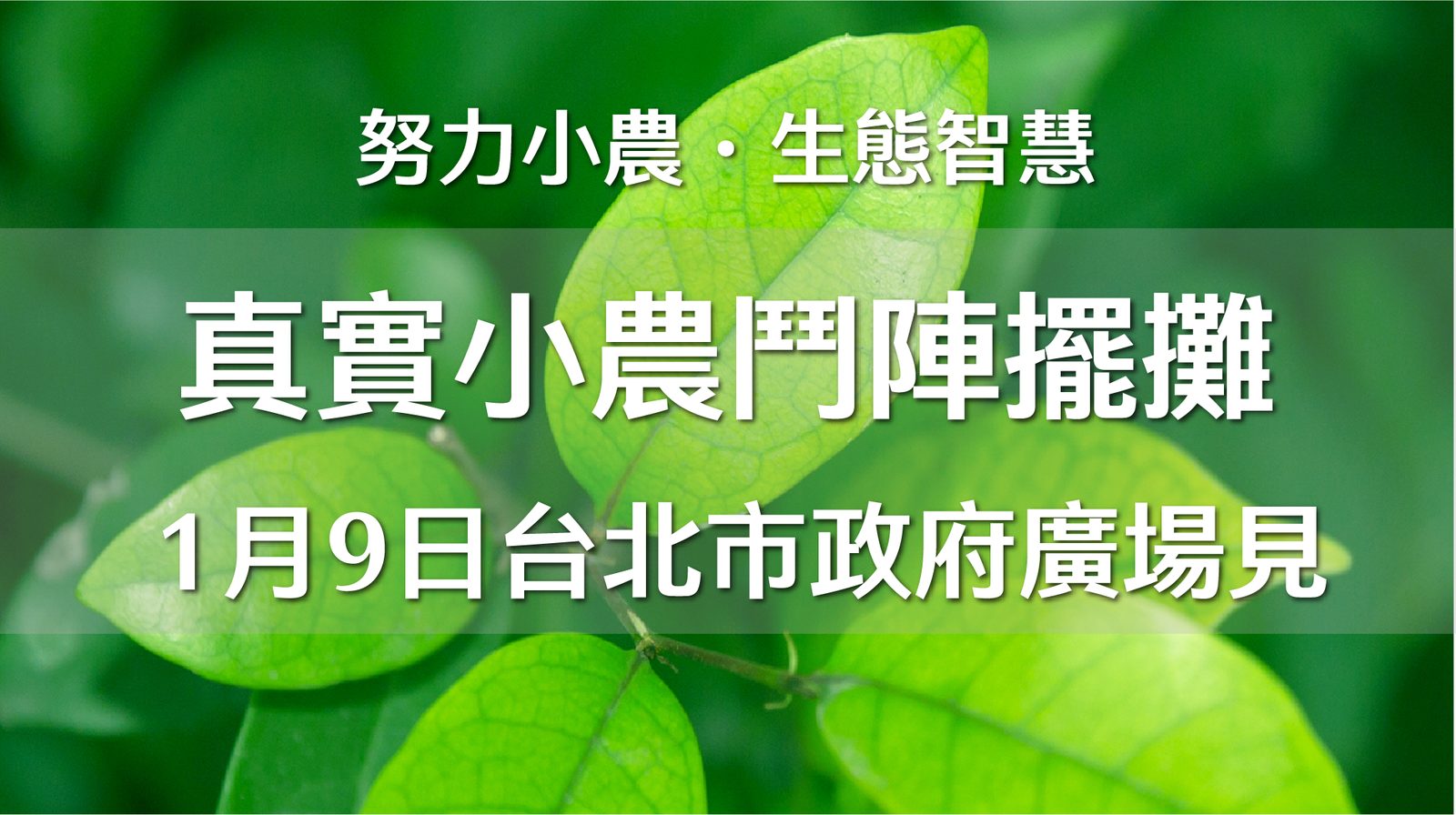
Real smallholders set up stalls together — see you at Taipei City Hall Plaza on 9 January
MiHuMiSang · Ecological Wisdom
Real smallholders set up stalls together — see you at Taipei City Hall Plaza on 9 January
Setting up stalls is part of smallholders' everyday life. From 9 a.m. to 4 p.m. on 9 January, at the plaza in front of Taipei City Hall, several Taipei Rotary Clubs are holding the "2022 Charity, Environment, Rotary Moving Forward Together" fair. At stalls 30 and 31, the Green Consumers' Foundation will showcase smallholder products, which can be bought directly from smallholders not on site via the MiHuMiSang app, and five smallholders from different regions will sell their products in person, meeting consumers face to face.
Many smallholders with stalls in Taipei are really represented by middlemen, but this time five genuine smallholders from around Taiwan, each with their own character, will be there in person to sell their products.
Supplier of lilies for state banquets
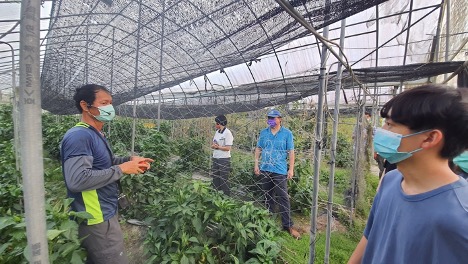
Caption: Chiang Yu-pao takes bookings and welcomes everyone to visit his farm.
Chiang Yu-pao Organic Farm in Shoufeng, Hualien supplied lilies for the presidential state banquets after the changes of government in 2008 and 2016. Twenty years ago his daughter asked him where the fireflies and earthworms had gone, and Chiang, who had farmed conventionally for more than ten years, suddenly realised that his farm, supplying a tonne of cucumbers a day, had become an ecological killer. With the conviction that "if I can't make organic work, probably nobody can", he took the path of organic farming. In the first few years he hit wall after wall and nearly gave up. Later, when friends and family wanted to eat lilies, he resolved to grow organic lilies; after many setbacks and over a million dollars in losses, he finally succeeded, and he also supplies organic cucumbers, bell peppers, rice, soybeans and more. He has many stories and lots of experience — come and talk with him.
From motorbike mechanic to tea grower and tea-making artisan
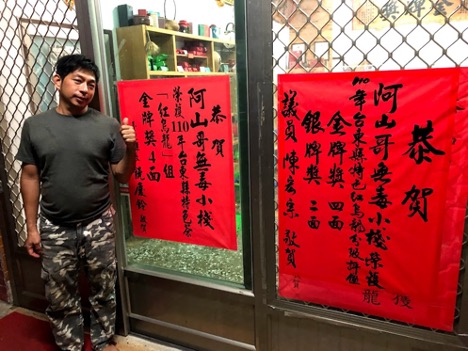
Caption: Chang Huan-jui went home to grow tea expecting to "eat dirt", but often comes home with gold and silver trophies.
Chang Huan-jui of A-Shan-Ge Non-Toxic Hut in Luye, Taitung makes a distinctive red oolong tea; last year he won 4 gold and 3 silver medals at the Luye Red Oolong competitions. Chang is from Yong'an Village, Luye. As an adult he repaired motorbikes in Taipei, and at 30 decided to go home and grow tea. Though he didn't grow up growing tea, his uncle had a tea garden and a tea factory. He devoted himself to growing and making tea and found his own way, and his rapport with tea master Mr Hsiao keeps growing; since the year before last he has won a prize at every red oolong competition. His tea is praised as elegant and clean, with floral, fruity and honey notes, as good as the sky-high-priced Oriental Beauty, because his tea garden keeps a good ecology and tea green leafhoppers bite the leaves, stimulating them into a special biochemical reaction similar to the principle behind Oriental Beauty. Come and taste the red oolong he brews himself and chat with him about tea.
From computers and electronics to a committed eco-friendly egg farmer
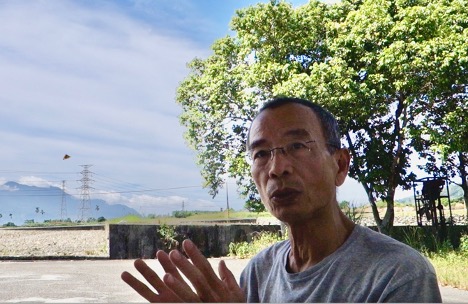
Caption: Hsu A-hua is dedicated to eco-friendly laying hens, producing clean, safe, healthy eggs every day.
An An Probiotic Eggs in Guanshan, Taitung. Hsu A-hua was a top salesman in the tech industry who travelled the world and lived in South Africa and Switzerland. Four or five years ago he came back to Taiwan to look after his elderly father and started raising chickens with relatives in Yuemei Village, Guanshan, living a country life. Hsu focuses on adding astaxanthin extracted from algae (not shrimp) to his hens' feed. He brought in French laying hens and raises them free-range, earning certification from the eco-friendly egg alliance for humane chicken farming. When we visited the coop, the hens were very friendly to visitors and all came running to "check out the visitors". Hsu is still in the trial stage, so he keeps only 700-odd hens. Every day he and his assistant collect the eggs and carefully wipe each one rather than washing them, ensuring egg quality and shelf life: a month at room temperature, 3–6 months refrigerated. Eggs that fall on the ground or get soiled are washed and given to care homes or schools for lunches. Sparing no expense, Hsu sends his eggs and water to a third-party lab for testing every six months — and of course they always pass. If you'd like to learn Hsu's unique way of raising chickens, come to the stall and make a friend.
Back to basics: Yeman Garden, a permaculture training ground
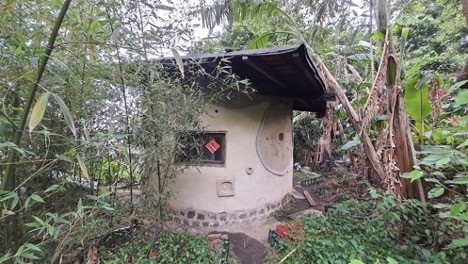
Caption: Yeman Garden is full of produce grown and raised by permaculture students' own hands and eco-friendly buildings built by hand.
Yeman Garden in Taipei is a farm practising permaculture design, on Shamao Road in Yangmingshan. Twenty years ago its owner Ya-man left architecture and the cable TV industry to study natural healing in India, and on returning to Taiwan devoted himself to permaculture, offering courses in permaculture and traditional handicrafts. Covering several jia, Yeman Garden grows hundreds of kinds of plants and raises pigs and goats, practising permaculture farming. Its products are many: vegetables, fruit, flowers, herbs, coffee, rice, wheat… a plot of just a few ping can serve as a food bank. Yeman Garden also processes farm products: sour citrus tea, dried fruit, soy sauce, vinegar, jam, wood-fired bread… In a disaster it would definitely be a self-sufficient place. Yeman Garden is normally open for visits and hands-on experiences and offers work-for-stay. If you're interested, come and chat with Ya-man.
Zero-carbon soy sauce brewed across the Central Mountain Range
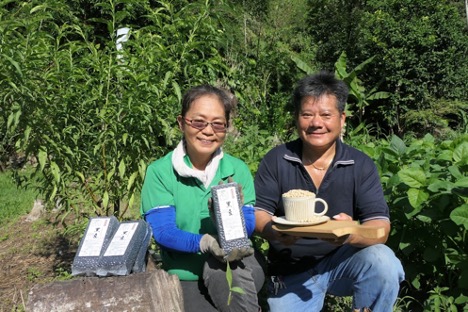
Caption: Lu Ling-ling and Hsieh Ching-po, owners of Yuemeiqiao Eco Farm, have put down roots in natural farming in Hualien, growing natural yellow and black soybeans.
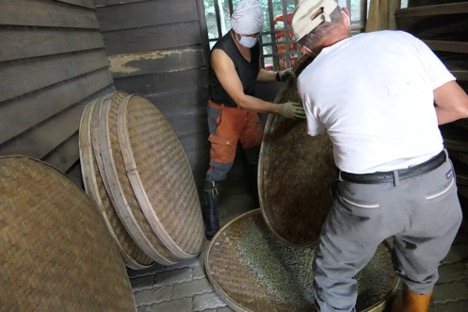
Caption: Three generations of the Fu family at Meidong make handmade soy sauce 100% by traditional methods, using only firewood from their own lychee trees, no electricity, and fermenting the beans in a century-old cypress koji room; yellow soybean soy sauce takes 550 days to brew. (Pictured: father and son Fu Tsung-ko and Fu Yen-hung)
Doudou Jiang's traditional zero-carbon soy sauce from Hualien is the first powerful collaboration across the Central Mountain Range between the yellow and black soybeans of Hualien's Yuemeiqiao Eco Farm and Dongshi, Taichung's Meidong handmade sauce works. But you have to wait 365 days for the black soybean soy sauce (out of the vats in November 2022, just two vats) and 550 days for the yellow soybean soy sauce (out of the vats in May 2023, just four vats). This batch has minimal additives, no barley, is gluten-free, and some has no sugar at all — less salt and no sugar, healthier. The whole process of growing the beans and making the sauce will be disclosed on the MiHuMiSang app. Hsieh Ching-po and Lu Ling-ling of Yuemeiqiao insist their fields use "nothing and add nothing", growing the native Hualien No. 1 yellow soybean and native yellow-kernel and green-kernel black soybeans. Because they use no fertiliser at all, at each harvest they leave nearly half the beans in the field to grow naturally the next season as fertiliser for the season after. Meidong is a remarkable traditional handmade sauce works. In 1928 Fu Po-yu learned Japanese soy sauce methods and moved from the north to Dongshi, choosing this hillside with a mountain to the east, which only gets sun after 9 or 10 each morning, and developed the family's sauce-making craft, passed down to his son Fu Tsung-ko and grandson Fu Yen-hung. They use prunings from their own lychee orchard as firewood; every vat is wood-fired, including steaming the beans and sterilising the glass bottles; and the koji room is a century-old cypress building. The whole production process is supervised by the Green Consumers' Foundation, and consumers are welcome to witness it too — all bioenergy, zero carbon emissions. If you'd like a taste of soy sauce as it was 50 years ago, you must come and try it.