努力小農
本文尚無譯文。
Biochar: something ancient, innovative and controversial
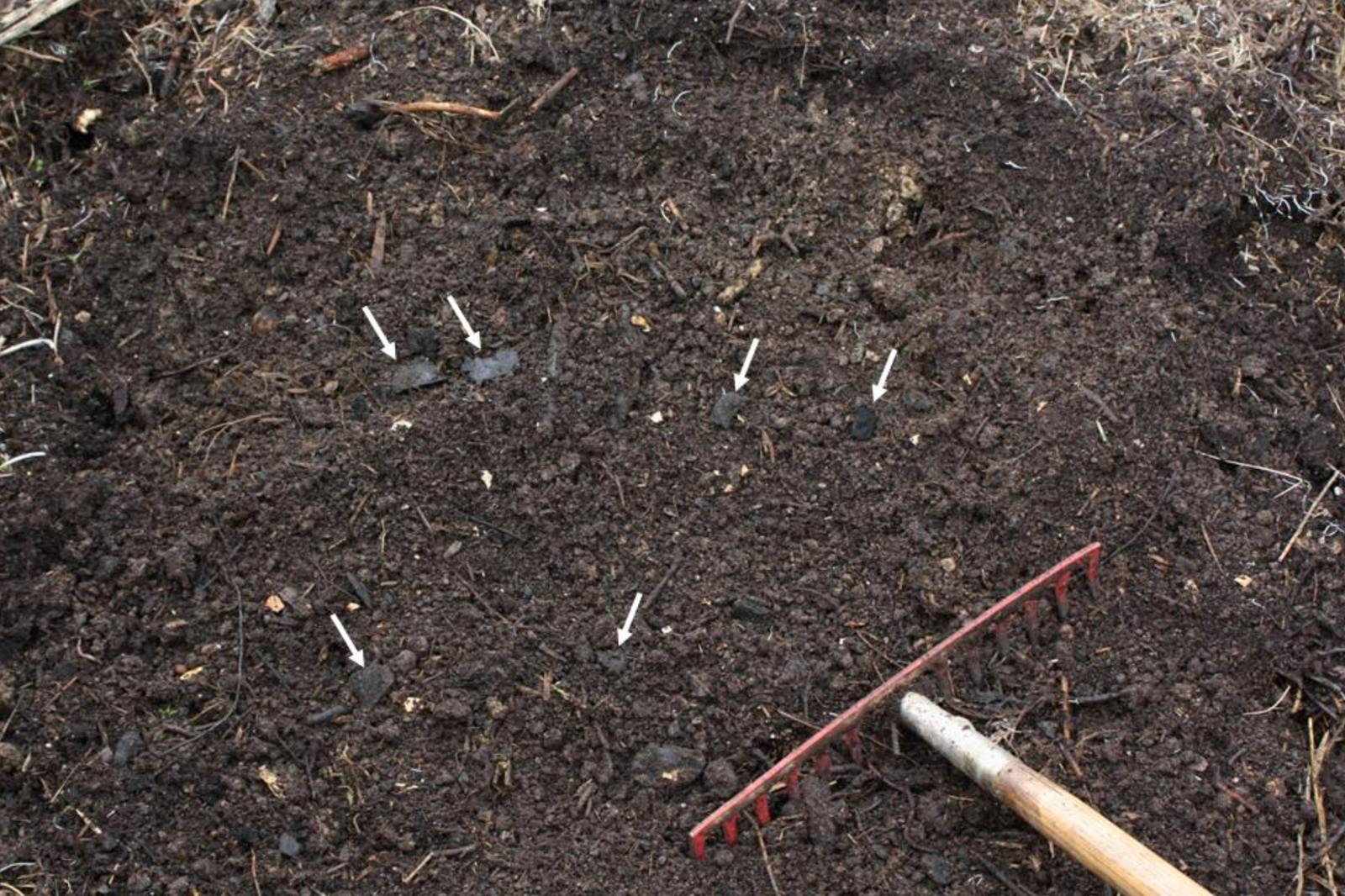
How Terra Preta was formed is still not settled. (Image: Wikipedia)
Over the past century or so, archaeologists have found "dark earth" (Terra Preta, Portuguese) in the Amazon rainforest basin of Brazil and in other South American countries. It was once thought to have been formed by Andean volcanoes or by sediment from lakes and swamps, but in recent years it was found that the charcoal in the soil is the same as the charcoal in pottery, so it was judged to have been produced by humans on a large scale.
The past and present of dark earth
Compared with ordinary tropical Oxisols disturbed by cultivation and animals, Terra Preta contains more carbon, and its formation can be dated back 4,500 years. How human activity at the time turned Oxisol into dark earth is still a mystery; perhaps it relates to the slash-and-burn methods used by many Indigenous peoples, but nothing has been settled.
Because soil science is a very complex field with too many uncertain variables, there are differing arguments as to whether dark earth actually helps crops grow and stay healthy, and no very concrete conclusion.
However, biochar as a "carbon reduction tool" has been accepted by many, because simple chemical equations show it has great potential to lock carbon away.
In photosynthesis, plants take CO₂ from the air and water absorbed by the roots and, in the chlorophyll, through the light reactions (which need light energy) and dark reactions (which don't), synthesise six-carbon sugar (glucose), which the plant's physiology then turns into the organic matter of the plant body. When this organic matter undergoes pyrolysis at over 350°C without oxygen, part of it is released as combustible gas — small carbon molecules such as methane and carbon monoxide, also called "syngas" — while about half of the biomass is converted into tough biochar.
Biochar has a polycyclic aromatic hydrocarbon structure. Because of its continuous benzene-ring structure, biochar itself doesn't easily undergo chemical change and persists for a long time as carbon molecules.
"Biochar" is just a general term. Its tough structure can have a half-life of one or two thousand years: 1 kg of biochar made today would take one or two thousand years to become 0.5 kg.
Precisely because biochar is so "stubborn", some people liken it to "plastic": biochar can be pulverised into particles, like nano-scale "carbon black", and some compare these char particles to microplastics that pollute the environment.
By contrast, ordinary organic molecules, when oxidised, turn entirely into CO₂: rapid oxidation (burning) or slow oxidation (rotting) both release carbon into the air. If organic molecules are in an oxygen-free environment or digested by termites, the carbon becomes methane released into the air, and methane's greenhouse effect is 28 times that of CO₂.
With a half-life of one or two thousand years, biochar can fulfil the mission of "carbon sequestration" well, locking large amounts of CO₂ into the soil.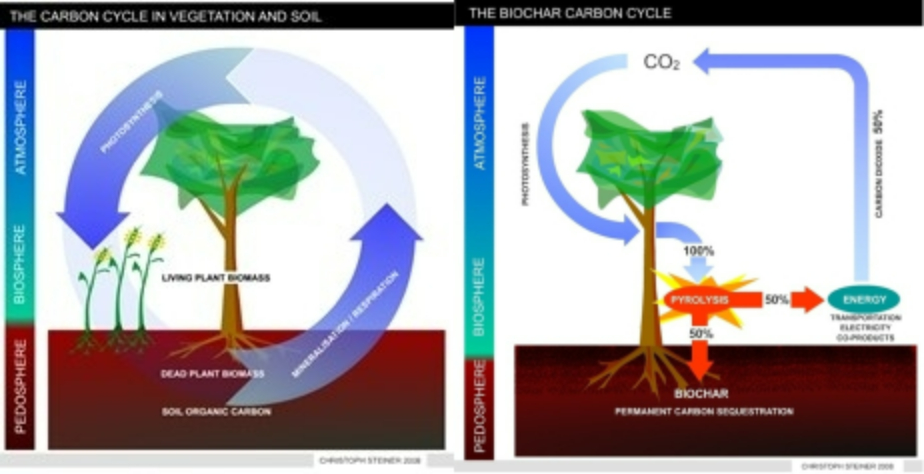
Left: the plant carbon cycle — almost 100% of the carbon cycles from the air into the living world of plants and back into the air. Right: adding anaerobic pyrolysis turns plant matter into biochar; about half is oxidised to produce energy and becomes CO₂ again, while the other half becomes carbon-fixing biochar that can be stored in the soil long term. (Image: biochar.org)
Biochar becomes a hot research field
As global climate change research has become an unstoppable trend, biochar has become a hot topic in international academia in recent years. Even the British scientist James Lovelock, now 102, considers biochar a necessary means of reducing greenhouse gases. Lovelock invented the electron capture detector, which can detect CFCs and made it possible to discover the hole in the ozone layer. He is world-famous for the "Gaia hypothesis", which is not only a scientific argument but also a key text of the New Age movement: he sees the Earth as a super-organism with the ability to restore itself. He also believes that nuclear power, if used safely, is a good way to tackle climate change.
Many start-ups producing and selling biochar have also emerged, some even treating it as a cure-all with all kinds of marketing language. Plenty of people believe it implicitly, while others scoff. As noted above, soil is a very complex system, and we shouldn't use one or two short-term results with biochar as grounds to oppose or champion it.
Although biochar is red-hot internationally and some people in Taiwan are promoting it, biochar is not yet an official international carbon reduction methodology, because its feedstock sources, production methods, processes and environment, soil characteristics, plant traits, application methods, dosages, blends and climatic factors are all full of uncertainty.
But some of biochar's benefits are undeniable. Overall Taiwan is virgin territory for biochar. How to introduce it appropriately, use it well, and maximise the benefits while preventing abuses will be one of the necessary means of agricultural carbon reduction in Taiwan's future.
Source: CM Media ( https://www.cmmedia.com.tw/home/articles/32965 )