 努力小農
本文尚無譯文。
Let photosynthesis cut carbon: ancient charcoal faces a brave new world
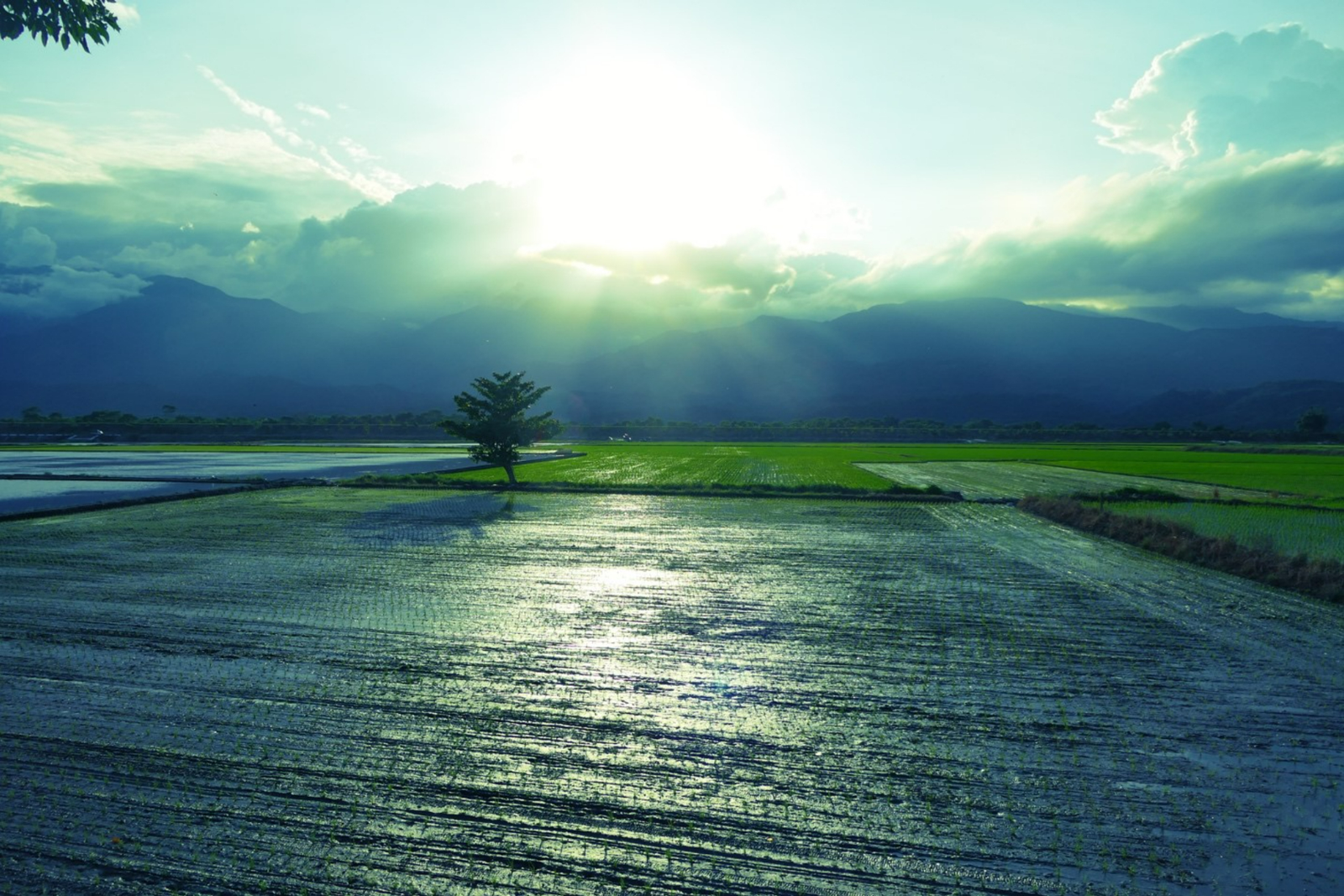
Beneath beautiful fields, countless microbes are at work to keep farm produce coming generation after generation. Without microbes, agriculture would wither too.
Amid the COVID pandemic, many have forgotten that all things support and check one another. Hundreds of millions of years of evolution have created symbiosis, and humans live in symbiosis with bacteria and viruses too. Counted by cells, our bodies are 90% bacteria and only 10% human. More and more scientific evidence shows that the bacteria in our gut decide what we want to eat, and even our thoughts and behaviour. Seen as a whole, microbes rule the Earth.
All kinds of beautifully packaged "probiotics", from Yakult to Greek yoghurt, come in dazzling variety, boasting astronomical live bacteria counts and surrounding us with polished advertising and packaging.
The Buddhist idea of countless worlds within worlds is reflected in farmland and soil. Over the 60 years of the Green Revolution, humanity has unhesitatingly taken up the weapons invented in the Second World War — tanks, aircraft, artillery, poison gas, even the atomic bomb — and beaten swords into ploughshares that became weapons of mass destruction aimed at the land: turning forests into fields, ploughing with tracked tractors, spraying from aircraft, applying vast amounts of pesticides and chemical fertilisers, driving soil microbes to extinction or accelerating their mutation, and changing the Earth's ecology on a massive scale.
Plant residues such as fruit shells, rice husks, branches and stems, heated to high temperatures without oxygen, are pyrolysed into charcoal called "biochar". The plant's organic matter is cracked and gasified, leaving carbonised cell walls, vascular bundles, fibre bundles and carbon material that form a porous structure — a quite stable carbon molecular structure. It doesn't itself break down into nutrients, but it provides space for microbes and organic matter to interact, acting like a catalyst that promotes biochemical reactions and turns plant and animal residues in the soil into humus. Simply put, adding biochar gives microbes a home where they can live, feed, metabolise and multiply stably.
The health of the microbial ecosystem determines the health of the soil — this is almost a law.
Inorganic soil can't grow organic produce
Over the past two years I've visited many smallholders who talk at length about organic farming, but when I ask about the organic matter in their soil, few can answer, because we can't see our important "partners/enemies" — bacteria — and so assume they don't exist. Today we must take microbes seriously and treat them as partners we live in symbiosis with, not enemies.
Many people "revere" organic farming, but the KPI (key performance indicator) of organic shouldn't be a certificate. Only long-term growth of organic matter and humus in the soil is truly "organic".
True organic doesn't depend on spreading organic fertiliser; it depends on the microbial ecology of the soil. Of the CO₂ plants absorb, 40% is released through the roots into the soil. With the right microbes it forms organic matter and then humus; with a poor microbial ecology, in Taiwan this organic matter is lost within half a year.
Plants absorbing CO₂ and turning it into soil organic matter is not just "organic farming"; it is also storing CO₂ in the soil as carbon sequestered in organic matter. The methodologies of the UN's offsetting tool, the Clean Development Mechanism (CDM), cite extensive literature showing that organic matter produced by photosynthesis and secreted by roots, plant and animal residues, and natural processes involving soil microbes and earthworms are tools for agricultural and forest carbon reduction. These are classed as nature-based carbon sequestration under Land Use, Land-Use Change and Forestry (LULUCF), and can effectively reduce CO₂ in the air.
This is different from ordinary industrial or green-power carbon reduction or artificial carbon capture and storage (CCS). It is a natural process that needs almost no external fossil energy or fuel, its carbon reduction effect is clear, and its ethical risks and controversies are smaller.
Let photosynthesis fulfil its age-old carbon reduction mission
If we grow a plant in a pot, as it grows the combined weight of pot, soil and plant keeps increasing. Generally, plants absorb CO₂ through photosynthesis and convert it into glucose, which together with water and minerals from the soil is turned into amino acids, proteins, oils and other biomass that make up the plant. If a plant absorbs 100 kg of CO₂, 30 kg becomes above-ground plant tissue, including stems, leaves, branches and fruit; 30 kg goes into the roots in the soil; and 40 kg is metabolised and enters the soil through the roots. These plant metabolites are organic matter.
This organic matter released by roots into the soil accounts for 40% and is very important. When it interacts with soil microbes, along with a healthy soil ecosystem of earthworms and insects, most of it turns into humus, which helps plants absorb nutrients and grow healthier and better.
But modern agriculture's use of chemical fertilisers and pesticides has long since wiped out the microbes in the soil. It's like our gut without bacteria: we can't digest and metabolise food properly, we're unhealthy and fall ill easily. So we must restore a healthy, complete ecosystem in the soil to turn its organic matter into long-lasting humus; otherwise organic matter is very easily washed away.
Metal, wood, water and earth in farming — don't leave out fire
Taiwan lies in the tropics and subtropics. Even with organic fertiliser, most of the organic matter is lost after half a year and can't be retained — even on organic farms — because a healthy soil ecosystem is missing.
In nature, besides photosynthesis, water, air, CO₂, and nutrients such as organic matter, humus and minerals in the soil, many people overlook the importance of "fire". Naturally, volcanic eruptions bring large amounts of volcanic ash, which contains nutrients, and porous "pumice", whose pores can be "homes" for bacteria, promoting symbiosis between bacteria and plants.
Forests and grasslands also have wildfires, producing plant ash, and the parts that smoulder under the fire also produce biochar. Biochar is also highly porous. Researchers have found that the pores of 1 gram of biochar can reach 1,000 square metres — about two and a half basketball courts, ten times the roughly 100 square metres of all our lungs' alveoli. The total surface area of our small intestine's villi is also about 100 square metres, and alveoli and villi ensure we make effective use of the oxygen in the air and the nutrients passing through the gut.
Pumice and biochar are nature's secret weapons for increasing the soil's surface area. These porous materials with astonishing surface areas are like houses and cities for microbes, creating the foundation for a vast, flourishing living world. Even after volcanic eruptions and forest fires, though plants are destroyed in an instant, they recover at astonishing speed, and the forest may become even denser than before.
The 1988 fire in Yellowstone National Park in the US burned 3,231 square kilometres, close to a tenth of Taiwan's area. But when I visited Yellowstone five years later, there was hardly any trace of the fire; I could only marvel at nature's ability to restore itself. Friends at the national park explained that after many large trees burned, seeds and saplings got access to sunlight, and with the soil's nutrients increased after the fire, new life had a chance to thrive.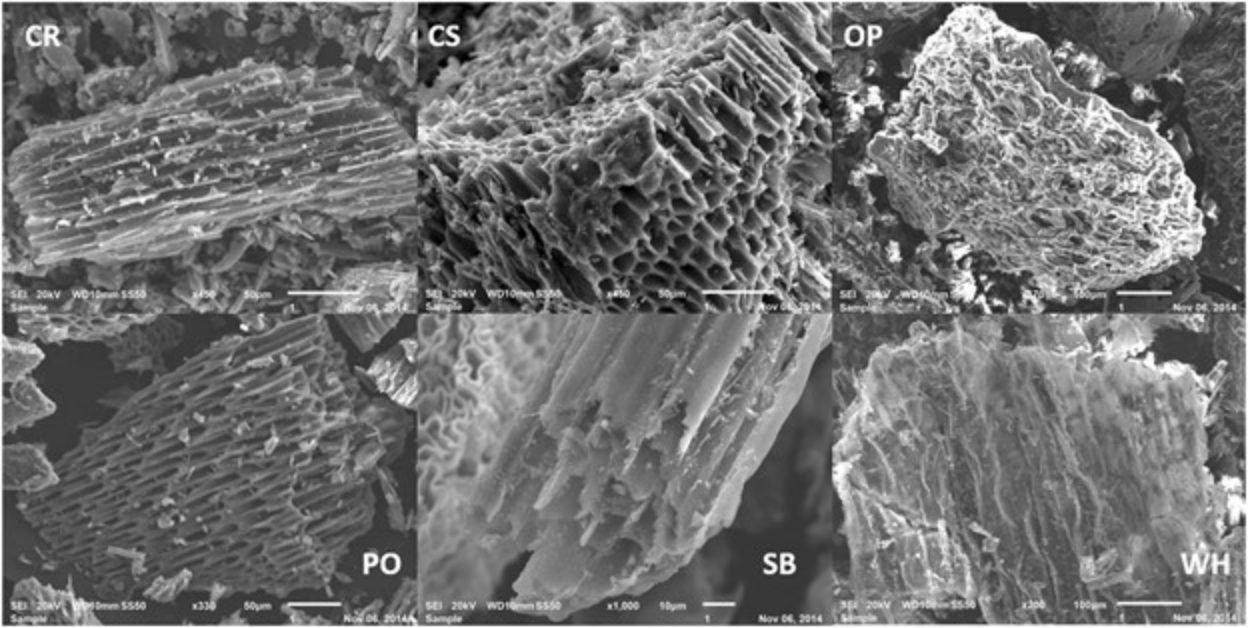
Scanning electron micrographs of biochar samples at 450× (CR – charcoal, CS – coconut shell), 170× (OP – orange peel), 330× (PO – palm fruit fibre), 1000× (SB – sugarcane bagasse) and 200× (WH – water hyacinth). (Image source: Scientific Reports, Nature)
In the five elements, each generates and checks another: wood feeds fire, fire makes earth, earth bears metal, metal carries water, water nourishes wood — a picture of the natural ecological cycle. Fire is rapid oxidation; it produces alkaline ash and pyrolysed biochar, which build the soil, and the soil's nutrients and minerals (metal) together with water give rise to wood. Japanese agriculture is advanced and environmentally conscious, yet surprisingly Japanese farmers still burn straw and rice husks to this day. The Japanese government doesn't ban it; although it causes air pollution, after weighing the pros and cons the benefits outweigh the harm.
Slash-and-burn farming was once seen as a symbol of barbarism, yet moderate use of fire turns out to be a foundation of sustainable agriculture. My previous article, "Biochar: something ancient, innovative and controversial", mentioned the discovery of Amazonian dark earth (Terra Preta) and the academic research that has made biochar a new star of carbon reduction.
There was only 1 scientific paper on biochar in 2005; by 2019, 3,209 had been published. The California state government set up a biochar research committee in 2016; in 2017 the California Department of Food and Agriculture required biochar products to be registered; and in 2020 it sought recommendations on biochar management for healthy soils.
It seems that with biochar, this ancient farming method, today's science is still like the blind men and the elephant. Indeed, facing global climate change, humanity faces the next brave new world.
We are seeing ever more clearly that plants, photosynthesis, healthy soil built by microbial ecosystems, biochar as a medium, and farming models that work with the natural environment will be indispensable carbon reduction tools in future.
Source: CM Media ( https://www.cmmedia.com.tw/home/articles/33116 )


