 努力小農
本文尚無譯文。
Earth Day: thinking about how humanity should face the next pandemic
Getting COVID to zero is impossible, but getting ourselves to net-zero carbon is not. (Photo: Pixabay)
On Earth Day, 22 April last year, President Tsai Ing-wen announced that Taiwan was actively mapping out possible pathways to net-zero emissions by 2050, and on 30 March this year the National Development Council published Taiwan's 2050 net-zero emissions pathway. Can we really solve the problems of the future? 2050 is 28 years away — what are the milestones for every year, every five years, every ten years? At the very least, I have yet to see a roadmap for the 2025 nuclear-free homeland; there's no solution for how to clear the overloaded nuclear waste from the spent fuel pools of nuclear plants.
The Earth's environment and ecology are made up of many vast, complex systems. Systemic problems can't be solved once and for all by a single fix. I personally believe that greenhouse gases and global warming are not a problem with carbon reduction as the one option or standard answer; they need systemic, multi-layered and diverse solutions.
The firefighters tore down my house
These days Taiwan's daily COVID case count has passed a thousand and may soon reach ten thousand, alarming many people. Many activities have been suspended, and restaurants and tourism, which had just begun to recover, have been hit hard again. Look at Shanghai — even worse: lockdowns so strict that many people go hungry and the sick can't get treatment. Some joke bitterly that it's a pity they don't have COVID; at least then they wouldn't go hungry.
This is the 52nd Earth Day. This environmental awakening movement, launched half a century ago by American hippies, has now become a "greenwashing day" for many companies, and "protect the Earth" has become an unshakable slogan. But does a 4.6-billion-year-old Earth need humans to "protect" it?
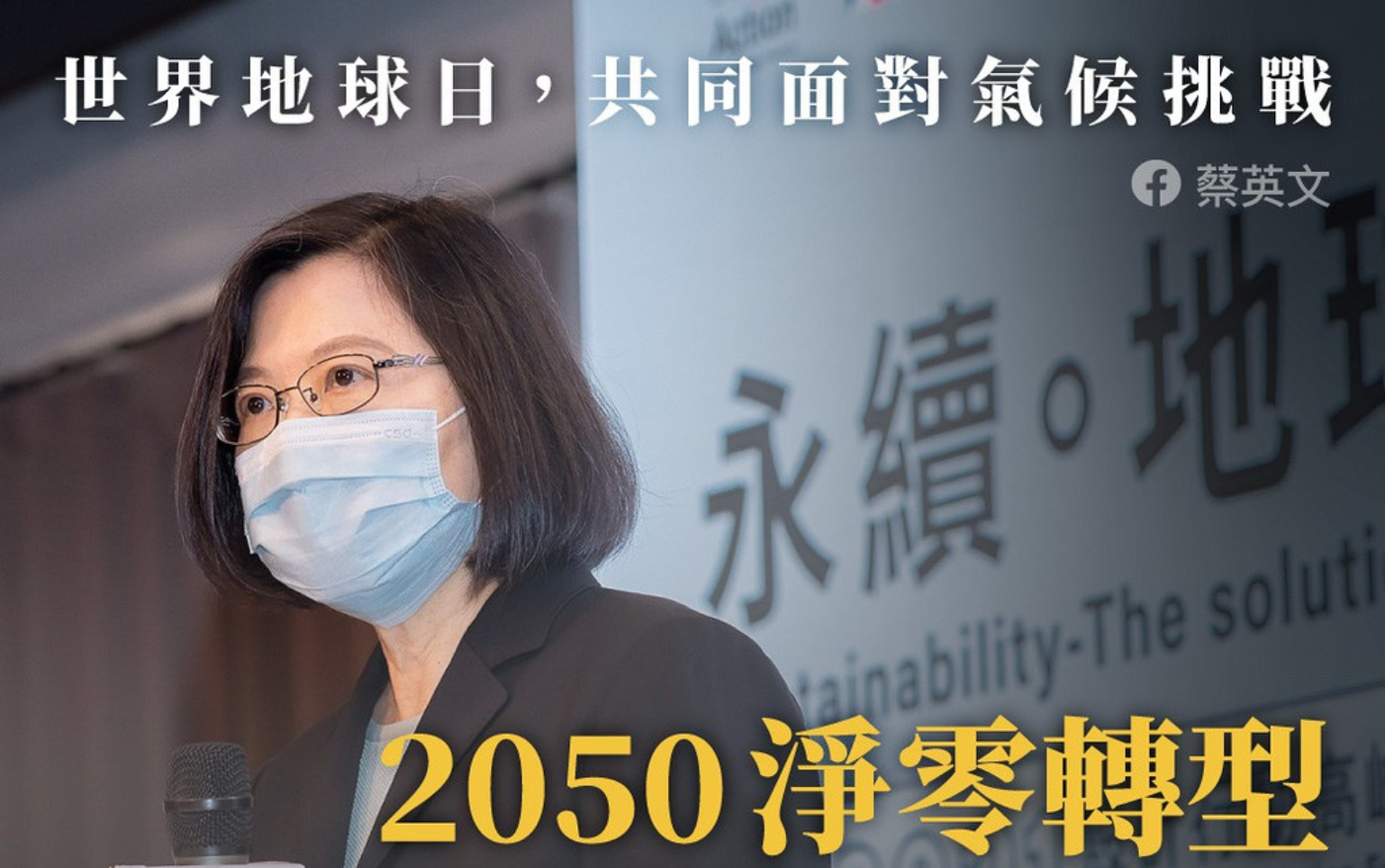
On Earth Day 2021, Tsai Ing-wen publicly announced that Taiwan was planning for net-zero carbon by 2050. (Image: Tsai Ing-wen's Facebook)
That a coronavirus that isn't actually all that formidable could bring a global pandemic shows how fragile and incompetent humanity is. As someone put it: the kitchen caught fire, the firefighters broke in and tore down the living room, bedroom and bathroom, yet the kitchen fire burns ever more fiercely.
Looking back at SARS and COVID, they originated in wild animals: habitat destruction let viruses escape, food systems became vehicles of transmission, and globalised flows of people and goods accelerated the spread, creating a perfect plague storm that swept the world in 24 months. It tested not only public health but also political leadership and the definition of human rights: can a single viral epidemic justify unlimited restrictions on people's freedom of thought, movement and speech?
Much about COVID is uncertain, but one thing is certain: if we can't face the Earth's ecology honestly, there will be other pandemics in future. Viruses may not wipe out humanity, but humanity already has the ability to wipe itself out.
How could the 10% of me defeat the 90% of me?
From a biological and physiological point of view, of the cells making up the human body, 10% are human and 90% are bacteria (including viruses). Much evidence from modern science, neurology and physiology shows that people's thoughts, behaviour, appearance and even fate are determined by the bacteria in their bodies. Understand this and you can let go of the shock of COVID — it's really nothing.
Put simply, COVID is a challenge issued by microbes to humanity: if you keep recklessly destroying the ecological environment, the humblest bacteria will take back their place as masters of the Earth.
Russia's invasion of Ukraine now dominates Western media. Europe and the US are reopening, and people have begun to move past their COVID fears, worrying more about whether Russia will use nuclear weapons; some have started stockpiling iodine tablets just in case. Looking at the statistics, case numbers, deaths and death rates in Europe and the US are far higher than in Asian countries — seemingly in direct proportion to how civilised and democratic they are.
For now everyone talks only of the UNFCCC (the UN Framework Convention on Climate Change). At COP 26, the 26th Conference of the Parties in Glasgow, UK last December, Taiwanese only worried about whether other countries would impose border carbon taxes. Taiwan's net-zero pathway of 30 March, following everyone else's lead, has only a dazzling 70% green energy and little else of note. Whether and how Taiwan's grid can dispatch 70% green energy, nobody seems to care. (Here I can predict that a roadmap developed blindly without adequate communication and consultation is unworkable. Fortunately, no one in Taiwan takes it seriously. I can also predict that the 2025 nuclear-free homeland is bound to fall through — those responsible are only in office until 2024.)
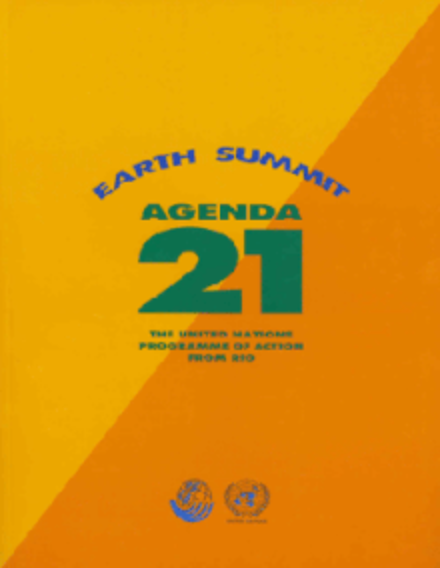
The Forest Principles, the Convention on Biological Diversity and Agenda 21, born at the same time as the UNFCCC, now receive little attention.
In 1992 a group of fellow environmentalists and I took five flights to reach Rio de Janeiro, Brazil, to attend and witness the Earth Summit, where the UNFCCC was signed. Alongside it were the Convention on Biological Diversity, the Forest Principles and Agenda 21, meant to work together and advance in step; they must be practised together to be effective. In Taiwan these three non-binding instruments receive even less attention.
I believe that talking only about cutting carbon, without addressing Taiwan's systemic structural problems — just shouting "cut carbon, cut carbon, cut carbon" — is putting the cart before the horse. It wastes time and resources on useless or ineffective work and misses the chance to solve problems in time, possibly causing an even bigger environmental and ecological crisis.
Smallholder carbon farming is not just carbon farming
I've recently been studying agricultural carbon reduction. According to FAO research, food systems account for a third of emissions from human activity — more than energy, transport or industry, which many people can't imagine. Yet no one levies international carbon or environmental taxes on agriculture and food, because farmers are relatively disadvantaged in every country. The real source is the large-scale industrialised farming that followed the "Green Revolution", using huge amounts of chemical fertilisers and pesticides and destroying the microbial ecology of the soil.
We started with smallholder carbon farming because smallholders are themselves part of local ecosystems and a link in global carbon and nitrogen cycles. Smallholders can preserve biodiversity and protect forests, which large-scale mechanised farming cannot.
Smallholders are mostly at the boundary between town and country, where wildlife habitats meet human activity, and where the human food chain is supplied. These are ecologically sensitive areas, and smallholders carry the dual responsibility of supplying food and protecting ecosystems.
Food is the best teaching material and a vehicle for knowledge, helping everyone see that ecology, living, life and production are one. Only a healthy environment and soil give healthy ingredients and food, and only then healthy people. Carrying a chain of ecological knowledge along the food supply chain is education that truly touches people's hearts.
Reduce food waste, cut carbon by 10%
How we eat also matters a great deal. Many studies indicate that food waste accounts for a third of food-related emissions. If agrifood emissions are a third of the total and a third of those come from food waste, then tackling food waste alone could address 11% of emissions.
Looking at my own household, roughly a third of our food is wasted: we buy too much, can't finish it, and it spoils. If we ate all that food, the carbon would be stored in our own bodies (getting fat, overeating, unhealthy), so I've changed my habits: I don't buy too much food, reducing waste.
But in supermarkets, lots of food near its expiry date doesn't sell and is destined to be destroyed, and "ugly food" that can't go to market from the fields is also wasted. If we can really reduce food waste, we can cut 10% of unnecessary greenhouse gas emissions.
So we'd rather choose smallholders' food — a little more expensive, but buy a little less, eat a little better and more refined, and be healthier. Helping smallholders who protect the environment is the way to tackle the problem at its root.
Drive out fear and face it bravely
Of course we must also demand that big companies and government agencies protect the environment and cut carbon at multiple levels. Net zero should not be a slogan; it should become policy and methods of implementation, and change everyone's thinking, so we re-examine how we live and work and how to live healthier, happier lives.
Getting COVID to zero is impossible, but getting ourselves to net-zero carbon is not. Achieving net-zero carbon is the best remedy for facing the next pandemic.
The last century's quality guru Deming taught "drive out fear". Quality is about solving problems. When we meet a problem, the answer is not fear, still less blaming others and heightening mutual fear inside and outside the organisation, but cooperation: examine the system and structure, find the causes, plan together with stakeholders, act to solve the problem, check whether it is really solved, and keep improving.
Facing viral plagues and global climate change, which could bring humanity disasters on the scale of extinction, we should not fear and blame each other, but recognise the root of the problem and work together to remove it. That is the attitude with which to face the next disaster.
Source: CM Media ( https://www.cmmedia.com.tw/home/articles/33436 )


