 努力小農
本文尚無譯文。
"Hualien–Taitung grows good rice" is both pride and burden: the key to carbon farming is channels and sales
Rice paddies are currently the largest area of farmland. Reducing tillage, reducing flooding, rotating with soybeans and other carbon-storing methodologies can cut carbon effectively — but how do we get farmers to accept them? Only if their produce has buyers, earning more than carbon farming itself, is there a chance.
"We know that rotating paddy and dryland crops would be good for the environment and for us, and we'd love to rotate rice, maize and soybeans — the government is pushing in that direction too. But the problem is that in Yuli, Hualien and in Taitung there are no grain merchants buying maize or soybeans. If we grow them, nobody buys…" Rice farmers Chiu Chui-chuan and Su Chun-lung, the first and second to sign "smallholder carbon farming" contracts, said the same thing independently.
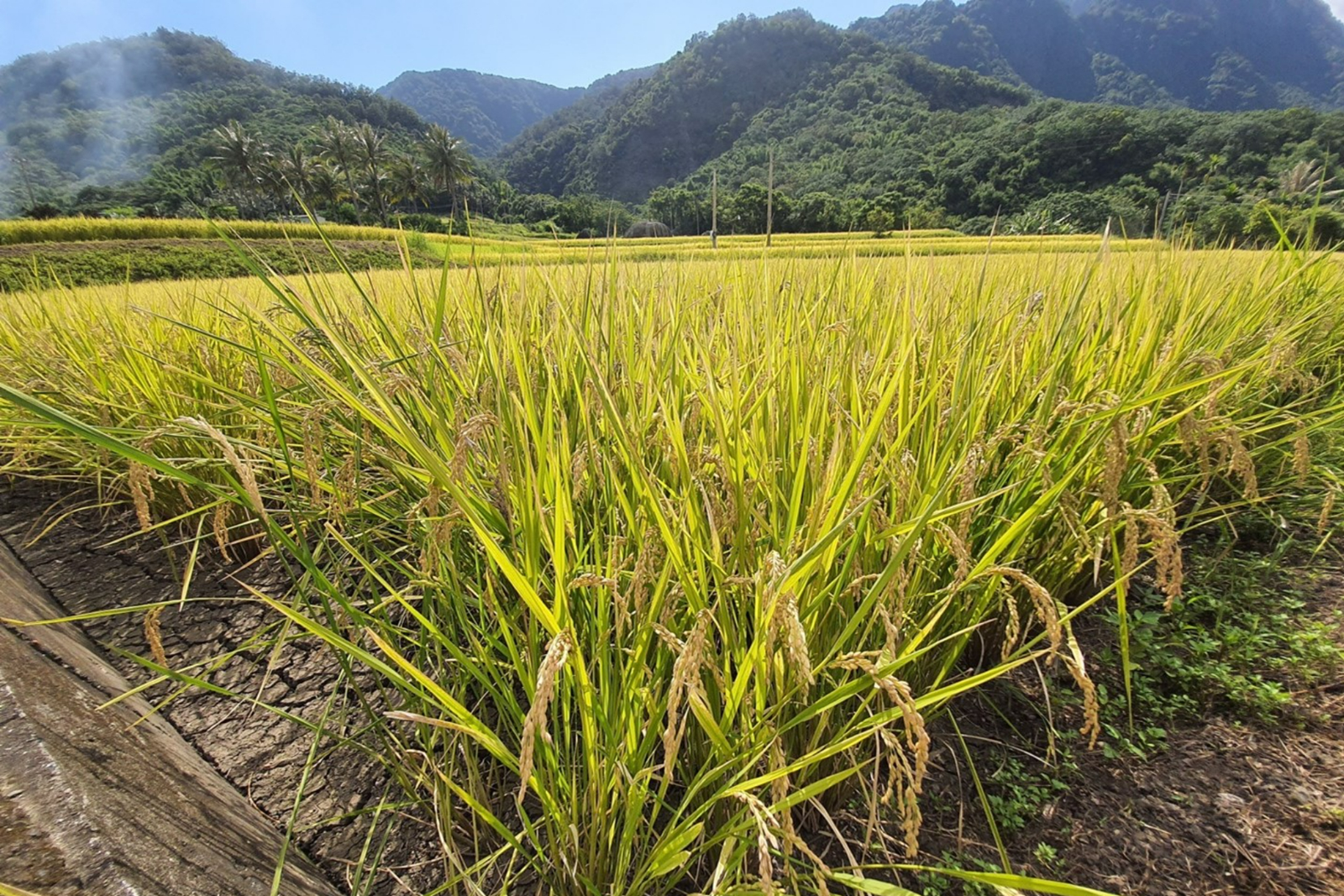
Past Fenglin in the Hualien–Taitung Rift Valley, all the way to Chishang, Guanshan and Luye in Taitung, both sides of Provincial Highway 9 are lined with rice paddies. In May, when the rice is in ear, walking through the fields you can smell the fragrance of rice flowers — utterly refreshing.
Rotating rice and soybeans has benefits, but who will buy our soybeans?
Yet rice farmers know that growing rice alone, two crops a year for years on end, does great harm to soil fertility. Though some green manure is grown in between, more fertiliser is still needed to make up the difference, and in the long run the soil will one day be exhausted. "Hualien–Taitung grows good rice" is both a source of pride and a burden. Grain merchants have recognised the value and price of Hualien–Taitung rice, driving consumer demand, while other cereal grains are unknown in Hualien–Taitung and so are not grown.
To keep an ecosystem balanced and stable, biodiversity must be maintained: different species support and check each other, forming a dynamic balance. With a single crop, the first harvests are usually good, and as long as the market likes it and farmers and merchants profit, everyone rushes to plant it. It becomes a vast monoculture, the ecosystem loses its original balance, particular insects, bacteria and viruses flourish, and large-scale pests and diseases appear — so even those who didn't use pesticides have to start.
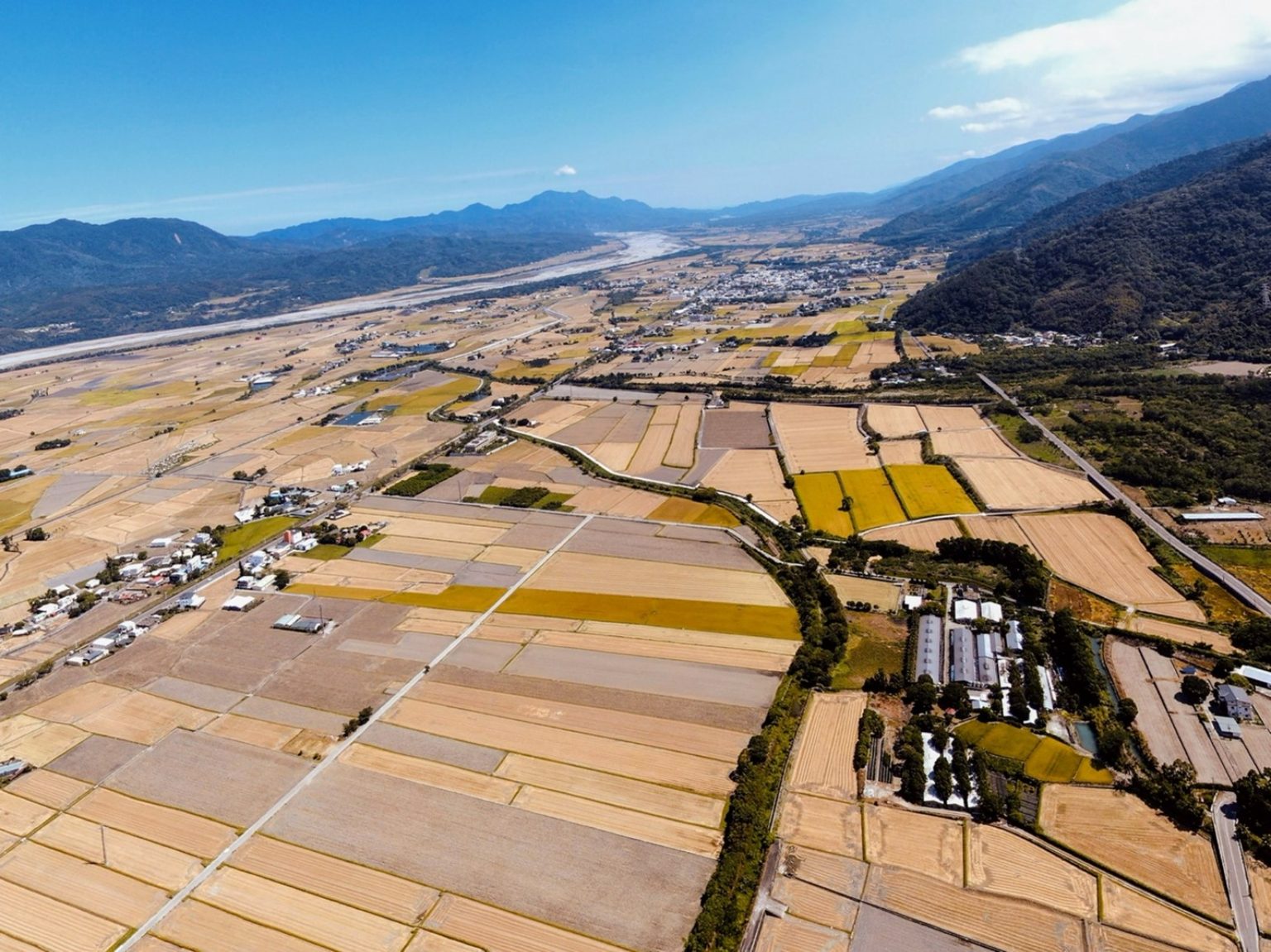
The Hualien–Taitung Rift Valley grows good rice. How to manage water well and rotate with legumes to reduce CO₂ will be an important carbon reduction issue.
Every farmer knows pesticides cost money and harm your health, but for the sake of the harvest at hand, as long as it covers costs they will use them. Once pesticides are used, insects, bacteria and viruses evolve faster and develop resistance, so next you must either apply heavier doses, find them ineffective, or switch to newer, more expensive products. To make a living, they can only put up with this vicious circle.
Sensible use of pesticides and fertilisers is also a key principle of agricultural carbon reduction, but once pests and diseases arrive it gets out of hand. Seeing pests, farmers feel safe only when every last one is gone; seeing their seedlings grow more slowly than their neighbours', they pour on nitrogen fertiliser. Over time the soil's microbes (the so-called beneficial microbes) disappear, the soil acidifies, organic matter vanishes, and only chemical fertiliser keeps it going.
Farmland becomes like a person with a chronic illness: it loses the ability to recover, yet must supply the nutrients crops need season after season, year after year. Gradually it can't feed itself and needs a feeding tube for nutrition and antibiotics to kill germs, its own immunity completely gone.
Ideals must take market realities into account
"Ideals are plump, reality is bony" — that's the most fitting description for countless smallholders. I've visited over a hundred smallholders to persuade them to join "smallholder carbon farming", and almost none disagreed. But to reach net zero and farm carbon, they must change their produce and farming practices, and in the end they face the problem of distribution channels and sales.
Some rice farmers have tried growing soybeans and maize with decent results, but with no buyers, growing them is pointless, so they had to give up.
A carbon farming project is like contract farming of carbon credits with farmers. The credits produced can't be measured with a scale or ruler; we can only use management to monitor and record farmers' original practices, analyse and calculate them, and set a "baseline". After the project starts, farming practices change and work follows approved methodologies — for example water management in paddies: shortening the time fields are flooded reduces methane emissions from paddies.
This is comparatively the simplest way to cut carbon, but the reductions are limited. Rotating with legumes increases organic matter in the soil and, in particular, uses rhizobia to fix nitrogen naturally, which can reduce nitrous oxide (whose 100-year greenhouse warming factor is about 300 times that of CO₂).
Soil is the best option for storing carbon
Academician Yang Chiu-chung of Academia Sinica, an authority on soil science in Taiwan and professor in National Chung Hsing University's Department of Soil and Environmental Sciences, has in recent years also worked on carbon neutrality in agriculture. He believes the key to storing carbon in farmland soil lies in large sources of organic matter: raising soil's "stable" organic matter content by 1% requires 22 tonnes of organic matter. He advocates using agricultural waste — "collected locally, processed locally, used locally" — to add organic matter effectively. Because microbes in the environment break organic matter down into CO₂ released into the atmosphere, easily decomposed organic carbon needs to be turned into stable organic carbon that resists decomposition. Biochar can also be used to increase soil carbon storage.
Academician Yang is also Taiwan's authority on rhizobia. The rhizobia he has isolated are supplied to farmers every year, covering 2,000 hectares. He strongly supports the "smallholder carbon farming" project and is willing to provide rhizobia inputs and technology to carbon-farming smallholders for legume rotations. This fixes nitrogen and will greatly reduce the use of synthetic urea or organic nitrogen fertilisers, cutting not only nitrous oxide emissions but also the methane used to make urea and methane leaks; making nitrogen fertiliser also needs a lot of energy and emits a great deal of CO₂. Rhizobial nitrogen fixation combined with rotation can achieve the best emission reductions.
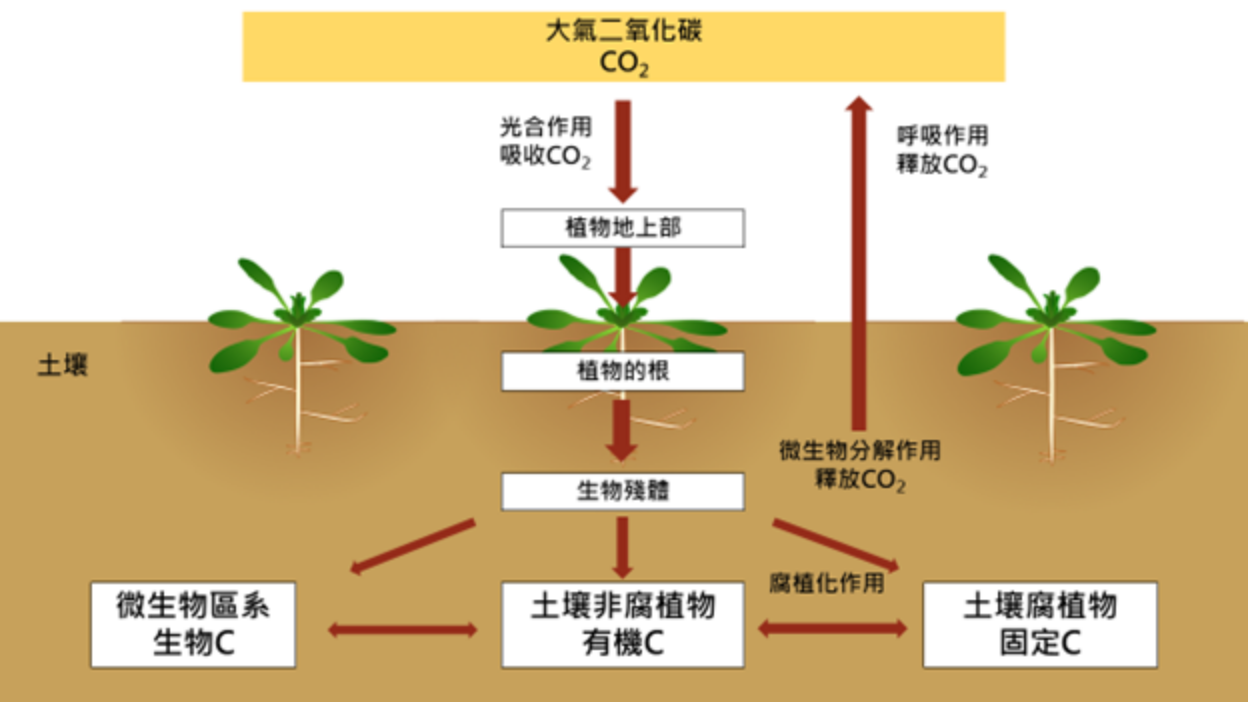
Increasing organic matter in the soil stores carbon in it and achieves carbon reduction — an important current direction for agricultural carbon reduction, and providing the relevant inputs and methods in future is very important. (Photo: Yang Chiu-chung)
But this brings us back to the first question: these products need open channels and markets before smallholders will be willing to change.
In future, "smallholder carbon farming" will not only require smallholders to farm according to carbon reduction methodologies; more importantly, there will be collective green marketing, bringing organic products that genuinely cut carbon and store it in the soil to market and linking marketing with corporate social responsibility and ESG. Only then can we open a broad road to net zero for carbon-farming smallholders.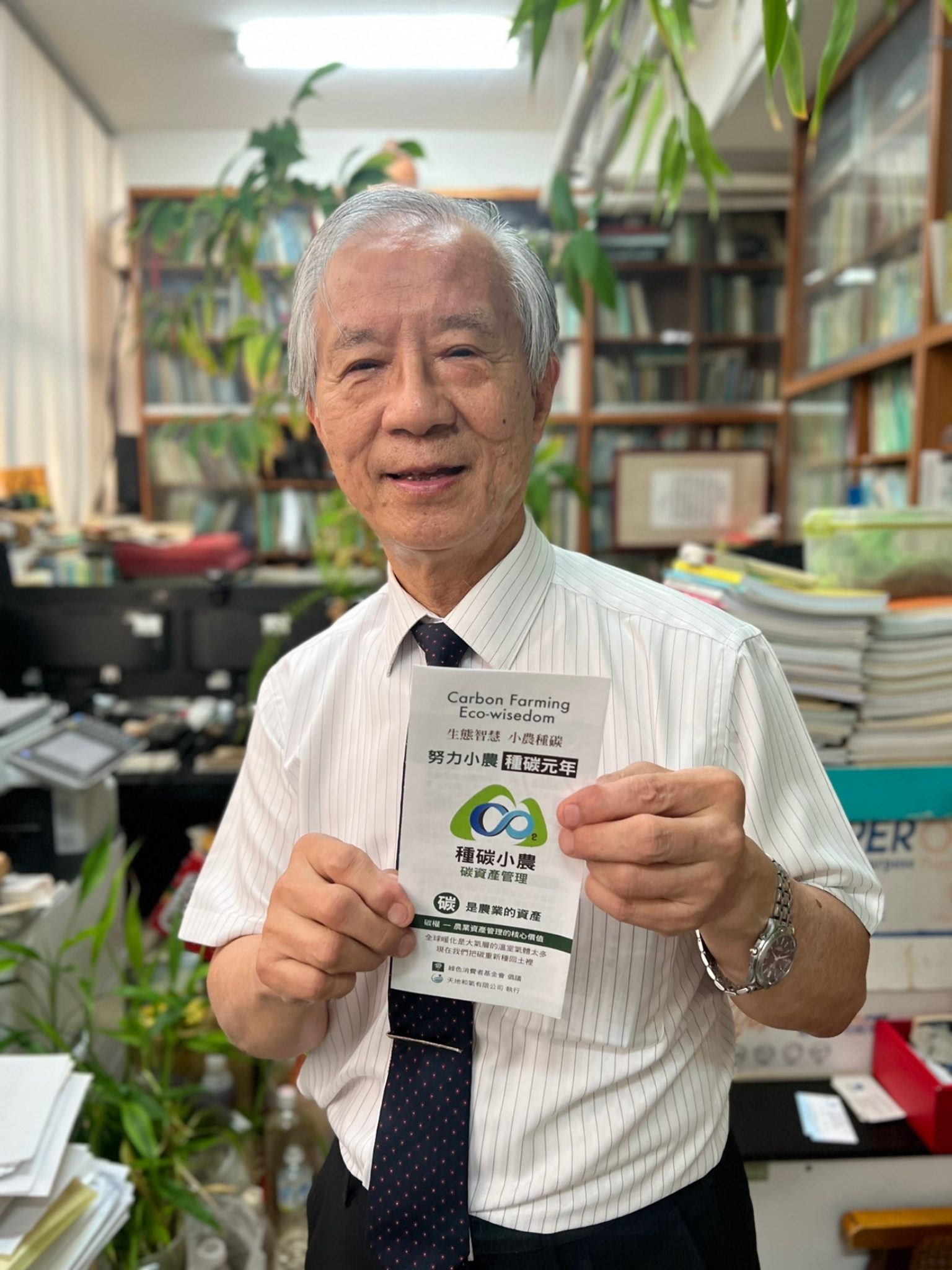
Academician Yang Chiu-chung, Taiwan's authority on soil science, is willing to take part in the smallholder carbon farming plan and provide inputs and technology to farmers.
Source: CM Media ( https://www.cmmedia.com.tw/home/articles/33842 )


