 努力小農
本文尚無譯文。
Cutting carbon doesn't mean "zeroing" carbon: did you know there's "natural carbon" and "fossil carbon"?
What agricultural carbon reduction must cut is the carbon from fossil fuels, not the carbon in the crops themselves.
If you travel in Japan in autumn, you can see farmers burning straw in the open in many fields. Many people find it hard to understand: in Taiwan, and even in China, this is illegal and should be banned, so how can it be done openly and on such a scale in Japan? Do Japanese law enforcement agencies turn a blind eye?
I used to think that all burning releases carbon dioxide — cars, gas stoves, thermal power plants, even charcoal barbecues — and that all of it should be reduced.
But after studying greenhouse gas reduction and carbon trading systems, I found that carbon has many sources and that there are rules for reducing it. Not all carbon has to be cut; reductions must be appropriate and make sense.
How should we cut carbon so that it makes sense?
If agricultural carbon comes from natural sources — photosynthesis absorbs CO₂ and converts it into glucose, which is metabolised into plants and crops, eaten by animals, excreted, broken down by bacteria and turned back into CO₂ in the air (natural carbon) — this cycle involves no net carbon emissions. It is "natural net zero" and poses no problem.
What must be cut is fossil fuel extracted from underground, because the CO₂ from burning these fossil fuels is additional. So it is fossil carbon that must be reduced, not natural carbon. Otherwise, could we reach the "net-zero target" simply by wiping out all ruminants and natural wetlands? That would be an absurd joke.
It's like dieting: you want to lose excess fat and unhealthy fat (though which fats are good or bad is a matter of opinion), not reduce fat to "zero" — and the core element of "fat" happens to be carbon. Likewise, in cutting carbon we must look at what kind of carbon it is. Never take it to extremes and "oppose carbon wherever you see it". Don't forget that all life on Earth, from the coronavirus to humans, is carbon-based organic life. In a carbon-cutting revolution, don't revolutionise yourself out of existence.
A third of emissions come from the agrifood sector — far more than we imagine
To cut carbon correctly, we first need to understand why we are cutting it and where this carbon comes from. The main reason for cutting carbon is the carbon in the greenhouse gas CO₂. Besides CO₂ there are methane, nitrous oxide and four fluorinated gases used mostly in the electronics and semiconductor industries (hydrofluorocarbons, perfluorocarbons, sulphur hexafluoride and nitrogen trifluoride).
At Glasgow last November the UN Food and Agriculture Organization stated that greenhouse gas emissions from agrifood production account for a third of total human emissions. An IPCC report in 2016 also showed agriculture accounting for 24% of emissions. Some people in other industries leapt at this, thinking that getting agriculture to cut carbon would take care of other industries' reduction responsibilities. Some even pinned methane emissions on cattle: if only everyone stopped eating beef and drinking milk, there would be no greenhouse gas problem.
If it's a matter of passing the buck, anyone can do it: push it onto the most vulnerable, the farmers and their pigs and cattle, make them cut carbon, and a quarter of emissions are gone, while everyone else carries on with BAU — business as usual. Wouldn't everyone be happy?
But why does no country levy a carbon tax on agriculture or impose mandatory agricultural emission cuts? That depends on the nature of agricultural emissions.
Before the Industrial Revolution around 1800, human agriculture already had a history of more than ten thousand years without creating a greenhouse gas problem. Of course, there were fewer than a billion people then and now there are 7.8 billion; population growth drove the expansion of agriculture. Yet look closely and the CO₂ produced by agriculture is also absorbed by agricultural crops.
NASA has visualised global atmospheric CO₂ concentrations. From 1 June 2020 to 30 June 2021, spring from March to May, when everything is flourishing, was actually when atmospheric CO₂ concentrations were highest. This is when land in the Northern Hemisphere is tilled, and tillage turns large amounts of carbon stored in the soil into CO₂ released into the atmosphere. But from the start of summer, between July and October, atmospheric CO₂ is clearly drawn back in by plants. So agriculture basically both breathes out and breathes in CO₂; we can't look only at agriculture's emissions and ignore its ability to absorb carbon. Overall, emissions from the growth of agricultural plants and animals are roughly in balance.
Agricultural carbon reduction starts with cutting the "fat"
The biggest cause of imbalance in agricultural emissions should be the chemical nitrogen fertiliser used in farming. Of US nitrous oxide emissions in 2020, 74% came from agricultural soil management, that is, heavy use of nitrogen fertiliser.
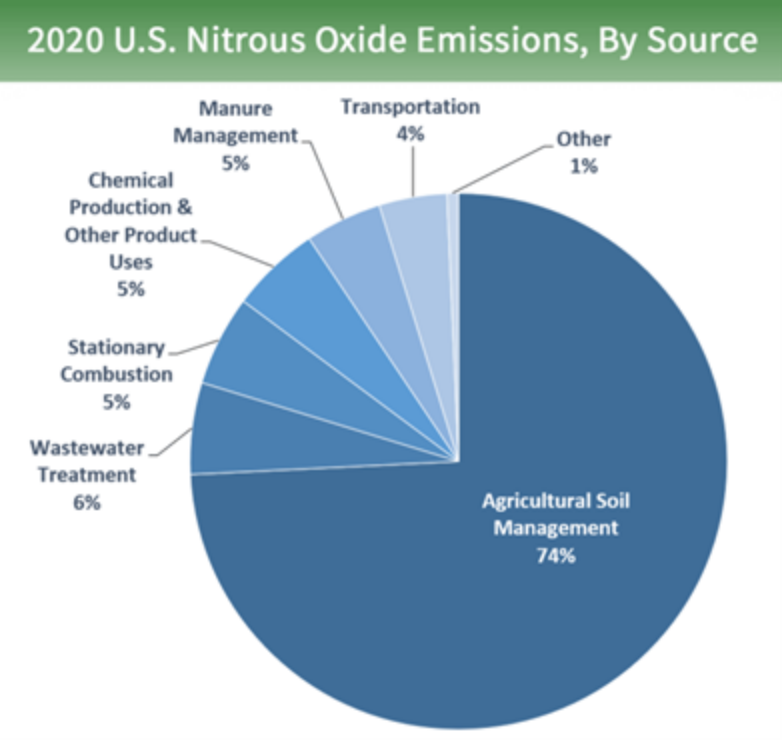
US nitrous oxide emissions show that synthetic nitrogen fertiliser in agriculture contributes the largest share, because synthetic nitrogen fertiliser (urea) emits huge amounts of greenhouse gases at every stage from production, transport and storage to use.
According to the National Greenhouse Gas Inventory published by the Environmental Protection Administration, Taiwan uses 29.27 thousand tonnes of urea a year. Although that is nearly 80% less than the 141.62 thousand tonnes of 1990 (much of the fall due to fallowing), if its greenhouse warming potential is calculated at 250 times that of CO₂, it is equivalent to roughly 7,300 thousand tonnes of CO₂ — hardly small.
If agriculture could cut "extra" nitrogen fertiliser such as urea, it would be a tremendous good. But today's farmers, especially older farmers over 60, are long used to scattering nitrogen fertiliser lavishly over their fields. Experts generally recommend just 30–40 kg per hectare of rice paddy, but many older farmers use over 100 kg, which is truly astonishing.
From a life-cycle perspective, nitrogen fertiliser is made mainly from natural gas (methane). On the one hand, natural gas is a fossil fuel from underground, and methane leaks during production, emitting greenhouse gases. On the other, converting methane (CH₄) into urea (CO(NH₂)₂) requires large amounts of fossil energy, producing yet more greenhouse gases.
Urea is made in factories and must be transported long distances, even across countries and continents, and the vehicles produce large amounts of CO₂. Once applied, urea in the soil turns into nitrite, also a carcinogen, so with too much nitrogen fertiliser vegetables retain excess nitrite, which is harmful to consumers' health.
Nitrite in the soil turns into N₂O, nitrous oxide, completing the last mile of nitrogen fertiliser's contribution to greenhouse gases.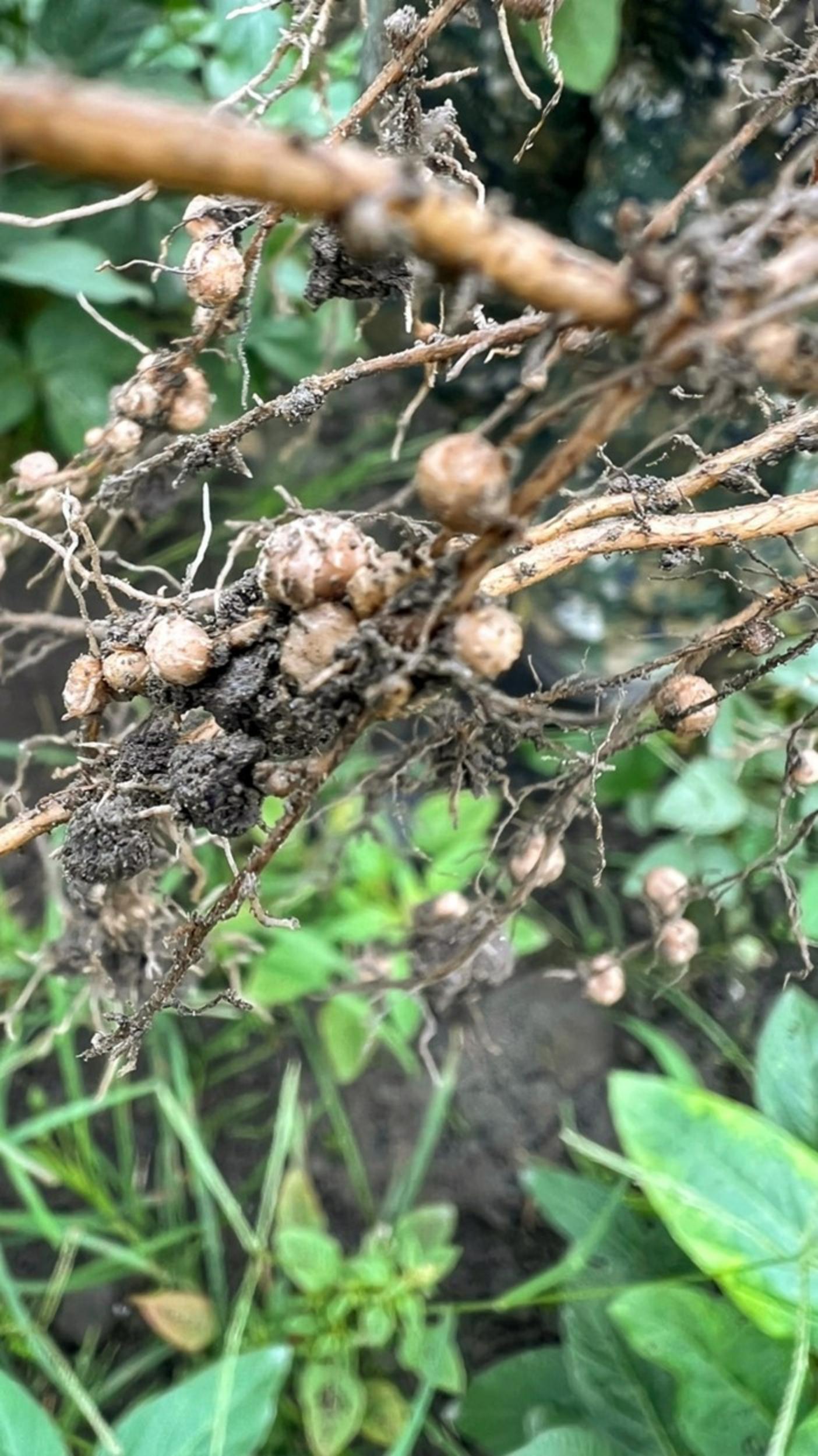
Rhizobia, which fix nitrogen naturally in the soil, also stop working because of heavy nitrogen fertiliser use.
Nitrogen fertiliser also kills beneficial microbes in the soil, so the soil loses its ability to fix carbon and nitrogen — there's hardly anything worse.
As consumers we should understand basic facts about crops and learn to recognise produce grown with less or no nitrogen fertiliser. Even though yields are lower, it may look less perfect and it costs more, we should encourage these smallholders. In the smallholder carbon farming project, besides obtaining international carbon reduction certification, we will also label smallholders who practise cutting carbon and cutting "fat", giving them a place in the market.
Source: CM Media ( https://www.cmmedia.com.tw/home/articles/34228 )


