 努力小農
本文尚無譯文。
Everyone thinks carbon reduction certification costs a fortune, but for smallholder carbon farming it's actually "zero, with change to spare"
Smallholder carbon farming: valuable but not costly. All certification costs for carbon farming are borne by the developer.
I recently attended two meetings on agricultural carbon reduction, and participants generally felt that agricultural carbon reduction certification is very expensive — hundreds of thousands, even millions — so how could farmers afford it?
For international voluntary agricultural carbon reduction plus "dual certification" under the UN Sustainable Development Goals — internationally recognised certification — how much does a farmer have to pay? The answer: "zero, with change to spare!"
Everyone says carbon reduction certification costs a fortune
Indeed, in many places certification is a near-monopoly industry, shrouded in opacity and uncertainty, with audits every year and a large fee each time. In agriculture, whether for organic, eco-friendly or traceability certification, each farmer's certification costs tens of thousands of NT dollars, but the government subsidises the vast majority, plus a further subsidy of several thousand to tens of thousands of dollars per hectare of farmland, so farmers can manage.
Without government subsidies, what a smallholder earns in a year might not even cover these certification fees. On top of that there are pesticide tests covering three or four hundred substances, costing three or four thousand dollars each time; testing every product once adds up to tens of thousands.
So, by the habitual thinking that "certification is expensive", a single carbon reduction certification project in Taiwan would cost hundreds of thousands or even millions — what smallholder could bear that?
The whole world is helping smallholders cut carbon
The international voluntary carbon market has special arrangements for agriculture, because farmers cannot pay high certification and testing fees, and smallholders' land is too small to generate large volumes of carbon credits. To encourage smallholders to join international carbon reduction action, international organisations give smallholders more "concessions" on certification.
All development costs and certification fees for carbon reduction projects are borne by the developer; smallholders pay nothing (there are no registration fees, signing fees or termination fees, and smallholders who withdraw for any reason need not pay compensation).
An individual smallholder's hectare generates 1 tonne of credits a year; even sold directly on the market, the proceeds would be at most US$30, which could never cover certification fees. That is why the role of the carbon reduction project developer is so important. At least 4,000 hectares combined are needed for it to have economic value.
The project developer must find enough smallholders and aggregate them into a project. In terms of project scale, under 10,000 tonnes of reductions a year is a micro-scale project, and 10,000 to 60,000 tonnes is a small-scale project. Given Taiwan's current situation, a micro project is just about achievable; only with over ten thousand hectares of land cutting carbon could it reach small-scale project size.
Certification fees are 100% borne by the developer, transparently and openly
Below is the certification fee schedule published by the Gold Standard, currently the largest international organisation for voluntary carbon reduction certification: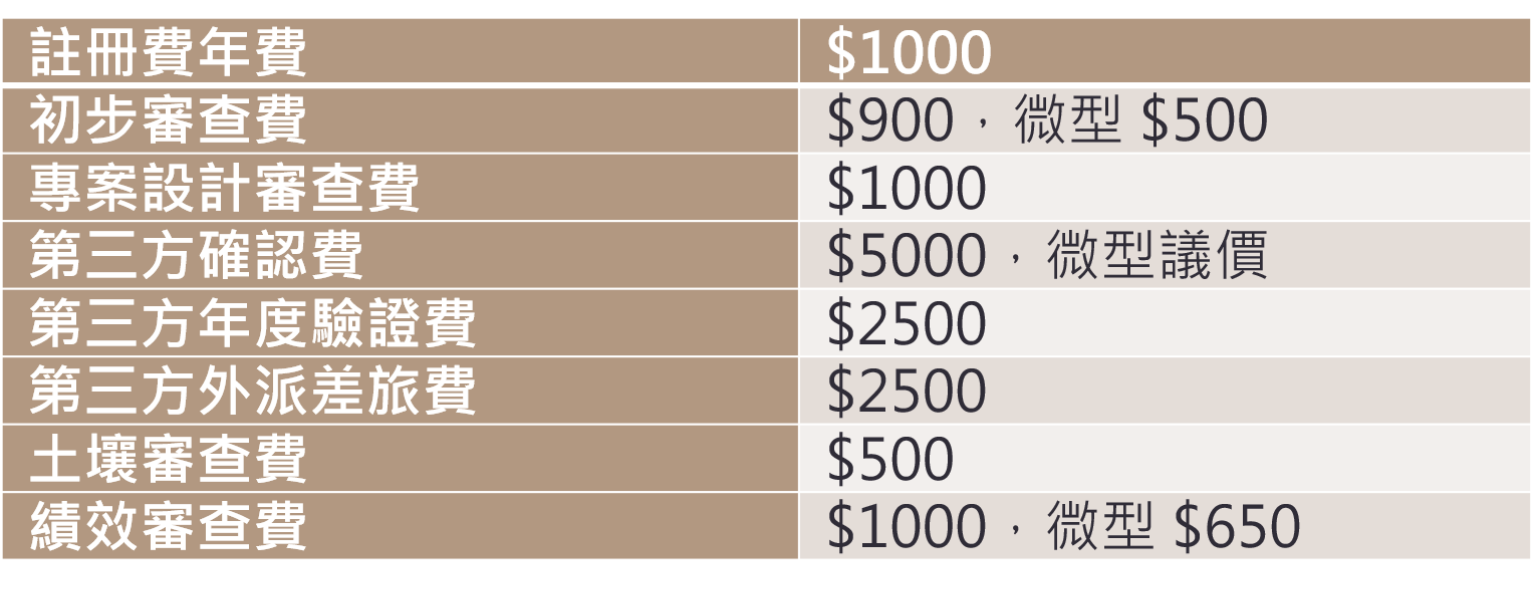
So a micro project costs about US$15,000 in total in the first year, and about US$10,000 from the second year on. In addition, during project development there are many costs for staff, travel, meetings, exhibitions, training, administration and so on, all borne by the project developer.
The project developer relies on trading the certified carbon credits to make a profit. After the carbon credits are certified each year, the developer pays each smallholder US$10 per tonne according to the credits that smallholder generated, then trades them openly on the carbon credit market. The price difference, after deducting costs, taxes and fees, yields a profit that is split 50/50 with each individual smallholder.
So for an individual smallholder, not only is carbon reduction certification free, but if they faithfully follow the carbon reduction methodology, they can receive at least US$10 per tonne in carbon credit benefits, and if the credits sell well, a further share of the profits.
The income from carbon farming credits may not be large, but developers are required, from the project's initial financial assessment to the public declaration of carbon trading income, to disclose everything openly on the international carbon trading platform, building public trust and avoiding the abuses of black-box trading.
Smallholder carbon farming earns little but brings boundless pride
According to transaction figures published by the Gold Standard, agricultural carbon reductions currently trade at about US$15 a tonne, and credits whose reductions deliver outstanding quantified SDG performance can fetch better prices.
As for developers, they must offer better services and efficient training and certification methods to obtain carbon credits of higher quality, higher transparency and stronger quantified sustainable development indicators, to achieve the greatest benefit.
Using the MiHuMiSang app as the MRV (monitoring, reporting and verification) tool for smallholder carbon farming, a smallholder can, after two hours of training, complete the year's carbon reduction work plan. By taking photos, checking in and uploading, they generate a report on each carbon farming activity, producing public, verifiable data in the cloud. Combined with a "Participatory Guarantee System (PGS)" run by local civic groups and consumers for voluntary participatory monitoring and assurance, this raises the value of smallholders' products, including farm produce and carbon credits.
This model is Taiwan's own invention. If it can succeed with Taiwan's small, diverse smallholder farms, it will work anywhere in the world — Taiwan's smallholders' contribution to smallholders worldwide.
So with the right approach, smallholders taking part in carbon farming and international voluntary carbon trading need not pay anything at all. They can earn a modest income from carbon credit trading, along with the huge carbon reduction and sustainable development results behind it. For the marketing and pride of Taiwan's smallholders, that is beyond measure in money.
Source: CM Media ( https://www.cmmedia.com.tw/home/articles/34369 )


