 努力小農
本文尚無譯文。
How to be a winner in the net-zero game? The crisis and opportunity of net zero in agriculture
If Taiwan doesn't cut carbon in future and only seeks market share through low prices, always looking to buy cheap energy, competitors will use "carbon leakage" as grounds to demand sanctions or higher tariffs or carbon taxes. (Photo: Pixabay)
McKinsey & Company recently published a report, "Accelerating toward net zero: The green business building opportunity".
The McKinsey report finds that, compared with current levels, reaching net zero by 2050 could require a 60% increase in capital spending on physical assets. By 2050, total investment of US$9.2 trillion a year would be needed, of which US$6.5 trillion a year would go to low-emission assets and enabling infrastructure.
McKinsey's analysis also shows that by 2030, growing demand for net-zero products could generate more than US$12 trillion in annual sales across 11 "value pools", including transport (US$2.3–2.7 trillion a year), power (US$1.0–1.5 trillion) and hydrogen (US$650–850 billion), with agriculture (US$0.55–1.2 trillion) in the middle. This shift in the global economy could create enormous growth potential for climate technologies and solutions.
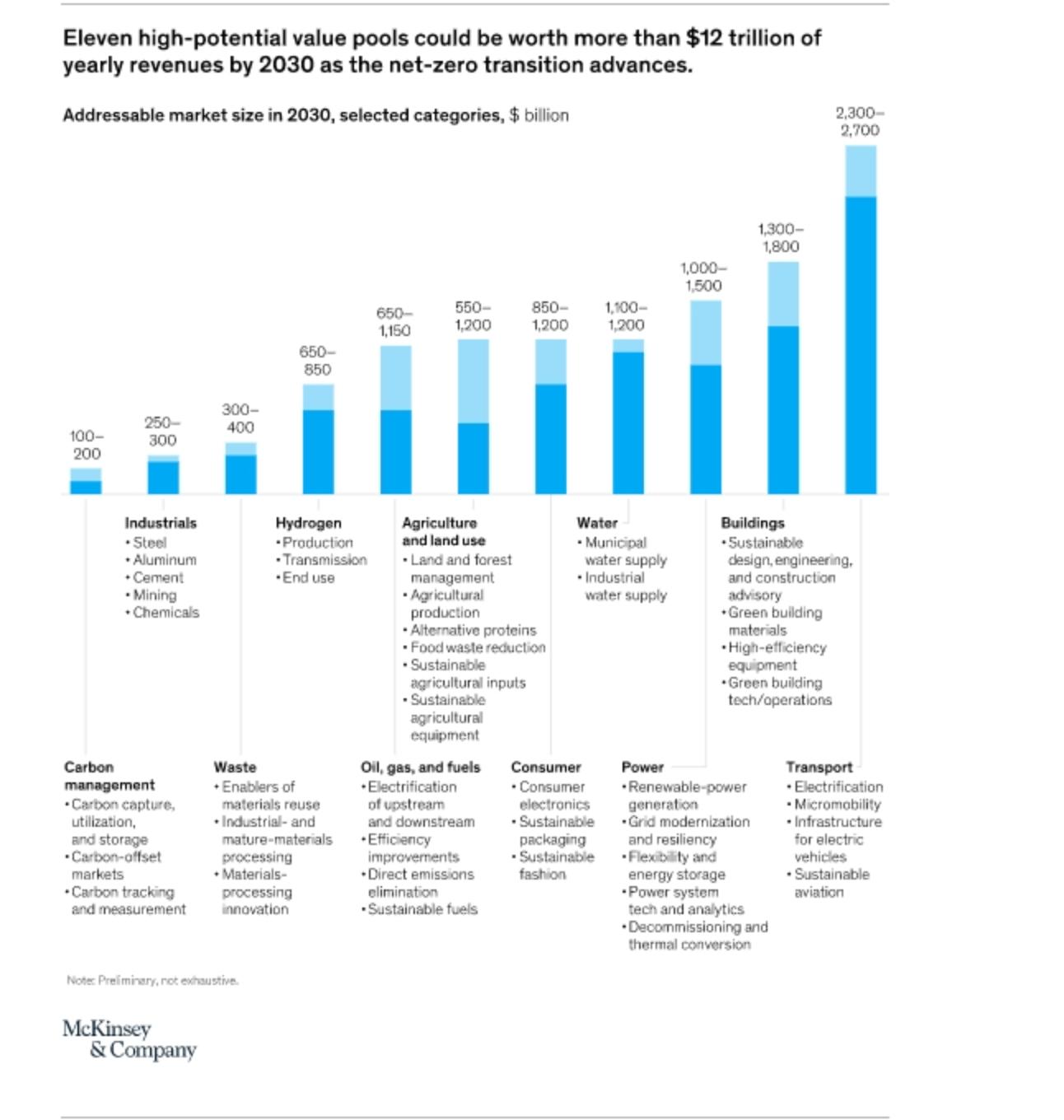
11 high-potential sectors will add US$12 trillion in revenue a year by 2030. (Image source: McKinsey & Company)
By contrast, public opinion in Taiwan mostly views the global net-zero movement passively, as something to cope with and with fear of higher taxes. People only think about how much the EU's border carbon tariff from 2025 will affect the GDP of Taiwan's industries, without considering how Taiwan can come out a winner in this net-zero game.
When industrial electricity prices rose by 15% this time, Douglas Hsu of the Far Eastern Group made a classic remark: in essence, that a sudden 15% jump was too forceful to get used to, and a gentler adjustment would be better.
Low industrial electricity prices will only push Taiwan into the carbon leakage trap
Carbon reduction is a global matter. Which governments or companies around the world will be gentle with Taiwan? Every country and company will use this opportunity to weed out the weak and back the strong. If the government uses everyone's electricity bills to subsidise big business, and Taiwan's industries long enjoy the "gentle comfort" of such subsidies, sooner or later other countries will see through it. Taiwan may well fall into the "carbon leakage trap": major international firms will inevitably abandon Taiwan to avoid the stigma of carbon leakage and the resulting consumer boycotts or even trade sanctions.
The US Department of Commerce recently listed Taiwan as one of 18 countries violating sanctions on Russia, because Taiwan, China and 16 others bought cheap Russian oil and coal. This also led the Healthy Air Action Alliance, an anti-air-pollution group formed by medical professionals in Taiwan, to protest at Taichung Port against imports of Russian coal.
When Russia invaded Ukraine on 24 February this year, Taiwan's Ministry of Foreign Affairs was quick to announce economic sanctions against Russia on the 25th. The words still ring in our ears, but international politics and business are realistic. If this is how Taiwan treats Ukraine, will other countries be "a bit gentler" with Taiwan?
If Taiwan doesn't cut carbon in future, and only seeks market share through low prices, always looking to buy cheap coal (low-grade coal), natural gas and oil, stuffing this small island full of carbon emissions, competitors will inevitably use "carbon leakage" as grounds to demand sanctions or higher tariffs or carbon taxes.
Carbon leakage is when a country or company claims to cut carbon but actually shifts high-carbon processes to other countries or companies to make its own reduction performance look better. Under current carbon accounting rules, however, besides your own emissions you must also count upstream and downstream emissions as your own; reducing carbon only on your own doorstep won't be accepted.
Our "smallholder carbon farming" initiative uses the momentum of net zero to drive a genuine, transparent and participatory carbon reduction and net-zero movement from the bottom up. Genuineness, transparency and participation are the most basic requirements for international carbon reduction certification, because carbon trading crimes have been rife in the past and have reached very high levels. Yet carbon trading is an essential tool for global carbon reduction, balancing the North–South gap, so its rules and systems are becoming ever more complete and strict. Participants must transparently disclose the location, subject and process of their reductions, calculate reduction quantities using conservative estimates and statistics, and achieve real reductions.
After holding the smallholder carbon farming "stakeholder consultation meeting", we must incorporate the views of all stakeholders and calculate "baseline" emissions (the scenario before the carbon farming project begins) step by step according to the methodology. First we must test the amount of organic matter in the soil, then choose methods: for example, reducing ploughing disturbance so that soil microbes thrive in symbiosis and soil health is maintained is the most important project work. Soil organic matter must be tested every year, and only if it increases can carbon reduction (soil carbon sequestration) credits be obtained.
At the same time, agricultural carbon reduction rules stipulate that smallholders must not reduce yield or output value because of the carbon farming project, for fear that some would cut production for the sake of carbon credits and cause a food crisis. This is less likely in Taiwan, because each smallholder's area is small and the credits they can accumulate are few: one tonne per hectare is already good performance, bringing a return of only about US$10 a year, not enough to have a major effect. In other countries, where farms often span hundreds or thousands of hectares, cutting production for carbon farming could lead to abuses.
Carbon reduction is not gentle at all
Since June this year, Dutch farmers have staged large-scale protests against the government's nitrogen reduction plan. On 7 July police even opened fire on demonstrators and arrested 19. The government and lawmakers argue that 70% of nitrogen emissions come from intensive livestock farming, which accounts for 1% of economic output. Dutch livestock farming is world-famous, and the Netherlands is the third-largest exporter of agricultural products after the US and France. Cutting emissions would halve poultry production.
If the Netherlands can be this "fierce" with its own farmers, is it likely to be "a bit gentler" with Taiwan's high-carbon products?
Rather than being forced to change, it is better to change proactively and make change your own competitive edge. Taiwan, like the Netherlands, is small and densely populated, but Dutch agriculture is export-oriented, exporting to the whole world; it ranks first globally in export value of dairy products, beer and cocoa. Most people will be familiar with Unilever (originally Dutch, now headquartered in London) and Heineken.
Taiwan's food self-sufficiency dropped sharply after joining the WTO, and large amounts of farmland have been lost. This is also a national security issue: in terms of calorie supply it is below 30%, export volumes are very limited, and sales are confined to neighbouring areas, often leaving Taiwan vulnerable and at others' mercy.
Where is our share, and where can we win?
I believe the short-term benefits of carbon trading from "smallholder carbon farming" are extremely limited, but in the long run it is very important. Going international, rebuilding smallholders' confidence and self-respect, and finding the meaning of land and soil in the new net-zero era — only by analysing these gains and losses with clear, reliable quantification and winning international recognition will it have meaning and real benefits.
Think about it: in the global "value pool" of US$0.5–1.2 trillion a year by 2030, where is Taiwan's share, and where can it win? I believe raising Taiwan's food self-sufficiency is the top priority, letting more young people enter farming easily. Achieving this means providing land at reasonable prices: whether renting or buying, long-term, stable land-use rights are needed, otherwise with short 3- to 5-year terms farming cannot be developed for the long term.
One carbon farming contract period is 10 years, which is hard for many smallholders to imagine. Young farmers without land don't know whether they'll still be farming next year; old farmers with land worry that no one in the family will take over, and whether they can keep going next year is uncertain. Add all kinds of land speculation, including green-energy solar farms, constantly tempting landholders to give up farming their farmland — which is only human nature.
Then there is the teaching and spread of good farming techniques and inputs. Most smallholders learn a bit here and a bit there, patching things together and crawling forward amid the frustrations of constant trial and error, and they easily give up. They generally can't find good resources for farming techniques and inputs, nor any way to verify results; they often hear that some machine or chemical works well and use it, only to be fooled by salespeople. In Taiwan good farming inputs are either unavailable or very expensive, and if you make your own the quality is hard to keep consistent.
Smallholders have too many things to juggle at every moment to specialise in growing itself, and even when they manage to grow something there are still problems of sales channels and prices, which is even more painful.
Lessons from Israel
In 1994 I visited cooperative collective farms in Israel. All the supporting work — water sources, drip irrigation systems including fertiliser, land preparation and other shared operations — was handled by professionals, rather like contract farming services in Taiwan, but more organised and systematic, with professional guidance.
I was amazed back then that in Israel, extremely dry with yellow sand as far as the eye could see, fruit, vegetables and fresh flowers were among the country's largest exports, and its water conservation, management and use were astonishing. Later I hosted Bill Clark, an official from Israel's Ministry of the Interior, on a visit to Taiwan. He was very surprised to see water tanks on the roof of every house. He asked me how much electricity that must use, and how the water quality in each household's tank was guaranteed. To this day I have no answer to that question.
However far we go with the metaverse, blockchain or artificial intelligence, in the end, eating our fill three times a day, eating well, eating healthily and happily — whether we live to eat or eat to live — food remains most people's "ultimate life goal". Since it cannot be avoided, why not face it properly and meet the challenge more positively? Joining international agricultural carbon reduction and carbon trading is only a small step, but an important one.
[MiHuMiSang: How to be a winner in the net-zero game? The crisis and opportunity of net zero in agriculture]
Source: CM Media ( https://www.cmmedia.com.tw/home/articles/35040 )


