 努力小農
本文尚無譯文。
Listening to the soil: carbon isn't the villain — it's the source of life on Earth
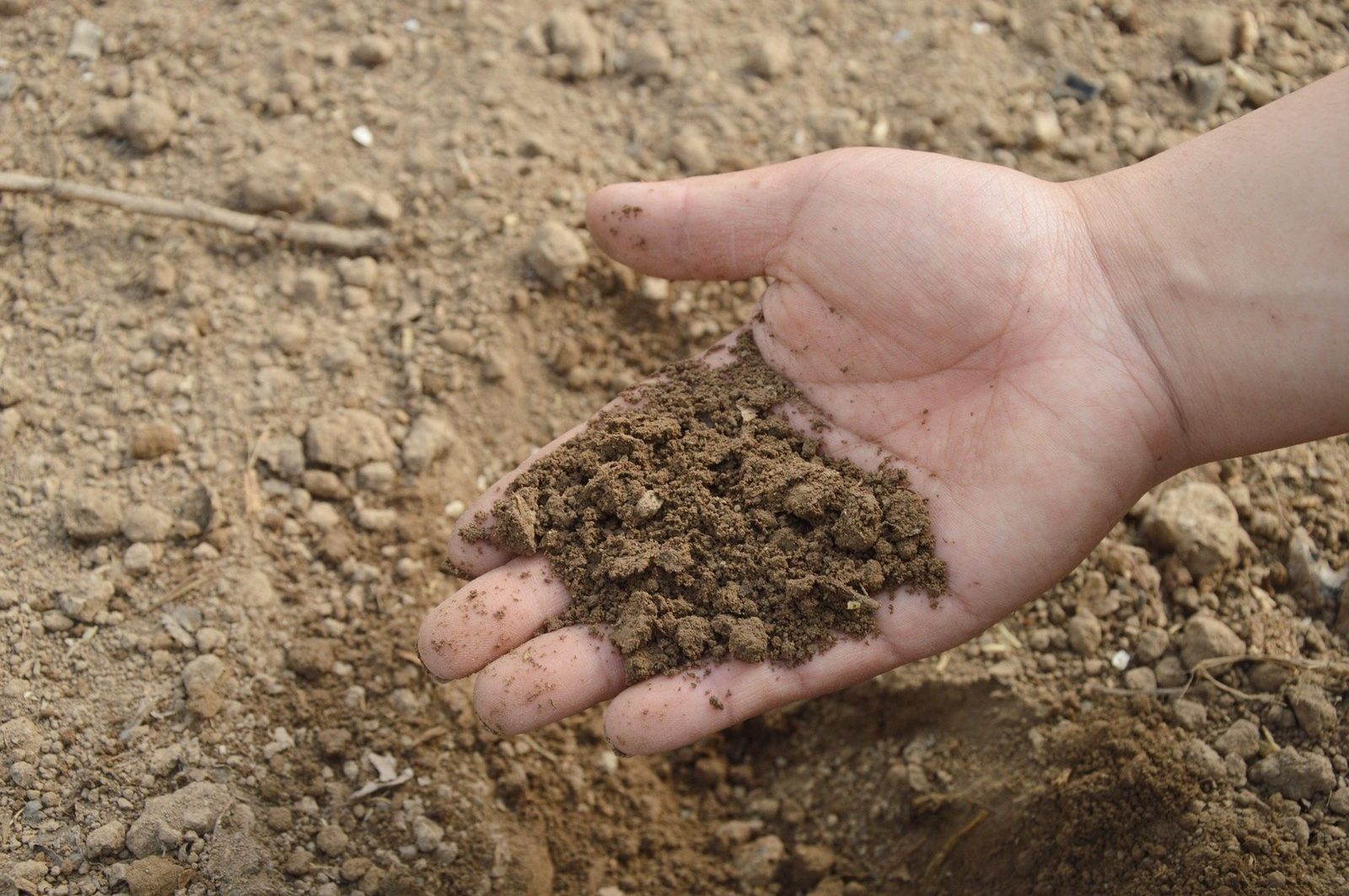
Agriculture is the best way to plant carbon back into the soil, because plants absorbing carbon dioxide and producing glucose through photosynthesis has been "the natural order of things" for hundreds of millions of years. (Photo: Jing @ Pixabay)
"Isn't carbon bad? Why do we still want to farm carbon?" a kind-faced woman asked me quietly at a "smallholder carbon farming" briefing in Pingtung a few weeks ago.
I think this is a huge misunderstanding. Carbon isn't the villain; it's the source of life on Earth.
Our bodies and all living things on Earth are organisms made of carbon-based molecules; "organic" means molecules with carbon at their core. Carbon dioxide in the atmosphere is the source of our bodies and all life. It's the loss of carbon balance that has caused the greenhouse effect and global change. We must learn from nature and "plant" carbon back into the land.
Many people talk about "Carbon Capture and Storage (CCS)", trying to separate and collect carbon dioxide from the air by physical and chemical means, then store it in big steel tanks or inject it into the Earth's crust — a massive undertaking. Calculated in terms of emissions, the energy and resources consumed by CCS produce emissions almost equal to the carbon captured and stored; in terms of economic feasibility it's superfluous.
Agriculture is the best way to plant carbon back into the soil, because plants absorbing carbon dioxide and producing glucose through photosynthesis has been "the natural order of things" for hundreds of millions of years. Using high-yield crops and afforestation as CCS tools today, we don't have to pay the sun or build large factories and storage facilities to make use of chlorophyll's age-old CCS, while also providing humanity with food and building materials. We need only change the exhaustive production methods of the past 60 years, with heavy use of pesticides and chemical fertilisers, which have wiped out vast numbers of soil microbes and insects and turned soil into desert.
The Loess Plateau becomes an oasis by storing carbon (soil organic matter)
Ecologist, journalist and filmmaker John Dennis Liu documented the natural restoration of 35,000 km² of the Loess Plateau (almost the area of Taiwan) into an oasis, with crop yields far higher than before. The principle is simple: maintain diversity, develop a little less land, stop deep ploughing and dense planting, and give the land a chance to restore itself, and the earth will repay humanity with more food and a safe environment.
Land itself is highly productive. Wasteland that no one manages becomes overgrown with weeds within a few years, then turns into dense forest — proof that governing by non-interference produces more biomass than more human intervention and forcing growth. Nature and life will find their own way.
What's the secret? The answer is organic matter in the soil (Soil Organic Carbon).
For carbon reduction, maintaining the carbon cycle is the way
Soil organic matter content is a sign of the whole ecosystem, the integral of the symbiosis of plants, animals, microbes and minerals. Excreta, remains and bodies of plants and animals always return "dust to dust, earth to earth". If the soil ecology is good and favours decomposition, they become soil organic matter and humus, providing ample nutrients for later plants. Plants feed animals, forming the endless cycle of producers (plants), consumers (animals) and decomposers (microbes) — something taught in secondary school biology.
In 2020 the Gold Standard, an international voluntary carbon reduction standard and certification body, developed the Soil Organic Carbon Framework Methodology, using changes in soil organic carbon as the target of carbon reduction certification.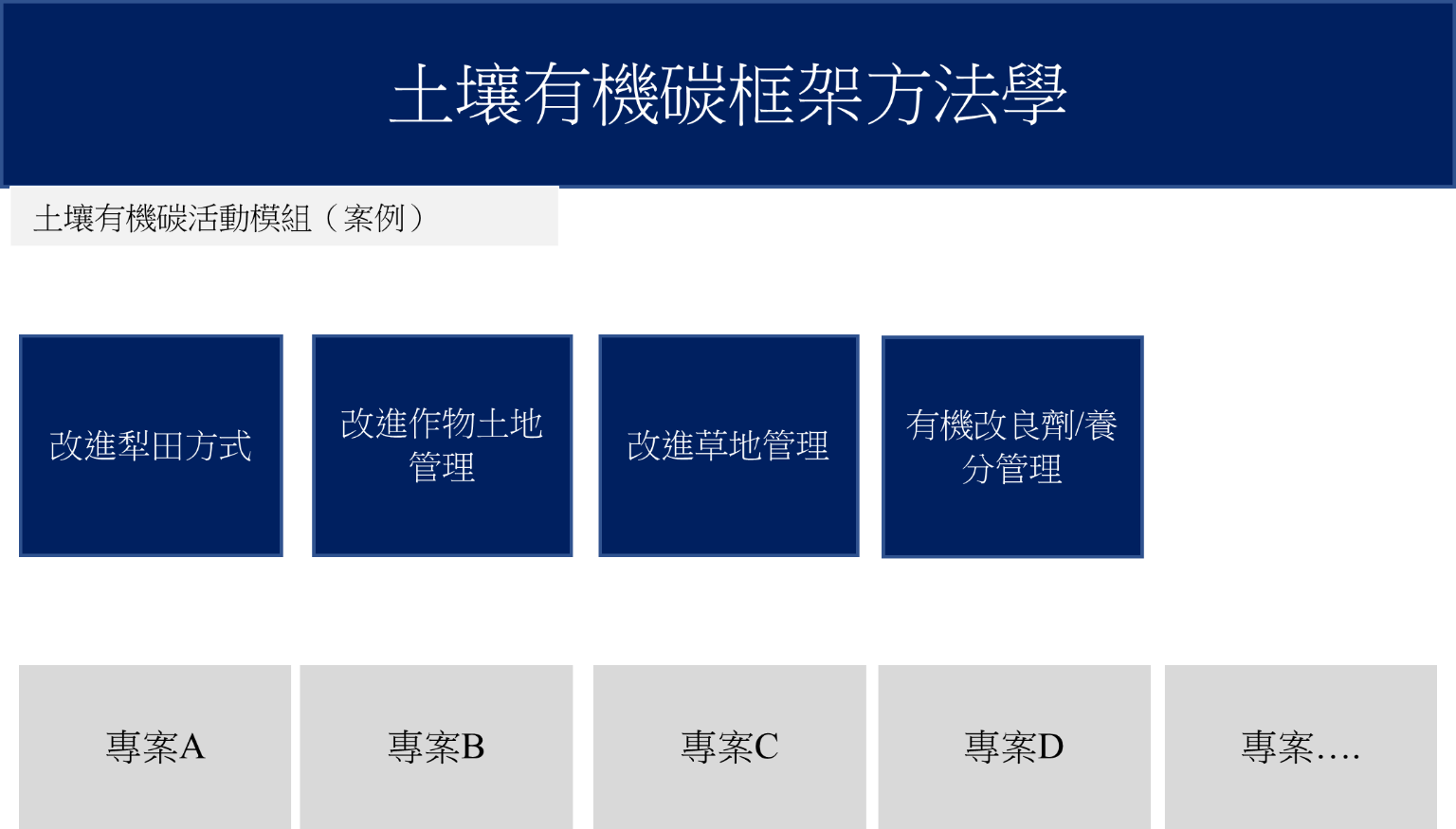
The Gold Standard's Soil Organic Carbon Framework Methodology.
The SOC methodology provides three approaches for quantifying the baseline (original SOC content) and the project (changed farming and management practices after the project starts) to demonstrate SOC improvement:
1. Take field measurements to directly record baseline and project SOC levels
2. Use peer-reviewed papers to quantify baseline and project SOC levels
3. Apply default factors to quantify SOC changes, following the general approach described in the IPCC Guidelines for National Greenhouse Gas Inventories (IPCC 2019).
Because Taiwan's terrain, geology and smallholder farming practices vary so much, it's hard to estimate SOC content using the second and third approaches, so we must use the first: measuring soil organic carbon directly.
To know SOC content, sampling must be done first, following the international method specified by the Gold Standard: "A Protocol for Modeling, Measurement and Monitoring Soil Carbon Stocks in Agricultural Landscapes" by the World Agroforestry Centre (ICRAF) and the Earth Institute, Columbia University (EI).
Quantifying the carbon content of soil
Interestingly, the method was developed for Africa, which is vast: a standard block is 100 km², a unit is 10,000 hectares, with 160 sampling points. That's enormous for Taiwan; apart from Taiwan Sugar, very few have a single 10,000-hectare tract. By conservative estimate, many smallholders in Taiwan have less than one hectare, so each one-hectare plot is used as a sampling area. For large areas of the same crop, perhaps 10 hectares could be one sampling point.
There are also rules on sampling methods. First, prepare the sampling tools.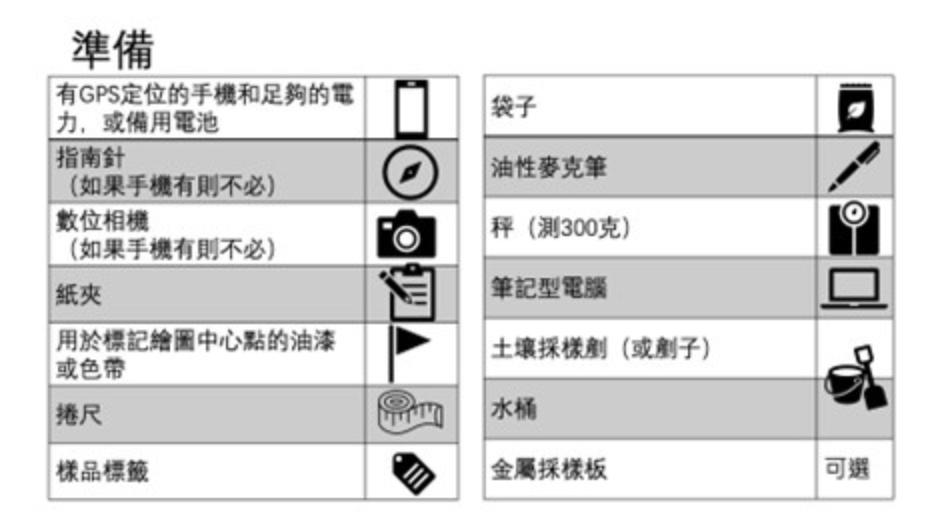
Then locate the centre point. With Google Earth's "ruler" tool you can draw the boundary of the land on your computer and see its perimeter and area (on slopes the area increases, so the gradient must be considered). Find the centre point on the land; to locate it, you can use the location function under "Site" in MiHuMiSang and take a photo, which marks the centre / sampling point.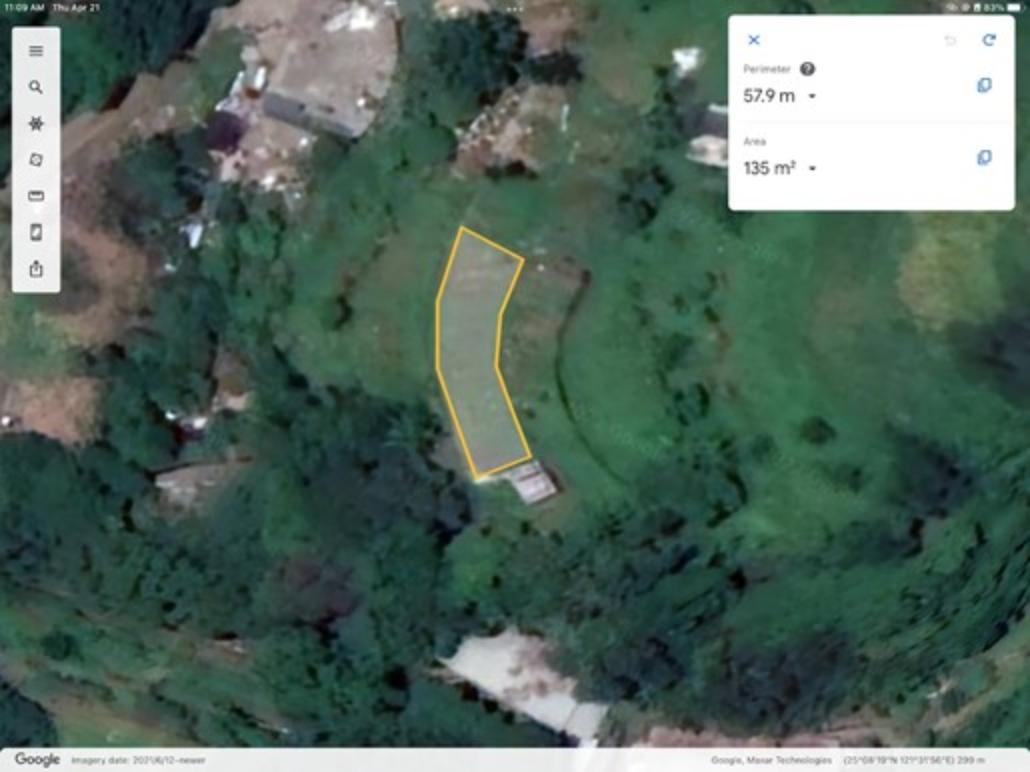
From the centre point extend 12.2 m north as the radius and draw a circle — this is a 100 m² sampling area. At the centre point and at 0°, 120° and 240°, take one sample from any spot within a 5.64 m radius of each.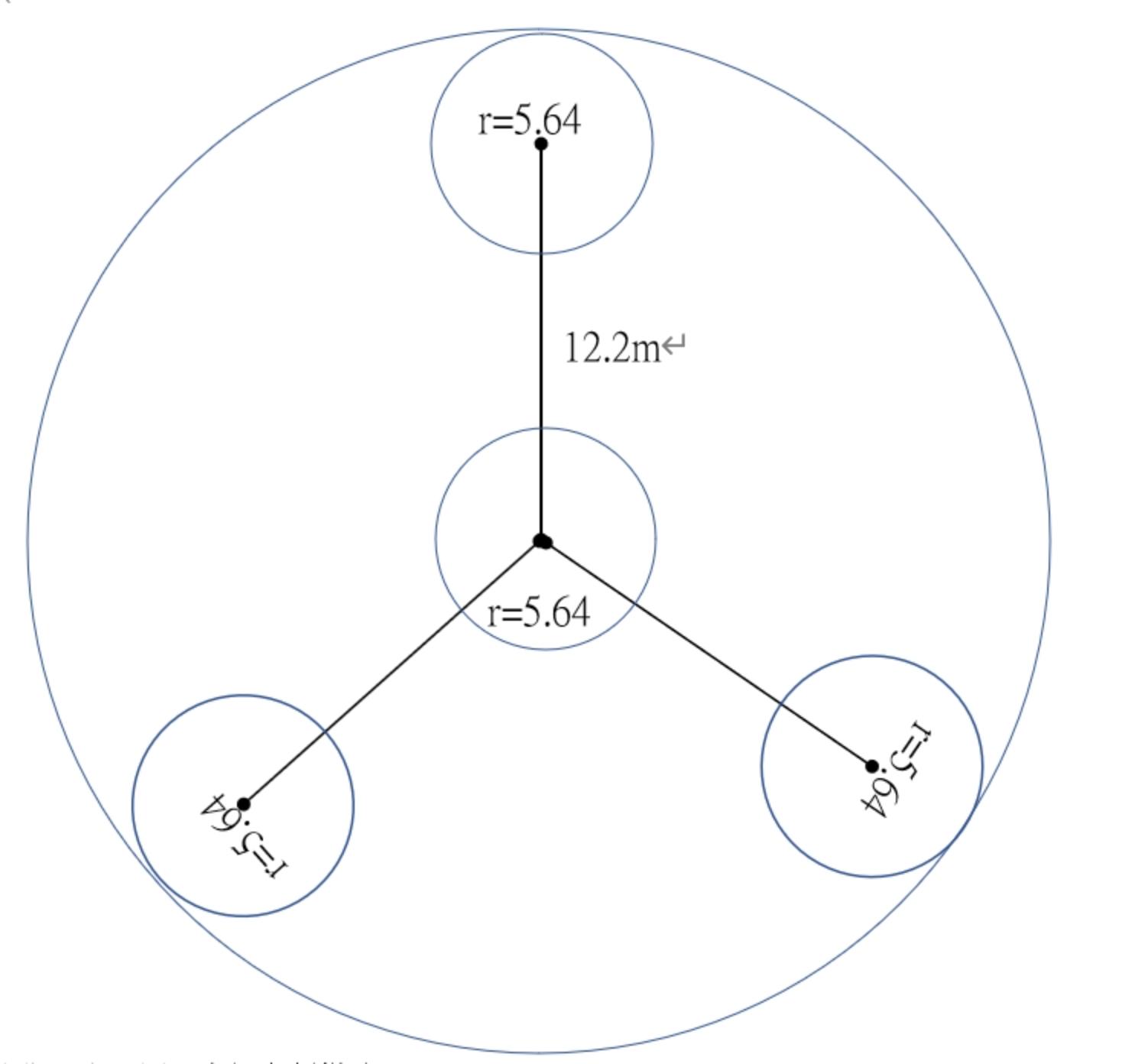
As shown above, establish 4 sampling points.
Sampling must be done as early as possible, after three days of sunny weather when the soil is fairly dry — but not too dry, or it's hard to dig. At each sampling point, first clear away fallen branches and leaves on the surface, dig down 20 cm, mix the soil evenly in a bucket, take 300 g into a sampling bag and label it with the sampling point number and depth 0–20 cm. Then dig down a further 30 cm to get the 20–50 cm soil, take 300 g into a sampling bag and label it with the sampling point number and depth 20–50 cm. Do this at 4 sampling points to collect 8 samples.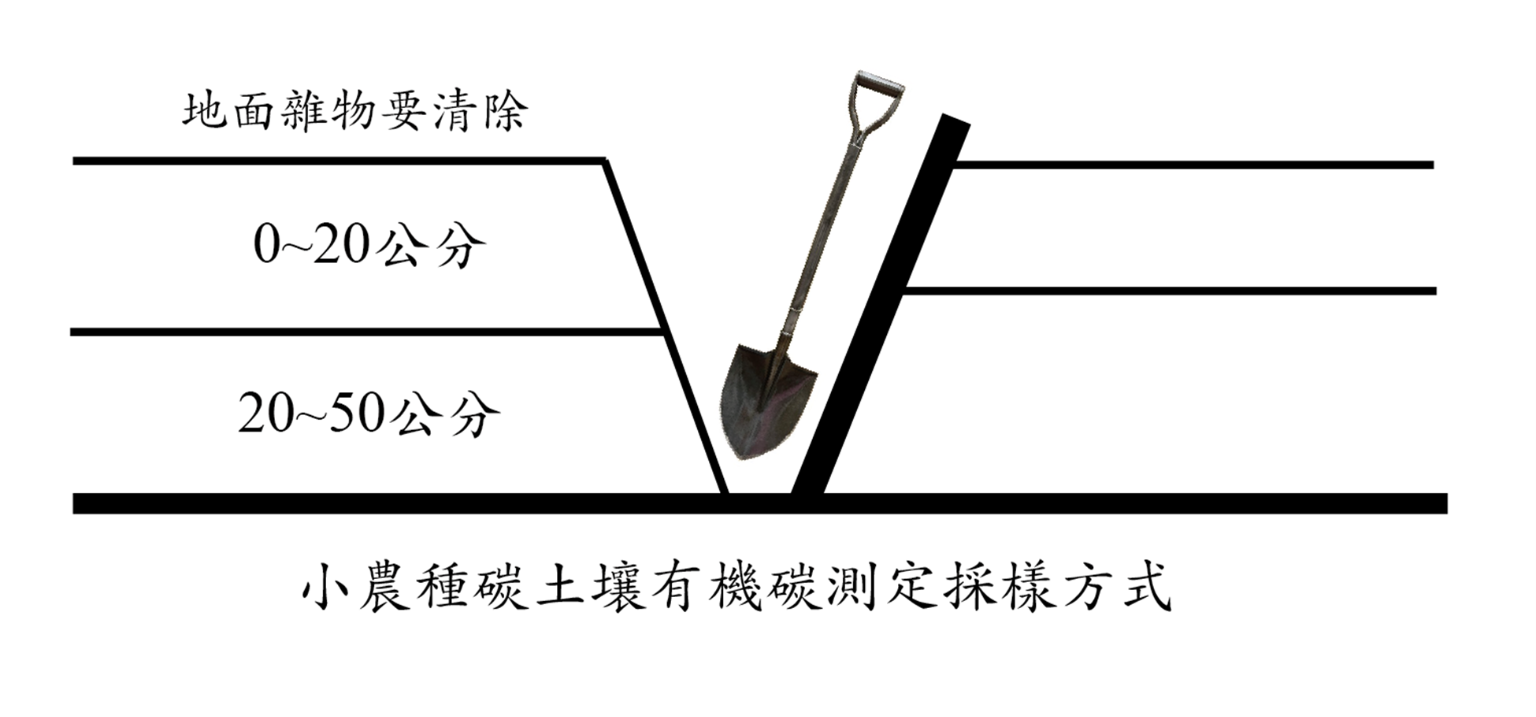
=================
Taiwan's seven District Agricultural Research and Extension Stations all test soil fertility for farmers free of charge. Farmers can pack soil samples according to their local station's rules and send them to the station. Contact details for each station:
Taoyuan station
Soil testing and crop nutrition diagnosis service
How to apply: farmers send samples labelled with name, address and phone number to the station's soil conservation lab. After lab analysis, farmers can view results on the station website's "soil fertility and crop nutrition diagnosis service page", and a written diagnosis certificate is also mailed.
Address: No. 139, Sec. 2, Dongfu Road, Neighbourhood 7, Houzhuang Village, Xinwu District, Taoyuan 327005
Phone: +886-3-476-8216
Miaoli station
Download the soil fertility analysis and nutrition diagnosis service procedure, print and fill in the form
Taichung station
Download the standard procedure for soil fertility analysis and nutrition diagnosis service
Tainan station
Download the standard procedure for soil fertility analysis and nutrition diagnosis service
Kaohsiung station
Soil analysis and crop nutrition diagnosis service
Please download the relevant information from the website
Hualien station
Rapid soil testing service
Please see the website for information and to download the application form
Taitung station
Plant tissue analysis and soil diagnosis
Because each station (or branch station) has somewhat different rules, farmers should confirm their local station and send samples according to its rules.
The station will give the soil fertility test results to the smallholder. We only focus on the percentage of soil organic carbon as the SOC baseline parameter. One year after implementing carbon farming methods (changing machinery, inputs or management), take soil samples again for testing. Compare the resulting soil organic carbon percentage with the initial baseline, multiply by density, soil depth and planted area, then multiply by 44/12 (atomic weight of carbon 12, molecular weight of carbon dioxide 44) to get that farmland's carbon dioxide reduction for the year.
At the sampling points, please take photos with the MiHuMiSang app, which records the time and place of sampling as proof that the sampling was done. Generally, besides the first year's baseline confirmation and SOC testing of project results, you only need to sample once a year thereafter, compare with the baseline, and calculate that year's added carbon credits.
These are simple steps that achieve results recognised by international carbon reduction certification. Smallholders are welcome to sign up and join in reducing carbon.
[MiHuMiSang: Listening to the soil: carbon isn't the villain — it's the source of life on Earth]
Source: CM Media ( https://www.cmmedia.com.tw/home/articles/35535 )


