 努力小農
本文尚無譯文。
The rock beneath the Dajia River bed: the 500,000-year story of the Dongshi soil series
Chen Tsun-hsien, deputy director of the Taiwan Water Resources and Agriculture Institute, used soil farmed organically for five years as a research sample and compared it with neighbouring farmland, finding the effects of organic farming on the soil.
As Taiwanese, we must know about Taiwan.
Taiwan's abundant produce today is the result of nature's succession over hundreds of thousands to millions of years.
Rock beneath the Dajia River bed 500,000 years ago slowly became soil,
making possible today's Taiwanese agriculture, which feeds the people of Taiwan.
Facing today's excess greenhouse gases and global change,
restoring organic carbon to the soil
is all humanity's redemption to save the future.
Parent rock of a riverbed 500,000 years ago becomes fertile farmland
"In recent years organic farming has brought this orchard to 2–2.5%, while the conventional field opposite is only 0.5%. It looks like just a 2% difference, but over five years each hectare has gained 80 tonnes of organic carbon — 16 tonnes per hectare per year. The results are quite astonishing!"
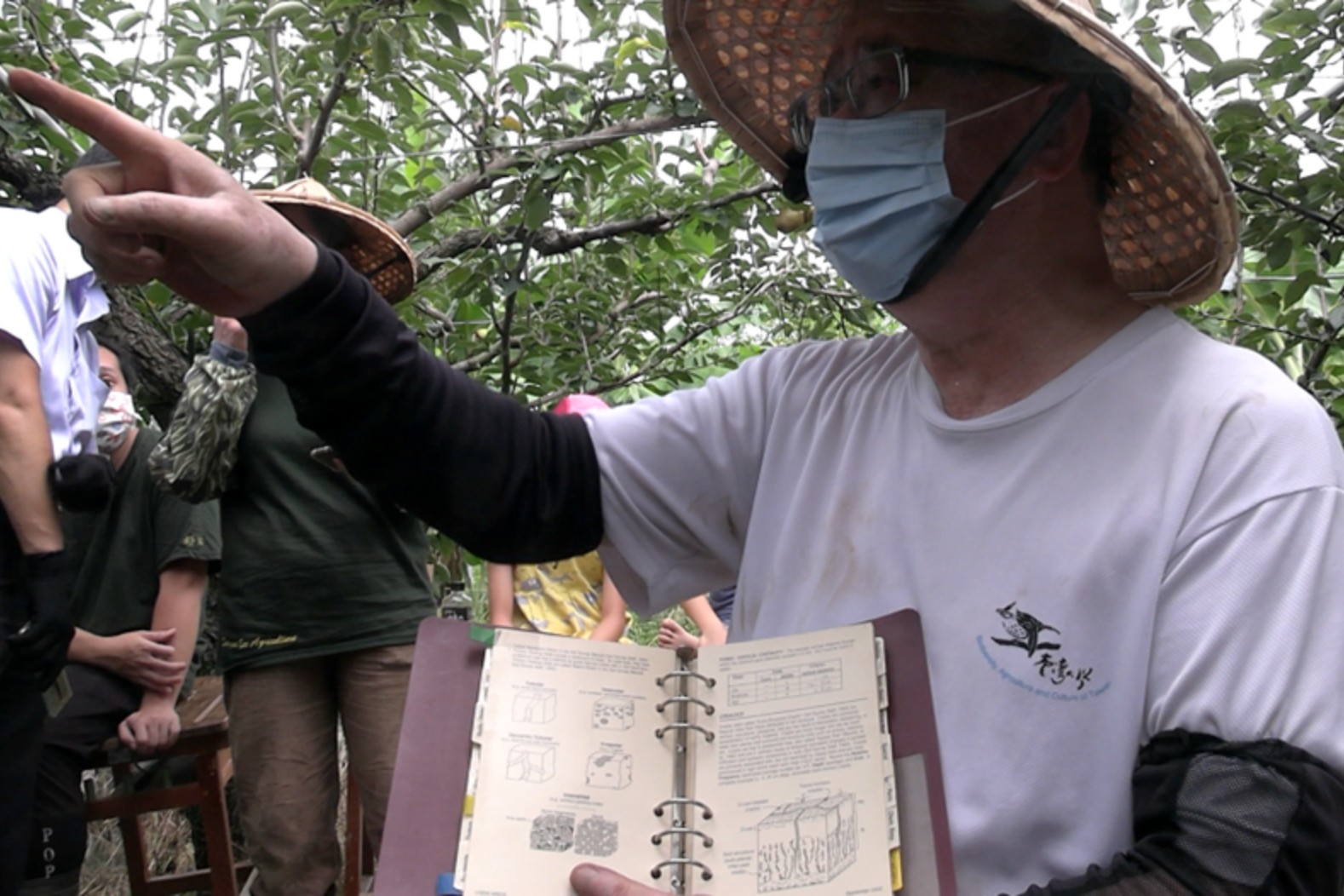
So said Professor Chen Tsun-hsien, retired from National Taiwan University's College of Agriculture and now deputy director of the Taiwan Water Resources and Agriculture Institute. Professor Chen has spent his whole career "playing with soil", studying soils all over Taiwan and around the world, with a large body of publications on agricultural soils.
On 15 August he went in person to Good Field Organic Farm in Dongshi, Taichung, and dug down three feet in both conventionally farmed land and land farmed organically for five years, to compare the two plots.
On the afternoon of the 14th, when the owner of Good Field Organic Farm began digging, he kept exclaiming in surprise, because more than 40 fat earthworms were dug up. In the neighbouring conventionally farmed soil there were three earthworms — nothing remarkable. This shows that after a few years of organic farming, earthworms — an important biological indicator — appeared, revealing rich soil organic matter, because earthworms are important producers of soil organic matter.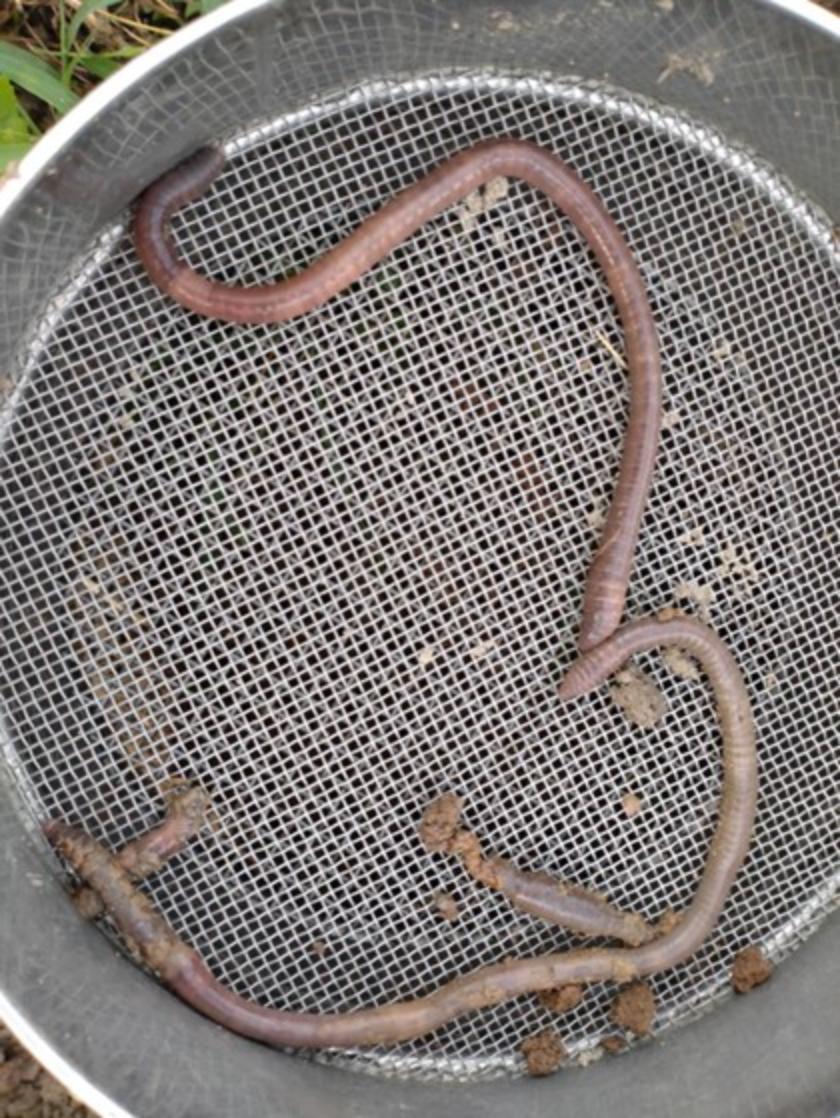
After organic farming, earthworms in the soil are numerous and very fat; earthworms are the best ecological indicator of organic farming. (Photo: courtesy of Good Field Organic Farm)
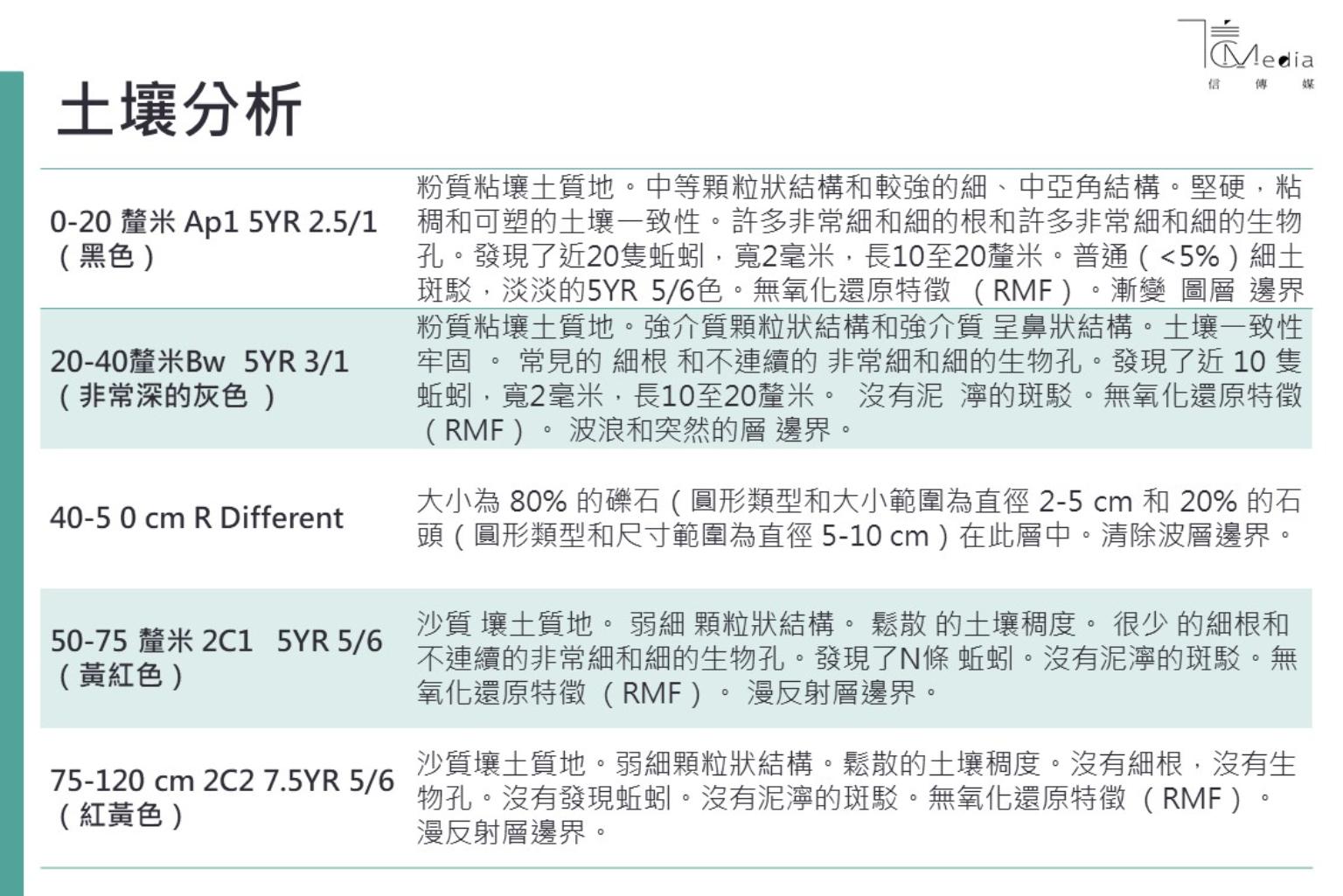
In his on-site explanation on the 15th, Chen first explained the structure and possibilities of the soil layers in the 1-metre-deep pit. "Judging by the cobbles at the bottom, this soil is related to the Dajia River. The Dajia River is now more than 150 metres below here; as a result of crustal uplift, about 500,000 years ago the parent rock on the Dajia River bed weathered and became soil."
The inorganic components of soil come from parent rock (a region's native rock), which weathers into sand, then into silt, and combines with organic matter to form clay particles. With water, clay can be kneaded into strands like dough; the thinner and longer the strand, the higher the soil's clayiness, plasticity, sand and cohesion. It also reflects tilth — the action and reaction forces of ploughing; the stickier the soil, the greater the reaction force.
In past soil surveys, soils around Dongshi were named the "Dongshi soil series". Here the mixed clay loam has 25–40% clay and 50% mixed particles, 70–80% in total — the work of 500,000 years. There is also loamy sand, with over 70% sand, which doesn't absorb water or hold fertiliser well.
Rock weathers into sand and silt, which combine with organic matter to become today's soil
As he spoke, Chen picked up a lump of soil, mixed it with water and deftly rolled a "soil noodle" between his palms. The longer it gets, the higher the clay content, which also suggests higher organic matter.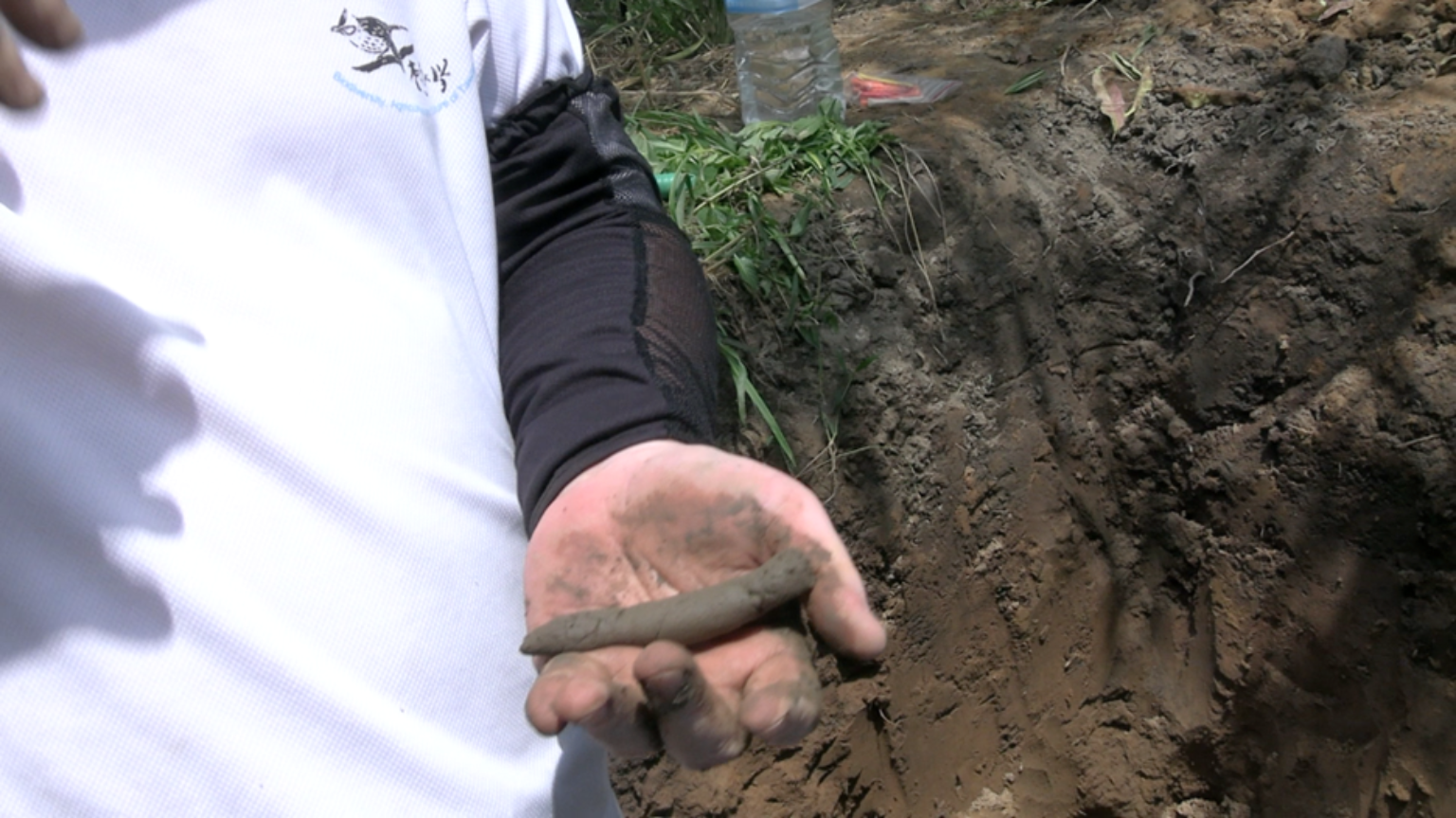
Chen kneaded soil with water, showing it contains a lot of clay — and thus more organic matter.
Then Chen explained the layers of soil in the dug pit. Ordinary soil forms from weathered parent rock in horizontal gradual layers. He pointed to a wavy boundary between layers, showing that other forces had pushed the soil layers formed from weathered rock — natural actions such as terrain, earthquakes and heavy rain, or perhaps hollows left after trees were removed. In soil surveys, these subtle features must be observed and recorded one by one.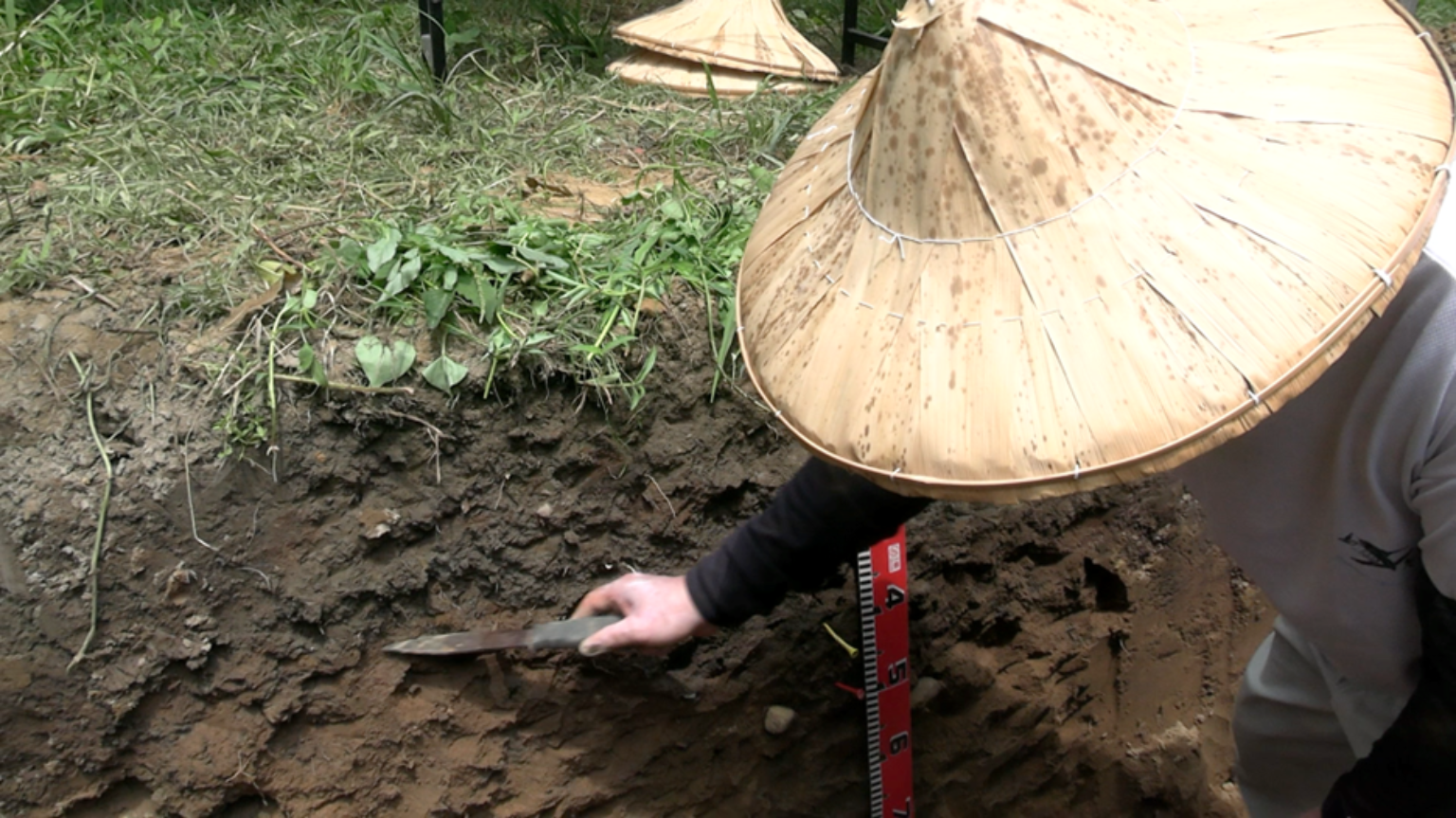
From the form of the boundaries between soil layers, you can judge what actions have caused the soil to undulate.
The evidence left by past soil history shows the two neighbouring fields were essentially the same, but analysis focused on the differences between non-organic and organic farming in recent years. Counting the topsoil as 30 cm, it's very hard to increase soil organic carbon by 1%: one hectare has about 4,000 tonnes of soil, so 1% equals 40 tonnes — four full truckloads of organic matter. To meet the 4 per 1000 Initiative, each hectare needs to gain 0.2 tonnes (200 kg) a year.
This organic farm's soil gained 2% organic matter over five years, equivalent to 80 tonnes, or 16 tonnes a year on average — a very good result.
Increasing soil organic matter isn't easy — it must be just right
Increasing soil organic matter isn't, as people think, just a matter of adding organic fertiliser, because applied organic fertiliser quickly decomposes and doesn't count as soil organic matter. The 4 per 1000 Initiative under the COP21 Paris Agreement calls for global agricultural and forest soils to store 8.9 billion tonnes a year — not as easy as people think. Common organic inputs such as seed-meal fertilisers (the meal left after pressing oil from soybeans, tea seeds or peanuts) decompose 100% within one or two months. Rice husks, straw, fallen branches and leaves generally take more than 100 years to decompose completely. So to increase soil organic matter, crop residues should be shredded and returned to the field.
Chen pointed out that the carbon storage effect of farmers using seed meal is almost zero. Farmers should be encouraged not to take crop residues away. In Northeast China, maize stalks were burned into charcoal instead of being returned to the fields, and the land began to lose fertility. Taiwan should recycle and reuse, shredding fallen branches and leaves and cycling them back.
Pores in the soil are also very important. Plant root systems create pores: when roots decay, the fine roots leave pores in the soil. Healthy plants (crops) can extend their roots smoothly downward in healthy soil — normal maize roots can grow 1.5 m deep. But because Taiwan grows rice and then maize, and rice cultivation creates an impermeable clay plough pan to hold water, maize roots only reach 20 cm, so Taiwanese maize lodges easily and isn't healthy.
Chen stressed that increasing soil organic matter doesn't mean applying lots of organic fertiliser. Farmers can calculate the percentages of N, P, K and other soil minerals in the harvested crop, multiplied by the quantity harvested — this represents the soil nutrients absorbed and taken away by plants during farming. They need only put back that amount plus a little into the field; more is useless.
Research on farm soils is best done together with archaeologists, geologists, microbiologists and other experts for an all-round diagnosis, to trace the past and then find ways to improve farming in future.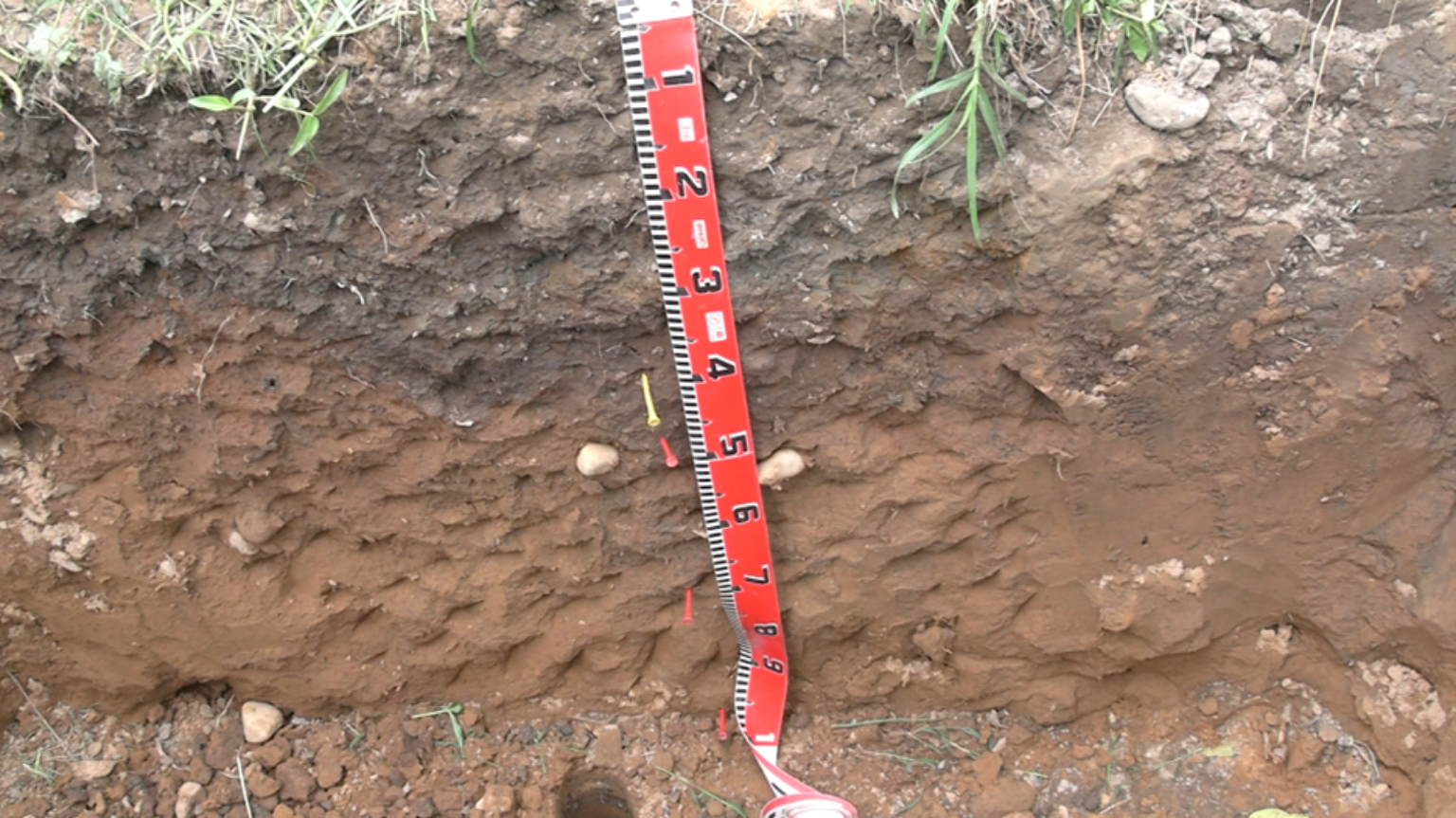
Soil tells stories. The Dongshi soil series was the bed of the Dajia River 500,000 years ago; as Taiwan's crust changed it rose more than 100 metres, and the original rock weathered into soil, becoming fertile farmland.
Chen pointed out that current international carbon credit certification requires proof of newly added carbon before it counts as carbon credits. The first step of international MRV (Measuring, Reporting, Verification) is M, measurement: first establish how much organic carbon was originally in the soil; only what's added later can count as carbon credits. So you must first understand the soil's organic components, the organic fertiliser inputs in farming, and return agricultural waste to the fields as much as possible.
After completing the soil analysis, Chen and his assistants refilled the pit with subsoil first, in the order it was dug, restoring the original soil layers in reverse — a necessary step after research.
Background (provided by Chen Tsun-hsien):
In 2016, Good Field Organic Farm fully adopted the Tarenna ECO farming method. Remote-controlled sprinkler heads and PVC irrigation pipes were installed, and liquid nutrients were delivered from 3-tonne plastic tanks through aeration and pressurised pump systems, applying the Tarenna ECO method and inputs for six years (2016–2022).
The inputs come from various amino-acid agricultural residues, including foul-smelling residues from livestock (pig and chicken) manure and irrigation and pond water. Through the "Tarenna Eco farming system", livestock excreta are rapidly deodorised by diverse aerobic microbes, and solids are rapidly decomposed into sub-micron sponge spheres and fulvic acid liquid (PGMP).
The system is an environmentally friendly, sustainable farming method. The ecosystem introduced by the "Tarenna Eco inputs" is based on photosynthetic bacteria (PSB), enhanced with symbiotic bacteria (PSSB) that can suppress various diseases caused by fungi/moulds.
The foul-smelling solid and liquid amino-acid residual biomass is then converted into diverse microbes (live bacteria and diverse metabolite nutrient sources) and fulvic acid (PGMP), incorporated into the fields to improve soil properties. Under a biomimetic model of diverse aerobic and anaerobic bacteria in crops above ground and in the soil, six years of practice have maintained plant vitality and health, achieving high quality, multiplied yields and good productivity in crops and orchards.
Source: CM Media ( https://www.cmmedia.com.tw/home/articles/36060 )


