努力小農
本文尚無譯文。
Agricultural photosynthesis "plants" carbon dioxide back into the soil: the world's first smallholder carbon farming app launches
Photosynthesis is the driving force of the Earth's "carbon farming". It fixes carbon for free and provides humanity's food. How to restore organic carbon in farm soil and create benefits for all is the mission of "smallholder carbon farming".
Can smallholders take part in international carbon reduction certification? Any certification or verification is quite expensive; carbon inventory certification in Taiwan costs NT$300,000, which is almost impossible for smallholders.
Now, smallholders can take part in international carbon reduction certification without spending money, with dedicated guidance. Using a mobile app, they can easily record key information on the carbon reduction process, accumulate carbon reduction credits and make them publicly verifiable. As long as they meet international carbon reduction requirements, they can earn annual carbon credits and income from international carbon trading, while also gaining quantified certification under the UN Sustainable Development Goals. Records of carbon reduction and certification are traceable worldwide, helping market smallholders' products and boosting the credibility and value of the carbon credits.
After nearly three years of planning and effort, the MiHuMiSang app has been updated to its second version, serving as smallholders' "Personal Digital Assistant (PDA)" for future carbon reduction. It is currently the world's first production-and-sales record app dedicated to smallholders, and smallholders can also use it to set up their own e-commerce and contact and trade directly with consumers.
Smallholders with organic, eco-friendly, product record or other certification needs can also download the app and keep complete records that meet various certification requirements, including international voluntary carbon reduction (agricultural carbon farming). More importantly, the app is completely free for both consumers and smallholders.
The app's name, MiHuMiSang, is a Bunun greeting and blessing, like Hawaii's Aloha. Built on the key elements of the ISO 9000 quality management system, it serves as a communication tool and bridge between smallholders (suppliers) and consumers (customers). Smallholders just install the app, truthfully enter details of themselves, their farm, products, farming methods, agricultural inputs (tools, soil conditioners, pest and disease control agents) and special features, and use the app's "smallholder diary" to take photos and check in while farming, to record complete production records.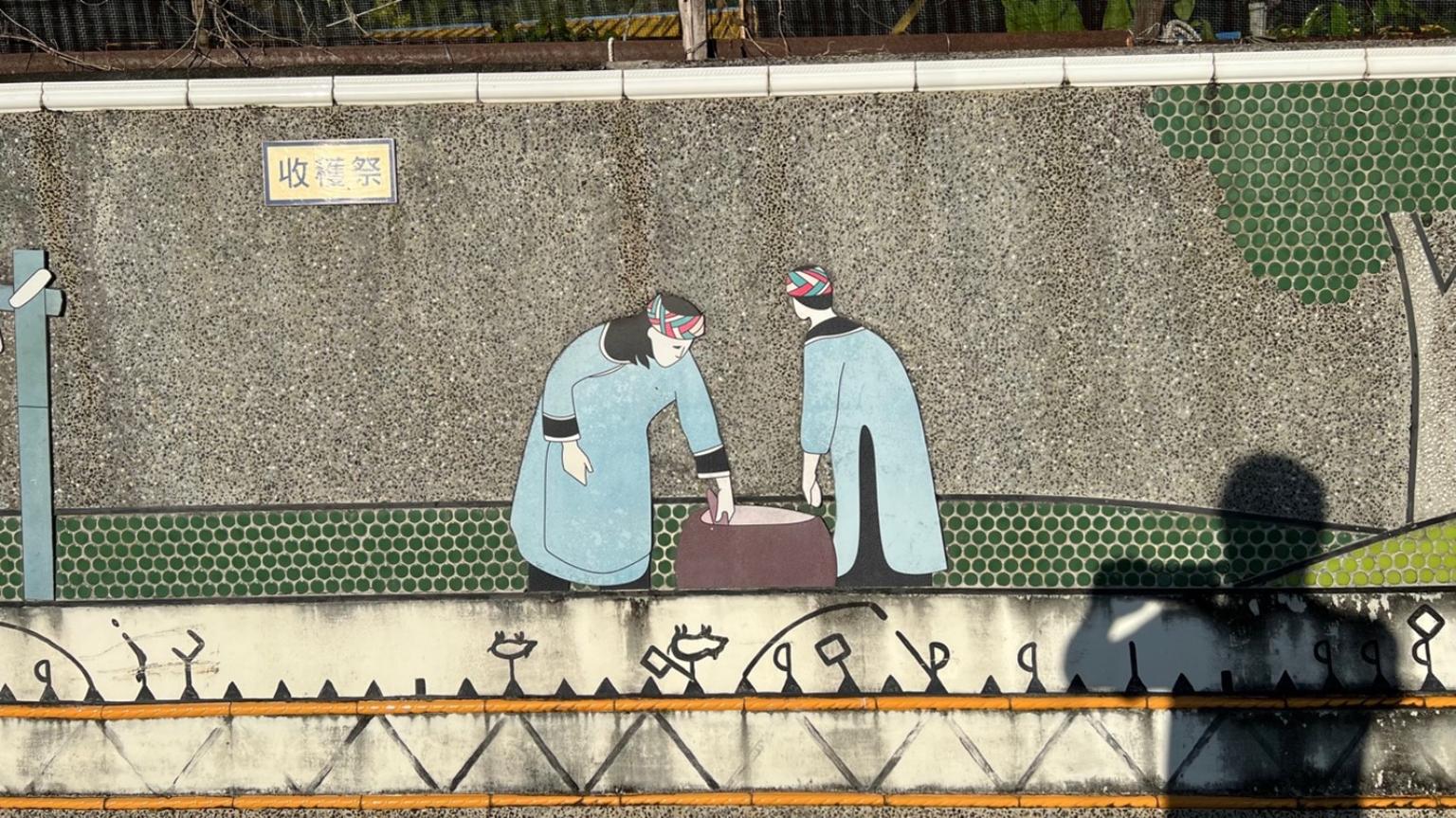
The MiHuMiSang app uses the basic phone functions of taking photos, checking in and uploading to record farm work, processing production records systematically and as planned in the cloud and building a tamper-proof chain of certification information. Taken at a Bunun mural in Nanxi Village, Changbin Township, Taitung.
Consumers can find quality, trustworthy smallholders
For fresh or processed products, smallholders can set their own prices and list them for pre-sale or immediate sale; they appear at once in the consumer interface for consumers to buy, like e-commerce. MiHuMiSang hopes consumers and smallholders will get to know each other and trade directly. Smallholders must handle orders and shipping themselves and contact consumers proactively to complete orders. Because the quantity and quality of smallholders' products may vary with weather and pests, and shipping times and quantities often can't be precisely controlled, they also need to communicate with consumers.
When using the app, besides seeing detailed product information as on e-commerce sites, consumers can also see information about the smallholder and the farm, and the "smallholder diary", to judge authenticity. It's best to contact the smallholder directly to agree on quantities, shipping times and the final price (such as shipping in batches, or whether shipping is included). If satisfied, they can become friends with that smallholder and order long-term.
The MiHuMiSang app has no profit mechanism in its production record and trading services, so it must create "added value" to have a profitable business model. Hence we launched "smallholder carbon farming", an international voluntary carbon reduction project, to create added value.
We use the increase in soil organic carbon as the standard for carbon reduction certification. The international 4 per 1000 Initiative of 2015 holds that increasing organic carbon in agricultural and forest soils by four per thousand a year could offset the growth of greenhouse gases from human activity, lowering atmospheric CO2 and easing the harm of global climate change.
On the other hand, the "agricultural Green Revolution" since the 1960s has caused massive loss of organic carbon from soils and the loss of their original carbon-fixing function. Large-scale monocultures increased pests and diseases; to boost yields and control them, large amounts of chemical fertilisers (which themselves consume huge amounts of fossil fuel energy) and pesticides (herbicides, insecticides, fungicides, bactericides, etc.) were used, wiping out soil microbes — the best symbiotic partners for soil carbon sequestration. In recent years, loss of soil and soil organic matter has become the root of the global food crisis, and protecting soil and soil microbes has become a major task of soil carbon sequestration. Many experts warn that if we don't pay attention to soil organic matter, soils in many regions can only last a few more decades.
Raising farmers' planning ability to achieve soil carbon sequestration
Increasing soil organic carbon is also an indicator of organic farming. Many certified organic farms fail to retain organic carbon in the soil because Taiwan lies in the subtropics and tropics, where organic matter in soil easily turns into carbon dioxide and disappears; soil microbes are needed to "fix" carbon.
Smallholders just need to review how they farm and choose usable carbon reduction methods, including: less tillage, more soil cover, breaking the plough pan to revitalise soil, appropriate use of agricultural inputs (even organic or natural fertilisers, if overused, kill soil microbes and defeat carbon sequestration), and good use of biological inputs and microbes that increase the soil's carbon-fixing capacity. The rest is up to heaven.
In short, carbon reduction is engineering by subtraction: not using more inputs, but cutting past improper waste and letting the land regain its vitality.
Because farming is full of unpredictable events and plans can never keep up with change, smallholders farm very much on the fly. Most aren't used to planning their work — what to grow and how is often decided "when the time comes" — nor to keeping records, relying on memory and feel. They can't produce quantified data, let alone statistical analysis.
The practice of increasing soil organic carbon in agriculture has only received international attention in recent years and is just taking off in Taiwan. Experience is lacking; even academic research is mostly in labs or on a small scale. Most farmers aren't familiar with how it works and need retraining and trials to build a systematic theory and practical application.
The "carbon farming edition" of the MiHuMiSang app adds work scheduling functions. Smallholders enter their carbon farming work schedules into the app's "schedule" — for example, "weeding", turning cut grass into compost or laying it on the field to increase soil cover, both important ways to increase soil organic carbon. Smallholders can preset schedules and add reminders. Schedules needn't be fixed to a specific day but can be arranged within periods according to the solar terms.
As long as smallholders carry out the relevant work within the scheduled periods, they successfully meet their self-set "carbon farming" requirements. Of course, workshops and training are given beforehand, and schedules are checked to ensure they meet the international certification requirements of the carbon farming project. After that, smallholders just follow the year's "work schedule". If weather or other factors require changes, they can adjust it themselves.
A personal assistant that simplifies smallholders' lives
When smallholders carry out farm work according to the "work schedule", the app acts like a personal assistant: remember to photograph, check in and upload. When taking photos, the app records the time and geographic coordinates and encrypts them so users can't alter them, building a foundation of authentic data. So smallholders must use the app's "smallholder diary" to take photos at the actual time and place of work, not upload afterwards, to ensure every record is authentic.
Smallholders just follow the schedule planned at the training workshops and complete the year's work step by step. Comparing soil organic carbon content at the start and end, the added carbon is calculated to give that year's carbon reduction result. All this is computed in the cloud; smallholders needn't calculate anything themselves to obtain a year's carbon reduction credits.
In the carbon reduction project, besides carbon reduction being SDG 13 Climate Action, smallholders using the app to plan is a form of quality education; increasing organic carbon improves soil and boosts production, reducing hunger (SDG 2), and increases income (SDG 8) as quantified indicators. Certification covers carbon reduction and at least three sustainable development indicators at the same time.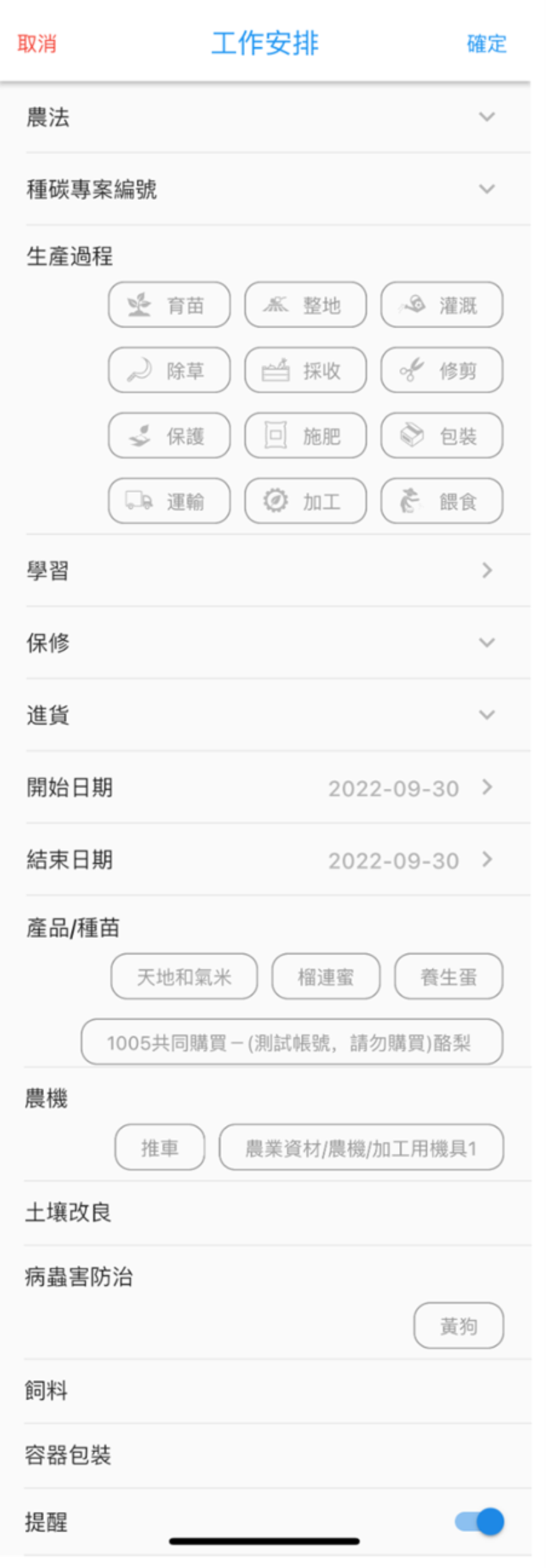
With a simple app interface, smallholders can plan their work schedules anytime, anywhere, produce high-quality, carbon-reducing farm produce, and keep complete records to obtain open, transparent certification. (The "work schedule" planning interface of the carbon farming edition of MiHuMiSang)
Agricultural carbon reduction certification used to be very difficult because farm work is scattered across many places and times, unless on large, corporately managed farms. Add expensive certification fees, and in Taiwan not only smallholders but any farm under a thousand chia couldn't do it. But the convenience of mobile phones and automation of digital devices reduce the difficulty of record-keeping and improve the authenticity and reliability of records, laying a feasible foundation for certification so that many smallholders can take part, aggregated into one shared project.
Besides smallholder carbon farming to increase soil organic carbon, in future we will add agricultural carbon reduction projects for water management in rice paddies to reduce methane, legume–grain rotation to reduce nitrous oxide, and turning agricultural waste into bioenergy. Stay tuned.
Source: CM Media ( https://www.cmmedia.com.tw/home/articles/36373 )