 努力小農

本文尚無譯文。
Our Common Hereafter
Would a 4.6-billion-year-old Earth care about humanity's momentary rise or fall? (Photo: Look Up Look Down Photography @ Unsplash)
The English word "hereafter" as an adverb means "from now on"; as a noun it means "the time after one's death".
Lee Yuan-tseh, former president of Academia Sinica and Nobel laureate in chemistry, recently revealed in a media interview that when he advised President Tsai Ing-wen on climate change and energy, she replied that after 2024 (hereafter) it would be the next generation's (hereafter) business.
In democratic politics, every election brings a new ruler and new ministers. The first four-year term is spent preparing for the next four years, and at most after eight years you're out. Policies live and die with the people in office. So for long-term policies and goals, is talking to elected national leaders like "discussing ice with a summer insect"?
The policies of a nuclear-free homeland by 2025 and a 20% share of green energy are bound to fall short — a matter for after 2024. Looking back at how these policies were formed, there is no quantified research, discussion, public consultation or hearing that pooled ideas to clarify the feasibility and reliability of the policy goals, nor any failure analysis or contingency plans.
The same goes for the "Taiwan's Pathway to Net-Zero Emissions in 2050", which grandly describes four transitions — "energy transition", "industrial transition", "lifestyle transition" and "social transition" — and two governance foundations, "technology R&D" and "climate legislation", supported by "twelve key strategies", setting action plans for important areas of expected growth in energy, industrial and lifestyle transition policies to achieve the net-zero transition goal. Look closely at its 82-page "General Explanation": it's mostly nouns, adjectives, adverbs and numbers, but the numbers lack sources, calculation methods, peer review, and open, transparent mechanisms for citizen participation. How were the timeline decisions made? Another question mark.
Sinking downwards: a systemic inevitability, not one party's monopoly
More important is "accountable politics": if goals aren't met, who is responsible? What accountability is there? In Taiwan, any law without penalties is a dead letter — such as the Administrative Procedure Act and the Freedom of Government Information Law. Because there are no penalties, civil servants "don't act according to law" or "act not according to law", with no administrative, political, legal or conflict-of-interest accountability.
The downward slide and corruption Lee Yuan-tseh attributed to the DPP in power isn't the DPP's monopoly, because Taiwan's political ethics and bureaucratic legal system "legally don't exist". Anyone in power would be the same; it's caused by the system, not by a particular person or party, because the legal system has hollowed out the necessary mechanisms of oversight and checks and balances. This phenomenon pervades every sector, and the problem of plagiarised theses arises from the same structure.
Taiwan's energy policy is simply a "price freeze". Such "slap your head and decide" decisions only postpone problems rather than solve them, sweeping dust and rubbish under the carpet until hereafter, when the next administration can't cover it up any longer and the volcano of problems erupts.
In our smallholder carbon farming programme, which reduces only a few hundred tonnes of carbon a year, besides adopting a suitable "methodology" we must consider risk assessment, contingency plans, emission-reduction credits and quantified targets for sustainable development indicators over the next ten years. In addition, the issues of "additionality" and "carbon leakage" must be ruled out before valid emission-reduction credits can be obtained.
SOPs with technique but no principle
Recently, because of heavy rain from a typhoon's outer circulation, the three letters "SOP" (Standard Operating Procedure) have become popular "again". Taiwanese people always have "SOP" and "do an xx action" on their lips; add a few English acronyms and it sounds very sophisticated.
Carbon reduction is the same. On various occasions I meet many people earnestly discussing how to establish a "methodology", as if having a "methodology" means carbon reduction has succeeded, because many people think "a methodology is the SOP for carbon reduction" — have an SOP and the problem is solved. But everyone overlooks how to build an SOP, and the strategic principles and tactical goals above the SOP. An SOP alone is like a car that is only wheels: it doesn't know where to go, and can't carry people or goods.
International emission-reduction certification is built on a framework that is developing rapidly. Under the strategic goal of the 2015 UNFCCC Paris Agreement — keeping temperature rise to 1.5°C to avoid irreversible global disaster (according to the scientific conclusions of the Intergovernmental Panel on Climate Change) — each country must set its own strategic goals, such as net zero by 2050. Projects must also align with the 17 goals, 169 targets and 232 indicators of the Sustainable Development Goals released in 2015. Every emission-reduction project must be checked against other goals besides SDG 13 Climate Action, to avoid the risk of focusing on carbon reduction at the expense of other aspects of social justice.
All these international conventions, standards, guidelines and methodologies have been repeatedly discussed in public and revised — changing almost every year — with non-governmental organisations playing an important role.
Smallholder carbon farming: a small path, yet worth seeing
Smallholder carbon farming may be a small path, but it is worth seeing. Whenever we discuss project content with each smallholder or with peers, we must achieve transparency and inclusiveness. Besides strictly observing international and domestic regulations, any stakeholder may give opinions, and all must be taken into account. Even matters unrelated to the emission-reduction project, such as government subsidies, must be recorded, with an explanation that they are outside the project's scope.
Our small project of a few hundred tonnes of reductions a year, besides the required SDG 13 Climate Action reductions, has also been analysed as meeting SDG 4 Quality Education, providing smallholders with knowledge and practical application of carbon reduction and increasing soil organic carbon. This lets them grow quality, high-yield food, meeting SDG 8 Decent Work and Economic Growth, and can also ease the problem of low food self-sufficiency, meeting SDG 2 Zero Hunger. All these can be realised in this project of increasing soil organic carbon.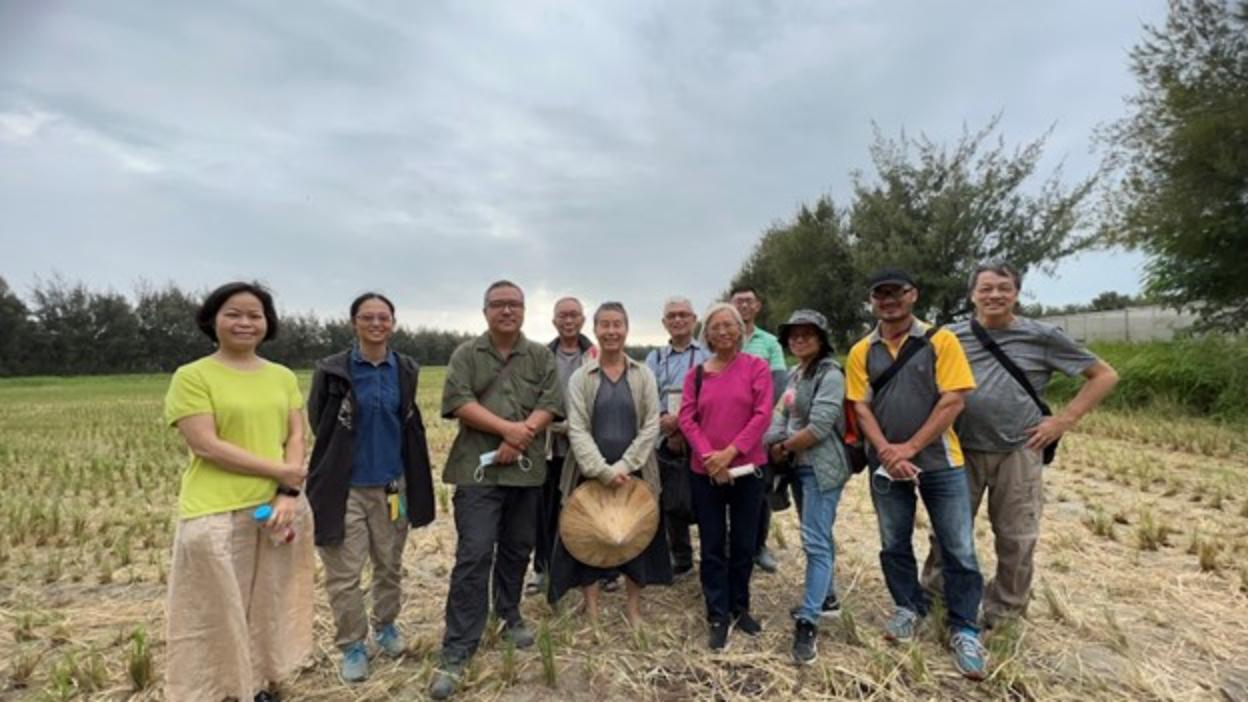
A group of smallholders starts reducing carbon from their own fields. After them, they will leave organic carbon lasting in the soil, having worked to reduce carbon dioxide in the air.
Taken on 11 October 2022 at Kantiantian Farm, Dongshi, Chiayi.
None of this is groundless speculation. Concrete evidence and facts are needed to support the project's estimates, along with a "Monitoring Plan". Each year the verification body must check the actual values achieved for each indicator before emission-reduction credits can be confirmed. All this must be presented in English reports, verified annually and published online.
This is a highly system-integrated (System Integration, SI) system, not something an SOP can support. Without systemic understanding, efforts only scratch the surface and can't solve the problem. Without facts and data as the basis for decisions, the road to carbon reduction and net zero will end up like a blind man on a blind horse, or the father and son with the donkey who please no one — going nowhere, the only path an endless downward slide.
Global change is not a one-generation problem. Besides the Earth's own natural cycles of warming and cooling, human acceleration and intensification stems from the Industrial Revolution over 200 years ago — the use of internal combustion engines and massive development of fossil fuels — which meant carbon and nitrogen greenhouse gases couldn't be cycled by natural photosynthesis in time, creating a vicious cycle of continually accelerating accumulation. Even if we didn't emit another gram of carbon dioxide from today, it would take hundreds of years to gradually "digest" the greenhouse gases emitted over the past 200-plus years.
The 1972 Stockholm Conference produced the Declaration on the Human Environment; in 1987 Our Common Future was published by the commission chaired by former Norwegian prime minister Gro Harlem Brundtland (a woman); and the 1992 Rio Earth Summit signed four global environmental agreements: the Framework Convention on Climate Change, the Forest Principles, the Convention on Biological Diversity and Agenda 21. Fifty years have passed in the blink of an eye — just one hundred-millionth of the Earth's 4.6 billion years. So this can't be one president's business, nor just our generation's; it is "Our Common Hereafter".
We start with smallholders. Don't fail to do good because it's small. In the course of the Earth's evolution, a group of smallholders once worked together to store a few thousand tonnes of carbon in the soil, leaving a little chance for those who come after.
Source: CM Media ( https://www.cmmedia.com.tw/home/articles/36738 )


