 努力小農
本文尚無譯文。
Soil carbon sequestration can be traced organically: soil sampling, the first step in smallholder carbon reduction certification
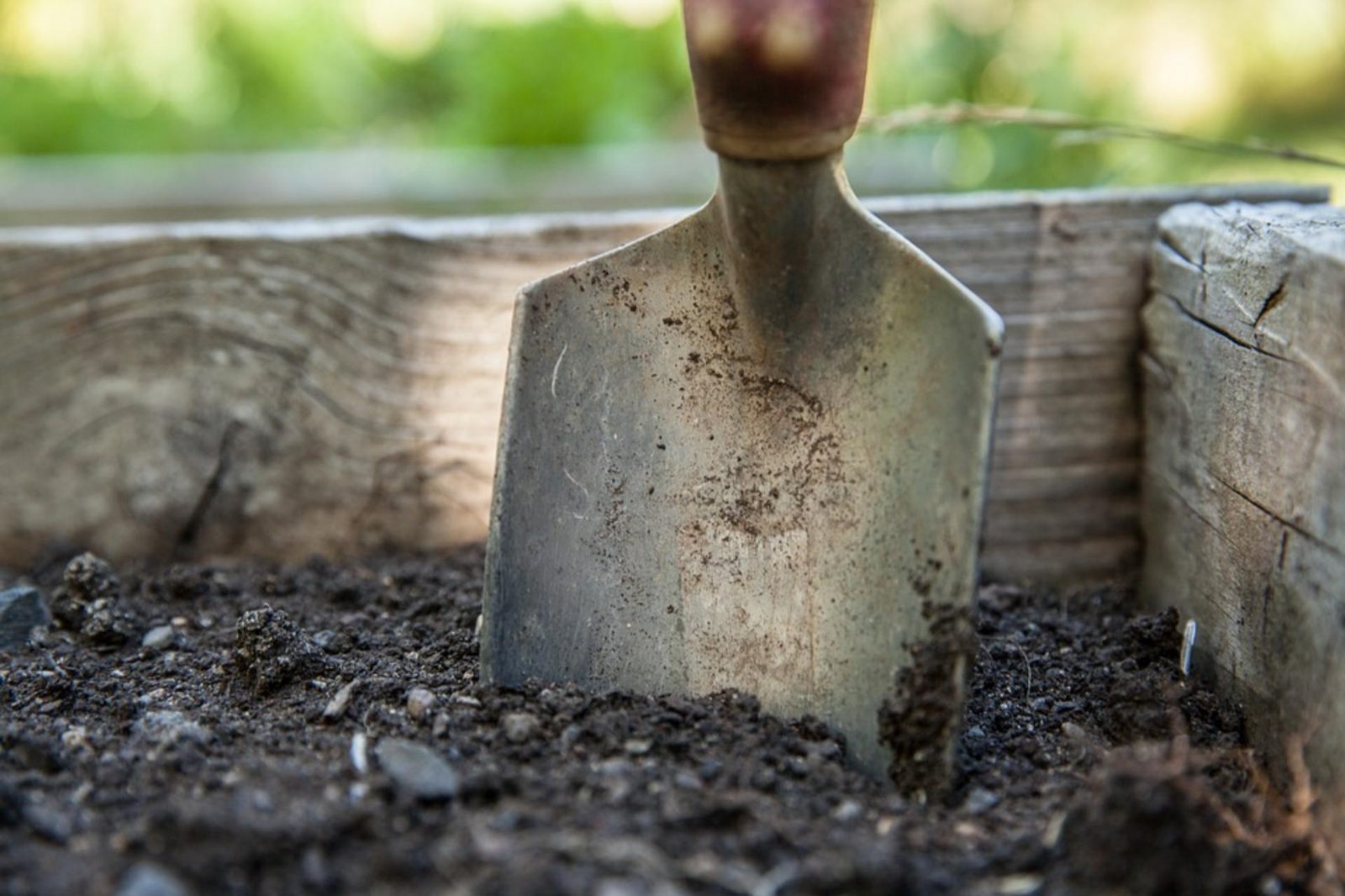
The first step in emission-reduction certification is to establish a baseline. Only with a baseline can we compare how much organic carbon the soil gains after the project's carbon-reducing activities. (Photo: Pixabay)
"Can I get carbon reduction certification and trade carbon by planting trees?"
More and more people have recently asked how "smallholder carbon farming" works, and: "How is carbon farming done?"
Please don't jump straight to conclusions. Agricultural carbon reduction is a century-long, millennium-long undertaking, and a journey of a thousand miles begins with a single step. We must first understand our soil, and to understand it we must carry out internationally certified sampling and testing to know the soil's current organic carbon content and decide our carbon farming / carbon reduction strategies.
Testing soil organic matter to establish the certification baseline
Most important is the "first step" of emission-reduction certification: establishing a "baseline". Only with a baseline can we compare how much organic carbon the soil gains after the project's carbon-reducing activities.
I spent a week collecting soil samples in Qingshui in Taichung; Chulu, Luye and Chishang in Taitung; and Fuli in Hualien. In the process I learned that soils differ from place to place, and combined with different farming methods and crops, there are endless combinations.
This sampling method differs somewhat from the current practice of Taiwan's District Agricultural Research and Extension Stations. Usually in Taiwan, farmers take five samples from the four corners and the centre of a field, mix them evenly, and send 1 kg of soil to the local station for testing. Besides soil organic matter, the tests are fairly complete, covering pH, electrical conductivity and available phosphorus, potassium, calcium and magnesium — and they're free.
For international carbon reduction, sampling follows the method recommended by the Gold Standard, the international emission-reduction certification body: the "A Protocol for Modeling, Measurement and Monitoring Soil Carbon Stocks in Agricultural Landscapes" by the World Agroforestry Centre (ICRAF) and the Earth Institute, Columbia University (EI). You find a centre point in the middle of the field; within a 100 m² circle (radius 12.2 m), from the centre point and in the 12, 4 and 8 o'clock directions, you locate four 10 m² circles (radius 5.6 m), and choose any point within each as a sampling point.
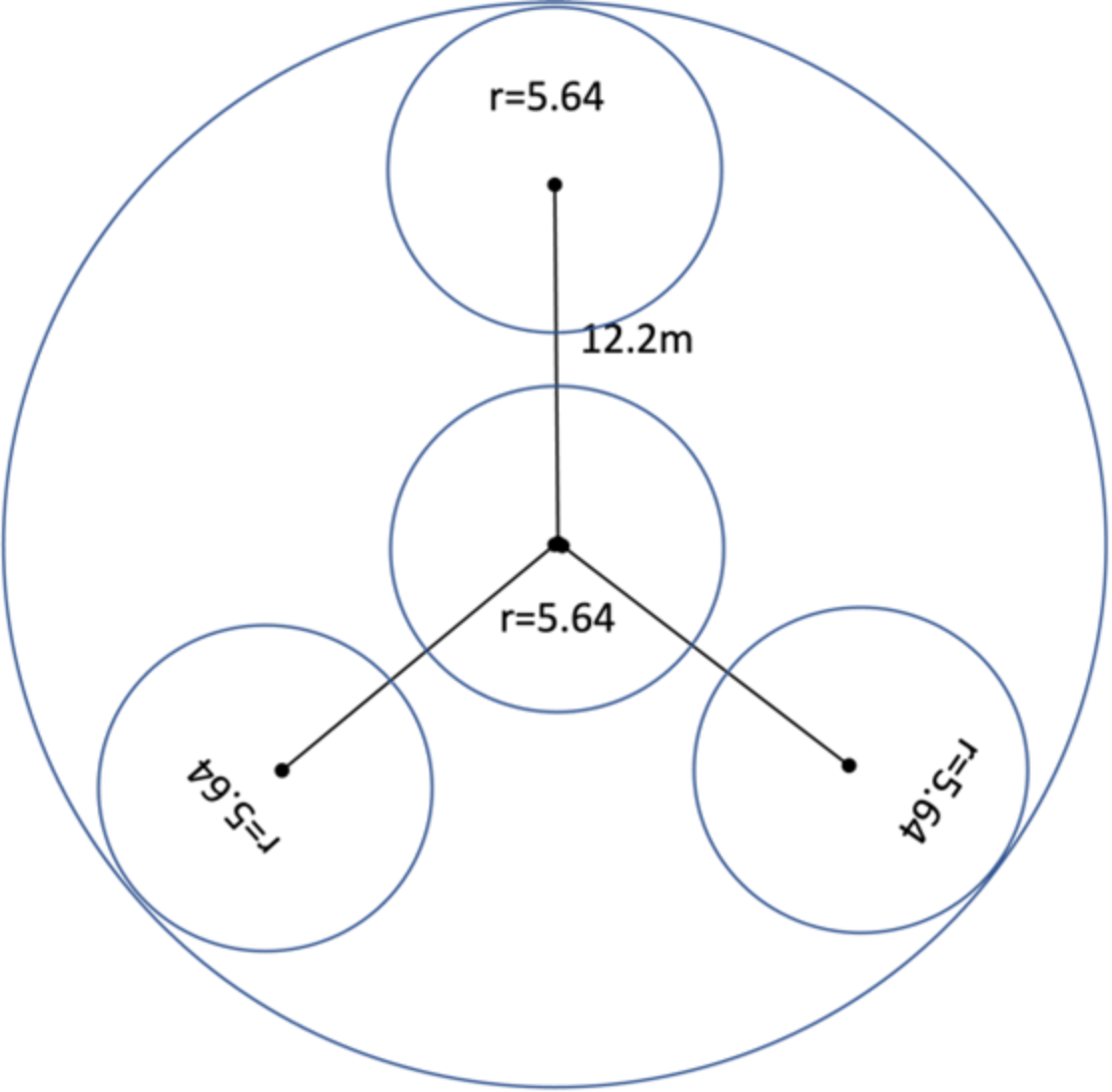
According to international emission-reduction certification sampling positions, there must be 4 sampling points within 100 m², each sampled at the upper layer (0–20 cm) and lower layer (20–50 cm), to determine the soil's organic carbon content.
Each sampling point must be sampled at two layers, upper 0–20 cm and lower 20–50 cm, to understand differences in soil structure. On much long-farmed land, compaction by heavy machinery forms a hard, impermeable "plough pan" at about 20 cm, blocking water and air, and the lower soil has almost no organic matter.
To calculate soil organic carbon, you need to look at soil density and the depth to which organic matter is distributed in order to calculate the weight of organic carbon per hectare. This also shows the condition of the soil: if possible, breaking through the plough pan can increase soil carbon sinks. But be careful with rice paddies — breaking the plough pan may stop the field holding water, doing more harm than good.
Retired junior high teacher Wang Chun-chih fulfils his farming dream
Wang Chun-chih, a retired junior high school physics teacher whose family has lived in Qingshui for generations, took up farming after retirement. He cleared fields beside the Dajia River and grows various crops — partly to fulfil his old dream of being a farmer, partly to make friends and enrich his retirement.
Wang Chun-chih chose a plot behind his home on Zhongshan Road in Qingshui as the sampling site. The land had long been used for rice. Taking the top 20 cm was easy; by eye, the soil's organic matter was very low, all loose sandy soil. At 20–50 cm the soil was very hard, and it took great effort to take a sample from the "plough pan" — whose soil looked completely devoid of organic matter.
Soil like this has a lot of room to increase organic matter. In future carbon farming can be developed well here: less tillage, more cover, and moderate use of compost.
17 November – Wang Chun-chih, Qingshui (Facebook live video)
Li Chun-lin of Chulu, Taitung, grows Hangzhou chrysanthemums
Li Chun-lin and his sworn brother Li Hsien-lin have spent the past five years clearing their family land at Chulu Ranch to create the "Dream Station Farm", mainly growing Hangzhou chrysanthemums. Every mid-November they harvest the chrysanthemums with help from friends and relatives. Growing chrysanthemums is highly labour-intensive, because they must be picked by hand, one flower at a time.
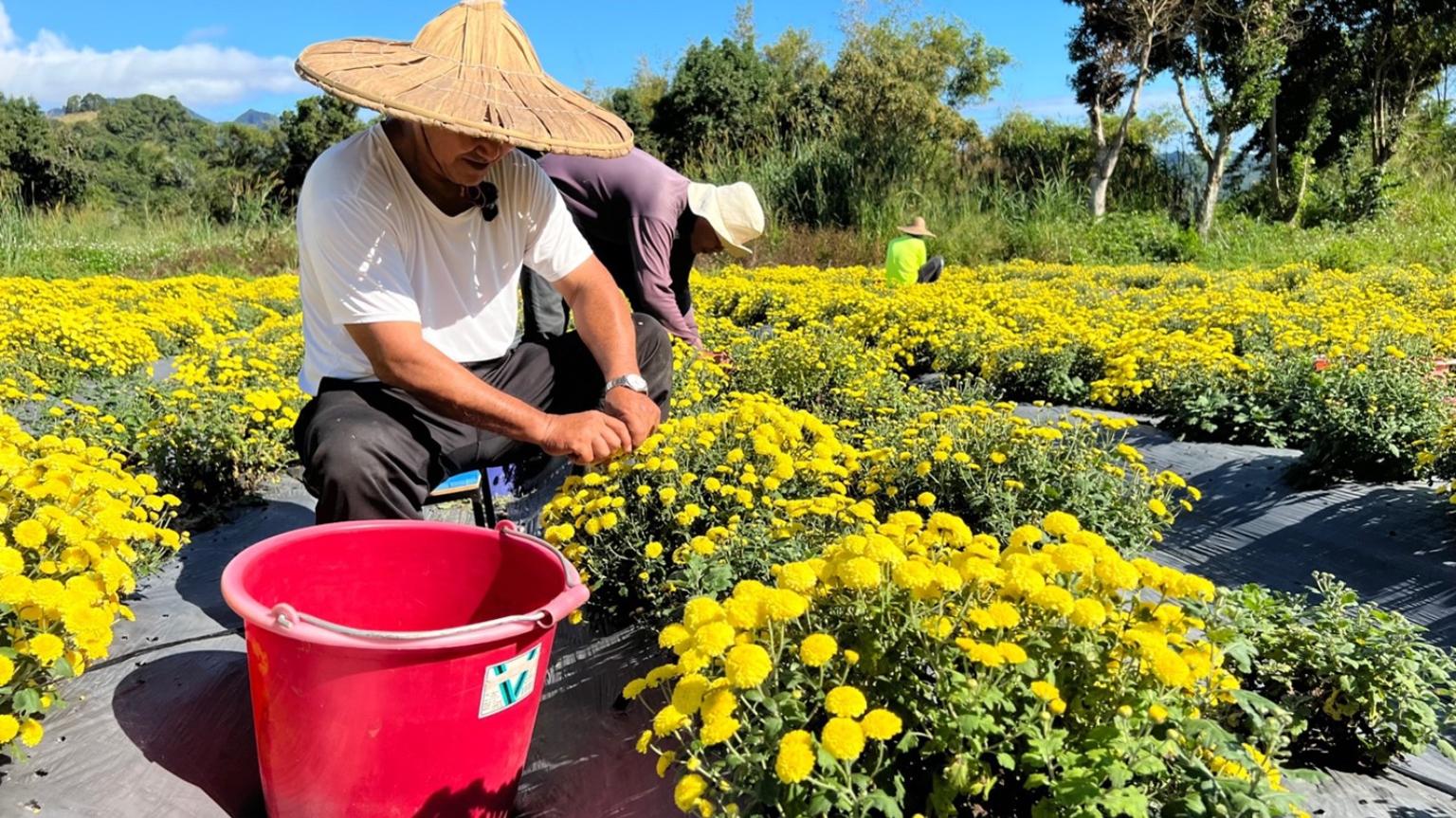
The fruit of a year's hard work by brothers Li Chun-lin and Li Hsien-lin is this chrysanthemum field. (Photo: courtesy of Jay Fang)
Li Chun-lin's land has been tamed for some time, so the soil is close to sandy loam, fairly loose, with upper and lower layers looking fairly similar.
356 Coffee Estate, Luye, Taitung
356 Coffee Estate is beside Provincial Highway 9 at kilometre 340. It was originally at kilometre 356, hence the name, but some sections were later straightened (the Suhua Highway Improvement), so the distance marker shrank.
Chen Wen-chou used to work in finance in Kaohsiung. After retiring he returned to Taitung and, with his younger brother Chen Shan-wu, inherited their father's land and began growing coffee, cacao, bamboo ginger and more, making their own coffee, chocolate and cane sugar. All their products have distinctive flavours and a group of loyal customers.
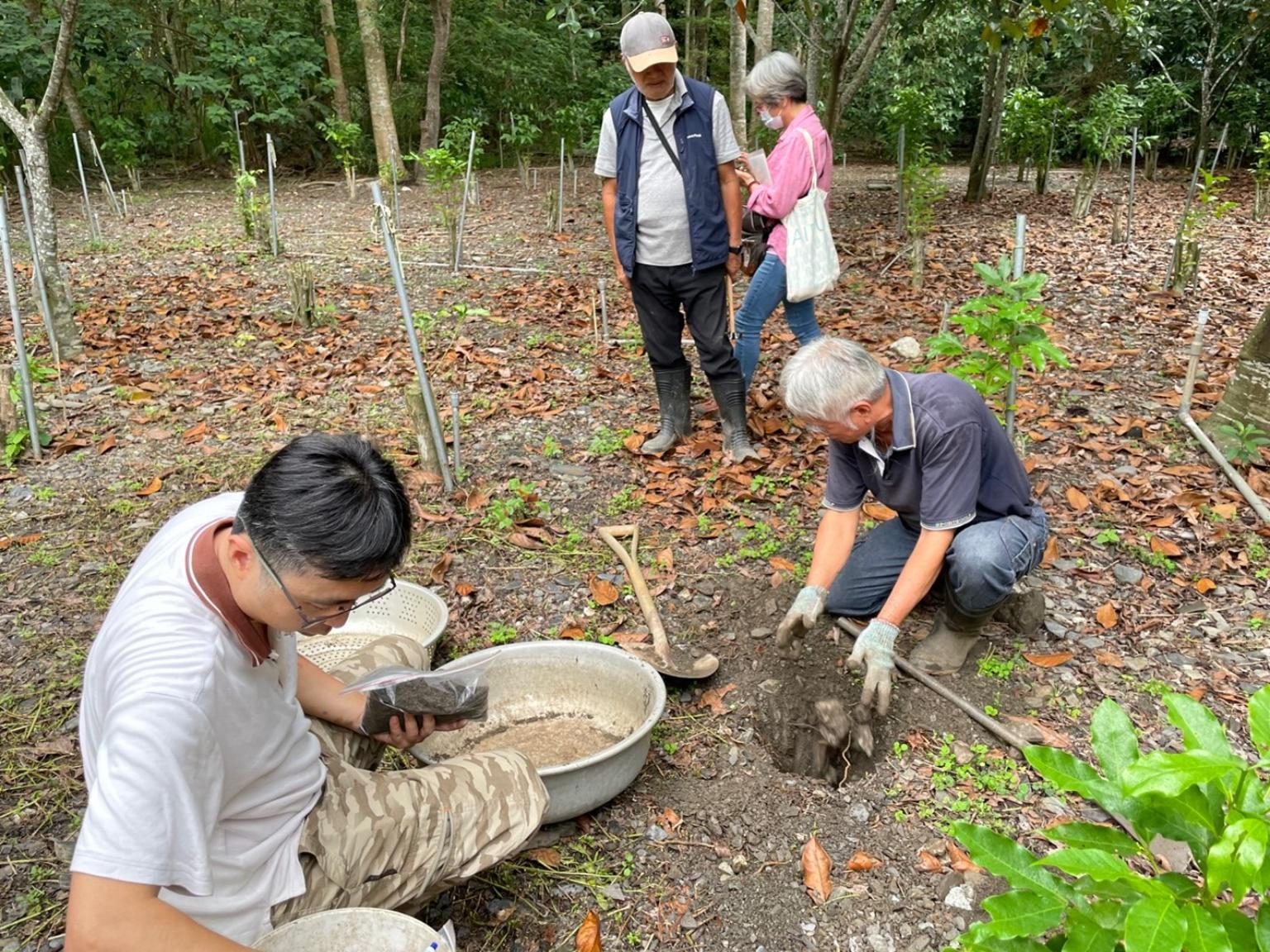
356 Coffee Estate's stony land is hard to farm, and taking soil samples also takes a lot of effort. (Photo: courtesy of Jay Fang)
Only when sampling did I realise how hard-working and remarkable the Chen brothers are. Digging with a spade turns up nothing but fine gravel, and the deeper you go, the more stones; the spade striking stones even sends up sparks. So they bought a small excavator to deal with this "stone land".
21 November – 356 Coffee Estate, Luye, Taitung (Facebook live video)
Liu Chiung-chin's rice paddies, Chishang, Taitung
Liu Chiung-chin used to live in Kaohsiung. Her husband was a career soldier who, after retiring, returned to Chishang and began farming. They took part in eco-friendly farming certification by National Taitung University's Center for Environment-Friendly Agriculture and Fishery Extension, hoping to keep a patch of clean land amid an environment full of pesticides and chemical fertilisers.
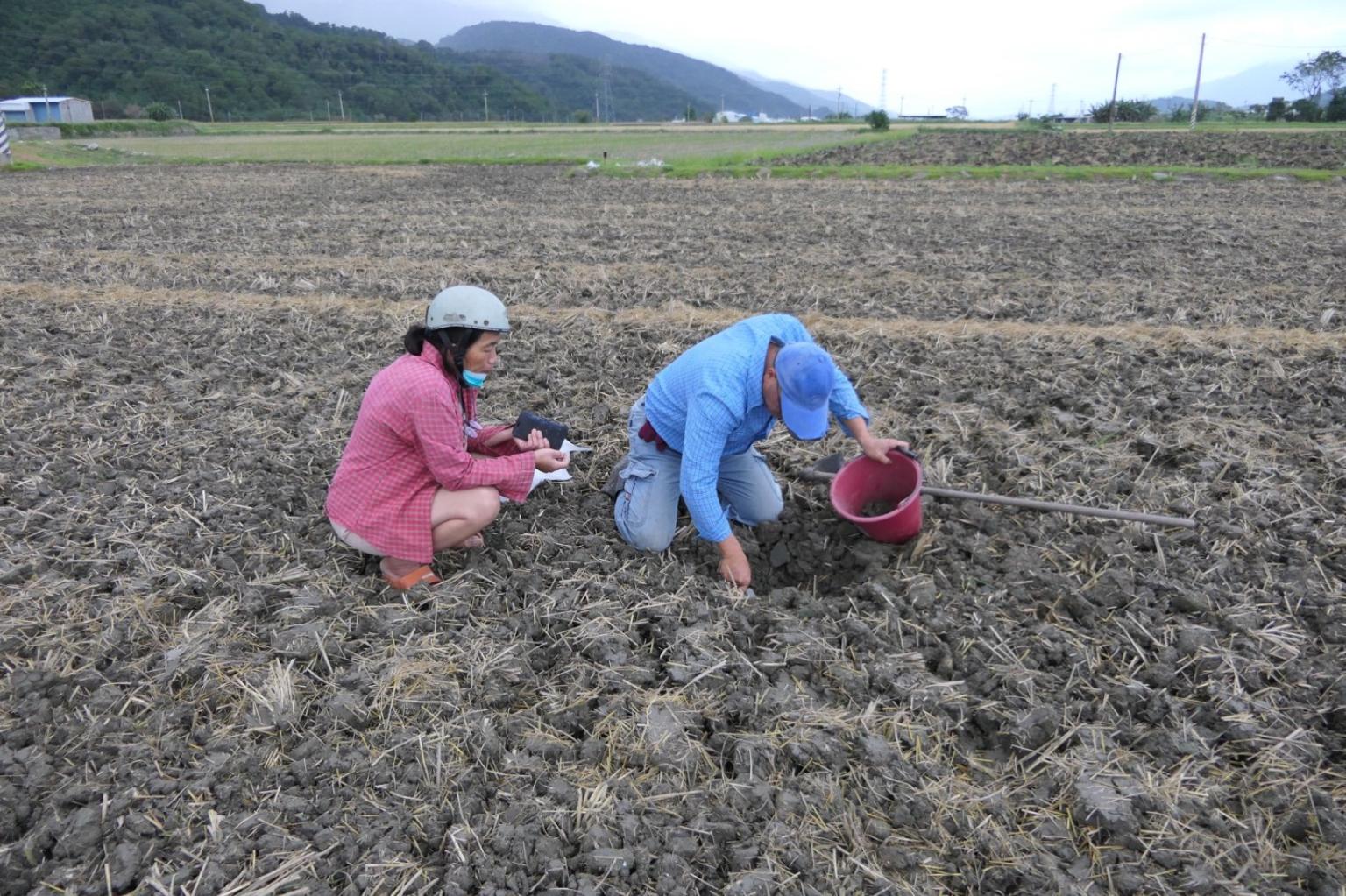
Liu Chiung-chin and her husband have farmed in Chishang for years; soil samples are taken ready to send for testing.
Chishang rice is famous far and wide. Sampling showed the upper soil has quite a lot of organic matter, while the lower soil is largely sandy, and there's no obvious plough pan — the soil is in relatively good condition.
Carbon farming smallholders No. 1 and No. 2: Su Chun-lung of Fuli and Chiu Chui-chuan of Yuli, Hualien
Chiu Chui-chuan and Su Chun-lung are smallholders No. 1 and No. 2, who formally signed up for "smallholder carbon farming" on 4 May this year. Su Chun-lung, born in 1992, is a hard-working, studious young farmer. He used to work for a construction company and returned home a few years ago to farm, also doing contract farming for neighbours. Because he can operate crop-spraying drones, he does contract work on 350 chia of nearby farmland, and often attends courses around the country to learn farming methods and new knowledge. Though a newcomer, his yields and quality are often better than veterans'. He has just harvested the second rice crop; despite drought, earthquakes and other natural disasters, the results were quite good.
Su Chun-lung's field in Fuli has rare moist black clay (which hardens and darkens when dry) that's easy to dig. With a small garden trowel he could dig down to 50 cm; though there were some stones at the bottom, there was still plenty of soil. Su Chun-lung's soil has been tested by the agricultural station, with organic matter of 3–6% — quite rare, as it's usually only 1–2%.
Chiu Chui-chuan said: "This shows the soil here is fertile. The worry is people adding too much fertiliser — Su Chun-lung's neighbours often use too much, and the rice lodges, which is actually bad." Chiu Chui-chuan used to work abroad. Two years ago, because of COVID-19, he switched careers to take over the family farmland. He interprets farming differently from other smallholders and is willing to learn, think and experiment to find new paths, including taking part in international emission-reduction certification.
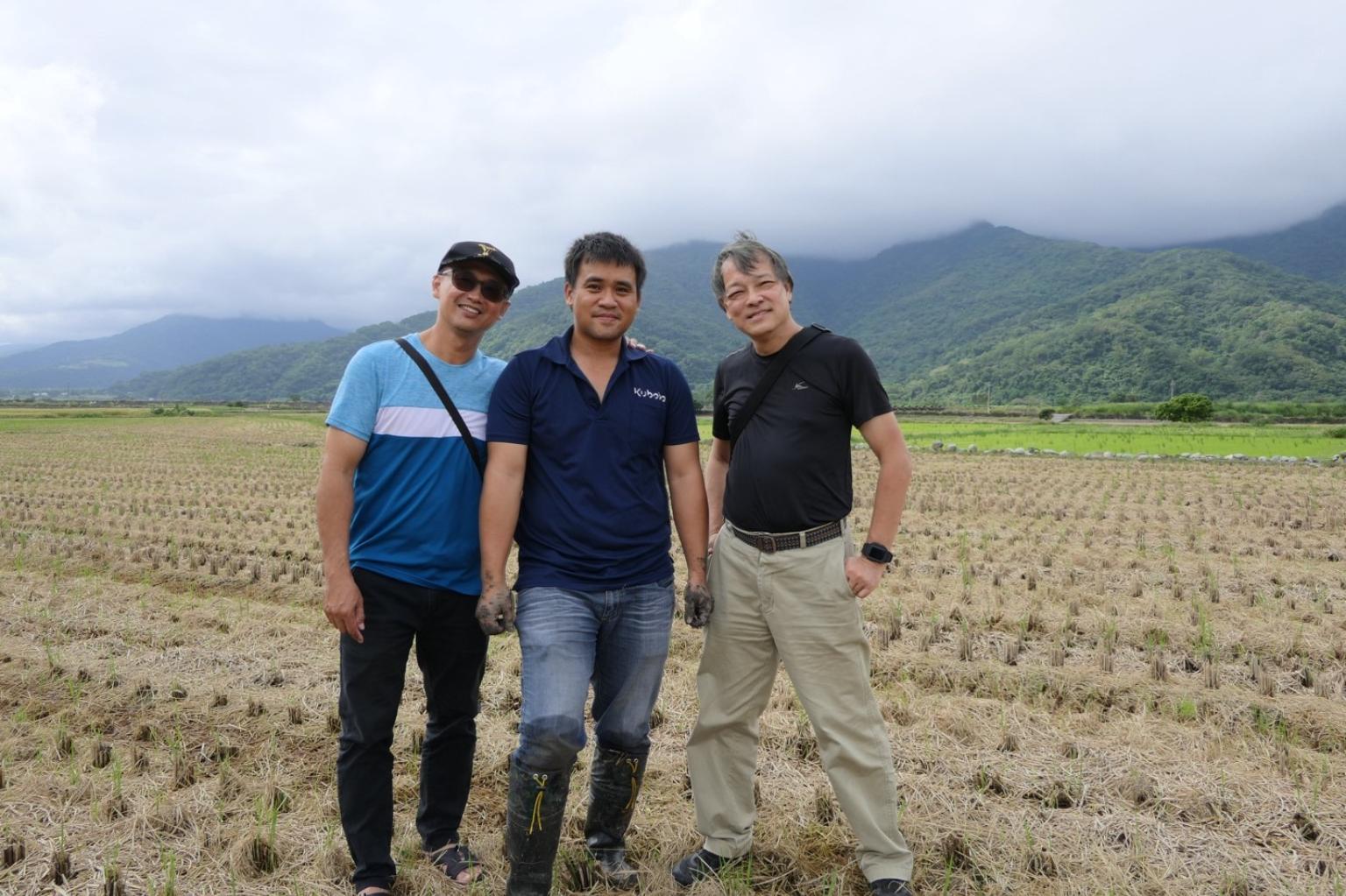
Carbon farming smallholder No. 1 Chiu Chui-chuan (left), smallholder No. 2 Su Chun-lung (centre) and Jay Fang (right).
Chiu Chui-chuan, born in 1968, is the same age as Su Chun-lung's mother, but Chiu says it's often Su Chun-lung who teaches him how to farm, including using drones.
Internationally, the concept of organic farming goes beyond the rigid rule of not using pesticides and chemical fertilisers; it places great weight on biodiversity. Besides plants and animals, it also values the ecology of microbes, insects, earthworms and small animals (mice, snakes, frogs) in the soil. The indicator of biodiversity is soil organic matter, because the diversity of invisible microbes represents biodiversity and is reflected in the proportion of soil organic matter. We hope promoting the carbon farming project will help Taiwan's farmers pay more attention to soil organic carbon and related biodiversity indicators.
24 November – Su Chun-lung of Fuli and Chiu Chui-chuan of Yuli, Hualien (video of Su Chun-lung sampling soil)
Source: CM Media ( https://www.cmmedia.com.tw/home/articles/37306 )


