 努力小農

本文尚無譯文。
Body and land are one: World Soil Day 2022 – where food begins
This year's World Soil Day message, "healthy soils for healthy life", ties people and soil together at the level of atoms and molecules, linking the natural food chain from soil to people. (Photo: Brooke Lark @ Unsplash)
"Body and land are not two" (shendo buni) originally meant karmic cause and effect in Buddhist teaching. The Southern Song monk Zhiyuan's commentary on the Vimalakirti Sutra records: "Below the two Dharma bodies is shown the non-duality of body and land; because the dependent and the principal are not two, the manifest body expresses the land. That there is no land apart from the body, as Jingxi said, is the clear text on the non-duality of body and land in the Dharma body." When Korea's agricultural cooperatives launched a campaign to eat domestic produce in the 1960s, they also used "body and land are one".
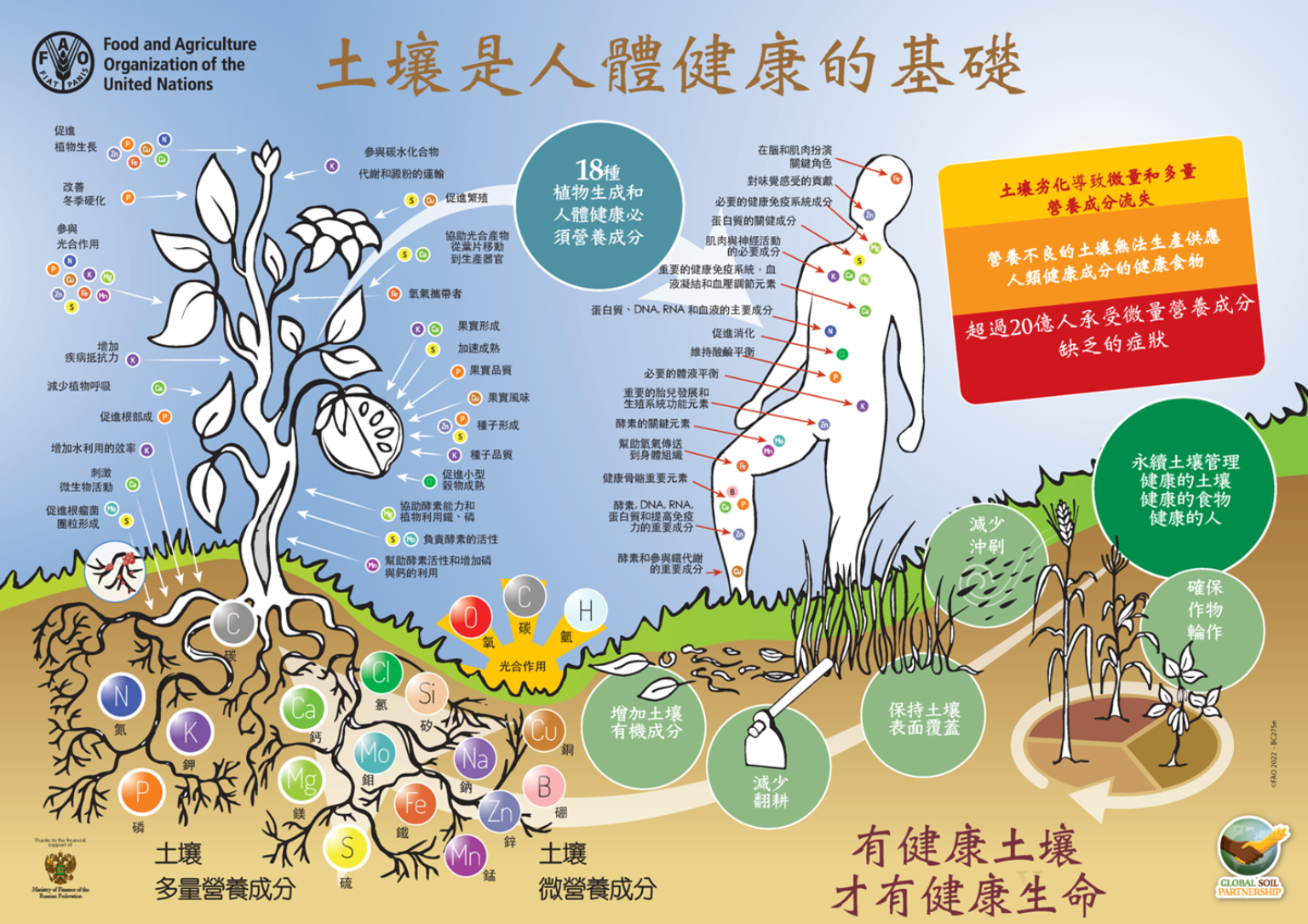
This year's World Soil Day (5 December 2022) has the theme "Soils: Where food begins". Its poster focuses on the relationship between 18 elements in the soil and the human body — "healthy soils for healthy life" — tying people and soil together at the level of atoms and molecules and linking the natural food chain from soil to people.
Everything is cause and effect, and cycles
This image brought back what I learned and the lab experience I had from primary school through university and graduate school. I once set up and managed a "Food Forensics" laboratory, using PCR to test DNA for species identification of food and farm products, and a stable isotope ratio mass spectrometer to analyse the isotope ratios of five essential elements of organic molecules — carbon, nitrogen, hydrogen, oxygen and sulphur — building big-data "origin isotope fingerprint maps" to verify where food comes from. During that time I applied what I had learned in biology, ecology, geography, geology and biochemistry to experiments, so in the lab I could see the movement of these elements' atoms and molecules.
"Body and land are one" is about cause and effect, and I firmly believe nature's cause and effect applies to everything — for example, reliability engineering, industrial management and the life cycles of ISO 9000 and 14000 all describe the causal relationships among people, machines, materials, methods, environment and measurement.
"Each land nourishes its own people", "bad bamboo can sprout good shoots", "an orange grown north of the Huai becomes a bitter orange", "seas become mulberry fields", and in English "you are what you eat" — these sayings we've recited since childhood also describe cause and effect.
Photosynthesis uses the sun's energy to turn 6 molecules of carbon dioxide from the air plus 6 molecules of water into 1 molecule of glucose and 6 molecules of oxygen. This is a crucial step in the origin of life, allowing life to use nature's energy to grow, metabolise, sense, move and reproduce. Starting from simple glucose carbohydrate molecules, adding nitrogen and sulphur forms proteins and fats. Nitrogen, phosphorus and potassium are plants' main, essential nutrients, so for good harvests crops need continual supplements of N, P and K fertilisers.
In complex biochemical reactions, some micronutrients also play key roles, including mineral elements such as calcium, chlorine, silicon, sodium, magnesium, iron, manganese, zinc, copper and boron.
These 18 nutrient elements are absorbed and used by plants from the soil, each playing a different physiological role in the plant. Through the food chain they are eaten by people and become part of the human body, continuing their roles as nutrients. When animals or plants die, these elements return — dust to dust, earth to earth — to the air, water and soil, entering the next cycle.
A convenience-store rice ball: you buy far more than 18 nutrients
It's not impossible that a carbon atom in a fat droplet in our body today came from carbon dioxide breathed out by the Buddha as he meditated under the bodhi tree more than 2,000 years ago. The endless cycle of cause and effect makes up the miracle of life on Earth.
Take iron, a micronutrient: in plants it carries oxygen, and in the human body the iron in red blood cells' haemoglobin plays the same role. If we lack iron we become anaemic and dizzy, because iron deficiency reduces our ability to carry oxygen.
Zinc is involved in forming seeds, and is also an essential trace element for the human reproductive system and the foetus. Magnesium helps plant enzymes work, and is also an essential part of a healthy human immune system.
To be alive, our "temple of the five organs" is constantly drawing nutrients from the soil through what plants provide — this is "body and land as one".
To absorb nutrients from the soil more efficiently, humans developed agriculture and animal husbandry to obtain sugar, fat and protein quickly and in quantity — not only to survive but to satisfy our appetites. This also generated huge commercial interests and many social institutions supplying far more food than we need.
When we buy a rice ball (hand roll) at a convenience store — about as simple as food gets — besides the 18 nutrients, it contains a long list of unpronounceable ingredients, such as disodium 5'-inosinate, a flavour enhancer. As Chinese influencer Xin Jifei says, it's "tech-and-ruthless tricks" that make you addicted at first bite, because you've never tasted anything so savoury in nature. Afterwards, other food doesn't taste as good, which keeps you coming back to buy more.
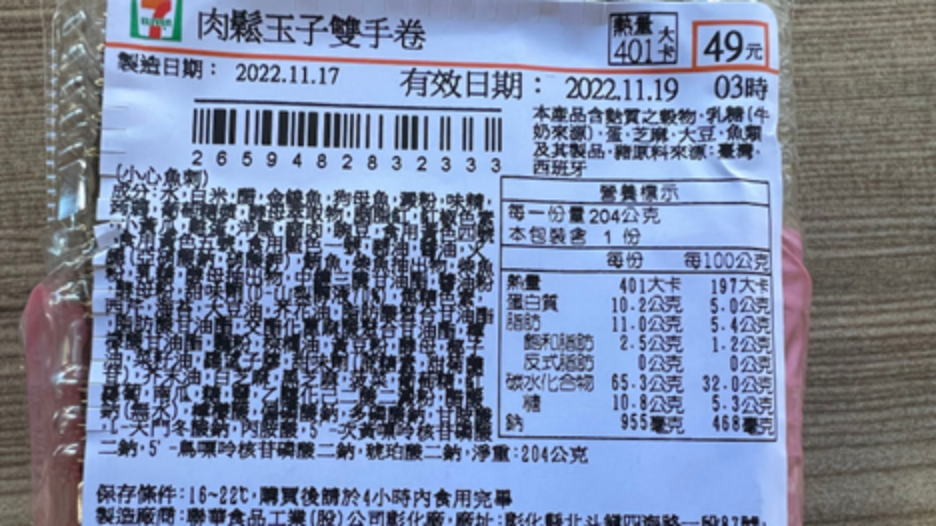
Excessive, unnecessary additives far beyond the 18 nutrients deceive our taste buds. Setting aside whether they cause allergies or cancer, these synthetic flavourings and artificial extracts are things our ancestors never or rarely encountered. How much they affect our bodies may only become clear in our grandchildren's generation.
The human food industry has separated "body and land". Under the banner of "food factories" and "artificial meat" — "tech-and-ruthless tricks" — it deeply processes, synthesises and reconstructs food, accustoming us to a dazzling, confusing world of colours and flavours.
Soil goes from "body and land are one" to "body and land torn apart"
Only in recent years have humans realised there is too much carbon dioxide in the air, and one important reason is that organic carbon originally in the soil has been lost to the air. Heavy ploughing disturbs the soil, and excessive fertilisers, pesticides and herbicides kill the microbes and small creatures that help plants metabolise (bacteria, fungi, mushrooms, earthworms, insects, frogs, dragonflies and so on). After 60 years of "baptism" by the agricultural Green Revolution, future soils may no longer be able to feed humanity for the next 60 years.
Humans extract huge amounts of natural gas, not only for energy, but also — using electricity generated with large amounts of fossil fuel — very energy-intensively replace natural gas's carbon atoms with nitrogen atoms from the air to make urea, i.e. fertiliser, instantly more than doubling yields. Nominally this feeds more people, but in fact, because food resources are unevenly distributed, rich countries can buy cheaper farm products and food and consume more, causing pathological obesity — an international social problem — while the hungry in Africa simply can't buy these "cheap farm products".
In agriculture and food, humans have done every kind of self-inflicted harm, making people lose their health and the soil lose its health too, turning "body and land are one" into a road where "body and land are both torn apart" and perish together.
To reduce carbon, the world promotes "carbon farming". It sounds a bit mysterious, but putting it into practice just takes the principle of "less": less ploughing, less fertiliser, fewer pesticides. With less, you get "more": more microbes and small creatures in the soil, and more diverse ecology. Because soil quality improves, plants are healthier, pests and diseases decrease, resistance to drought and flooding increases, and normal yields and quality rise too, entering a virtuous cycle. Most importantly, we naturally turn excess carbon dioxide in the air into organic carbon through photosynthesis and store it in the soil — that's "carbon farming".
The "smallholder carbon farming" we are promoting is a response to World Soil Day. It is an international emission-reduction certification programme that, besides quantified certification of carbon reduction, also quantifies certification against the UN's 17 Sustainable Development Goals. Beyond carbon sinks and carbon credits, more importantly it creates better sales channels and prices for farmers' produce — after all, increasing soil organic carbon is the scientific indicator of "body and land are one".
Source: CM Media ( https://www.cmmedia.com.tw/home/articles/37419 )


