 努力小農
本文尚無譯文。
A sea change no one can stand apart from: looking back on and ahead from the first year of smallholder carbon farming
Vast farmland, well managed, is a treasure house of carbon sinks; badly managed, it becomes a hotbed of greenhouse gases.
2022 is over. Three years of COVID had a huge impact on all humanity; looking back over those three years feels like another lifetime. What lessons has COVID taught us? Every country and every trade will have its own take. Responding to the international 4 per 1000 Initiative, we launched the "smallholder carbon farming" movement. On World Soil Day, 5 December 2021, we declared 2022 "Year One of Smallholder Carbon Farming" — the start of smallholders taking part in international emission-reduction certification and carbon trading. It was also inspired by and a response to the global COVID pandemic: the end of one era and the start of a new one.
A new start in the post-pandemic era
Although it's called "smallholder carbon farming", it is really a costly experiment in systems engineering and social engineering, and in building public will. "Smallholder" is just a byword: in every trade, smallholders are everyone who works — just as computer programmers are called "code farmers" — all those toiling quietly, faces to the soil and backs to the sky; in different fields they are different kinds of "farmer".
The most common question is: aren't we supposed to reduce carbon — why farm it? In every trade, production emits carbon, and the only option is to reduce it. But farming, forestry, fisheries and livestock are biologically based: they emit carbon, but also absorb CO2 through photosynthesis. Forty per cent of the organic carbon from photosynthesis is further stored by soil microbes in the soil as organic matter, becoming nutrients for plants.
Photosynthesis is the most basic biochemical reaction by which plants have changed the Earth's ecology over 1.5 billion years. Because modern agriculture, to increase output fast, uses large amounts of fertilisers, pesticides, herbicides and fungicides, and farms with heavy machinery, it kills and even wipes out soil microbes. Soil microbes lose their ability to fix carbon, so the organic carbon produced by photosynthesis returns in large amounts to the atmosphere, causing atmospheric greenhouse gases to soar.
You can see this in time-lapse footage from NASA's atmospheric CO2 monitoring satellites: every March, April and May, during spring ploughing in the Northern Hemisphere, atmospheric CO2 rises from 380 ppm to 420 ppm. (In general it would need to go back to 250 ppm for the Earth not to warm or become climatically extreme; at 450 ppm we fall off the cliff into irreversible global climate disaster.)
NASA time-lapse of global CO2, 2020–2021:
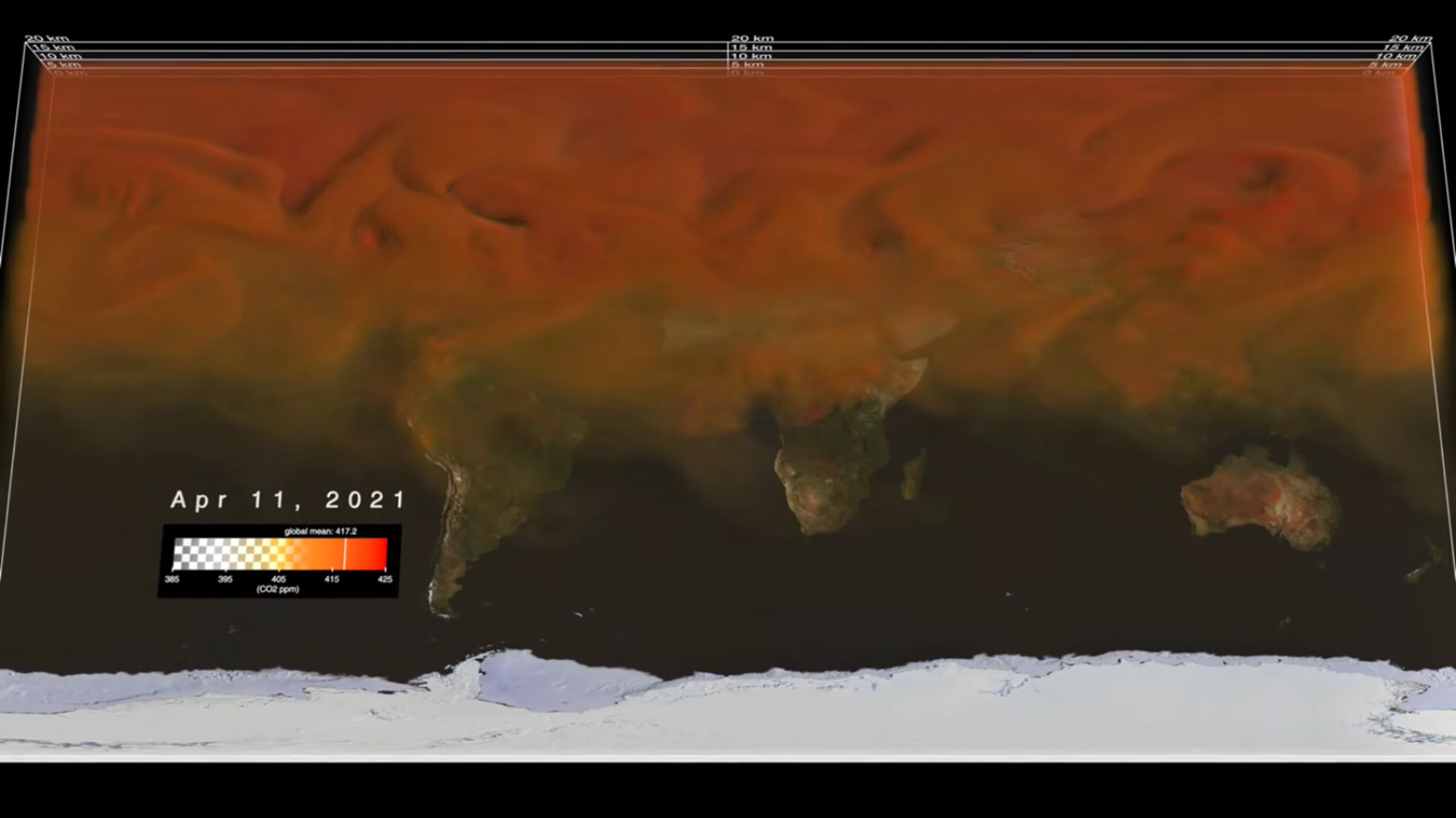
This NASA time-lapse of global atmospheric CO2 in 2020–2021 clearly shows the Earth's CO2 concentration soaring in March, April and May because of farmland tillage, proving that agriculture adds 30 ppm of greenhouse gases. If this could be reduced and the CO2 stored in the soil as organic carbon, it would be good for the environment, agriculture and human health. (Image: from YouTube @NASA Climate Change)
I have to keep stressing the causes of agricultural emissions, because they run exactly counter to most people's perceptions. If not for hard scientific evidence, who would believe that hard-working farming and abundant production contribute 27% of CO2, and that emissions from tillage exceed the much-maligned steak and burgers, even coal power, chemicals, cement and transport?
A sea change no one can stand apart from
"If even smallholders can farm carbon back into the soil, who can refuse to reduce carbon?" This is our basic belief. First, thanks to the nearly one hundred smallholders who joined the first group of carbon farmers; the number is still growing, so we can't give an exact figure. Smallholders of every kind — natural, organic, eco-friendly or conventional — can join. Carbon reduction and carbon farming must be a universal value; no one can stand apart.
Once you join carbon farming, you must follow internationally standardised methodologies. We originally wanted to use water management in rice to reduce methane, or soybeans to fix nitrogen and cut chemical fertiliser to reduce nitrous oxide, but because of insufficient baseline data and the difficulty of gathering evidence after implementation, we are running only a soil organic carbon sequestration project.
We must define the scope and boundary, determine baseline emissions, and establish genuine "additionality" (the results due to implementing the project meet the methodology's requirements), leakage (increased emissions outside the project caused by implementing it), uncertainty (the error between actual and expected results), risk assessment and safeguarding plans (ensuring the project can be carried out), and a monitoring plan (regularly monitoring and reporting the project's parameters), and complete the project design and implementation reports. Only then can a project be established, with emission reductions confirmed by third-party verification, generating carbon credits that can be traded on the market.
Carbon reduction is not only carbon reduction
Besides reducing and farming carbon, we must define and estimate how much benefit the smallholder carbon farming project can bring farmers — higher yields, higher income (e.g. higher product prices, more eco-tourism), and education on environmental agriculture and food safety. These must meet UN Sustainable Development Goal indicators and the requirements for quantified sustainability impact of emission-reduction projects before a project can be established.
This whole series of complex tasks is not something smallholders can carry out; even sizeable companies and listed firms may lack the capacity. It depends on a project developer to design and plan, find resources and keep the project running smoothly.
Yet in Taiwan I hear many people talk about carbon reduction only in terms of "what I did, how much carbon it cuts and how much it sells for", lacking the systems engineering described above. Simply put, the international community no longer recognises emission-reduction projects that look only at tonnes reduced; it looks at the accompanying social benefits.
Incidentally, take the green electricity Taiwan is pursuing with such fervour: without overall systems engineering for carbon reduction and sustainable development, generating green power alone can no longer meet international net-zero requirements. Merely buying green power doesn't count as carbon reduction either: besides the sustainability of the green power's source, you have to see whether the buyer's business conduct meets reduction requirements.
On this year's smallholder carbon farming journey I've met hundreds of interested smallholders, members of the public, professors and scholars. In agriculture I'm a layman who can't tell one grain from another; I help smallholders, cooperatives and villages design and develop emission-reduction projects. Just as I knew nothing about manufacturing yet helped hundreds of automotive suppliers meet the quality requirements of the international automotive supply chain and enter global supply chains — that's the beauty of standardisation.
How can the world catch up with Taiwan?
On COVID, Taiwan's early deployment was unrivalled in the world, so former health minister Chen Shih-chung proclaimed in the Legislative Yuan: "How can the world keep up with Taiwan?"
On net-zero emissions, the UN has developed increasingly mature international conventions, systems, standards and norms, with open, transparent reporting and disclosure. From national emission-reduction pledges and SDG reports to company-level ESG reports, they all stress commitments and roadmaps to future net zero, with quantified figures linked to financial reports — only then is a report acceptable. Recently, during COP27, the International Organization for Standardization published the ISO Net Zero Guidelines, setting out how countries, local governments, companies and other bodies with governance responsibilities should apply existing ISO standards, science-based targets (SBT) published by international NGOs, greenhouse gas accounting and reporting standards and so on, providing management guidance.
What these international standards don't emphasise is establishing baseline data — many countries have built databases over decades. Instead they focus on the goals to be achieved by 2030 and 2050, how to achieve and report them, combined with corporate sustainability, with financial support and financial performance.
Net zero is an unavoidable trend. As with any viral epidemic, herd immunity is the only solution, whether immunity comes from infection (tragedy) or from inventing vaccines (comedy); sooner or later we must face it. We must seize the initiative amid future global change. Net zero is a golden opportunity: if we can take the chance to deploy early and reach net zero ahead of time, we will be more competitive.
Unfortunately, most SDG and ESG reports by Taiwan's government and companies today are honour rolls looking back at how many "good deeds" were done, rather than estimating and committing to what actions we will take by 2030, how much we will spend and what we will achieve. Most companies lack baseline data and have no clear roadmap, because everyone spends their energy on retrospectives.
It's like a marathon: everyone else has left the 2015 starting line and is running towards the 2030 midpoint and the 2050 net-zero finish, while Taiwan still hasn't found the track — facing back towards the start, discussing how to find the starting line and how to run.
We hope to start with smallholders, properly follow international guidelines, reduce carbon honestly, and let the world catch up with Taiwan.
---------------------------------------------
Source: CM Media ( https://www.cmmedia.com.tw/home/articles/37925 )


