 努力小農
本文尚無譯文。
Smallholder carbon sinks and net zero bring honour to Taiwan
More than 300 smallholders in Taiwan have joined the international emission-reduction certification "Smallholder Carbon Farming Project", which has received project design certification from the international emission-reduction standard body Gold Standard. (Photo: Pxhere)
While Taiwan's companies, government and civil society are racking their brains over how to bring Taiwan to net zero by 2050, Taiwan's smallholders are quietly taking concrete action, increasing soil organic carbon and setting out on the road to international emission reduction, net zero and carbon trading — opening a door to international certification in the country's deadlocked net-zero situation.
Smallholders open a door to the world for Taiwan's 2050 net zero
In Taiwan, 270 hectares and more than 300 smallholders have joined the international emission-reduction certification "Smallholder Carbon Farming Project". On 8 February it received project design certification from the international emission-reduction standard body Gold Standard, announced in thecertification announcements section, with full details of itsproject content. This means smallholders can in future follow the project design, and after annual verification of soil organic carbon content, generate carbon credits as well as quantified certification of the SDGs.
Although this is a micro-scale project, generating about 300 tonnes of carbon credits in its first year, with successful international certification the number of participating smallholders and the area of soil carbon sinks (long-term organic carbon stored in the soil) should grow year by year. The project targets the annual increase in soil organic carbon, actually measuring carbon content in the soil. Farming by carbon-reducing methods can raise soil carbon sinks year by year, in line with the international 4 per 1000 Initiative (raising soil carbon by four per thousand each year could offset carbon emissions from other human activities).
It is also the first project in the world to bring together many smallholders, while meeting six UN Sustainable Development Goals: SDG 2 (Zero Hunger), SDG 3 (Good Health), SDG 4 (Quality Education), SDG 8 (Decent Work and Economic Growth), SDG 12 (Responsible Consumption and Production) and SDG 13 (Climate Action). The project also uses information and communication technology (ICT): the MiHuMiSang app helps smallholders scattered across the country keep carbon-reduction diaries on their phones, which the public can view in the app, and lets them sell their products. This meets transparency and inclusiveness, the two most basic principles of emission-reduction certification, and helps prevent greenwashing and improve the authenticity and traceability of reductions.
The developer has also committed to co-marketing for participating smallholders in line with Gold Standard's claims guidelines, including being able to state participation in "Gold Standard emission-reduction project GS11818" and quantified certification for six SDGs. Eco-tourism based on smallholder carbon farming and net zero will also be designed, raising the profile of smallholder producing areas so they gain additional income and promoting local rural economic development.
The project developers, Green Consumers' Foundation / Eco-affinity Inc., call on companies to take part. Besides being able to join from now on and use the related documents and publicity, this is also the best ESG investment for companies, and an opportunity to help improve the environment, agriculture, food safety, and the social and environmental conditions of farmers and rural communities.
Taiwan's smallholder carbon farming partner groups go beyond carbon reduction
Smallholder carbon farming is not something one company can carry out alone; it needs help from all sectors of society. At present eight organisations are first-phase partner groups. Without the partners' help, the first step could not have been achieved.
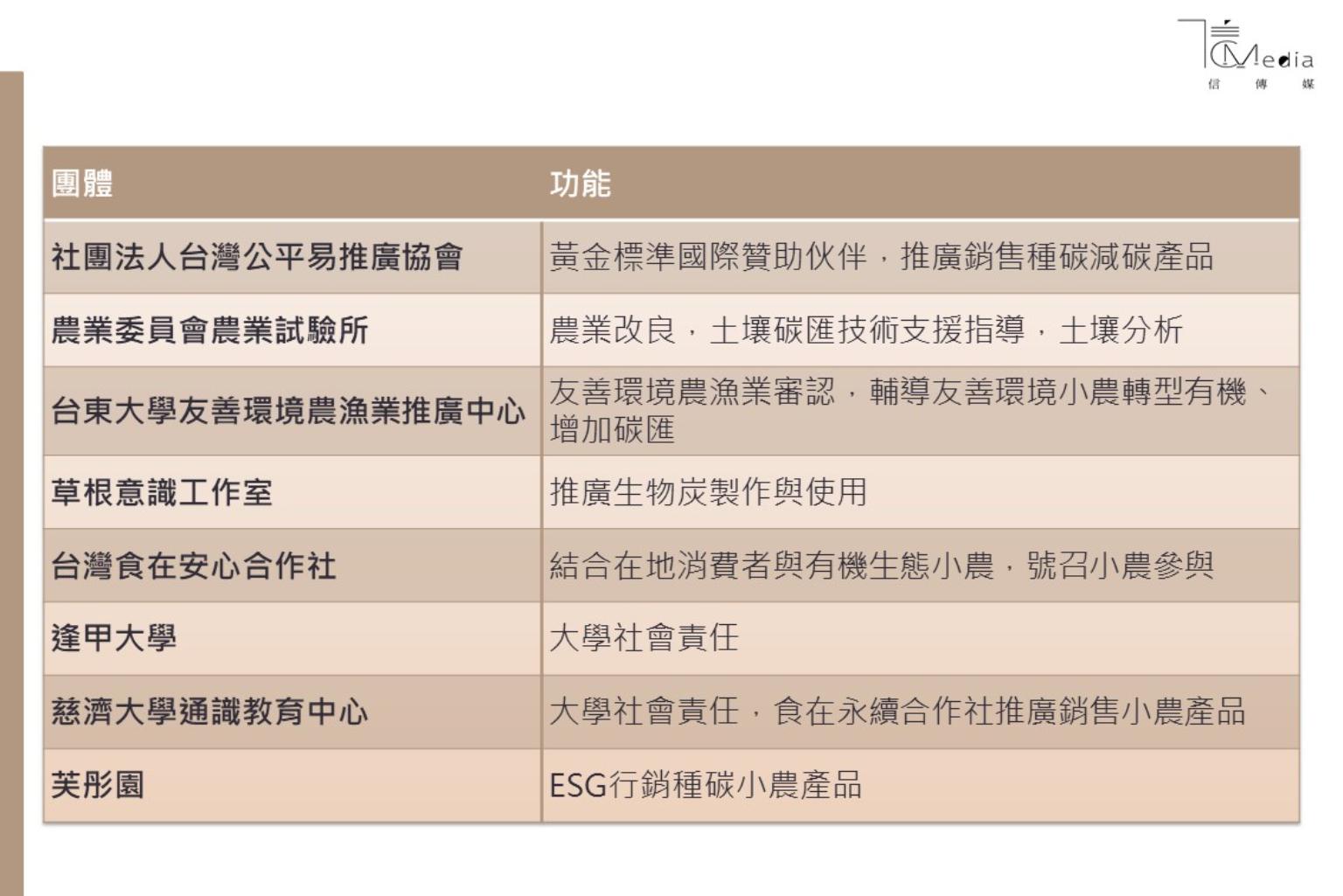
This is a golden team, each group doing its best — the first wave facing the global climate challenge and the UN Sustainable Development Goals. We hope the team keeps growing and opens new possibilities for net zero in Taiwan's agriculture.
Gold Standard registration documents
Because international voluntary emission reduction stresses the two principles of "transparency and inclusiveness", all documents of the whole process of a reduction project must be public, and anyone can log in to see them.
On the Gold Standard certificationregistry listyou can see voluntary emission-reduction projects around the world. Taiwan's is the only one focused on "small farmers". This is an important milestone for promoting smallholder carbon reduction in future, proving that such a project design can generate carbon credits for each smallholder, pool them for trading, and also create SDG impact.
Introduction to the Taiwan Smallholder Carbon Farming Project
This project description is taken from theGold Standard Impact Registry page
The smallholder economy is crucial to modern agriculture, because small-scale or micro farming has limited impact on the environment and greenhouse gas emissions: it uses little land, maintains biodiversity and emits fewer greenhouse gases. Taiwan is a biodiverse island. It used to be mainly agricultural and is now dominated by high-tech industries such as semiconductors, but Taiwan still has millions of smallholders, responsible for supplying Taiwan's food and a small share of exports.
Taiwan lies on the Tropic of Cancer and is a young island formed by colliding tectonic plates. Its land area is 36,000 km², with 268 peaks over 3,000 metres and steep, fast-flowing rivers and streams. Add natural disasters such as earthquakes, typhoons, torrential rain and debris flows, and the soil lacks organic matter and is relatively poor. Since modern agriculture with heavy use of pesticides and chemical fertilisers was introduced in the 1960s, over more than half a century large amounts of farmland soil have acidified, and lack of organic matter is widespread.
Using the Gold Standard for the Global Goals' "smallholder carbon farming (Soil Organic Carbon Framework Methodology)" can encourage Taiwan's government and farmers to adopt agriculture that is more environmentally friendly and good for soil health, food security and consumer health. More importantly, it means taking part in global climate action and reducing greenhouse gas emissions. It also motivates smallholders to act on the 17 UN Sustainable Development Goals.
Agricultural carbon sinks — many smallholders joining global climate action through carbon farming — are very important. But smallholders lack resources, including money, knowledge and experience, and find it hard to record and report their work logs, making it difficult to submit evidence for certification of greenhouse gas reduction actions. The project developer Eco-affinity Inc. provides smallholders with a smartphone app called "MiHuMiSang" (a Bunun blessing greeting). Social media apps have been popular since smartphones arrived, and many farmers are used to taking photos, checking in and posting photos to share.
Smallholders can easily use encrypted technology to photograph and record their carbon project activities. The authentic photo files are automatically tagged with timestamps and geotags, and once uploaded to the cloud database they cannot be altered, forming systematic big-data blocks that help smallholders achieve certification-grade quality assurance and quality control (product and process QA/QC). Apart from personal information that must be kept confidential, all data will be public on the internet for public participation and witness.
Verification and Validation Bodies (VVBs) can also easily trace and verify project activities, increasing the credibility of certification, preventing carbon leakage and double-counting loopholes, and producing high-quality verified emission reductions. This applies not only to Taiwan but in future to smallholders around the world, encouraging more farmers and consumers to join climate action and achieve the UN 2030 Sustainable Development Goals. This is a micro-scale project — a seed that will grow into trees and then a forest.
Source: CM Media ( https://www.cmmedia.com.tw/home/articles/38883 )


