 努力小農
本文尚無譯文。
Greenwashing harms the fight against warming: govern climate fraud through openness and transparency
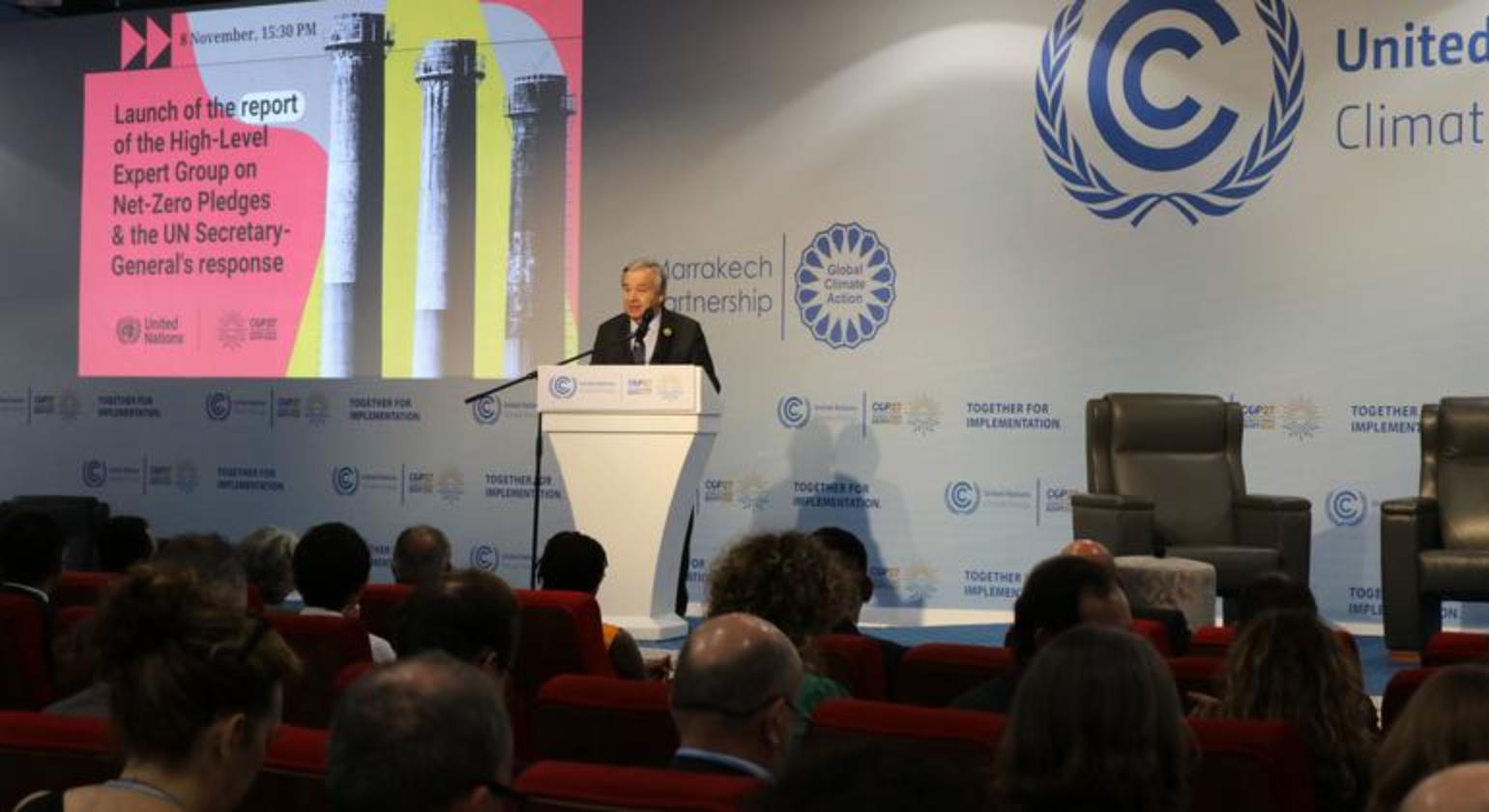
At COP27, the UN Secretary-General attacked the petrochemical industry's greenwashing, which will delay the chance to solve the global warming crisis. (Photo: United Nations)
On 8 November last year the United Nations issued a strongly wordedpress release, declaring zero tolerance for greenwashing in emission reduction, because the UN's High-Level Expert Group on the Net Zero Emissions Commitments of Non-State Entities had published a report, "Integrity Matters: Net Zero Commitments by Businesses, Financial Institutions, Cities and Regions(INTEGRITY MATTERS: NET ZERO COMMITMENTS BY BUSINESSES, FINANCIAL INSTITUTIONS, CITIES AND REGIONS)", sounding the alarm against net-zero fraud.
It drew a strong response at the 27th Conference of the Parties to the UN Framework Convention on Climate Change (COP27) in Egypt, because the globally destructive disasters brought by climate change are increasingly evident and net-zero emissions brook no delay. As the UN Intergovernmental Panel on Climate Change (IPCC) stresses, emissions must fall by at least 45% by 2030 and reach net zero by 2050, with interim targets set every five years from 2025, if the disasters of climate change are to be slowed.
The petrochemical industry profits from disaster through greenwashing
Yet this state of emergency has become a carnival for climate fraudsters worldwide. The more urgent the situation, the better the opportunity for these vultures scrambling to profit from global disaster: from polluting multinationals, financial groups, accounting firms and consultancies to individuals or companies offering fabrication services on the side, and even governments, brazenly putting forward false reports.
Although fossil fuel companies pledged while excluding the core products and activities that poison the planet, UN Secretary-General Guterres still issued a strong warning to the petrochemical industry and its "financial enablers", urging them to re-examine their commitments and bring them in line with the report's guidelines and with real action.
Guterres said, in essence, that using false "net-zero" pledges to hide a massive expansion of fossil fuels deserves condemnation; it is outright fraud, a toxic cover-up that could push our world over the climate cliff, and the deception has to stop.
This means the UN cannot stand by and watch the petrochemical industry's greenwashing. Guterres drew red lines on greenwashing: 1) pledges must not be a "toxic cover-up"; 2) plans must be detailed and specific; 3) pledges must be accountable and transparent; 4) voluntary action must become the norm. I believe these will also be the four basic questions we use to examine any company's climate action claims in future.
The Guardian strikes at the fossil industry's fake forest carbon sinks
Today more than 80% of global emissions are covered by "net-zero pledges". These pledges must be examined, verified and confirmed; otherwise they are empty slogans and hype that will only cause more emissions and greater disasters.
On 18 January this year the UK's Guardian, known for its investigative reporting, published the bombshell "Revealed: more than 90% of rainforest carbon offsets by biggest certifier are worthless, analysis shows", attacking false certification in the forest carbon (REDD+) credits of Verra, the world's largest private voluntary emission-reduction body.
The company involved was Shell, which advertised "carbon-neutral natural gas". Shell had sold this greenwashed gas to CPC Corporation; because TSMC needed to meet its net-zero pledge, it had to pay a higher price for "carbon-neutral natural gas" used to generate electricity specifically for TSMC.
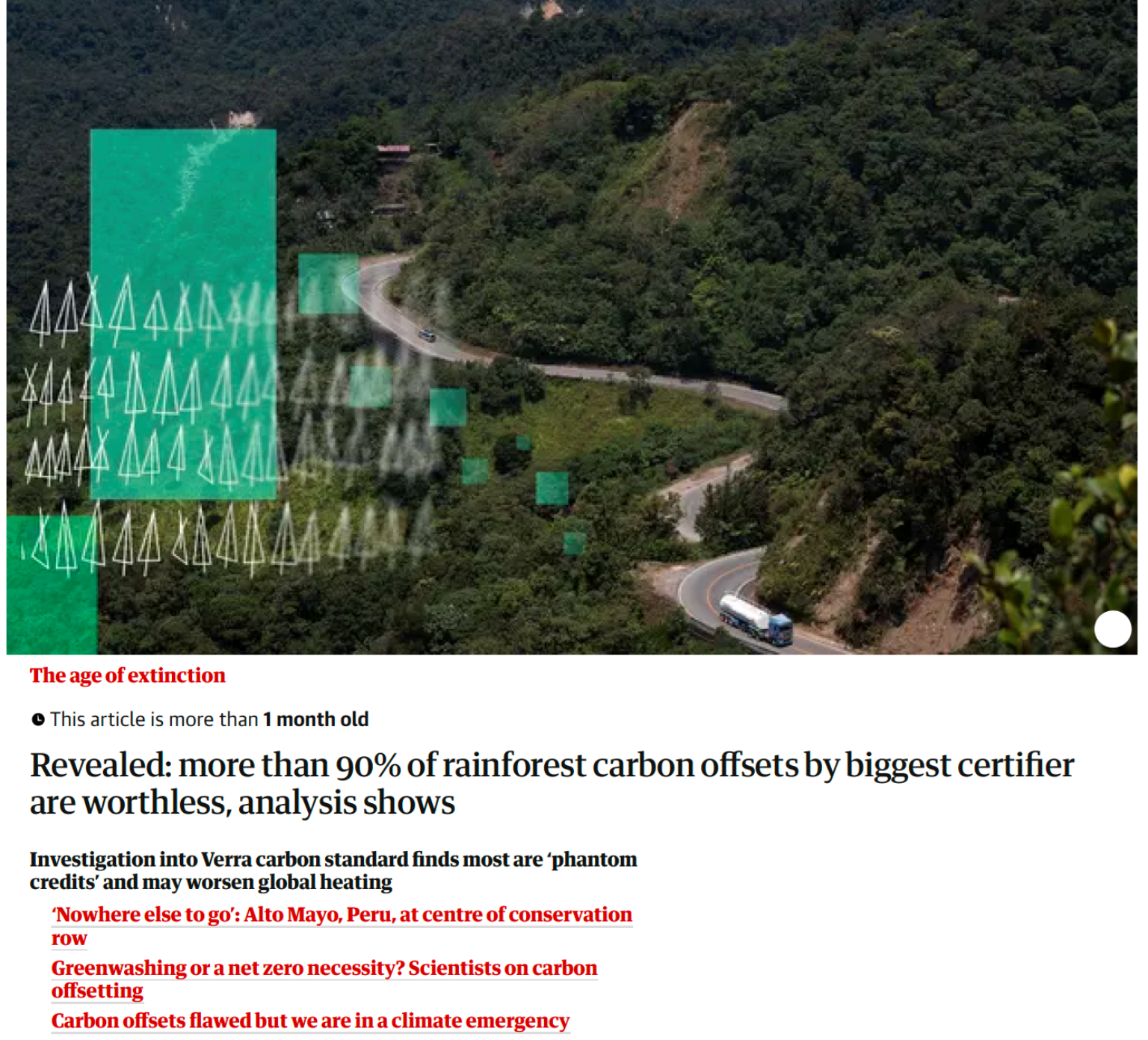
On 18 January this year the Guardian named and criticised false certification of forest carbon by a major certification body. (Image: screenshot from the Guardian)
As early as 11 August 2021, Bloomberg News had warned "How it's possible to sell 'carbon neutral' fossil fuel that doesn't exist", directly naming Shell as suspected of using false forestry carbon reductions to pad out its carbon neutrality, with several multinationals also involved.
Although Verra issued apress releasein response to the Guardian on 18 January, denying false certification and stressing that the research cited by the Guardian led to wrong conclusions, Verra also admitted it would revise its REDD project methodology, which is still being developed.
On 3 February Verra also issued apress release, suspending all projects under the methodology for reducing methane through rice water management and re-reviewing all of them. It gave no reason, but industry insiders point out that such projects are often unsupported by evidence: outsiders cannot know how much the flooding period of paddy fields was actually shortened, or how much methane reduction that equals. This may be why Verra was uneasy about the authenticity and transparency of these projects. (When paddy fields are flooded, organic matter in the soil ferments anaerobically and produces methane, so shortening the flooding period reduces methane. But it is hard to verify how many days of flooding were cut, so the effect is hard to validate.)
This wave of international anti-greenwashing has only just begun. Faced with a carbon trading market worth tens of billions a year, too many unscrupulous people want to cash in. This rests on many companies not daring to disclose their emission-reduction data, using business confidentiality as an excuse and letting so-called "third-party" certification and audits "guarantee" their verbal "pledges". Can government regulation challenge these big companies?
Look at ourselves: don't be a hidden champion
Taiwan has a great many so-called "hidden champion industries" that are actually illegal factories on farmland. Why do they quietly make a fortune instead of moving to legal industrial zones? Because once they had to bear the social and external costs of environment, labour and industrial safety, they couldn't make money. But they are big taxpayers, so the government turns a blind eye. Which government is willing to tackle such a long-standing problem?
If huge factories standing in the fields can't be seen, wouldn't verifying invisible carbon emissions be even harder?
Looking at ourselves: the "Taiwan Smallholder Carbon Farming Project" has passed Gold Standard project design certification, and we must strictly follow the principles of transparency, openness and public participation. Taking part in global climate action is an honour, an action in line with universal global values (the UN Sustainable Development Goals), and we must act openly and above board.
Character determines the product: only a bright, healthy character produces good conduct and good products. After June this year, products meeting the Smallholder Carbon Farming Project's requirements will gradually reach the market, bringing opportunities to carbon-farming smallholders. To keep this going, we must rely on an even more open and transparent attitude, proactively disclosing and publishing our carbon-reducing, carbon-farming practices.
Without reducing yields: less tillage, more cover, more soil organic matter and biochar, moderate fertiliser and pesticide use or none at all, using photosynthetic bacteria and biological inputs — these are the basic principles of carbon farming. As smallholders do this work day after day, photosynthesis and plant physiology will naturally help the soil build carbon sinks.
In future we will actively promote eco-tours visiting carbon-farming smallholders, as well as food and agriculture education, making Taiwan smallholder carbon farming an international benchmark for honest, sincere emission reduction.
Source: CM Media ( https://www.cmmedia.com.tw/home/articles/39014 )


