 努力小農
本文尚無譯文。
ESG means investing in sustainability, not short-term adoption
Sustainable, organic agriculture is the field with the greatest ESG social impact in the trend towards carbon reduction and net zero.
This Earth Day (22 April) we will "crowd-raise" ESG (environmental, social and governance) investment (ESG investing) for the smallholders whose emission-reduction project design has received international certification.
The ESG activities we usually hear about are mostly charitable activities such as cutting plastic, cutting waste, handing out reusable bags and cups, beach clean-ups and adopting parks. But I have heard some business owners talk about it as something to get through, like "ISO 9000 certification" — getting in the way, wasting time and holding up work.
In the minister's message in theNational Development Council's 2021 Voluntary National Review of the Sustainable Development Goals, the first sentence by National Development Council Minister Kung Ming-hsin says that sustainable development has become a universal value and a crucial issue for human survival. How many people agree? How many believe it? How many practise it?
If ESG exists for corporate sustainability, it should be a secret weapon and a mindset that boosts competitiveness, not redundant, burdensome red tape. That is not sustainability; it is a troublemaker. During my years working in companies, I believed ISO 9000 was not a hindrance, because at the Big Three American carmakers it promoted external communication between suppliers and customers and internal communication within suppliers, and reduced waste, rework and scrap. That is the true purpose of ISO 9000 — "meeting customer requirements" (internal and external customers). Sadly, today all that remains is a certificate, not the benefits of implementing a quality management system.
Now add the global fight against climate change and the trend towards net zero, and Taiwan is full of competing voices. My business friends often tell me they can't make sense of it, or that it's all sales talk without sources, far removed from international emission-reduction and sustainability goals. Taiwanese companies, which have never cared much about the global environment, easily get lost in the jargon of carbon reduction and net zero.
The FSC against greenwashing
In December 2022, the Financial Supervisory Commission's draft key strategic action plan on "green finance" for Taiwan's 2050 net-zero transition pointed out the dilemma facing funds invested in "sustainable" economic activities. In summary: as governments focus on climate change, private capital is pouring into green or sustainable fields, but without clear definitions or standards for "green" or "sustainable", products, companies or activities that "greenwash" or "sustainability-wash" in the name of environmental friendliness or ESG easily appear. To help market participants identify genuinely green or sustainable products and economic activities and support industry's sustainable transition, the EU, the UK, Singapore, Malaysia and others have been drawing up criteria. The EU Taxonomy, first published by the EU in March 2020, has become the reference for most countries and an important mechanism for steering capital into genuinely sustainable activities that contribute to the environment.
Clearly the FSC has also seen the risks and crisis of global greenwashing. In the report's section on "climate and ESG information disclosure", it notes in summary that, to prudently supervise the possible impacts of climate change and help financial markets assess and set response strategies early, data gaps and integration problems should be resolved soon — an area international financial organisations are working on. To unify international sustainability disclosure frameworks, the IFRS Foundation announced the International Sustainability Standards Board (ISSB) at COP26 to promote consistent disclosure standards. To achieve the Paris Agreement's goals and combat climate risk, the Network for Greening the Financial System (NGFS), made up of more than a hundred central banks and supervisors, is also promoting cooperation to close data gaps. Singapore, South Korea and Hong Kong are also building integrated ESG information platforms so that financial firms, companies, investors and stakeholders can understand ESG product information, investment opportunities and the current situation.
Because Taiwan is not a UN member, it can only watch these UN rules from afar, lacking in-depth discussion and understanding, and its attempts often end up as poor imitations.
The cut-throat competition behind multinationals' sustainable development
I have long observed multinationals' "sustainable development strategies". In fact, setting international rules and environmental requirements is cut-throat business competition. More than 30 years ago, if DuPont had not supplied environmental groups with information on the damage CFCs did to the ozone layer, how could CFCs have been banned worldwide so smoothly? DuPont had prepared substitutes for CFCs well before the ban began — in effect ending its own previous generation of products that no longer had commercial value, while earning a good environmental reputation. Companies in developing countries, like Taiwan, could only follow behind gnawing on the bones, earning money from highly polluting, energy-intensive work with high occupational health and safety risks.
Sustainable development is not following the crowd blindly or a slogan for publicity; it is the business way of corporate survival. This competition will weed out companies that lack the universal values of sustainability.
The "Taiwan Smallholder Carbon Farming Project" has received international emission-reduction project design certification, along with quantified certification for six sustainable development indicators. Under international emission-reduction certification rules, we welcome companies to take part in and support "smallholder carbon farming" through "ESG investment", moving towards shared sustainability. Earlier, in CM Media's "How to quantify net zero and ESG scientifically? Smallholder carbon farming shares the same universal values as big companies", I explained how "smallholder carbon farming" combines with and meets the various requirements of the UN Sustainable Development Goals, implementing the principles of openness, transparency and public participation.
Since this is sustainable development, the investment is sustainable — not a one-off subsidy or relief. It provides a fishing rod and teaches how to fish, rather than giving a fish that lasts only one meal. Our project design certification for six sustainable development indicators is our greatest shared asset. Besides carbon farming (emission reduction / carbon sinks), it includes increasing the quantity and quality of food (SDG 2 Zero Hunger); healthy soil for healthy food and healthy people (SDG 3 Good Health and Well-being); training of all kinds and exchanges among smallholders (SDG 4 Quality Education); consumers proactively cooperating and exchanging with smallholders (SDG 12 Responsible Consumption and Production); and cutting carbon by increasing soil organic carbon (SDG 13 Climate Action).
Sustainably investing in smallholders' sustainable actions is real governance
Please note: we are not asking companies to "adopt" smallholders, but to invest. They invest in smallholders' land to protect the environment and in smallholders' work to increase organic carbon in the soil and produce healthy food and products, combining into a new model of sustainable development: ESG investment. Smallholder carbon farming currently covers less than 300 hectares, but once "performance certification" generates tradable carbon credits, it is bound to keep growing.
Governance is the hardest part of ESG to demonstrate. In the Smallholder Carbon Farming Project, we help smallholders carry out the PDCA cycle — the first step in governance. Smallholders must also learn to govern to become leaders in their field; likewise, only companies that govern well will invest in smallholders who govern well.
Companies taking part must understand the spirit of "smallholder carbon farming" and the content of the six quantified SDG indicators. They can pre-order smallholders' products, support smallholders in using better carbon-reducing, carbon-farming inputs and methods, support and join food and agriculture education and eco-tours organised by smallholders, and help market their products. Participating companies can also, under Gold Standard's claims guidelines, gain publicity benefits for six SDGs and actual quantified results (excluding carbon credit trading).
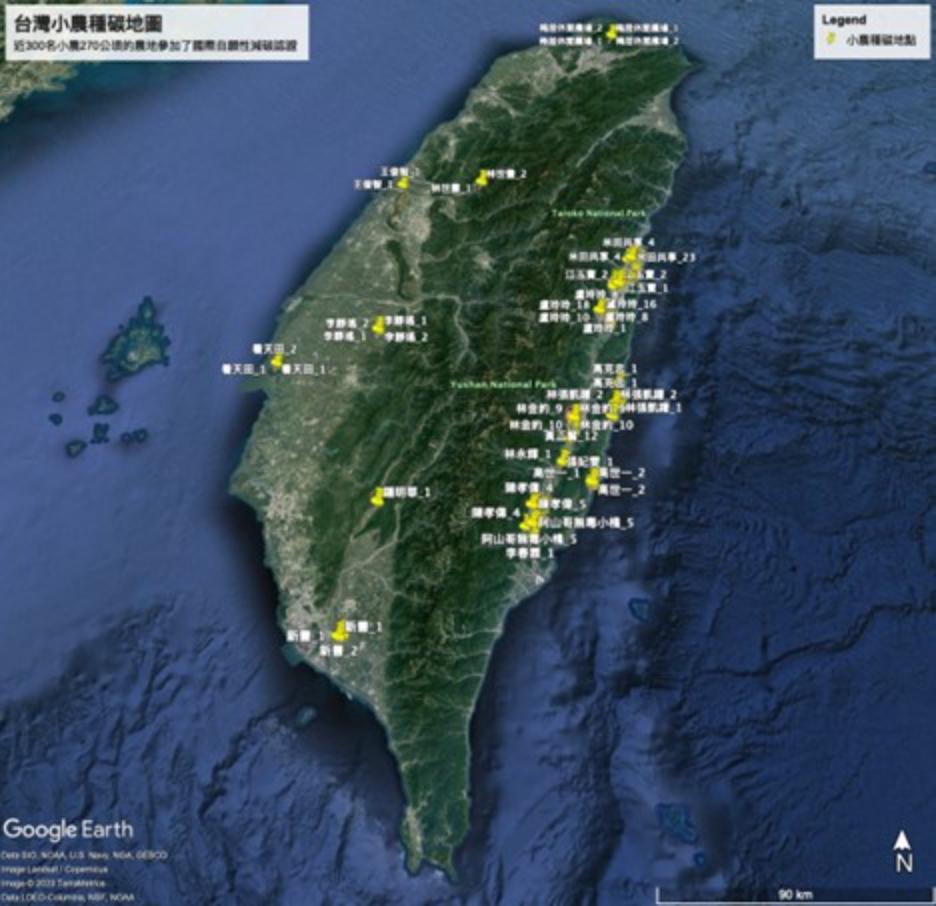
The 270-plus hectares of farmland in smallholder carbon farming are all transparently disclosed. Companies are welcome to make ESG investments in these smallholders.
We plan to launch our smallholder carbon farming products on Earth Day this year. On 21 April at the NGO House in Taipei (No. 8 Qingdao East Road) we will hold the 2023 Earth Day "Smallholder Carbon Farming ESG Investment Expo", growing step by step with social resources from one tiny seed of carbon farming.
Thanks to Chan Ju-hui, general manager of Fu Tong Yuan, who will help smallholder carbon farming find companies to make ESG investments. Our efforts will become targets of, and contributions to, corporate ESG investment: by bringing in corporate resources and fully implementing the carbon farming methodology and international certification, companies can obtain high-quality, internationally certified, quantified SDG/ESG results effectively over the long term. This will be the best investment (because it is not just carbon reduction, but also the value and quantified performance of five other SDGs).
Source: CM Media ( https://www.cmmedia.com.tw/home/articles/39426 )


