 努力小農
本文尚無譯文。
Earth Day 22 April: from a newspaper to smallholders — who says you can't change the world?
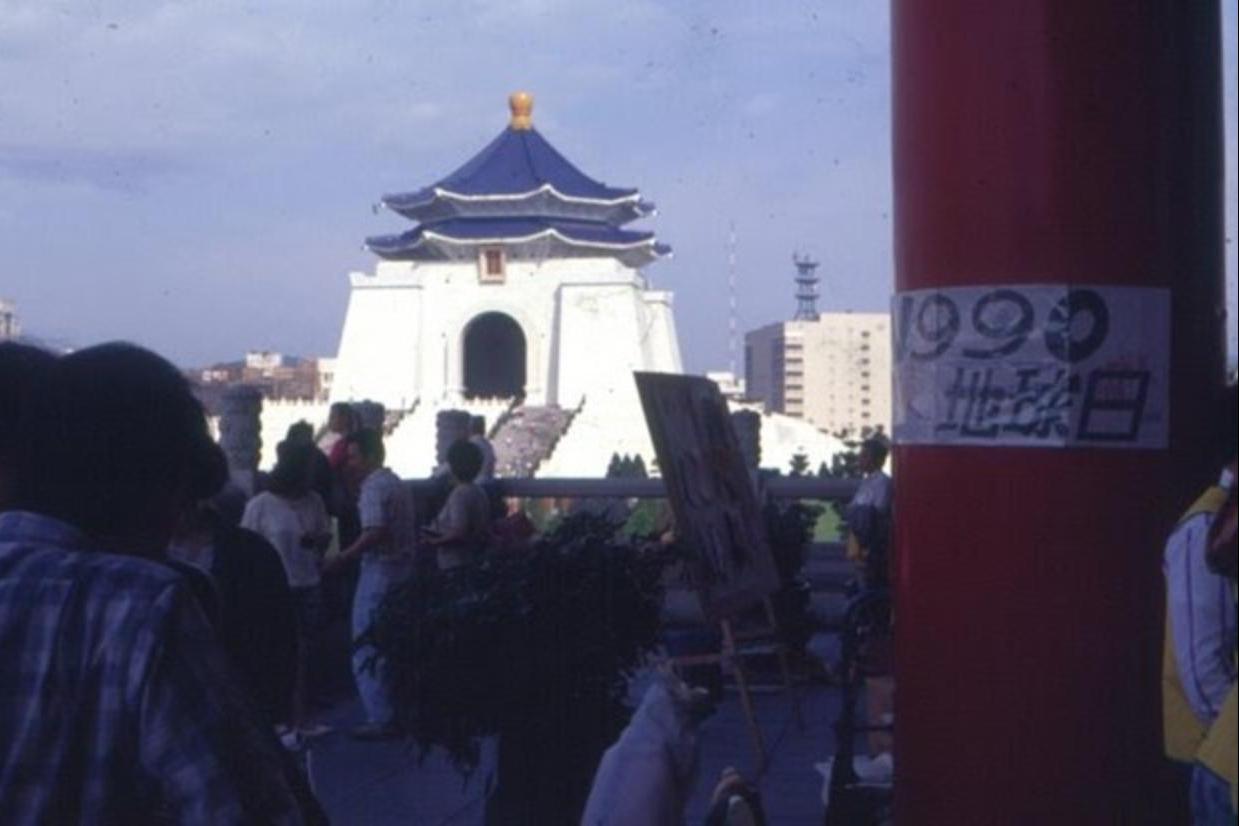
Earth Day 1990 was probably an unprecedented environmental movement in Taiwan, launched at the Chiang Kai-shek Memorial Hall less than a month after the Wild Lily student movement. (Photo: environmental preacher Nien Hsi-lin)
1990 was a turning point in my life. My father died on 3 January. While at home in mourning, I helped with a lot of liaison work with the Earth Day headquarters in Palo Alto, and without meaning to I became Taiwan's Earth Day coordinator. Yu Fan-ying, publisher of the China Times Express where I worked, was understanding, and to mark the China Times' 40th anniversary she sponsored Earth Day. On 22 April at the Chiang Kai-shek Memorial Hall there was an "Ecology Expo" by day, and in the evening CTS broadcast the Earth Day concert, aired in rotation with the rest of the world.
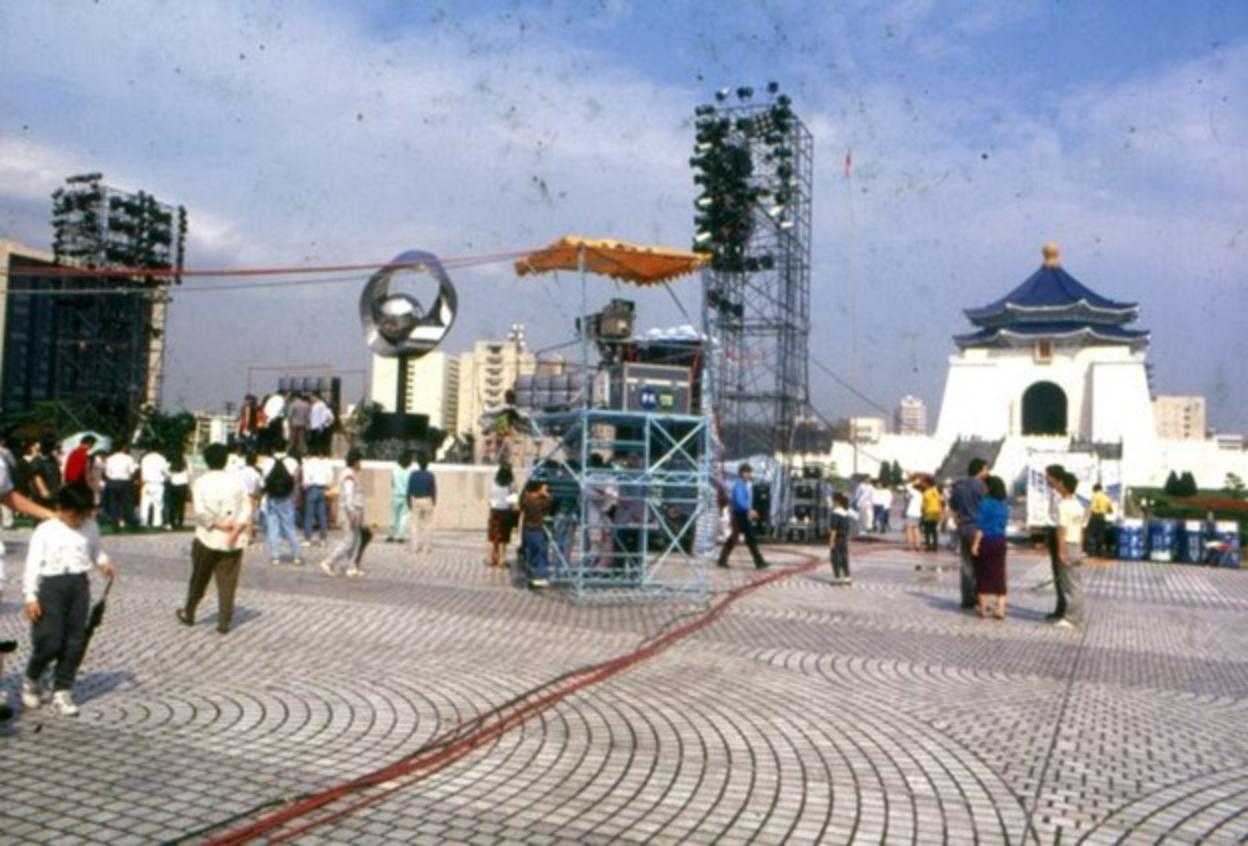
Earth Day 1990 used artist Yuyu Yang's sculpture "Ever New" as a symbol of endless, sustainable renewal. (Photo: environmental preacher Nien Hsi-lin)
I asked Chen Yu-feng to write the concert script and edit the photo video for the multimedia video wall backdrop. The hosts were Hu Yin-meng and Li Li-chun, and the stage director was Stan Lai of Performance Workshop (the following year his play donated NT$100,000 to Earth Day 1991). Singers that day included Pan Yue-yun and Pan Mei-chen, as well as Chang Yu-sheng, then doing military service in the army's arts troupe. He told me he could come and sing, but not "My Future Is Not a Dream". I replied: this is Earth Day — sing whatever you like!
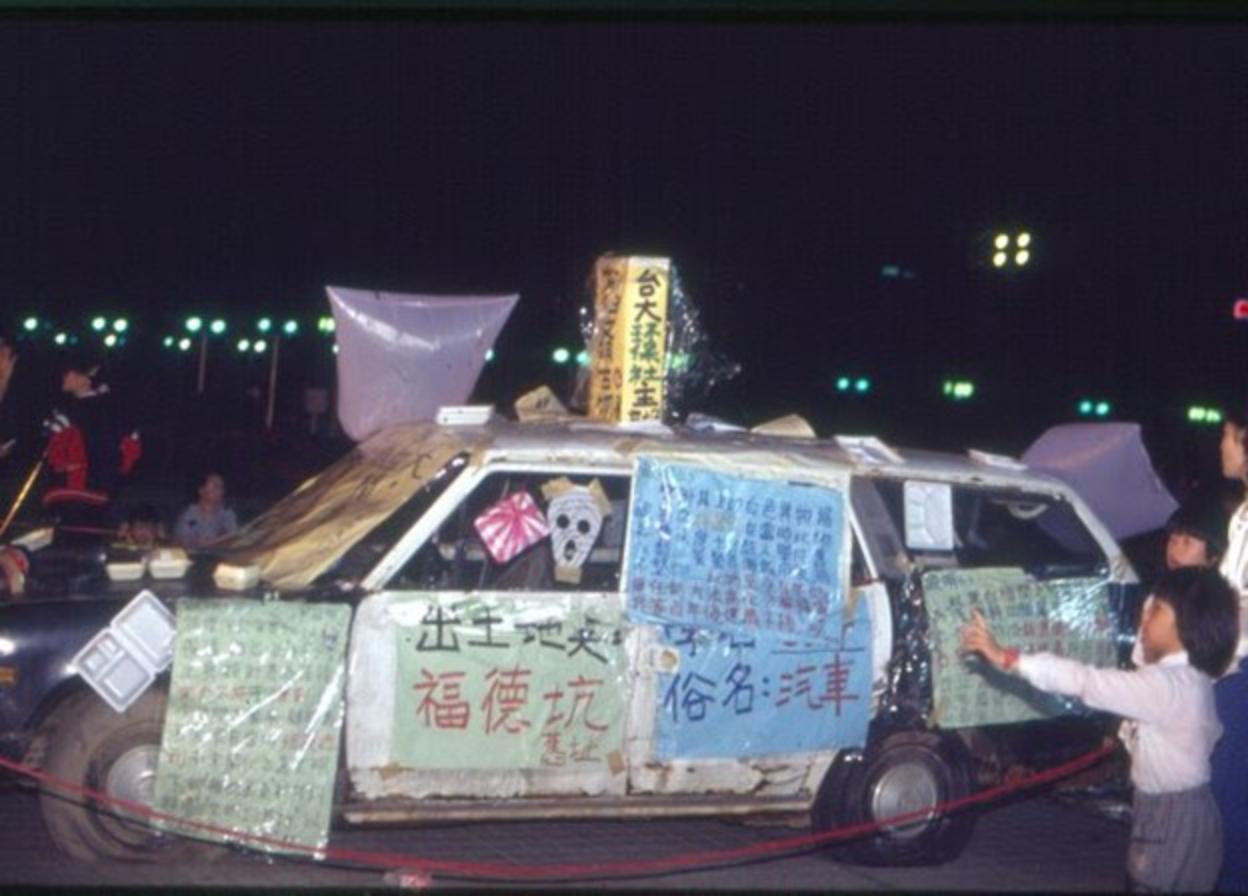
Members of National Taiwan University's environmental club, fresh from the student movement, helped smash up and decorate a scrapped car, which drew all eyes at the memorial hall. (Photo: environmental preacher Nien Hsi-lin)
Unfortunately Chang Yu-sheng was scheduled to close the show. Just before the end on the night of 22 April, a violent storm suddenly hit the square. The video wall holding up the stage sound system was blown over onto the drummer below, who bled heavily on the spot, and the performance ended abruptly. So Chang Yu-sheng never took the stage — the pouring rain from heaven took the place of Yu-sheng's ("Rain-born") singing.
That night I laughed in the downpour, because I had invited the Tao (Yami) people of Orchid Island to perform their traditional hair dance and war dance in Taipei. During the war dance, a Tao elder denounced the chief of the big island, Lee Teng-hui, for dumping nuclear waste on their home. I still remember the elder saying that whatever the colour of one's skin, whoever one is, the big must not bully the small: we don't use nuclear power, yet you dump nuclear waste on our home. The nationwide live broadcast carried those words. Afterwards there was quite a storm, of course, but I have no regrets.
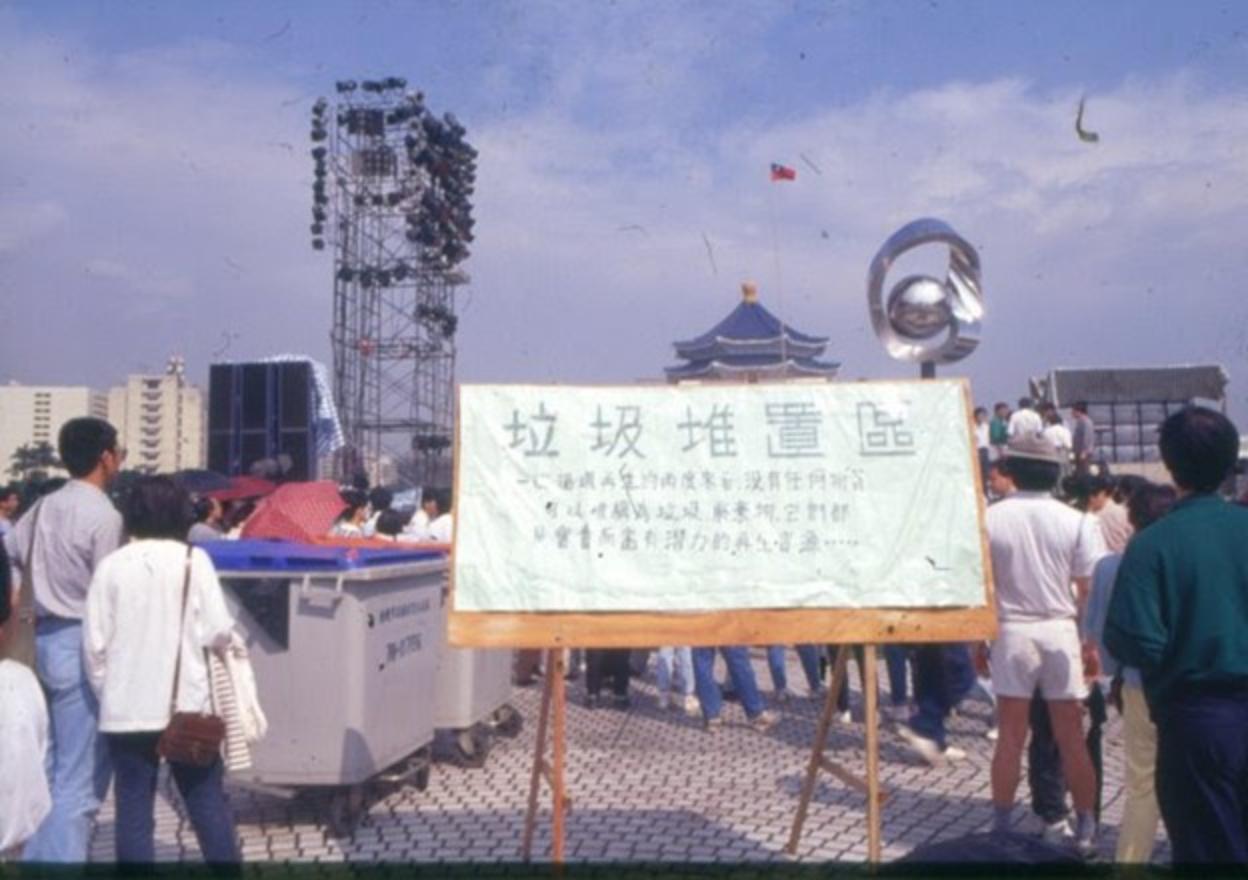
Rubbish from ten bins piled into the shape of Taiwan. (Photo: environmental preacher Nien Hsi-lin)
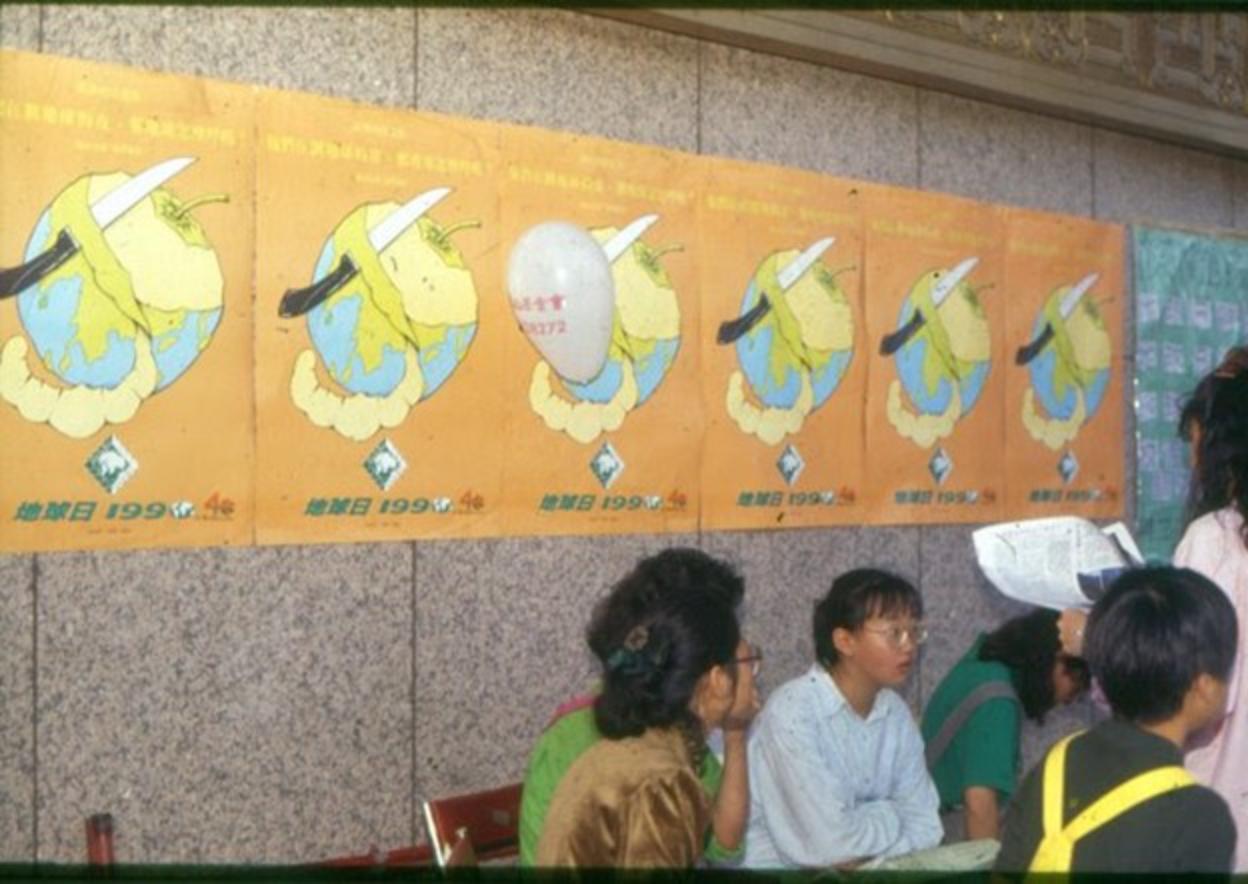
The 1990 Taiwan Earth Day poster, a peeled Earth, drawn by veterinarian Chi Wei-lien. (Photo: environmental preacher Nien Hsi-lin)
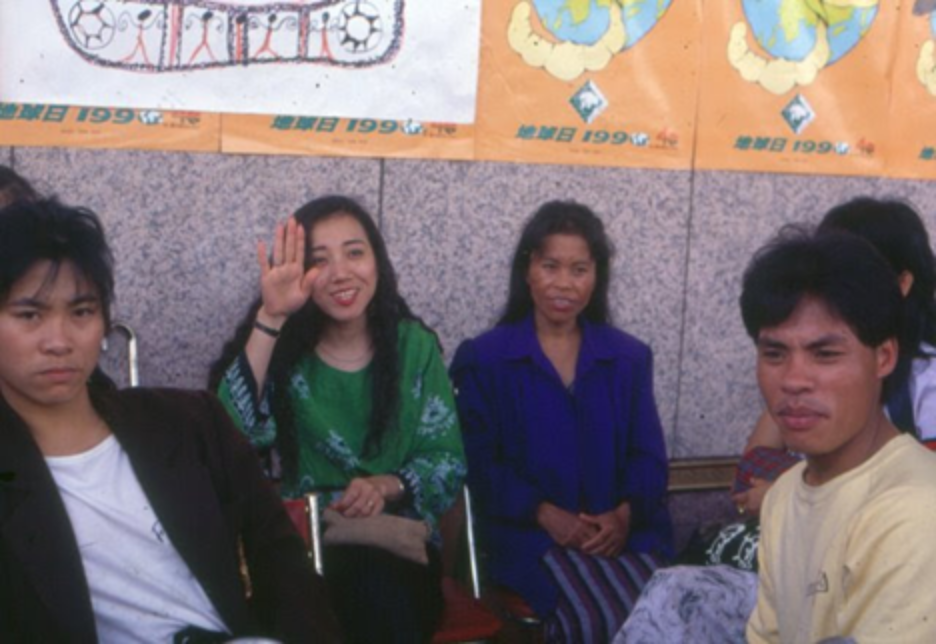
Young Tao man Kuo Chien-ping (right) came to Taipei with elders and fellow tribespeople for Earth Day. At the evening performance he interpreted, faithfully translating the elder's protest against Lee Teng-hui's nuclear waste as ethnocide. I consider this the single most meaningful thing about Earth Day 1990. (Photo: environmental preacher Nien Hsi-lin)
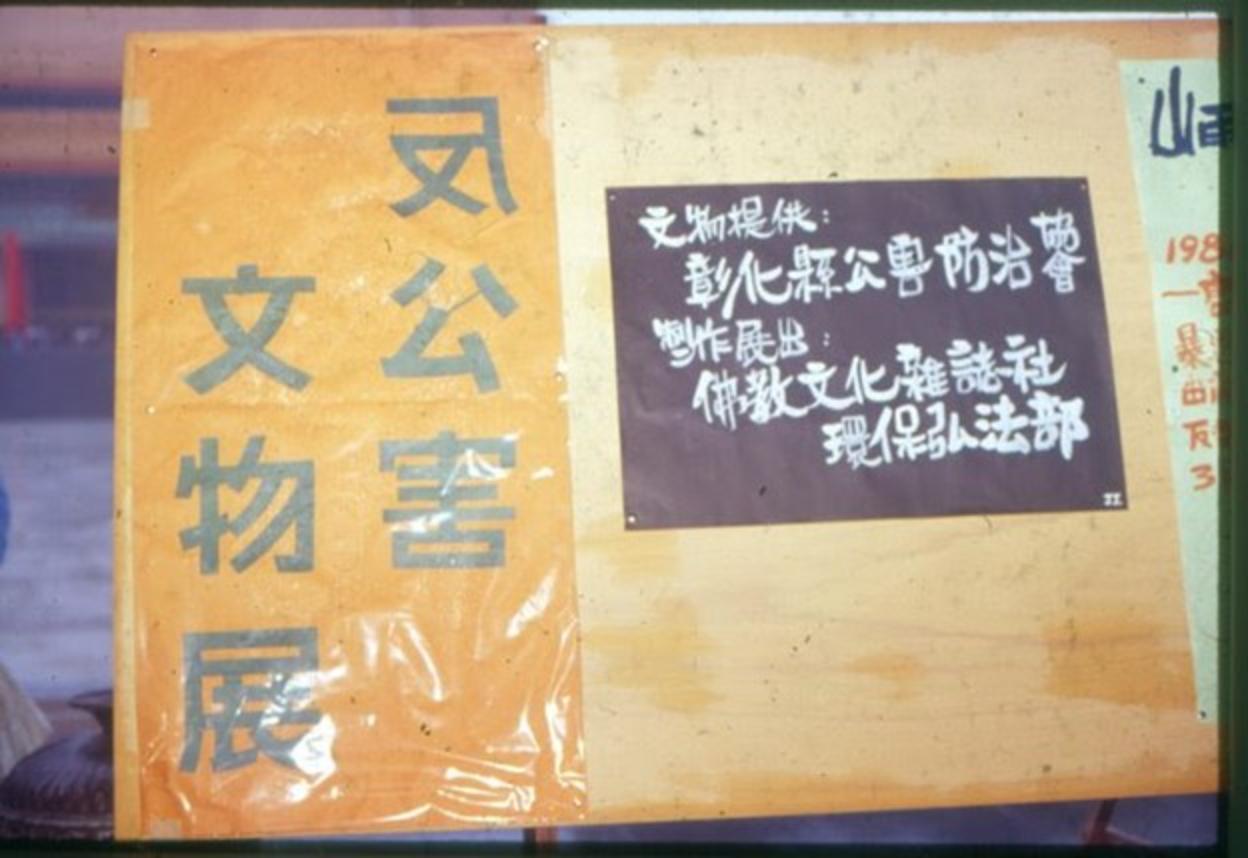
Earth Day arose by linking anti-pollution struggles across the country. Earth Day 1990 kept this fine tradition, linking anti-pollution groups from around Taiwan in marches and demonstrations. (Photo: environmental preacher Nien Hsi-lin)
Multiple coincidences
Organising Earth Day tied me inseparably to the environmental movement. On the principle of avoiding conflicts of interest, I chose the environmental movement and gave up journalism.
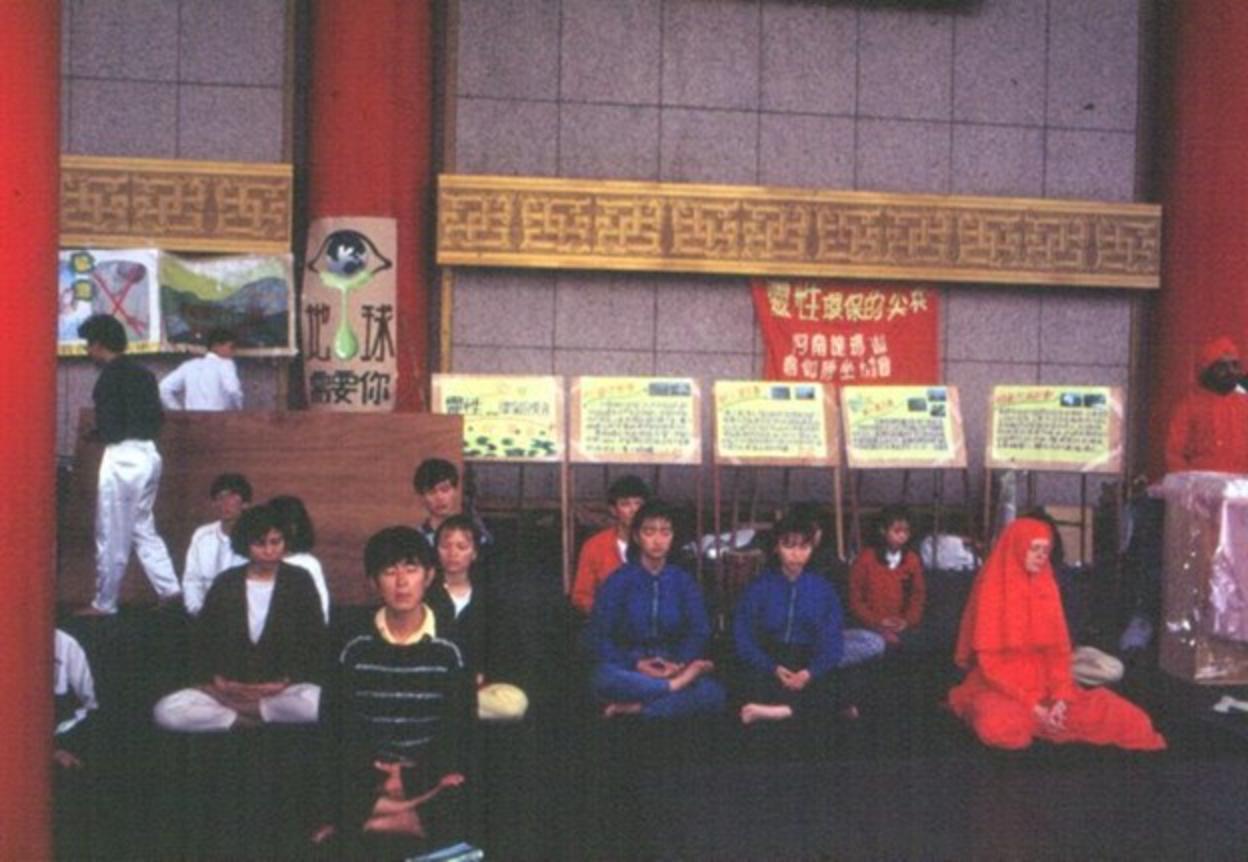
Religious and yoga groups take part in Earth Day. (Photo: environmental preacher Nien Hsi-lin)
On 24 December 1990 my daughter was born at Veterans General Hospital, where earlier that year I had said goodbye to my father. Coincidentally, my daughter's lunar birthday fell on the same day as my father's. Much seems destined.
How did I get involved with Earth Day? In May 1989, if I hadn't been investigating a suspected PCB poisoning case and taking patients' blood samples to Kumamoto University for testing, I would have gone to Beijing to cover the student movement — I had pushed to go, and had already reported from Beijing in 1988. If I had gone to Beijing, I wouldn't have joined the "US West environmental tour" organised by the Asia Society in early July and led by my teacher Lin Chun-yi, wouldn't have visited the international headquarters of Earth Day 1990, and none of what followed would have happened.
All I can say is that a chain of coincidences tied me to Earth Day. With mainstream media behind it, the first Earth Day made a big splash. Images of Yuyu Yang's stainless-steel sculpture "Ever New" at the memorial hall, the Taiwan shape piled from ten rubbish bins by the NTU environmental club, and a smashed-up wreck (recreating the image of Earth Day 1970) appeared in many international media. It was also the first time since Taiwan left the UN in 1971 that it joined the international environmental movement as civil society. (The UN Environment Programme was only founded in 1972.)
That year Earth Day insisted on being non-governmental and non-political, so we declined participation by the Environmental Protection Administration — very different from today, when the EPA organises Earth Day events. Earth Day 1970 had led to the US Clean Air Act, the US EPA and later the UN Environment Programme, and the university students who organised the marches then (mostly hippies) didn't care about government. By Earth Day 1990 those hippies had become yuppies, but they still kept watch on government. To carry on the spirit of Earth Day, we didn't let the government take part in Taiwan either. Unexpectedly, this also did Taiwan a favour: the Chinese government demanded that Earth Day list Taiwan as a province under China, and Earth Day refused, because everyone is equal before the Earth — and besides, Taiwan's participation was organised by individuals, entirely non-governmental, so the Chinese government had no right to interfere.
This was also the first time Taiwan joined the international environmental movement as Taiwan (not even as the Republic of China), all in keeping with the spirit and principles of Earth Day.
Earth Day on 22 April is just a coincidence
Earth Day itself came about through a chain of accidents. The peace and music anti-war event of 15–18 August 1969 (the Woodstock festival) brought together university students from all over. They rejected feudalism and tradition, called themselves flower children and yearned for nature. Pollution was severe then — rivers caught fire, and air pollution was so bad that pedestrians wore gas masks — and with the awakening sparked by the book Silent Spring, a new environmental movement surged forth.
After Woodstock, these students returned to their campuses and seriously discussed how to make society take environmental protection seriously. They decided to organise together. The real Earth Day should have been 21 April, the birthday of John Muir, the 19th-century leader of America's nature movement, but to fit Wednesday as the day for off-campus activities at American universities, falling between spring break and midterm exams when large-scale marches could be held, they chose 22 April.
Taiwan's Earth Day also had, besides the media, underlying social forces pushing it along. In March 1990 the Wild Lily student movement occupied the Chiang Kai-shek Memorial Hall, demanding an end to the "ten-thousand-year" legislators and National Assembly members, stirring up wave upon wave. In one week of demonstrations, from 16 to 22 March, it achieved four demands — "dissolve the National Assembly", "abolish the Temporary Provisions", "convene a National Affairs Conference" and "a timetable for political and economic reform" — driving the real democratic transition after martial law.
As a reporter I covered the student movement every day and got to know many students. When it ended, they came to help me with Earth Day, so we linked anti-pollution groups around the country and launched anti-pollution marches everywhere — because Earth Day 1970 was itself a great linked march against pollution across the United States.
Earth Day has been held in Taiwan for 33 years, and my fate has been tied to it. Today there are many Earth Day events, mostly beach clean-ups, fun runs or talks by celebrities. This Earth Day there are no marches and no concert. I have contributed my efforts of the past three years to help Taiwan's smallholders come together, starting with carbon farming in the soil, becoming part of the international emission-reduction movement and even a target for corporate ESG investment. It is a small thing, but added up across everyone, it can change the world.
Who says you cannot change the world?
Source: CM Media ( https://www.cmmedia.com.tw/home/articles/39715 )


