努力小農
本文尚無譯文。
An orchard where spring is no longer silent
In Lin Shih-feng's "grass-radical" orchard, there is more grass than trees.
"If you want to find me on Google Maps, typing the address won't work — type 'Shih-feng Orchard'. Oh, and the 'guo' in orchard is the one with the grass radical on top, so you won't get it wrong."
On 13 February this year, through an introduction by Hu Keng-feng of the Food Safety Agricultural Cooperative, I learned of Lin Shih-feng. Looking at his Facebook (https://www.facebook.com/farmer0116Naturefarm/), he has quite a following — over 9,000 followers. The photos of his fields he posts every day, sharing hardships and scenery, get two or three hundred likes and countless comments.
The "About" section of Lin Shih-feng's Facebook reads, in essence: "Healthy food comes from clean land; the poison in our fine food comes from humanity's endless destruction of the land to satisfy itself. If I did not do my best to stop humanity's destruction of nature, I could never again happily listen to a thrush sing. (Silent Spring/Rachel Carson)This is my vision as a fruit farmer."
"I want to join 'smallholder carbon farming' not to increase sales — plenty of friends buy my fruit, and there's not enough to go round. I just want to use the international certification of 'smallholder carbon farming' to verify, with scientific evidence, the 'Shumei natural farming' I've practised for over ten years."
After talking on the phone the night before, I set off from Taipei at 5 a.m. the next morning for Shih-feng Orchard in Zhulin Lane, Daguan Village, Heping District, Taichung. Only when I got nearby did I realise it was not far from the famous "Motianling". Turning into Zhulin Lane, the mountain road was steep; my 1500cc Prius c hybrid struggled a little on the climb. After more than ten minutes I finally reached the end of the road: Lin Shih-feng's home, which is also Shih-feng Orchard.
All the way up, the orchards on both sides looked like patches on a mangy scalp of hills. I thought that clearing mountains at such a slope must do great harm to soil and water conservation. If things looked bad, I'd decline Lin Shih-feng's request to join "smallholder carbon farming", because without soil and water conservation there's no chance of increasing soil organic carbon, and it would violate the Gold Standard's certification principles. But since I'd come all this way, I might as well take a good look at what made Lin Shih-feng different.
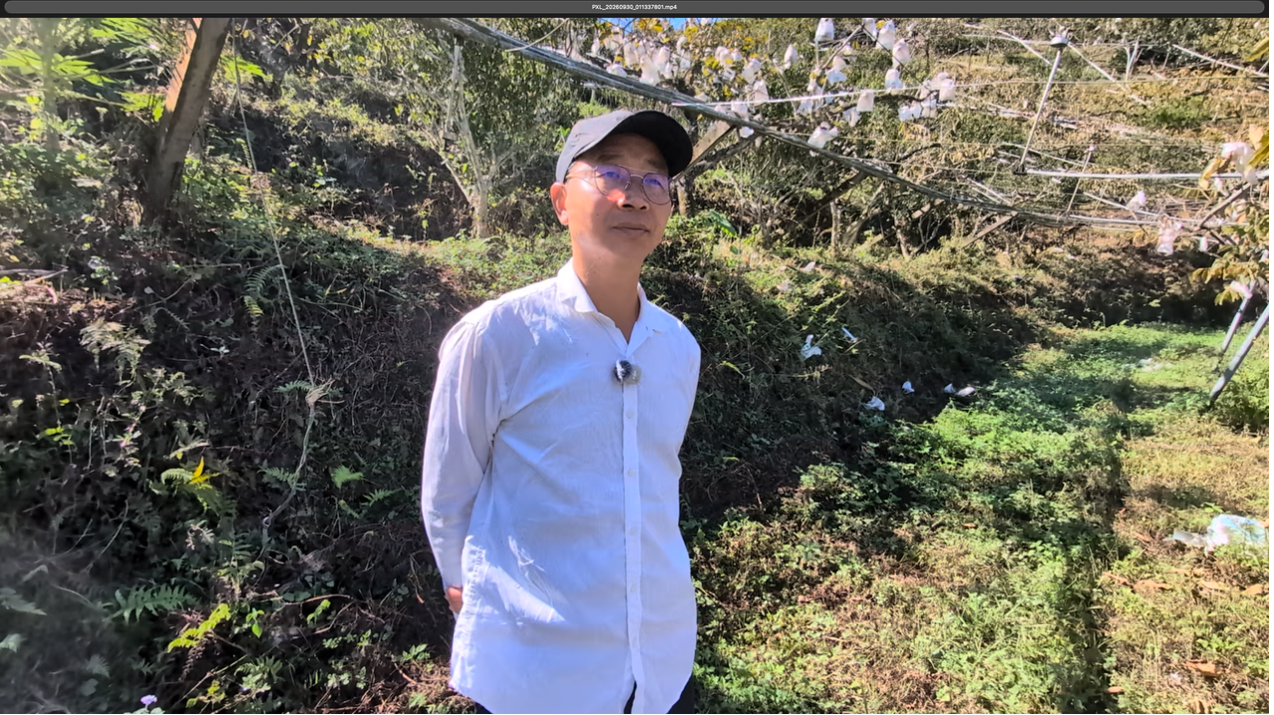
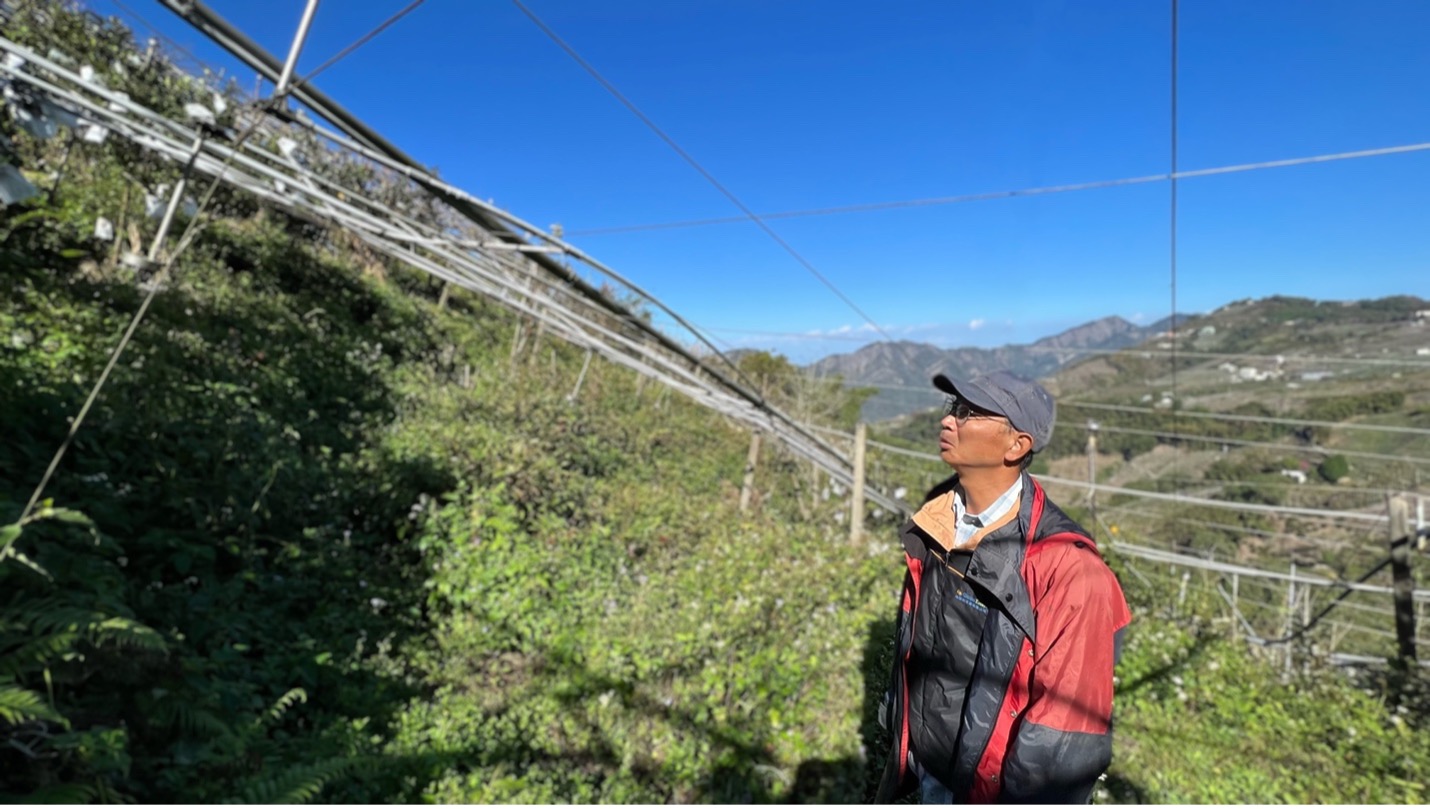
Lin Shih-feng greeted me in a raincoat and rain boots and took me to see his farm. It was basically mountain climbing — the slopes were mostly over 40 degrees. When I searched for the Lins' location on Google Earth to try to mark the orchard's boundaries, I found that the huge differences in elevation made the land surface rise and fall almost vertically, so even drawing the area was difficult.
Lin Shih-feng led the way as we surveyed his orchard. "Why do I use the 'guo' with the grass radical? Because my fruit trees all grow in the grass." As I saw it, with the steep mountain paths, fruit trees above and below the zigzag road and grass covering the ground, the "grass radical" was exactly right.
"Are the yields good?" I asked.
"What do you think? Of course I can't compare with conventional yields. Especially when I decided to give up conventional farming over a decade ago, yields fell almost to zero. But I stuck with it, and over the past ten years I've had yields again — still not enough to meet demand. I believe in contentment and don't ask for much. My produce has a full flavour no one else has, so my customers are all regulars. As long as it covers costs and living, that's enough. You can't get rich farming anyway."
Lin Shih-feng answered calmly. As we walked towards the centre of one of his plots, he pointed out a hole a wild boar had just dug. This orchard is a playground for wildlife — anything that comes in won't go hungry. Over decades the Lin family have planted many kinds of fruit trees, so almost all year round something is ripening. Precisely because of this, this orchard on a 40-degree slope meets the highest principle of "smallholder carbon farming": biodiversity.
Lin Shih-feng's orchard covers 4 hectares, with over 20 kinds of fruit, from plums and Chinese plums to loquats, sweet persimmons, Meirengan tangors, guavas, taro and more. He has to devote himself body and soul to caring for the land, the fruit trees, and the uninvited wild guests.
Lin Shih-feng's father began farming this land in the 1960s, which was even harder given the transport of the time. Later pesticides and chemical fertilisers came to Taiwan, the area was heavily cleared, and everyone used conventional farming to get yields and "compete". Massive use of pesticides and fertilisers changed the face of the area, and people developed cancer from time to time.
Over ten years ago Lin Shih-feng came home to take over his father's land. Fourteen years ago he decided to change things and tried "Shumei natural farming" himself, rejecting pesticides and chemical fertilisers — and not even using organic fertiliser, compost or probiotics.
"I absolutely don't use external inputs, and I don't make compost. Prunings from the fruit trees and cut weeds are all piled on the ground to rot naturally," Lin Shih-feng explained his method calmly. "There's only me; I don't have time to do all that." Indeed, using such inputs means hauling and applying them, and working on such steep slopes is very hard; hiring workers is also very difficult. Lin Shih-feng's "one-man orchard" can only be run with this kind of "natural farming".
"At first there was almost no production, but I had to keep going (do or die). After two years I began to harvest a little, then more each year, and gradually more people supported my ideas and became long-term customers. Only then could I sell my produce and support myself and my family."
"Smallholder carbon farming" requires scientific evidence. At the end of February, following international soil sampling standards, Lin Shih-feng took samples at 4 points within 100 m² on each of two plots, sampling topsoil (0–20 cm) and subsoil (20–50 cm) — 8 samples per plot, 16 soil samples from the 2 plots — and very carefully delivered them in person to the Council of Agriculture's Taiwan Agricultural Research Institute in Wufeng, Taichung, for testing.
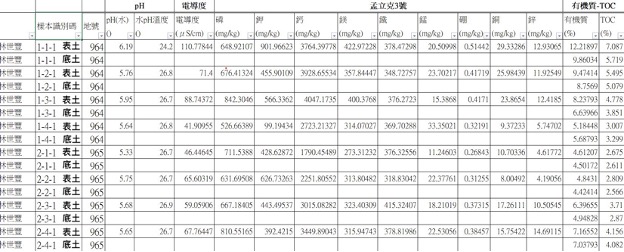
Lin Shih-feng's soil test report from March this year.
The results of Lin Shih-feng's soil tests were astonishing. The topsoil organic matter on plot no. 964 was as high as 12.21897%, and the lowest was 5.18448% — all much higher than ordinary farmland, approaching forest soil levels.
The method for testing soil organic matter: remove sand, stones, twigs and other debris, sieve, keeping only soil under 2 mm. Take about 10 g of sample and dry it in an 80°C oven for 8 hours to remove all moisture, then weigh the fully dried sample; the difference is the water content. Then put it in a 400°C oven for 8 hours to burn off all the carbon-containing organic matter in the dry soil. The remaining weight is dry soil without organic matter, and the difference is the amount of organic matter.
An average of nearly 10% organic matter means that 10% of the weight of Shih-feng Orchard's soil is microbes and other organic components. Ordinary lifeless organic components turn into carbon dioxide within a few months and can't be kept in the soil; only living microbes can retain organic matter over time.
Taiwan's land is relatively poor. After years of cultivation, organic matter in many farm soils falls almost to zero — under 1%. Among the 20-odd participants in smallholder carbon farming, most have only about 2%, and a few reach 4%. Generally only forest soils exceed 8%. Lin Shih-feng's topsoil reaching over 8%, with his subsoil also rising, is a classic demonstration of "carbon farming". After years of conventional farming, subsoil organic matter also falls, because long-term ploughing creates a hardened, impermeable "plough pan" (or "hoof pan") at about 20 cm, blocking nutrients, water and even air, so organic matter is lost and hard to rebuild. The fairly high organic matter in Lin Shih-feng's subsoil shows that plant roots have developed naturally and penetrated deeper into the soil.
Even rarer, Lin Shih-feng also has a soil test report from nine years ago. Compared with now, nine years of effort have nearly doubled soil organic matter. I joked that if "smallholder carbon farming" had existed ten years earlier, his carbon farming income per hectare would be over a million NT dollars.
Lin Shih-feng is a rather special and extreme case among smallholders. It takes tenacious willpower and faith, family support and consumers' backing to achieve this. How many people could do it — especially on such steep slopes, which makes it even harder? Farmers who value land above money and produce like this are extremely rare.
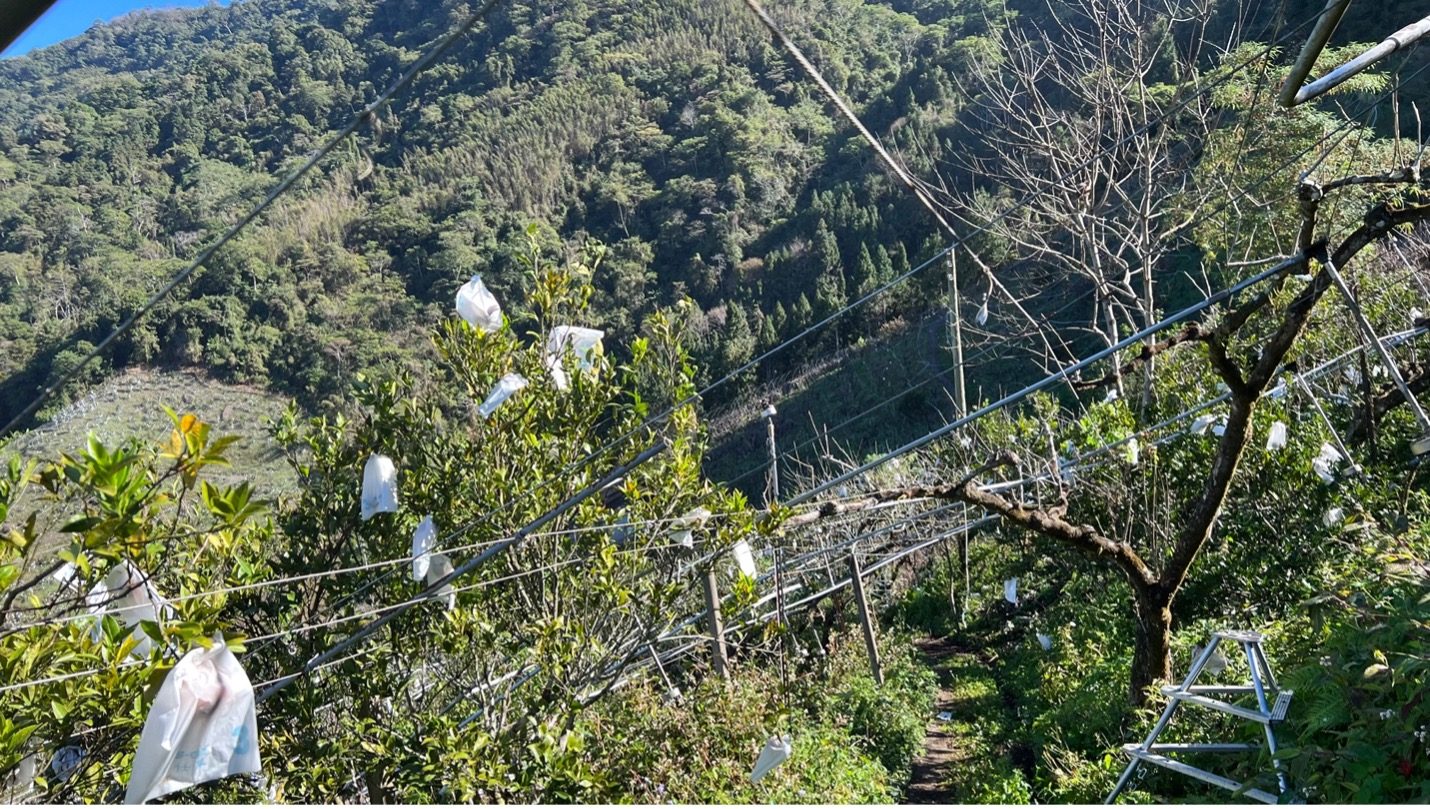
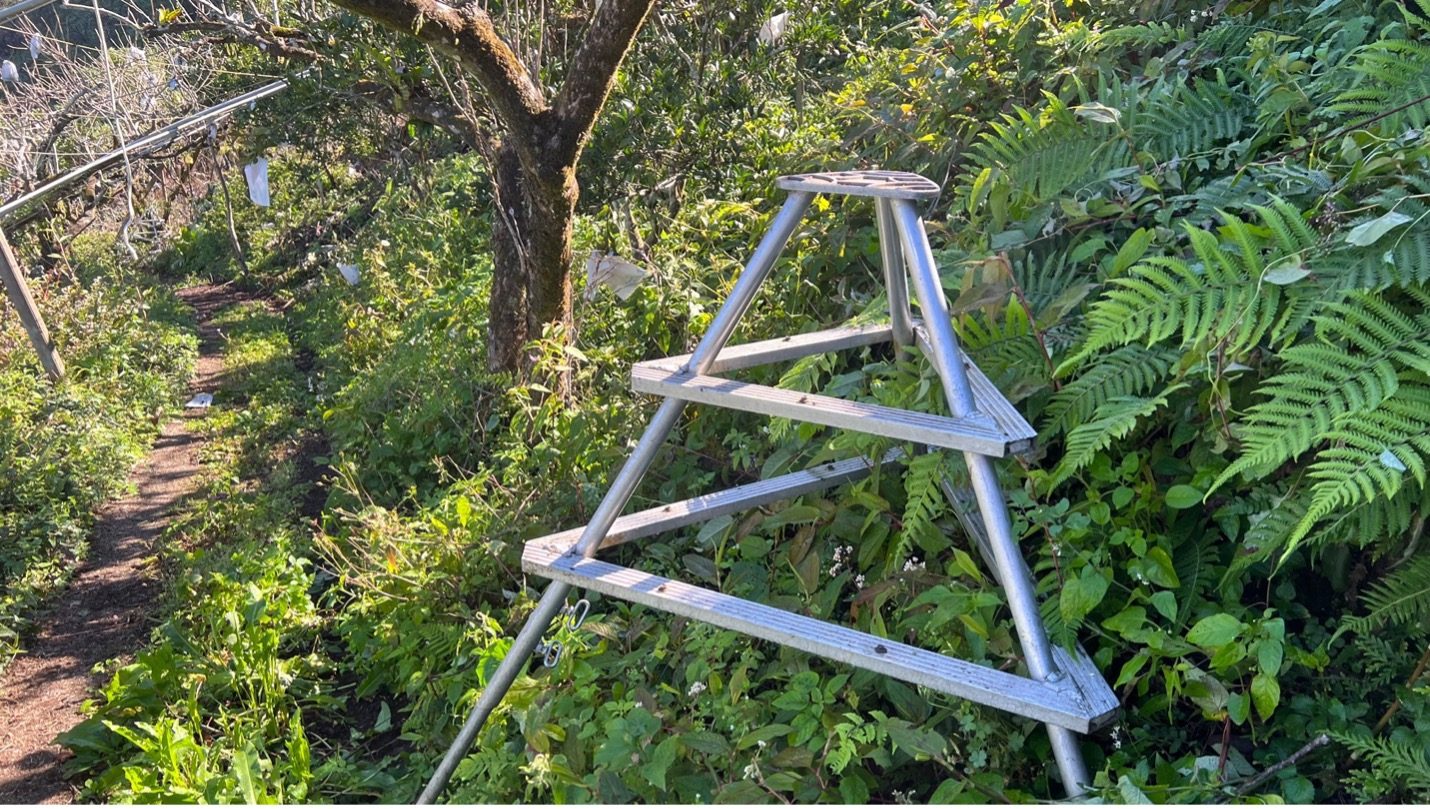
Harvesting in a hillside orchard means climbing up and down ladders, sometimes performing like a trapeze artist — no easy task.
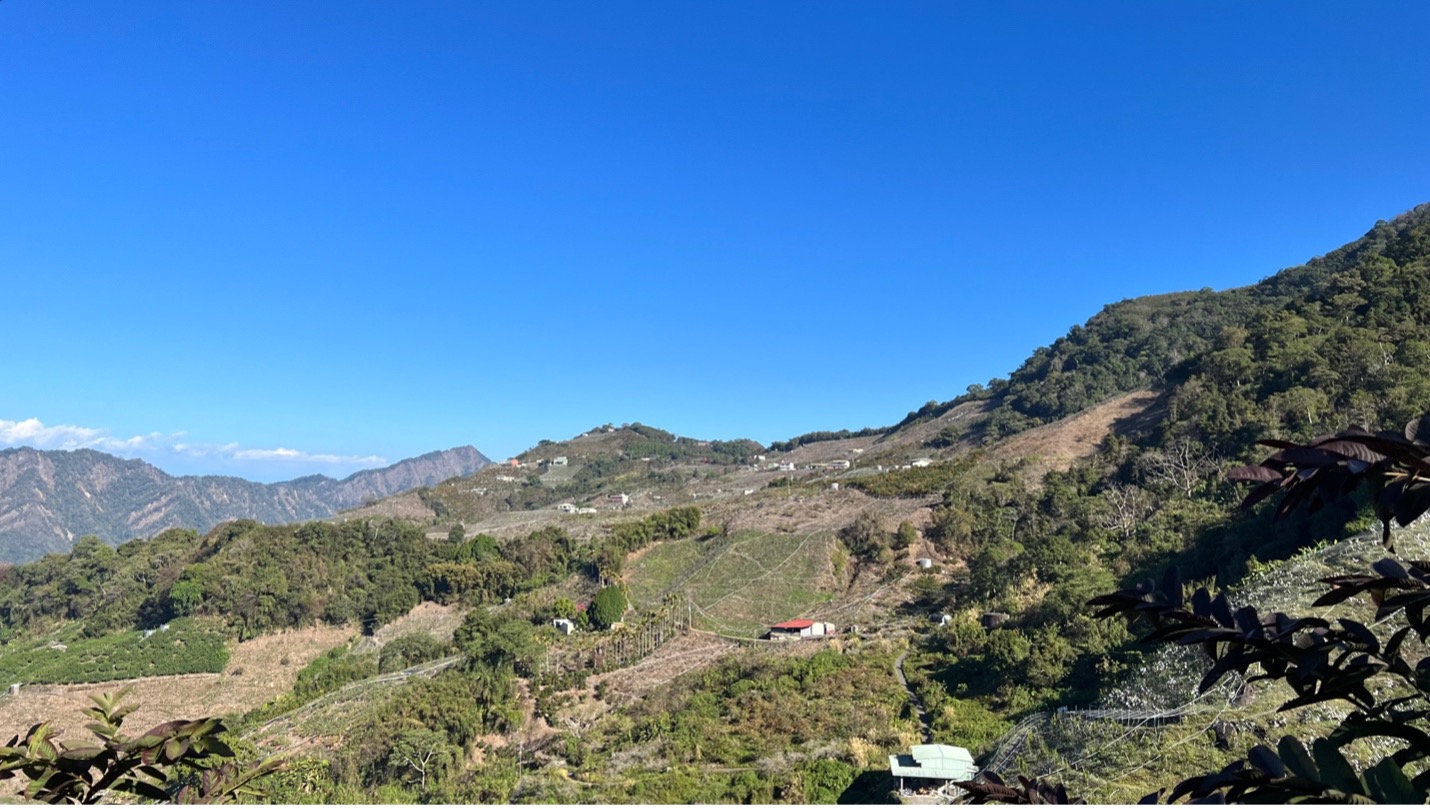
In nearby orchards the grass has mostly been cleared completely so it won't compete with the fruit trees for nutrients, but this has to be maintained with heavy use of chemical fertilisers, herbicides and pesticides — a danger to the land, the environment, and the health of farmers and consumers alike. (Lin Shih-feng's orchard is on the right.)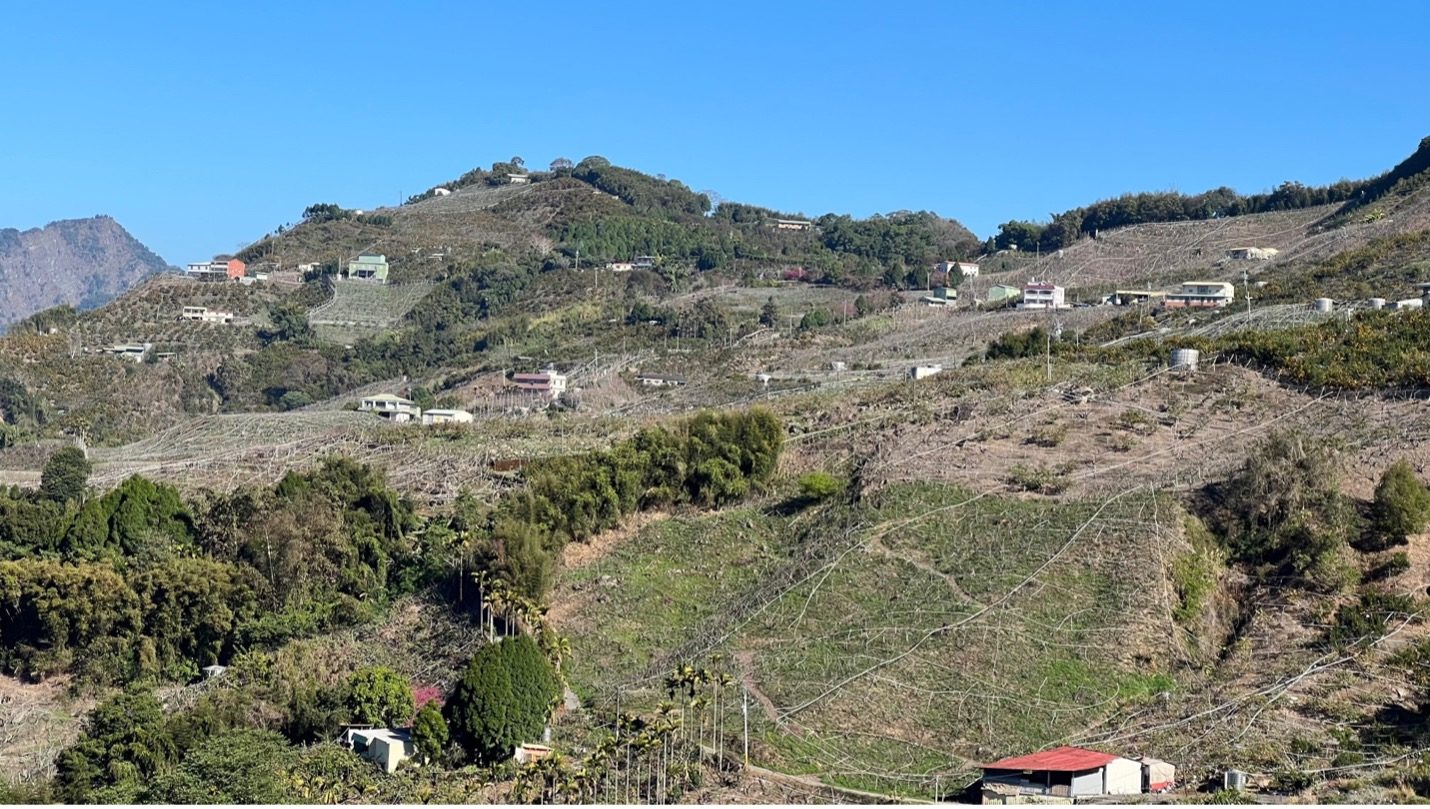
This is the typical scene of orchards developed on hillsides, with soil organic matter of only about 2%. Years ago the Lin family's land was the same. More than ten years of hard work and persistence with Shumei natural farming have opened a path of "carbon farming".
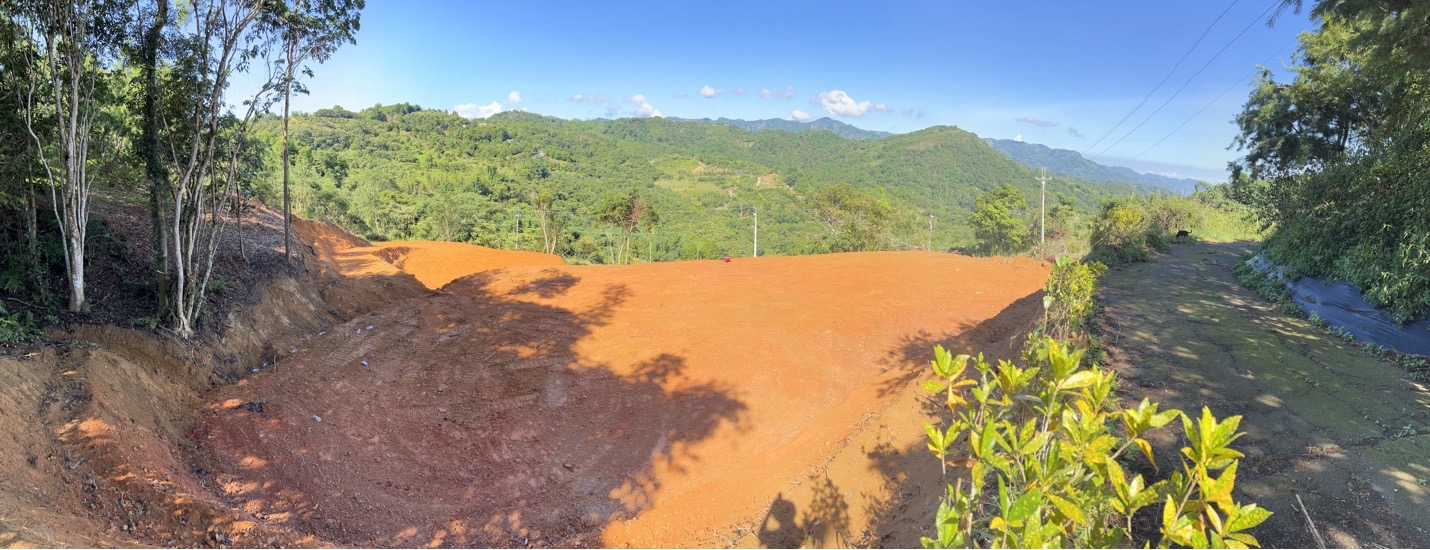
Ordinary farmers clearing land use excavators to flatten all the trees and grass, leaving bare earth with the soil layer completely destroyed, then apply large amounts of chemical fertiliser. What is grown this way can only be described as an outrage against heaven and reason.