 努力小農
本文尚無譯文。
Life is the foundation of carbon storage: land must be alive to be organic
Even on organically farmed land, if the soil is left bare after land preparation, its organic matter will still be lost, and adding organic fertiliser won't help.
One thing long puzzled me: statistically, the soil organic carbon ratio of organic farmland in Taiwan is actually lower than that of land farmed conventionally (with chemical fertilisers and pesticides). This may overturn many people's assumptions, but recent careful observation and study suggest there are reasons for it, which can be researched further in future as a reference for increasing soil carbon sinks.
The Gold Standard's Soil Organic Carbon Framework Methodology, Verra's Land Management Methodology, and the FAO's Recarbonizing Global Soils all indicate that using organic inputs can increase soil organic carbon, achieve long-term carbon reduction, and earn carbon credit certification.
Organic farming doesn't necessarily increase soil organic matter
Many people believe that after years of organic cultivation, the soil's "organic matter" will be high. In theory this is true: long-term use of chemical fertilisers and pesticides does cause organic matter to be lost from the soil, even leading to acidification and hard clods. That's understandable, and it's why many people think organic farming, using organic fertilisers, can increase soil organic carbon and achieve soil carbon sequestration over time.
But in Taiwan that's not the case. According to long-term monitoring by agricultural soil experts, in many places organic farms with the same soil conditions as their neighbours actually have lower organic carbon than conventional farms using pesticides and fertilisers. This finding surprised me greatly and contradicted what we had long believed, so over the past two years when visiting smallholders I've paid special attention to this question.
First, take as a control a woodland in an ecosystem without human intervention: no one turns the soil, no one fertilises. After a few years its soil organic matter will be higher than soil without woodland, because fallen branches and leaves, plus the life and death of small animals, bring new organic matter that accumulates in the soil. Trees, weeds, mosses and other green plants absorb sunlight and water drawn from the land and photosynthesise, converting carbon dioxide into glucose and starting the cycle of "biological carbon sequestration", setting off a complex, dynamic yet robust, endlessly renewing ecology of local microbes and insects. Over the long term, soil organic matter keeps increasing and soil forms — about 1 cm of soil in a thousand years.
1 metre of soil takes ten thousand years of nature's work
Take the soil of Yangmingshan: 1 metre deep, meaning it was formed by nature over ten thousand years. On the market it sells for just a few dozen NT dollars a kilo. In my view, soil should be worth more than gold and jewels, because soil can feed all living things, while gold and jewels cannot — they only let some people run roughshod over human society and end humanity's shared destiny. Every time I see people develop mountains and forests at will, I feel genuine disgust. If this isn't sin, what is?
Why is soil organic matter on organically farmed fields lower than on conventional ones? I'm not an agricultural expert, but from nearly ten years of scientific experiments and social observation, I offer the following humble views for reference:
1. Excessive soil disturbance. Every spring from March to June, during spring ploughing in the northern hemisphere, soil is turned over by large tillers — as the saying goes, "the year's plans are made in spring". Yet this collective human action is the root of soil carbon emissions. According to NASA's annual Earth atmospherecarbon dioxide concentration time-lapse, in this one-year time-lapse from June 2020 to June 2021video, you can see the Earth's carbon dioxide concentration jump from 380 ppm to 410 ppm between March and June, showing that farming activity is the main source of emissions. This may again overturn our long-held blame on methane from cattle burps and farts (microbes in ruminants' stomachs ferment grass fibre so ruminants can digest and absorb it, but this produces large amounts of methane).

NASA images show that the huge amount of carbon dioxide humans produce during spring ploughing exceeds emissions from other activities. (Image: NASA)
2. No cover after disturbance. When soil is cleared, ploughed or harvested and left uncovered, exposed to the sun, its microbes and small animals such as earthworms are killed by the sun or eaten by birds, causing a massive loss of life in the top 20 cm of soil. When we see egrets elegantly eating little bugs in freshly turned soil, don't think they're "eating pests" — they're eating the source of the soil's organic matter.
3. Misusing lifeless organic matter. Because agriculture repeatedly plants and harvests, organic matter, minerals and trace elements in the soil are depleted, so fertiliser must be added to maintain fertility. But if this organic matter is soybean meal or tea-seed meal left after oil extraction — often residues from extracting oil with solvents such as n-hexane — it is not only pure organic matter but may carry organic solvent residues harmful to microbes. For the soil, it brings no benefit and actually does harm. Pure organic matter fermenting in soil produces acids, alcohols and other germicidal substances that kill soil microbes, and the rotting meal also turns into carbon dioxide released into the atmosphere. Far from helping soil organic matter, it kills the microbes that maintain organic matter and produce long-lasting organic carbon such as humus and humic acid through metabolism. Many farmers report that land on which meal is used directly for a long time becomes acidified and hardened more easily.
4. Poor-quality organic fertiliser. Some farmers, for cheapness and convenience, use unrotted poultry and livestock manure directly as fertiliser; though this is illegal, some still do it. Some organic fertilisers, due to insufficient composting or sterilisation time, wrong methods or no quality control, contain too many pathogens, heavy metals and insect eggs, harming the soil and even introducing pests and diseases. Or, if stored too long without use, organic fertiliser can spoil and deteriorate, becoming a soil killer.
All of the above are everyday occurrences for some organic farmers. So "organic" alone does not raise soil "organic carbon" — it may even lower it. Only organic fertiliser rich in soil-friendly bacteria works: the organic matter is merely a carrier for the bacteria, which after entering the soil multiply and fulfil their mission as decomposers.
To farm in a way that increases soil organic carbon, the first step is to reduce soil disturbance. Second, after necessary disturbance, cover the soil immediately to reduce damage to soil microbes from the sun's UV rays. Third, understand the relationship between soil bacteria and crops — difficult for ordinary farmers, requiring professional help or long-term observation and understanding to find suitable ways to tell beneficial bacteria from harmful ones. Fourth, manage inputs and materials well: organic inputs have shelf lives and should be used within them as soon as possible; otherwise, like expired food, they may cause harm.
What we seek is not just organic, but the thriving life of soil microbes
Soil microbiology is cross-disciplinary and complex knowledge. In 1928 British bacteriologist Fleming accidentally discovered the bactericidal effect of penicillium, which later led to the antibiotic penicillin. The mutual promotion and inhibition in the microbial world is extremely complex, and soil microbial ecology can hardly be replicated artificially. Add factors such as climate, the structure of topsoil and subsoil, pH and moisture, and it is a microscopic world full of dynamic vitality that will need future effort and research to glimpse its secrets.
My recent realisation: because of Taiwan's tropical and subtropical climate, organic matter decomposes quickly, and the stock of soil organic carbon has little to do with how much organic fertiliser is applied. Only by relying on bacteria in the soil to grow and multiply, forming a circulating system of living organisms, does increasing the amount of bacteria — that is, increasing soil biomass — create the chance for long-lasting organic matter (biomass). This is not just organic agriculture; going further, it is "living" agriculture. Only the vitality of microbes makes carbon farming and increased soil carbon sinks possible.
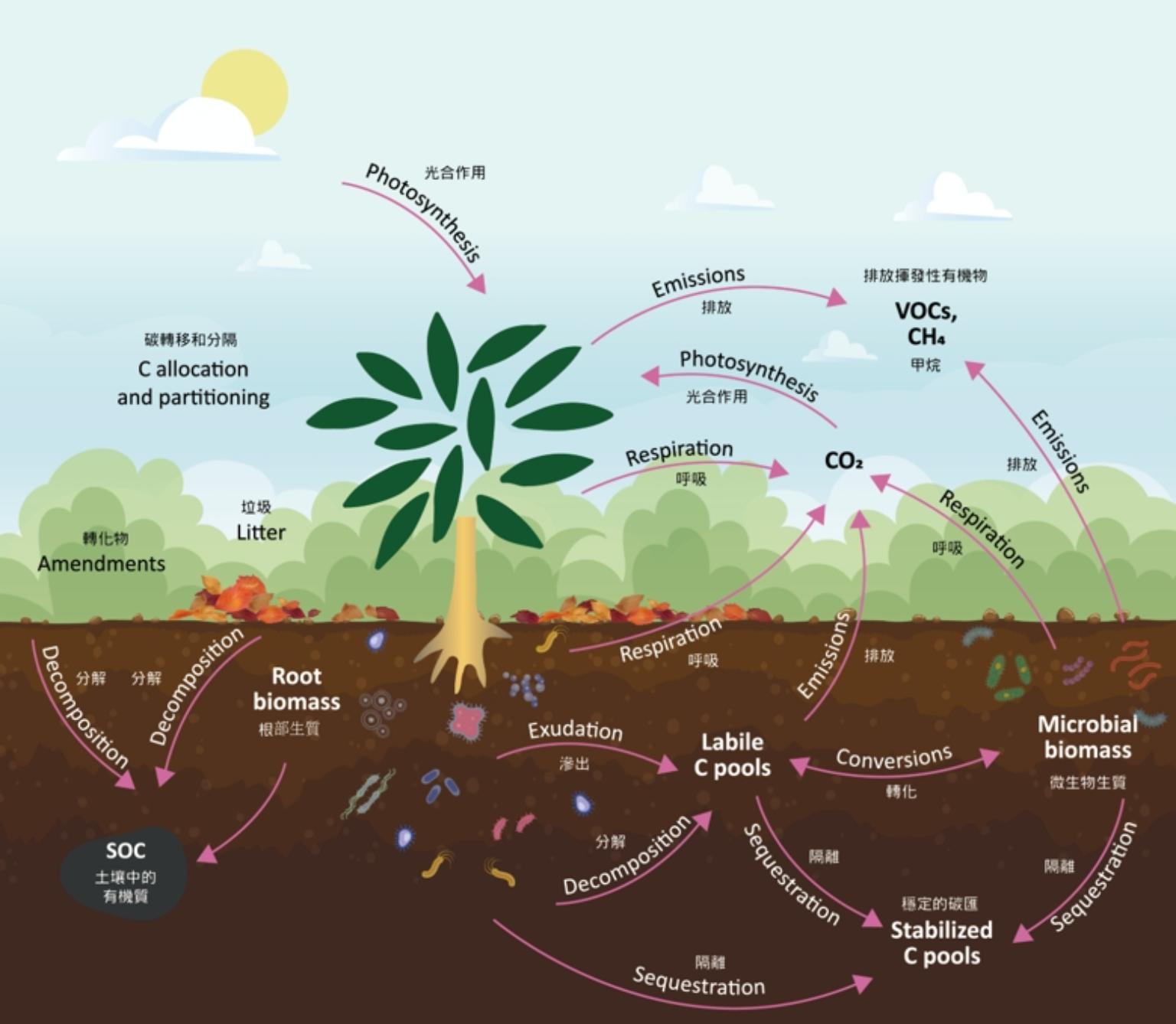
Soil is an extremely complex world full of life. I believe even a supercomputer would struggle to calculate the vast and complex activity of its microbes.
The first lesson of ecology teaches us that ecosystems have producers, consumers and decomposers. But we usually focus only on the producers and consumers we can see; because decomposers are tiny and need a microscope to see, we have long overlooked their importance and their place in the ecosystem.
Many people, influenced by long-standing education and the recent pandemic, think bacteria equal germs to be eliminated as quickly as possible. This leads to excessive sterilisation, destroying normal microbial ecology and producing "anti-life, anti-ecology" results. This deserves everyone's attention and a change of mindset: all things on Earth form one shared living body, and only by seeking balance among heaven, earth and humanity can we be sustainable.
Source: CM Media ( https://www.cmmedia.com.tw/home/articles/41808 )


