 努力小農
本文尚無譯文。
Getting rich from carbon reduction? 9 myths about carbon credits
Today carbon credits seem like the blockchain and Bitcoin in their heyday, fulfilling everyone's dreams of getting rich. (Photo: Flickr @ Pacific Southwest Forest Service, USDA)
Wherever you go in Taiwan lately, you hear people talking about carbon credits and carbon trading. At the carbon exchange's launch ceremony on 7 August, President Tsai Ing-wen said that, as the subsidiary regulations of the Climate Change Response Act come into force, bringing carbon pricing, carbon trading and other mechanisms, the net-zero transition will be driven on three fronts — voluntary reduction, offsets, and international trading — expected to spur NT$4 trillion of private investment from 2023 to 2030, create NT$5.9 trillion in output value, and provide more than 550,000 jobs.
It looks just like the "money wave" and "business opportunities" brought by blockchain, Bitcoin and all kinds of cryptocurrency, fulfilling everyone's fantasies of getting rich.
But carbon reduction, carbon trading and reaching net zero by 20xx require a rigorous, complete system to establish, validate, calculate, trade and offset carbon credits — and it must connect with international systems — before an independent carbon trading platform can be built using the same measurement, pricing and auditing methods.
Myth 1: Carbon credits offer high returns to invest in
Here are some common myths I currently encounter about international emission-reduction certification.
Carbon credits offer high returns to invest in. From the experience of green energy and green electricity development, we've seen many "gurus" grabbing money and land. How many people today have made huge profits from green energy? Those who did were speculators in "options": they made (or swindled) investors' money and ran, or got the rights and waited for a good price — like cable TV operators everywhere who once sold their subscribers like pigs.
Myth 2: You need a new factory to make money
You have to build a new factory or project to make money. A key requirement for carbon credits is that they be "additional": some "human intervention" must be made to existing operations to reduce the original emissions before reductions can be counted. For example, an existing woodland left as it is has a natural carbon sink effect that reduces atmospheric carbon dioxide, but it cannot generate carbon credits.
Myth 3: Carbon reduction = carbon credits
Any carbon reduction generates carbon credits. We must analyse the entire product life cycle, and it must be quantifiable. Planting trees can reduce carbon, but you need historical data for a quantified baseline (what it was like originally) and data on emissions and absorption, which can be evidenced and verified, and then the scenario changed by human intervention, before estimating possible reductions. This is actually very complex.
Myth 4: The cost of emission-reduction certification
Emission-reduction certification is too expensive to afford. Carbon trading is a highly mature trading activity — certainly not charity, still less ordinary people's "casual environmentalism". It requires third-party certification, which is costly: even a micro-scale project of under 20,000 tonnes needs nearly US$10,000 a year in third-party certification fees. If you only have a few trees, how could you pay? So economies of scale are needed for emission-reduction certification to make sense.
Myth 5: Carbon credits sell for high prices
Carbon credits sell for high prices. On the international carbon credit trading information platform (carboncredits.com), you can see daily carbon trading data and prices, which may be lower than many people can imagine. Voluntary carbon credits cost only a few tens of US cents a tonne — and that's the final trading price; those who generate the credits earn even less. Some cost US$80–90 a tonne, but those are prices for mandatory, regulated emission reduction, markets Taiwan simply cannot enter.
Myth 6: Big companies are all scrambling for carbon credits
Big companies are all scrambling for carbon credits now. Internationally, many commitments to reach emission-reduction targets fall in 2030 — such as the International Civil Aviation Organization, the International Maritime Organization and some big companies. Many multinationals are indeed making preparations, but they still have several years. No one knows what will happen in these years; they're just hurrying to plan and spying on each other. In future, carbon emissions will certainly be an important weapon in competition between big companies and products, but now and for the next few years is not yet the time to deploy it.
Myth 7: Electricity storage reduces carbon
Electricity storage reduces carbon. The late electrical engineering authority Chen Mo-hsing loudly argued that Taiwan is not short of electricity — Taipower has been short of management for over 40 years. But all of Taiwan seems to have caught "power-shortage madness", frantically building all kinds of generation and storage facilities, and even falsely exaggerating that storage reduces carbon. According to the law of conservation of energy, the more times and the longer energy is converted, the more is lost. If 100 kWh goes through storage and 90 kWh comes out, that's good; add AC/DC conversion and only about 80 kWh remain. Then there are the emissions from producing, installing, maintaining, repairing and disposing of storage equipment. How could it reduce carbon?
Myth 8: Tesla got rich from carbon credits
Tesla made billions of dollars from carbon credits. In the US, Tesla benefited from the Zero Emission Vehicle (ZEV) regulations, earning money under a cap-and-trade system for air pollution from carmakers that don't make electric vehicles: carmakers that fail to reach the ZEV ratio must pay, and that money goes to Tesla and other EV makers. The "emissions" here are air pollutants emitted by internal combustion engines, not carbon dioxide! Don't misunderstand.
Myth 9: The EU is about to impose an import carbon tax
The EU is about to impose an import carbon tax, so we must hurry to buy carbon credits. If you're interested in the EU's Carbon Border Adjustment Mechanism (CBAM), you should read the details on the official website rather than relying on hearsay. Under the EU Green Deal — net zero by 2050 and a 55% cut by 2030 (the 30/55 target) — CBAM was proposed to avoid carbon leakage (unfair competition from importing high-emission products into the EU). Its impact on Taiwanese companies is actually tiny, because very little of Taiwan's cement, steel, aluminium, fertiliser, electricity and hydrogen — the six products covered — is sold to the EU. Extending it to consumer products is probably not under consideration now, because regulation always starts at the source, not the end.
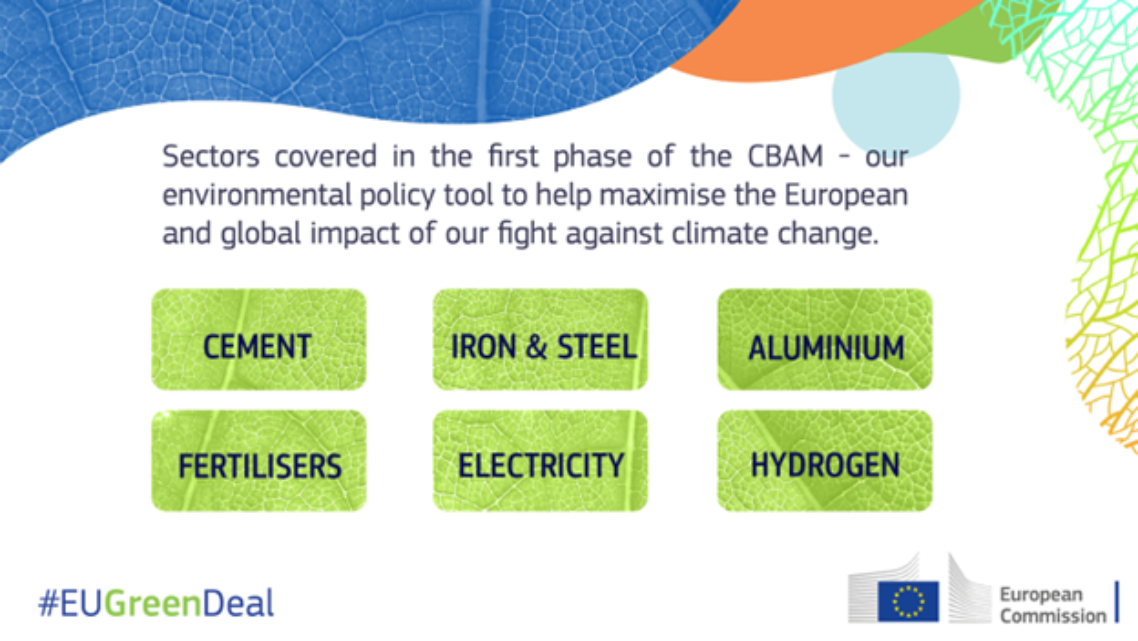
The six products covered by the EU CBAM (cement, steel, aluminium, fertiliser, electricity and hydrogen) account for very small quantities and values of Taiwan's exports to the EU — even zero. But many people think everything will be subject to carbon tax and impulsively rush to buy carbon credits.
Get the key point wrong, and how can you answer the question?
From what I observe, Taiwanese businesses actually know full well. They're just dancing along with the government and media and joining in the fun. Those who actually buy carbon credits are small companies wanting to show off, or for insignificant products (such as carbon credits offsetting the plastic in credit cards).
From a risk management perspective, any uncertain change is a risk. Net zero is indeed a big, uncertain risk for companies, but as far as corporate profits and losses go, it's still all thunder and no rain. And whoever governs Taiwan takes great care of high-pollution, high-emission companies, so they can rest easy.
But too much lip service can also do harm. Taiwan's current "greenhouse gas inventory" goes after the small and lets the big go: Scope 3 — the indirect upstream and downstream emissions that are companies' largest — is not included, and inventory data are not transparent or public. This will be a fatal weakness when Taiwanese companies pursue net zero in future. If upstream and downstream companies can't reach consistent understanding and action on carbon reduction, and supply chain emissions and reductions can't align with international standards, Taiwan faces the risk of being cut out of global industrial supply chains.
Source: CM Media ( https://www.cmmedia.com.tw/home/articles/41944 )


