 努力小農
本文尚無譯文。
Farmers' livelihoods under a just climate transition
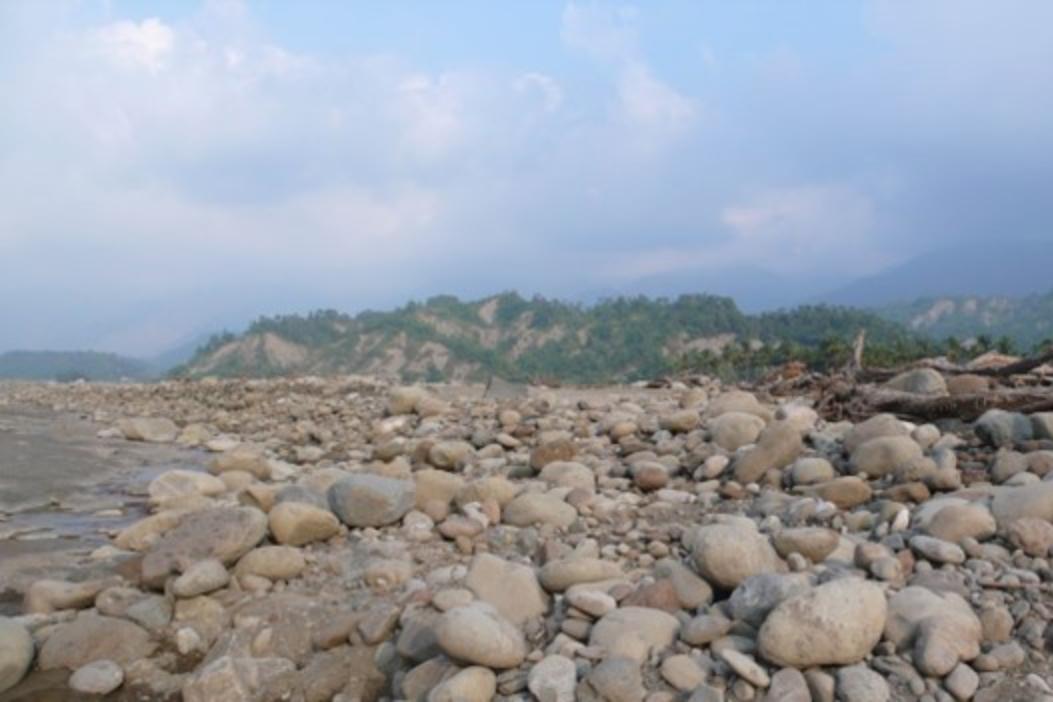
In a single night, Typhoon Morakot wiped out Xiaolin Village, more than 300 metres above sea level, and over 400 people perished in the scouring riverbed. This was a climate disaster — no need to wait for sea levels to rise. Where are Xiaolin's farming villagers now?
Since the 19th century, most changes in modern society — or political revolutions and changes of regime — have come from awakenings of thought and consciousness, as forces in different camps collide, confront, transform and merge. Add the rise of the internet over the past 30 years at the pace of Moore's law, and currents of human thought change by the instant. But in the end they all come back to the three most basic elements: heaven, earth and humanity.
Climate change is undoubtedly the biggest and thorniest problem human civilisation faces today. It seems far away, yet it is right in front of us; the huge climate disasters of recent years make it hard for even the most stubborn climate sceptics to justify themselves. After all, humans sprouted and grew by chance during a breathing space in hundreds of millions of years when the Earth was less violent, and now think they can stand tall between heaven and earth. But looking back over the Earth's 4.6-billion-year history, which has seen five known mass extinctions, how can we be lucky enough to survive a sixth? It will depend on the wisdom and efforts of humanity today.
Has the international just transition forgotten farmers?
2015 was a turning point. The UN Climate Change Conference in Paris and the adoption of the 2030 Sustainable Development Goals brought in the "just transition" as an important indicator of sustainable development.
In March 2015 the International Trade Union Confederation (ITUC) published a briefing, "Frontlines Briefing March 2015 — Climate Justice: There Are No Jobs on a Dead Planet". It emphasised the importance of climate action for trade unions and called for industrial transformation, quality jobs in the green economy, and "just transition" measures to ensure no one is left behind. It pointed out that climate change is not only a global issue but also a union issue: unions play a vital role in protecting jobs in existing workplaces and industries, and must also organise quality jobs in the emerging green economy. Unions should also work to secure "just transition" measures so that no one is left behind.
The briefing stressed: "We know the science is clear: without urgent and ambitious action we face a temperature rise of 4°C or more this century and irreversible climate change. Economists have also weighed in — the financial losses from global warming will far exceed previous estimates. People around the world want governments to tackle the pollution that causes climate change. According to the ITUC Global Poll, 73% want their governments to do more to limit the pollution causing climate change."
The briefing warned that we are out of time. Climate disasters and extreme weather (typhoons, floods, droughts, fires, melting glaciers, changing seasons, threats to agriculture, etc.) are increasing and hurting workers. In the US, for example, Hurricane Sandy displaced 150,000 workers and cost 11,000 jobs in New Jersey alone in 2012.
After all, this report was issued from a union's perspective and in its name. Workers are a group with relatively more voice and volume; they know well that of an iPhone selling for a thousand US dollars they get only a few dollars — small, but still traceable. For farmers, none of this works at all.
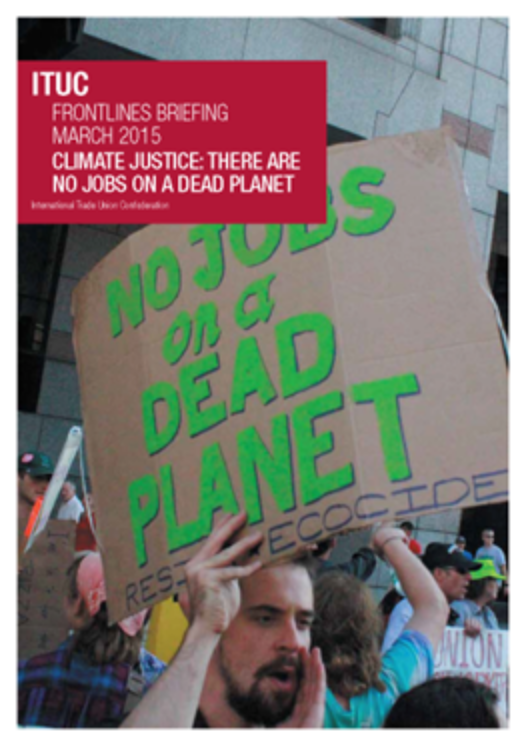
The ITUC's "There Are No Jobs on a Dead Planet" launched the global movement for a just transition under climate change.
Where is farmers' voice in the just transition?
In the traditional order of "scholars, farmers, artisans and merchants", scholars (government and intellectuals) and merchants (industry and commerce) control the channels of voice and real influence. The elites who run the UNFCCC and IPCC on climate change, under alliances of bureaucrats and multinational businesses — even the military-industrial complex — offer little more than flowery diplomatic rhetoric of no practical use.
I've also heard the anguished appeals of Swedish climate activist Greta Thunberg on behalf of future generations. But compared with the smallholders I've visited in Taiwan over these four years — people on the front line of climate harm — many are merely watching the fire from across the river.
In recent years the biggest problem facing Taiwan's smallholders is that the value of the land's agricultural productivity is lower than that of non-agricultural speculation. For example, "growing electricity" (solar) earns NT$300,000–400,000 per hectare a year for doing nothing — who would toil at farming? A hectare of rice paddy earning NT$350,000–360,000 a year is already good; after costs, what you pocket is only NT$30,000–40,000 — and that's in a good year. In a bad year, like last year with two typhoons, most farmers had negative income.
With falling birth rates and few opportunities and low incomes in rural farming, people with no children, or whose children won't come home to farm, may as well sell the land. Factories and villas on farmland are another fatal attraction. Given farming's uncertain, unstable income, why not sell the farmland and pocket millions, even tens of millions, safely?
Some, full of ideals or with nowhere left to turn in the city, want to farm but have no land and no skills; or they return to the countryside after retirement — and get badly bruised. I've seen someone retire home, do well in the first year, get carried away and invest more, then harvest nothing in the third and fourth years, burning through half his pension, too scared to try again.
Others want to process farm produce and invest money, but farmers can at most operate machines; doing business as well, they're stretched thin. In the end the produce doesn't sell, the money spent on machines is tied up, and they may lose everything.
Farmers may seem to have cars and houses, but once you know them you find they all carry heavy loans. Each household's tillers, harvesters, dryers and rice mills add up to tens of millions, supported by loans. There are government subsidies, but in the long run machines need maintenance and replacement, so they stay in debt. And what they rely on to repay is uncertain, unstable income from produce. Do the sums and quite a few are living off savings or even forced to sell land.
Of course there are also many "get-rich-quick farming stories" — sacha inchi at over a dollar a gram, quinoa and so on — visible but out of reach, with prices quoted but no real market. Farmers invest, but no one buys and it doesn't sell, while the market price just sits there. Consumers hesitate over these new foods; after all, not many people buy foods they don't regularly eat or use.
In the market there are also many obstacles. Much that is labelled "direct from smallholders" is actually the result of cross-Strait trade: these people import at low prices, repackage and sell at high prices. Because they know sales patter and channels, they make money, while genuine Taiwanese smallholders become the cushion. By the time consumers see them and buy their products, Taiwan's smallholders are already on their last legs.
As for the government, its subsidies and resources are distributed systematically. To prevent abuse it can't tailor them to individuals or prescribe for specific ailments; and abuse prevention brings layer upon layer of review and paperwork, so ordinary smallholders rarely benefit and often lose out in the exchange of official documents.
Personally I support the free market. In a free market everyone must compete to improve; the fittest prevail. Special cases belong to social welfare — disability, misfortune and so on — but otherwise these shouldn't become an excuse for some to lie flat.
All the problems stem from opacity and an inability to trace and hold accountable
But I place even more weight on the fairness and transparency of the free market. As I see it, the biggest problem in today's food and agriculture market is information that is opaque and asymmetric. Take the recent Sudan red dye case: clearly a long-standing systemic problem. These foods passed countless inspections, yet no one can clearly explain the origin, source, storage, distribution, recall or destruction. The question is: which link in the chain is transparent?
Consumers helplessly choose to trust the government and test reports emblazoned with English letters unconditionally, only to end up drawing water with a bamboo basket. The root cause is that nothing is open, transparent or traceable.
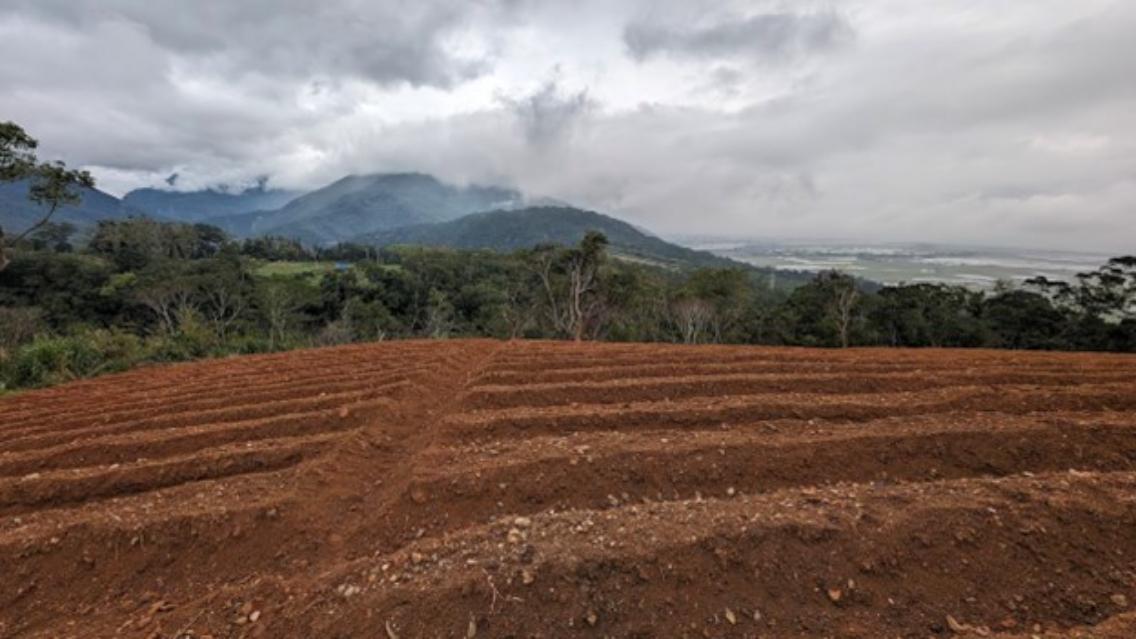
In Yuli, Hualien, ginger plantations investigated by the Control Yuan had no soil and water conservation at all and were developed with abandon in broad daylight, using large amounts of pesticide. If consumers knew, could they still buy this ginger with peace of mind? This shows the importance of genuine traceability.
With the Taiwan Smallholder Carbon Farming Project we are trying an experiment using a set of open, transparent international standards and methodologies with public participation. Agricultural carbon credits must originate from the land and soil, from real changes in how farmers cultivate, and from the sampling plan and testing of soil organic matter in the baseline and project scenarios — all of which must be genuine and traceable, with nothing missing. Any future projects should do the same.
This may be a bit of a bother: smallholders must remember to take photos, check in and upload their key work at critical points. But this forms a transparent "production-and-sales blockchain" that can be publicly witnessed. Beyond the internet, anyone can witness it in person, raise problems, and everyone improves and grows together.
In the end this benefits smallholders. Their work records are the rarest data package — the "first mile of production". Further down the line, unless they sell their own produce, as it enters a mature distribution supply chain these data packages travel with it all the way; origin, producer, time and yield are all clear at a glance. Even if a problem arises, the specific part can be identified and responsibility assigned, rather than destroying everything wholesale.
Once the project's certification is complete, carbon-farming smallholders' products will enter a new labelling system. Their six SDG certifications (including carbon-reduction certification) will all be traceable, and final consumers — whether companies investing and subscribing or shoppers in convenience stores and hypermarkets — will know how much of their money actually reaches the smallholders who produced that produce.
Over the past year I've taken part in the online meetings of the Living Income Community of Practice organised by ISEAL (International Social and Environmental Accreditation and Labelling Alliance), and felt deeply how helpless smallholders are in every country. We must find the least costly way: as long as every final consumer can know where their food comes from and how much of the money they spend reaches farmers, I believe increased livelihoods for farmers and transitional justice won't be far away.
Source: CM Media ( https://www.cmmedia.com.tw/home/articles/45770 )


