努力小農
本文尚無譯文。
Ten letters of food safety: FAT TOM and FIFO
Since the Polam Kopitiam food-safety incident, public awareness of food-safety risks in Taiwan has risen. (Image: Unsplash)
Food-safety news in Taiwan has been coming thick and fast lately — from Japan's Kobayashi Pharmaceutical red yeast rice poisoning deaths making international headlines, to the food poisoning reported at Hi-Lai Harbour's Dome branch in Kaohsiung, which is only the tip of the iceberg. This crisis stems from long-standing systemic food-safety problems that remain unsolved. But we can't just blame those involved; we need to understand the causes behind them.
Systemic problems make food safety unsafe
Around 2000 the US saw a number of food-safety incidents, including at well-known brands such asJeni's Splendid Ice Creams. The American Society for Quality's Food, Drug and Cosmetic Division was asked to help, and found that many of the FDA's (Food and Drug Administration) HACCP (Hazard Analysis and Critical Control Points) enforcement auditors around the country had problems with both the regulations and their enforcement. Meeting HACCP requirements is a mandatory US government requirement for food products to go on the market, so the ASQ developed a HACCP auditor certification exam to help the FDA strengthen food-safety controls and reduce future incidents.
In an outbreak in March this year, four people have died after eating stir-fried vegetarian rice noodles at Polam Kopitiam in Far Eastern Department Store A13; so far 33 people have tested positive and 2 negative, with 2 in intensive care. The cause has been proven to be bongkrekic acid.
Overnight, Polam Kopitiam became a pariah everyone wanted to stamp on. But seen as a whole, it is only one corner of the food-safety crisis. When the Taipei City Department of Health then inspected the Far Eastern A13 food court, it found that of 27 businesses, excluding 3 that had closed, 12 passed and the other 12 all had deficiencies. Locking the stable door after the horse has bolted is still "marking the boat to find the sword": even with harsh penalties, even with shops closing down, the root problem isn't solved — there are just a few more closed shops in a harsh economic winter.
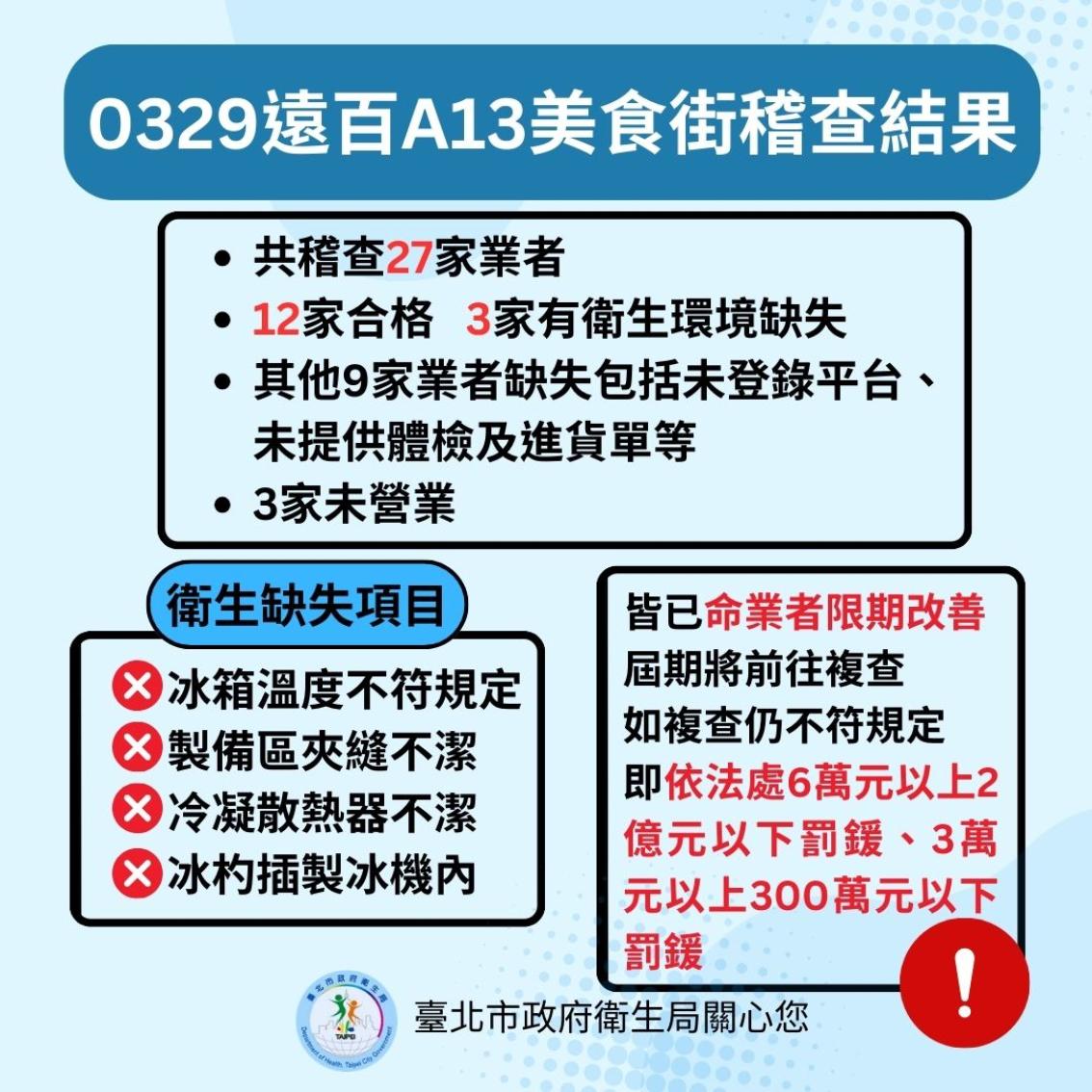
After the Polam Kopitiam case broke, the Taipei City Department of Health inspected the Xinyi Far Eastern A13 food court. (Image: Taipei City Department of Health website)
We learned from the news that the Ministry of Health and Welfare's Food and Drug Administration didn't even have a reference standard for testing bongkrekic acid; fortunately Changhua Christian Hospital had one, so the cause could be identified in time. This shows that, for all the resources of a state, we were unprepared for colourless, odourless and highly lethal bongkrekic acid. Polam Kopitiam is Taiwan's first case — were there really none before? Or did we just not know? Either way, without testing there is no evidence.
If even the state wasn't prepared to defend against bongkrekic acid food poisoning, how can ordinary food businesses down to street stalls be expected to have that capacity? Was Polam Kopitiam just unlucky to be the one caught? Taiwan's economy today is sluggish while the stock and property markets soar; food manufacturers and eateries must pay high rents or factory costs, so they cut investment in staff and food safety. This is a systemic factor of deterioration. Not just food safety, but the costs of other public safety and industrial safety are silently squeezed too, so naturally accidents happen.
Some American experience worth referring to
When I worked for the American Society for Quality, from 2002 to 2006, after training byAFDOthe Association of Food and Drug Officials, I was responsible for training HACCP auditors and for ASQ's certification exam, and during that time did placements in large food factories. The bigger the factory, the more they tread as if on thin ice, investing huge resources, manpower and equipment — better to wrongly kill ten thousand than let one slip — because any food-safety incident can at best ruin a big food factory's reputation and bring huge civil and criminal damages, and at worst close it down.
For food safety, excessive disinfection, sterilisation and preservation, overheating food, plus additives as a "necessary evil", along with uniform seasonings and colourings to keep products highly consistent, actually bring other hidden worries. My instructor back then said this is because HACCP was invented by NASA in the 1960s specifically to control astronauts' food and keep them from getting diarrhoea — because in space, without gravity, diarrhoea would fill the whole capsule with germs, which is extremely dangerous. So the seven principles of HACCP were set: 1. Conduct a hazard analysis. 2. Determine the critical control points. 3. Establish critical limits. 4. Establish a system to monitor the critical control points. 5. Establish corrective actions to be used when monitoring indicates a particular critical control point is out of control. 6. Establish verification procedures to confirm the HACCP system is working effectively. 7. Establish documentation of procedures and records related to applying these principles.
These principles are concise, yet even professionals with doctorates and master's degrees interpret the seven in their own ways, and implementing and auditing them is quite difficult. Even today,FDA websitepublishes every day which foods, drugs, medical devices, cosmetics and pet foods are being recalled — some voluntary, some mandatory — and even issues urgent alerts.
The food industry faces very many variables, and its barriers to entry are relatively low. As the saying goes, you can't eat a sesame flatbread without dropping a few seeds: recalls from non-malicious mistakes are routine. But a recall always has a batch number, a scope of impact and follow-up handling.
There are also many small food businesses — generally serving no more than 1,000 people a day — on which HACCP is hard to impose, so a simplified HACCP is used. Put simply, it is a set of food-safety control principles made up of ten letters: FAT TOM & FIFO.
First, a small food business must have a list of suppliers and purchase receipts, plus a floor plan of the processing area and a workflow chart. From receiving to dispatch, the flow must be one-way, without going back and forth; and any defective products must be in a clearly marked quarantine area so they don't contaminate the normal production line.
HACCP is hard to implement and needs plainer explanation
We must first carry out HA (hazard analysis), using the six "hazard points" of FAT TOM.
F – Food. The characteristics of the food itself: whether it spoils easily or readily produces toxins. Fresh meat and jerky, for example, have different characteristics and different risks and hazards: fresh meat must be refrigerated, while jerky can usually be kept at room temperature. The rice noodles involved this time can usually be kept at or below room temperature (25°C), but other risk factors must be considered (such as how long). With fresh meat, seafood, dairy or eggs, special attention must be paid to segregation and safety.
A – Acidity. The acid-base characteristics of food and its environment. Many foods keep in acidic conditions with pH below 5, or even more acidic. Of course it depends on whether the food suits acidity and how long it can be kept. For example, a pickled plum in a Japanese bento lets it keep a bit longer at room temperature without refrigeration or heating — but not overnight.
T – Temperature. Temperatures during processing, storage, transport and waiting are key characteristics too. Whether hot chain or cold chain, we must ensure equipment stays at the right temperature. Maintaining and recording equipment and environmental temperatures, along with equipment maintenance and calibration records, are critical points.
T – Time. Upper and lower time limits for each stage — processing, storage, transport and waiting — combined with temperature, all have safe limits, which must be properly recorded and kept to maintain food safety.
O – Oxygen. Bacteria can grow in both aerobic and anaerobic environments, so oxygen is an important safety indicator: whether food should be sealed or exposed to air during production, storage, transport and waiting becomes a key factor that must be thought through clearly.
M – Moisture. Water is essential for microbial growth. In dry, low-moisture foods or environments bacteria don't grow easily, so the degree of control is lower than in moist environments. With Taiwan's hot, humid climate bacteria grow easily, and uncontrolled environments can cause great harm.
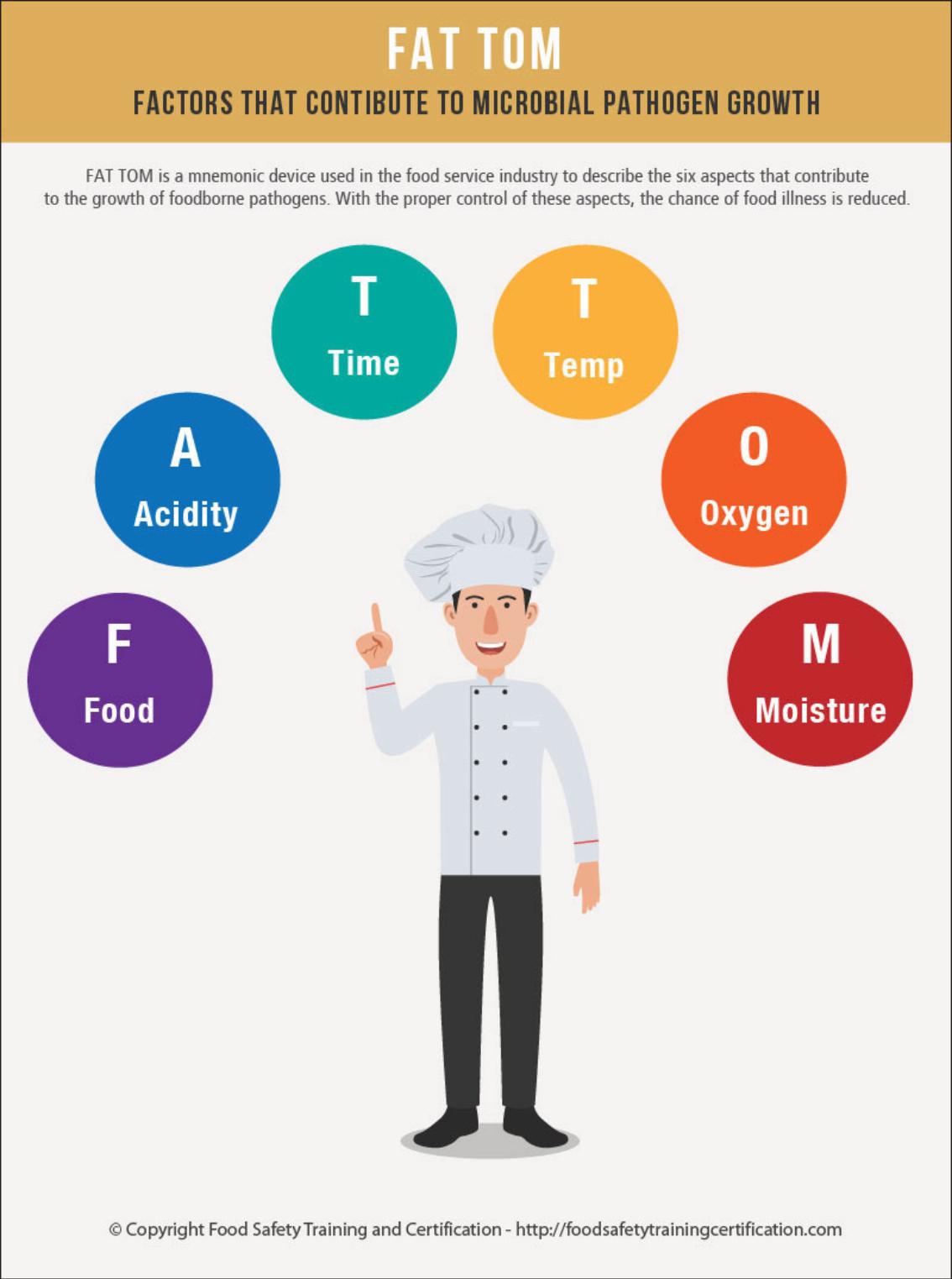
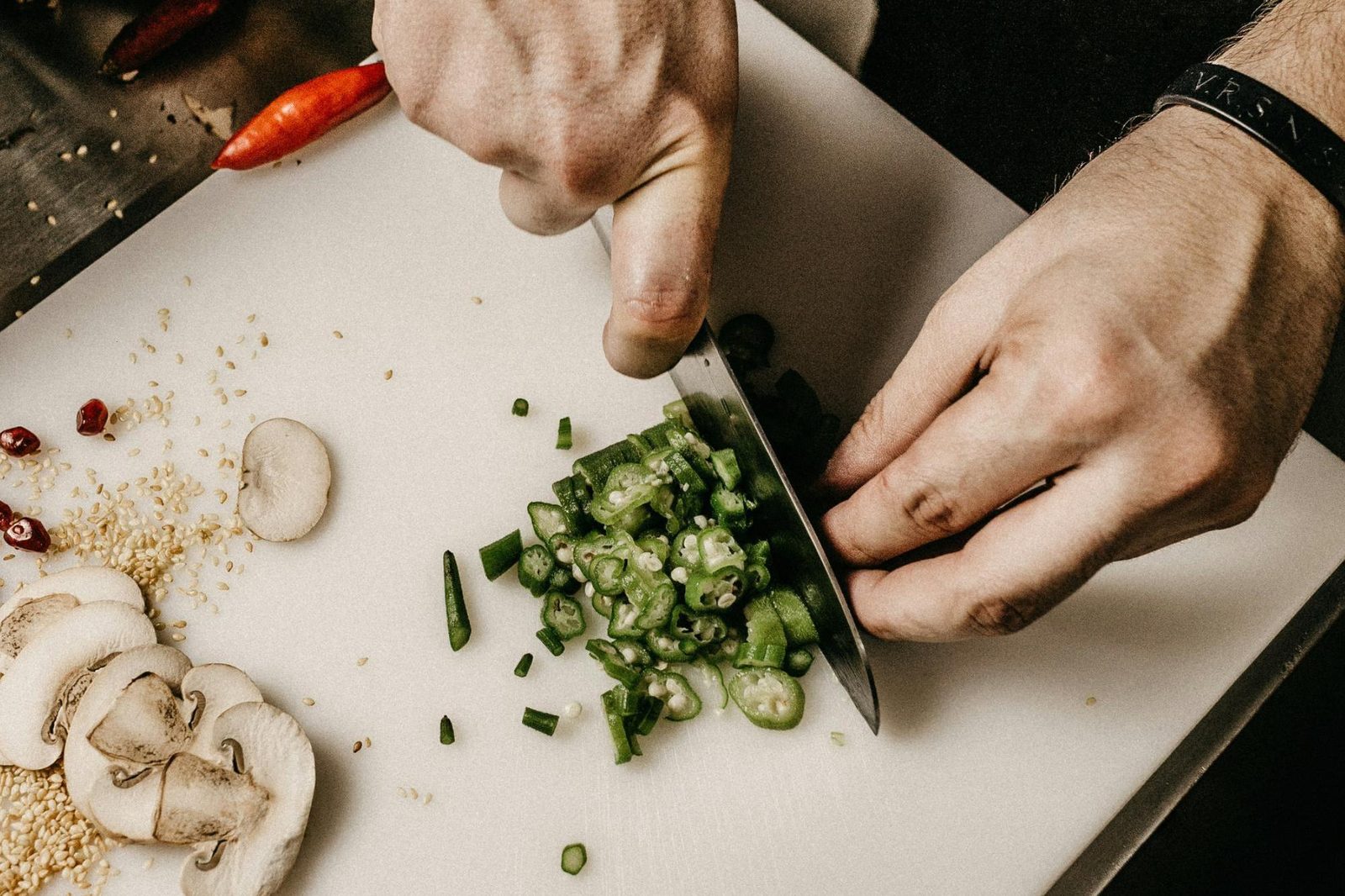
FAT TOM is six key hazard analysis and critical control points in food safety. Food businesses must clearly identify these hazard factors for every ingredient and every action in every production step. (Image: Food Safety Training & Certification)
We explain FAT TOM to small food businesses and, following the floor plan and flow chart, review the FAT TOM situation at each step one by one, setting safety limits and operating procedures.
Speaking of "operating procedures": people in Taiwan love to talk about "SOPs — standard operating procedures", or treat them as a talisman, yet they don't understand what an SOP is at all. Operating procedures must derive from hazard (risk) analysis, focusing limited time and resources on sources of risk and high risks. That comes from good training and long accumulated experience, not from casually reciting three English letters.
Once we've determined the HA and the necessary CCPs, we then check FIFO (First-In-First-Out). On a food production line — even just a kitchen counter — the positions and sequence of "in" and "out" must be distinguished and separated, ensuring the one-way flow line runs smoothly. Generally we don't check the tiny expiry labels on packaging, but whether the flow from purchase order to final product meets the FAT TOM conditions and the first-in-first-out principle.
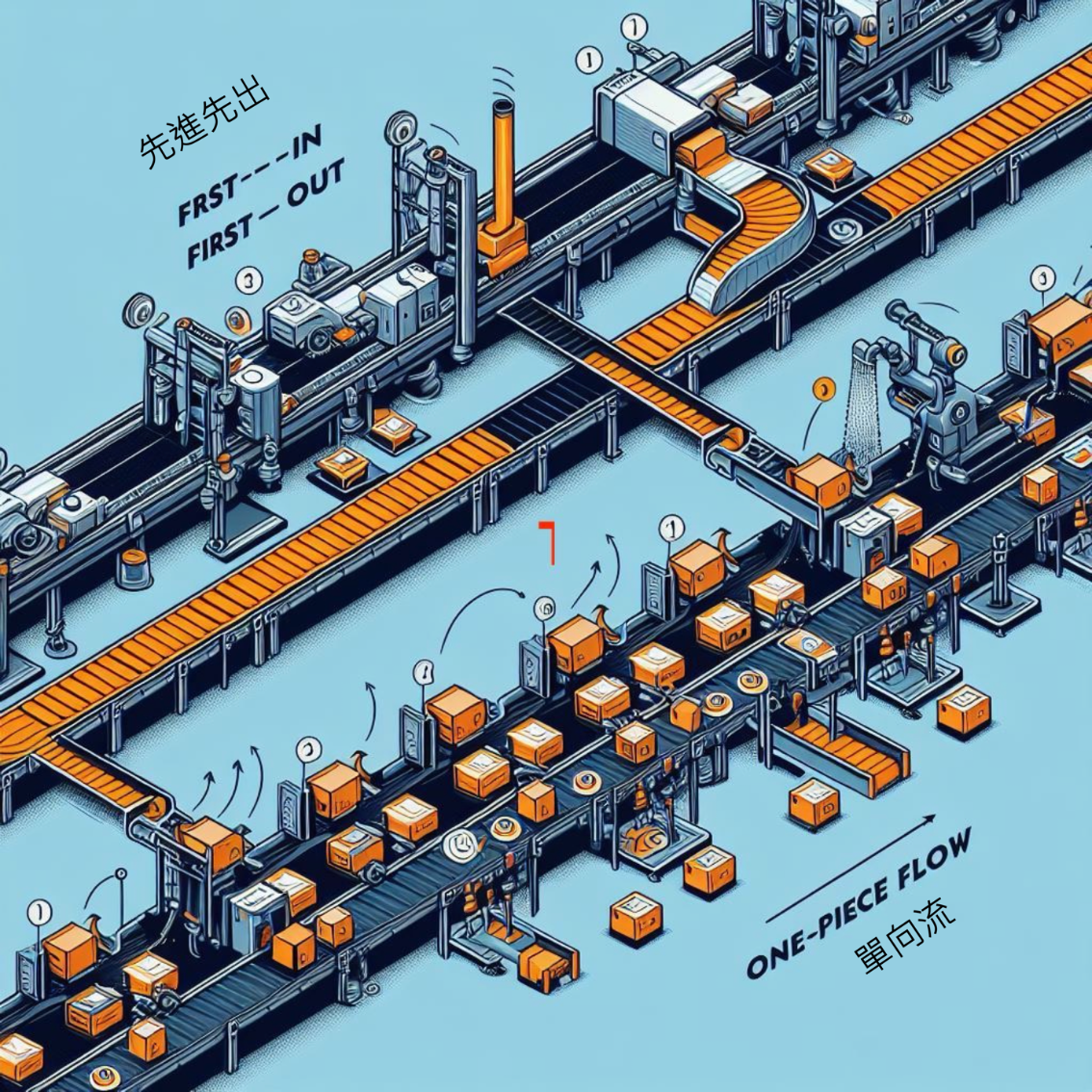
First-in-first-out: in food production premises materials must go out in the order they came in. This is both food safety and an essential means of materials management and cost control. (Image: generated with DALL-E)
First-in-first-out is a principle every food business must clearly implement, because it is not only food-safety management but also an important principle of inventory and cost management. Combining FIFO with FAT TOM is easy for small food businesses to understand and carry out — even a douhua or beef noodle stall can implement it effectively.
All this is still downstream management. Even more important is upstream management: from soil and farmland to the production and primary processing of agricultural, forestry, fishery and livestock products, everything affects food safety later on. HACCP principles shouldn't be limited to food production but must extend upstream to ensure food safety.
Relying on test reports alone is far from enough for food safety, because the samples tested are never what consumers eat, and failed test reports are never released. Yet everyone now holds up "passed XXX test" reports as a talisman. Carry on like this and it's like drinking talisman water to cure illness — really not OK!
Source: CM Media ( https://www.cmmedia.com.tw/home/articles/46658 )