 努力小農
本文尚無譯文。
Through the hard times... towards 1,000 hectares of smallholder carbon farming & FAQ (Part 1)
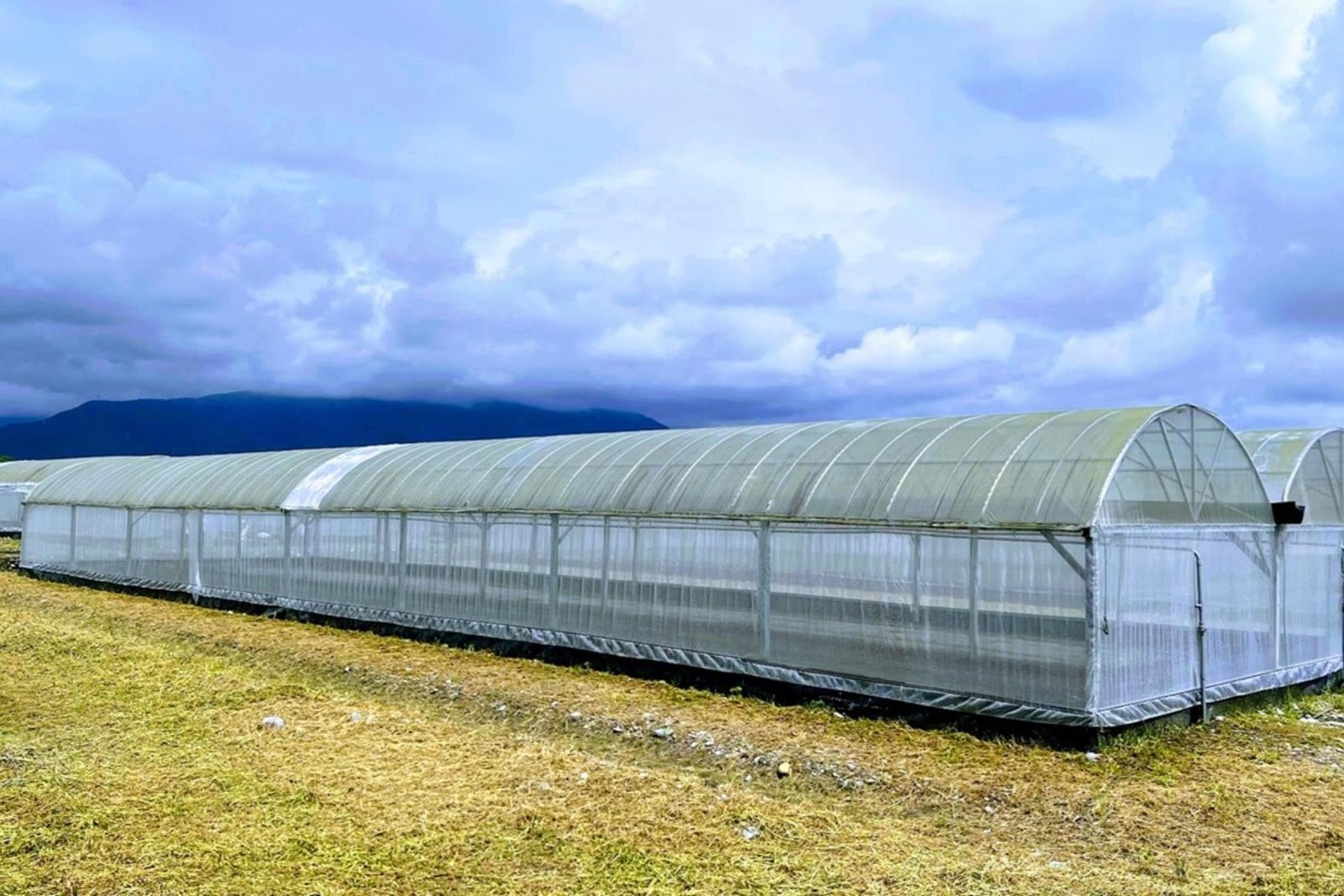
Whether greenhouse cultivation can join smallholder carbon farming depends on the circumstances. (Image: Jay Fang, taken at Chi-Lai Organic Farm, Shoufeng Township, Hualien)
After more than three months of consultation with various sectors, it has been confirmed that the Gold Standard-registered Taiwan Smallholder Carbon Farming Project will be upgraded from a micro-scale project of under 10,000 tonnes of soil carbon sequestration a year to a large-scale project of over 60,000 tonnes a year. In early June we submitted the project design change to the Validation and Verification Body (VVB); the review is now complete and has been submitted to the Gold Standard. Once it passes review, the first year's carbon credits can be issued (including emission-reduction performance and quantified performance on indicators for six Sustainable Development Goals).
Smallholder carbon farming comes through the hard times
We plan to grow from over 300 hectares in 2023 to 1,000 hectares, while improving parts of implementation and monitoring methods to make the smallholder carbon farming project easier to join, more transparent and more efficient.
With good results in the first year, the number of smallholders taking part will grow year by year. By conservative estimate, because of the project design change the working period in the second year (2024) is shorter, so we plan to go from 300 to 1,000 hectares, then add 1,000 hectares a year, reaching 7,000 hectares.
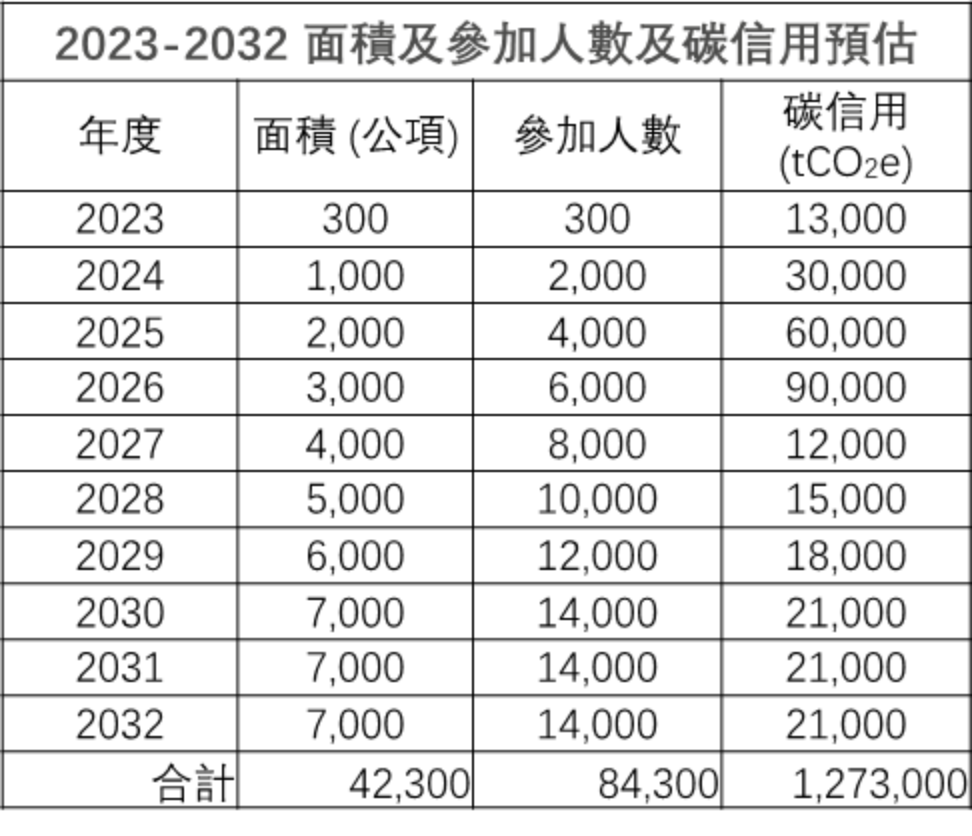
MiHuMiSang will grow year by year over the next nine years, aiming to sequester over 1.2 million tonnes of CO2 in ten years. (Image: provided by Jay Fang)
Although sequestration in 2023 averaged about 85 tonnes per hectare, these smallholders had already done three to five years of eco-friendly farming or preparatory work such as rotation before joining. At large scale, there will be newcomers whose soil sequestration may not match the 156 hectares reported in the first year, so we use one per thousand of carbon a year — about 30 tonnes — as the estimate, meaning 30,000 tonnes per thousand hectares.
From mid-July we will tour Taiwan's counties and cities to bring more smallholders into the carbon farming project. As the saying goes, a journey of a thousand miles begins with a single step — better to act than just talk. Chi-Lai Organic Farm in Hualien has already joined with nearly 30 hectares, and the Huwei Township Farmers' Association in Yunlin is preparing to sign up over 200 hectares of contract peanut fields. We will reach every corner step by step.
Q&A
Here is an FAQ of questions we often encounter.
Q1. If a plot hasn't been farmed for many years, can it join?
A1. Actually engaging in farming as an economic activity, with more than three years of operating and sales records, is a requirement. Land that has been fallow or abandoned for years and become mixed woodland may already be sequestering carbon; farming it again would reduce soil organic carbon. So from a carbon-reduction perspective, bringing fallow or abandoned land back into agriculture for the sake of carbon reduction is actually bad for soil sequestration.
Q2. If my field is farmed for half the year and left fallow for half, can it join?
A2. Leaving it fallow for part of the year helps sequestration. We generally sample after harvest, not after the fallow period before planting.
Q3. If I plant trees, can I join smallholder carbon farming?
A3. Tree planting and afforestation, or regenerating forest, count as forestry and are outside the scope of the smallholder carbon farming project.
Q4. What about fruit trees?
A4. Fruit trees can join smallholder carbon farming if they are an agricultural economic activity with an annual harvest; even flowers and horticultural landscape crops can, but ornamental garden trees can't. The key is agricultural business activity.
Q5. Which crops qualify?
A5. The vast majority of crops qualify, except aquatic crops grown in ponds such as lotus seeds, lotus flowers and water caltrop that grow in water long-term — water movement is too great to calculate soil carbon storage. Paddy fields and taro, which alternate between wet and dry, are fine. Grains, vegetables, fruit trees, tea and nurseries all qualify.
Q6. What about protected cultivation in greenhouses or net houses?
A6. Greenhouses and net houses vary a lot, so it depends on the actual situation. The principle is that soil organic carbon content must be clearly calculable and the environment stable over the long term to support long-term sequestration. Although greenhouses and net houses create stable growing conditions, in the long run they may be moved or destroyed, and soil long sheltered from rain may harden and degrade — all of which must be considered.
Q7. Must the land be my own? What proof do I need to provide?
A7. Gold Standard certification places considerable weight on social justice. Many smallholders don't own land and rent it from landowners, or the land belongs to a large extended family with many descendants, making it practically difficult to get every owner's consent. So after consulting the Gold Standard, and in light of how Taiwan's smallholders use land, we contract with the actual cultivator; agreements between landowners and smallholders are not considered. Also, on the principle of trust and to protect personal data, privacy and commercial interests, we do not ask for title deeds, leases, ID cards or other documents, but keep phone and mobile numbers, addresses and satellite positions of the farmland for future verification and audit.
Q8. What restrictions apply to land-use zoning?
A8. The land must be legal agricultural and pastoral land, not a protected area, forest compartment, wetland or marsh.
Q9. Is there a minimum land area? Must plots be contiguous?
A9. Certification incurs sampling, testing and certification costs. Although these are paid by the project developer, these necessary costs will eventually be deducted, so an area of less than 0.3 hectares (3,000 square metres) isn't cost-effective. It should be at least over 0.3 hectares to be economically viable.
Plots needn't be contiguous, but for sampling statistics, a plot must be in the same nearby watershed and the slopes mustn't differ too much, because slope and aspect affect crops' photosynthesis.
Q10. Do I have to pay a fee to join the smallholder carbon farming project?
A10. We expect to pay project development and certification costs from carbon credit sales revenue, and also need a surplus to operate sustainably. Given smallholders' economic circumstances, we will never charge any fee.
Q11. Do I have to farm organically to join the smallholder carbon farming project?
A11. No. In Taiwan's current situation, there's no evidence of a direct link between the amount of soil organic carbon and whether farming is organic. However, in theory and experience, approaches such as permaculture, Shumei natural agriculture, grass cover, "regenerative agriculture" and "circular agriculture" have better soil sequestration effects. Also, if you switch from conventional farming with chemical fertilisers and pesticides to organic, note the international emission-reduction certification rule that projects must not reduce yields by 5% (unless a special natural disaster causes across-the-board losses, which must be documented). This is to ensure food security (SDG 2 Zero Hunger).
Q12. What should I do to increase soil organic carbon and enhance soil carbon sinks?
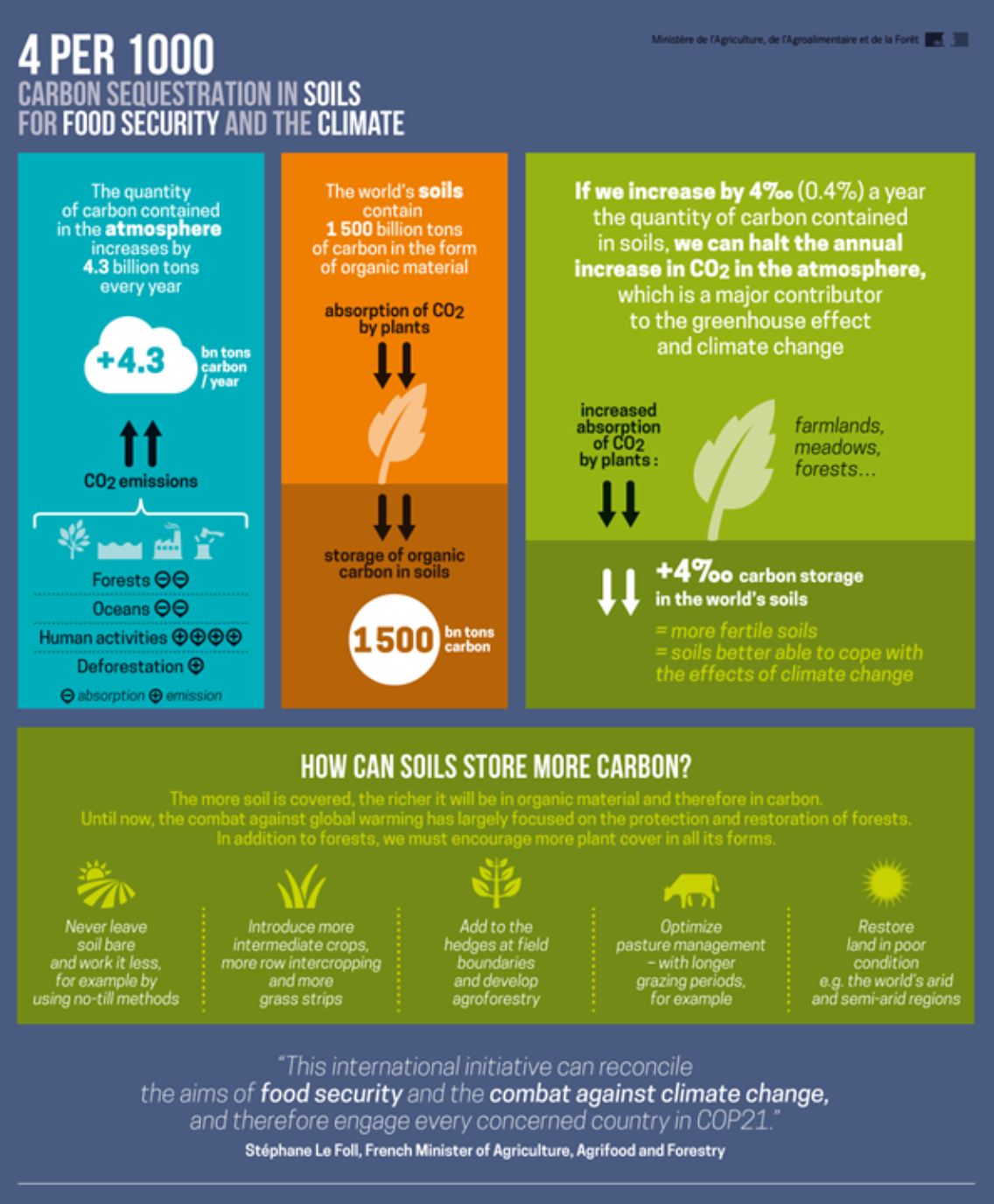
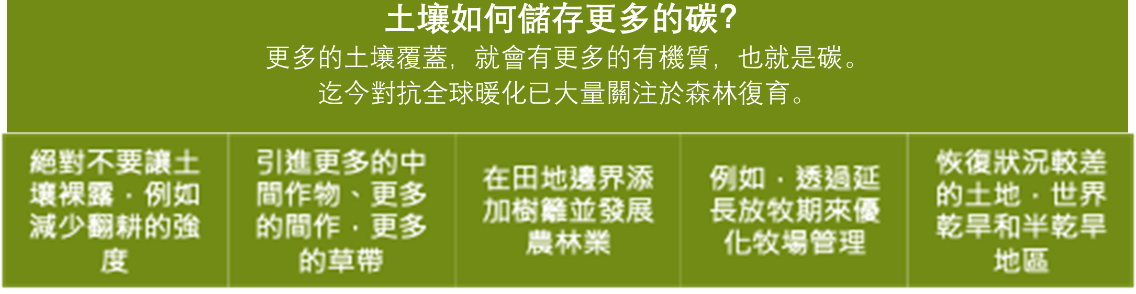
A12. In any case, not reducing yields (within 5%) is an important constraint. As for which methods smallholders adopt, there are only guiding principles; smallholders should adjust and change according to their own situation. Based on the 4 per 1000 Initiative, our recommended basic principles are:
1. Reduce physical and chemical disturbance of the soil — for example, reduce the intensity of tillage. Note: it's not that you can't till, but you should try to reduce the soil disturbance caused by tillage, which leads to losses of soil microbes, earthworms and organic matter.
2. Increase soil cover. Soil is like human skin: it needs moisture and protection from UV, so appropriate cover is essential — for example, leaving cut weeds on the ground after weeding, or "rolling" weeds instead of cutting them. If you use plastic weed mats, be sure to collect and dispose of them properly after use, because many recent studies show microplastics in soil hinder the accumulation of soil organic matter.
3. Rotation and intercropping. Smallholders' ecological value lies in small-scale farming with less impact on natural biodiversity. If smallholders also rotate (different crops at different times) or intercrop (different crops mixed in one field), they can spread pest and disease risks and recycle soil fertility. Rotating or intercropping legumes with grasses in particular effectively reduces external fertiliser and promotes crop growth.
4. Use biological organic inputs. Soil organic carbon comes mainly from the combination of soil microbes with organic matter secreted by plants; microbes also decompose plant and animal remains into soil organic carbon, helping it accumulate and be stored.
5. Biochar. Biochar is best produced from your own field's agricultural residues in a carbonisation kiln. Bought-in biochar is expensive and unregulated, of unknown source and composition, and may contaminate soil. Biochar itself doesn't act; rather, its tiny pores (300–1,000 square metres of pore surface per cubic centimetre) give soil microbes better living space, helping preserve soil organic matter. (See the earlier column:Biochar is a carbon-reduction tool: how to seek the good and avoid the bad?)
Source: CM Media ( https://www.cmmedia.com.tw/home/articles/47837 )


