 努力小農

本文尚無譯文。
Smallholders to the rescue of the planet in crisis
Agriculture is the foundation on which 8 billion people depend. The Green Revolution of 1960 developed an industrialised, mechanised large-farm system. Labour fell and yields rose sharply, yet today American agricultural experts believe that if things go on like this, we may have only about 60 harvests left. Large-scale farming not only causes soil loss but is also a major cause of global warming: soil is no longer a sink for organic matter, and the soil organic matter accumulated over tens of thousands of years is turned into CO2, aggravating climate change.
Scientists around the world are reflecting that agricultural systems must move towards small-scale, diversified models. This is also smallholders' chance to save the planet.
The life cycle of the Earth's carbon cycle
The Earth has a history of 4.65 billion years, and humans appeared only in the last 300,000. If the Earth's history were a day, humans would appear less than 3 seconds before midnight. Yet in the last 300 years — equivalent to the Earth's last three-thousandths of a second — we have almost completely destroyed the environment capable of nurturing humanity that took the Earth billions of years to evolve.
When the Earth formed it was chaos: the atmosphere was full of helium, nitrogen, hydrogen, carbon dioxide and methane (biogas), in which living things could not survive, and temperatures were very high. Only 1.5–1.6 billion years ago did green plants appear. Photosynthesis absorbs CO2 from the air, producing oxygen and glucose and generating organic substances such as proteins and fats. Green life sequestered carbon and released oxygen, giving rise to all things. Green plants combined with weathered crustal bedrock to produce soil, nurturing algae, fungi and plants; animals came later, gradually forming the Earth's ecosystem.
Everything has its "life cycle". Flowers bloom and fall, fallen leaves return to their roots, all in line with the conservation of matter. Before the Industrial Revolution, gathering, farming and herding were only local cycles; even when they had an impact, it was brief and local. After the Industrial Revolution of the 1780s, machines used vast amounts of coal, oil and natural gas; the agricultural "Green Revolution" of the 1960s brought massive use of pesticides, chemical fertilisers and heavy automated machinery; and globalisation after 1990 meant that carbon stored in the Earth's crust over hundreds of millions of years was dug up and extracted in these 200 years, burned without limit and turned back into CO2, causing the greenhouse effect, accompanied by emissions of all kinds of toxins. It is like releasing all the carbon green plants stored under the crust and in the sea over more than two billion years — chaos under heaven.
The life cycle of agriculture's carbon cycle
Our crops still dutifully photosynthesise and do their part in sequestering carbon; carbon emissions and absorption could have been balanced. But our farming methods, aiming for large volumes, speed and less labour, use vast amounts of machinery, pesticides and fertilisers, weakening the ability of plants and soil to absorb CO2, so far more carbon is produced than absorbed.
Generally, if a plant absorbs 100 kg of CO2 through photosynthesis, 30 kg becomes stems, leaves, branches and fruit, another 30 kg becomes the root system, and the other 40 kg is metabolised into the soil. Without human intervention, as in primeval forest, microbes, fungi, insects and earthworms in the soil turn organic matter metabolised by roots into soil organic matter, including long-term stable humus or humic acid — an important source of nutrients for plants.
In recent years, agriculture has had easy access to large amounts of cheap (subsidised by governments everywhere) fertilisers, pesticides and herbicides. They're convenient and give an immediately visible boost to yields, so farmers use them lavishly — and these chemicals (even so-called natural organic fertilisers) kill soil microbes on a large scale.
Take tea-seed meal, an organic farming input. Besides organic matter it contains saponin, which controls golden apple snails: like soap, saponin washes away the mucus on molluscs' bodies, stripping them of their skin so they die in great pain. Saponin is non-selective: besides killing snails, it also kills earthworms, loaches and other mucous-skinned creatures beneficial to soil health.
Organic fertiliser does not equal more soil organic matter
The largest source of soil organic matter is the organic matter metabolised by plants themselves through photosynthesis. To hold onto it stably and form long-term organic matter requires the help of microbes, moulds, mushrooms and small creatures such as earthworms. These tiny organisms feed on plants' organic matter and fallen leaves and twigs, then metabolise them into organic matter — that is, it must be converted again by microbes into soil organic matter.
Sadly, microbes are killed by over-nutrition from excessive fertiliser — just as people who overeat die sooner — or poisoned by pesticides and herbicides. After a few years of cultivation, soil organic matter declines or even disappears, for lack of microbial carbon sequestration.
What causes massive losses of soil organic matter, making it a major source of the Earth's CO2, turns out to be spring ploughing. Over the past 20 years NASA data have shown that the peak CO2 concentration in the Earth's atmosphere comes not during the winter coal-burning heating season but in March, April and May, when farmers are working the land in spring; only in July, when summer arrives, ploughing stops and photosynthesis is at its height, does CO2 decrease. (See the video NASA Global Carbon Dioxide: 2020-2021: https://www.youtube.com/watch?v=VbOF--Xgs8s&ab_channel=NASAClimateChange)
Video QR code
Who'd have thought ploughing is agriculture's biggest carbon emitter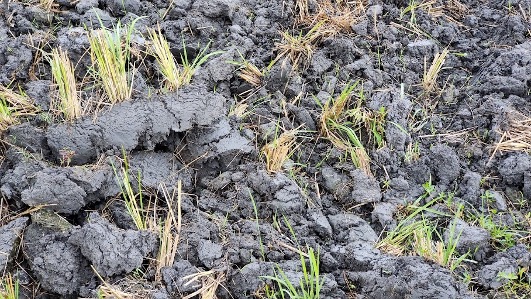
Large areas of bare soil are the main cause of losses of organic matter and microbes, and the biggest source of human greenhouse gas emissions on Earth.
"How can we not plough?" is many farmers' first reaction. The long-held belief is that ploughing loosens the soil and keeps air flowing to roots, and turning the soil to expose it to the sun disinfects it and kills pathogens.
But the scientific evidence says whether soil is loose depends on whether it has enough organic matter. In healthy soil, when plants die their roots are decomposed by bacteria, leaving gaps that are channels for air in the soil; and fungal hyphae bring minerals and other nutrients, making the soil more fertile. In theory, plants can grow well without ploughing — the great trees of the forest never need ploughing yet grow to a hundred metres, their root systems clearly well developed and not short of air.
With frequent crop rotations and too few bacteria in the soil, there's no time for roots to decompose; add compaction by heavy machinery forming an impermeable, airless plough pan, and as crop follows crop, soil lacks organic matter and doesn't let water and air through. A vicious circle forms: the soil gradually becomes inorganic and hardens into clods like stone. That stands to reason.
Soil microbes are indeed easily killed by the sun's UV, but beneficial bacteria in the soil suffer too, and the soil loses its vitality, hastening its death.
I believe that for 21st-century agriculture to restore green plants' capacity to sequester carbon, smallholders are the greatest opportunity and can form the greatest force to restore soil as the Earth's largest carbon sink. Healthy soil means healthy crops and healthy people. At the same time, agricultural carbon sinks return excess greenhouse gases to the fields as organic nutrients.
The following images are screenshots of NASA's 2020–2021 changes in atmospheric CO2 concentration. They show CO2 in the northern hemisphere rising sharply by over 30 ppm (nearly 10%) due to spring ploughing. In summer, plant photosynthesis draws CO2 back into plants or stores it in the soil. In winter, fossil fuels (oil, natural gas, coal) burned for heating raise CO2 again, but by less than the emissions caused by ploughing.
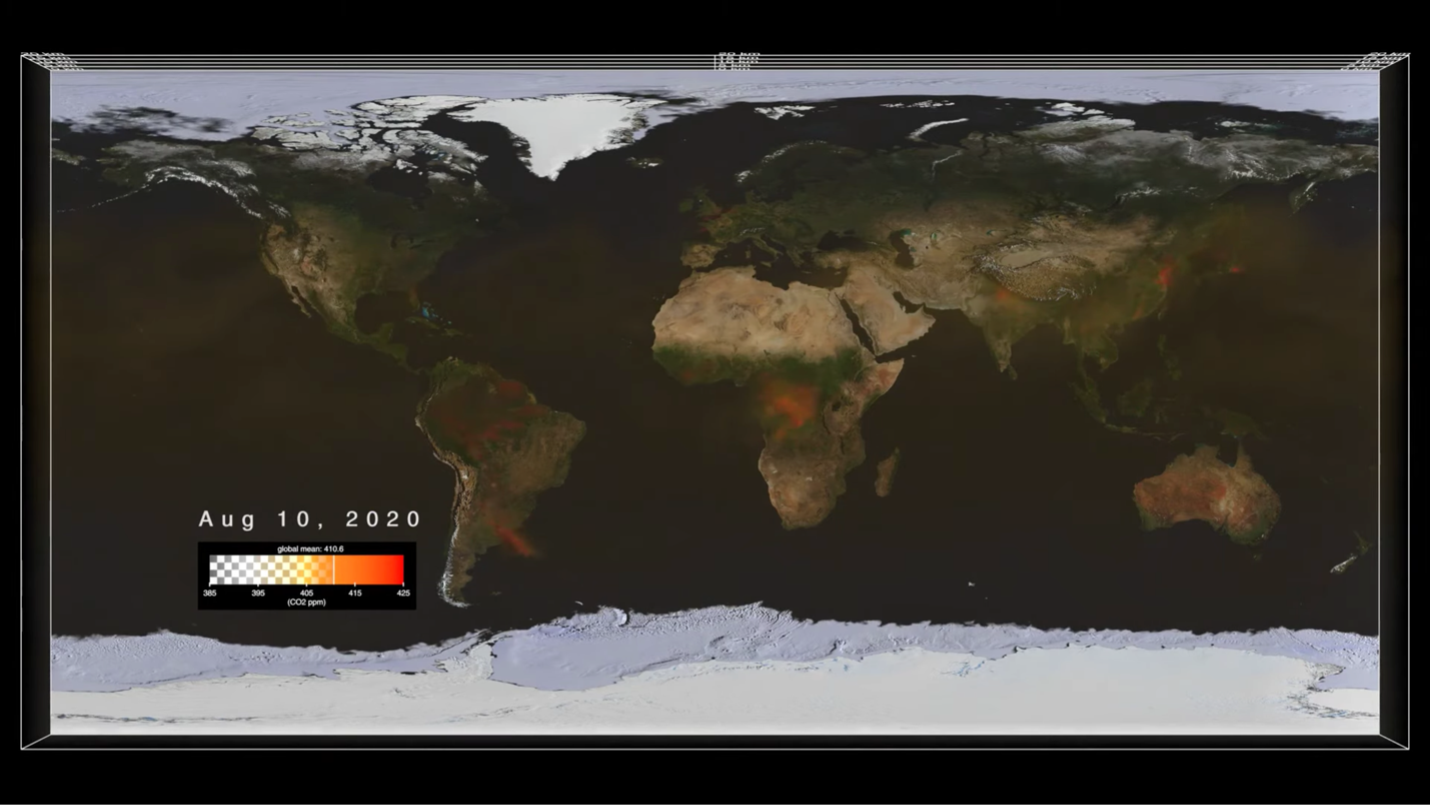
Northern-hemisphere summer is when atmospheric CO2 concentration is relatively lowest. (Source: NASA)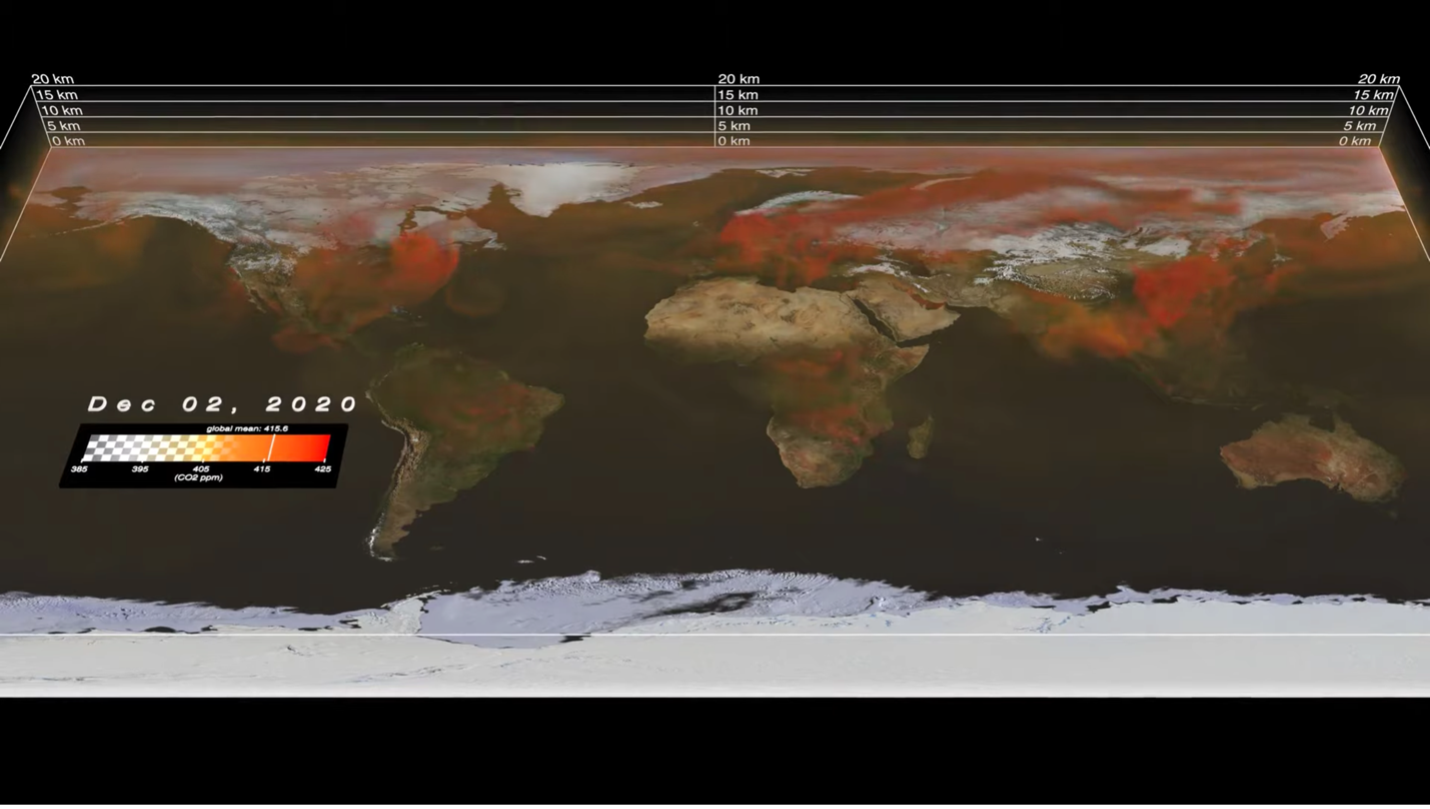
In winter the northern hemisphere uses large amounts of energy for heating, and CO2 increases. (Source: NASA)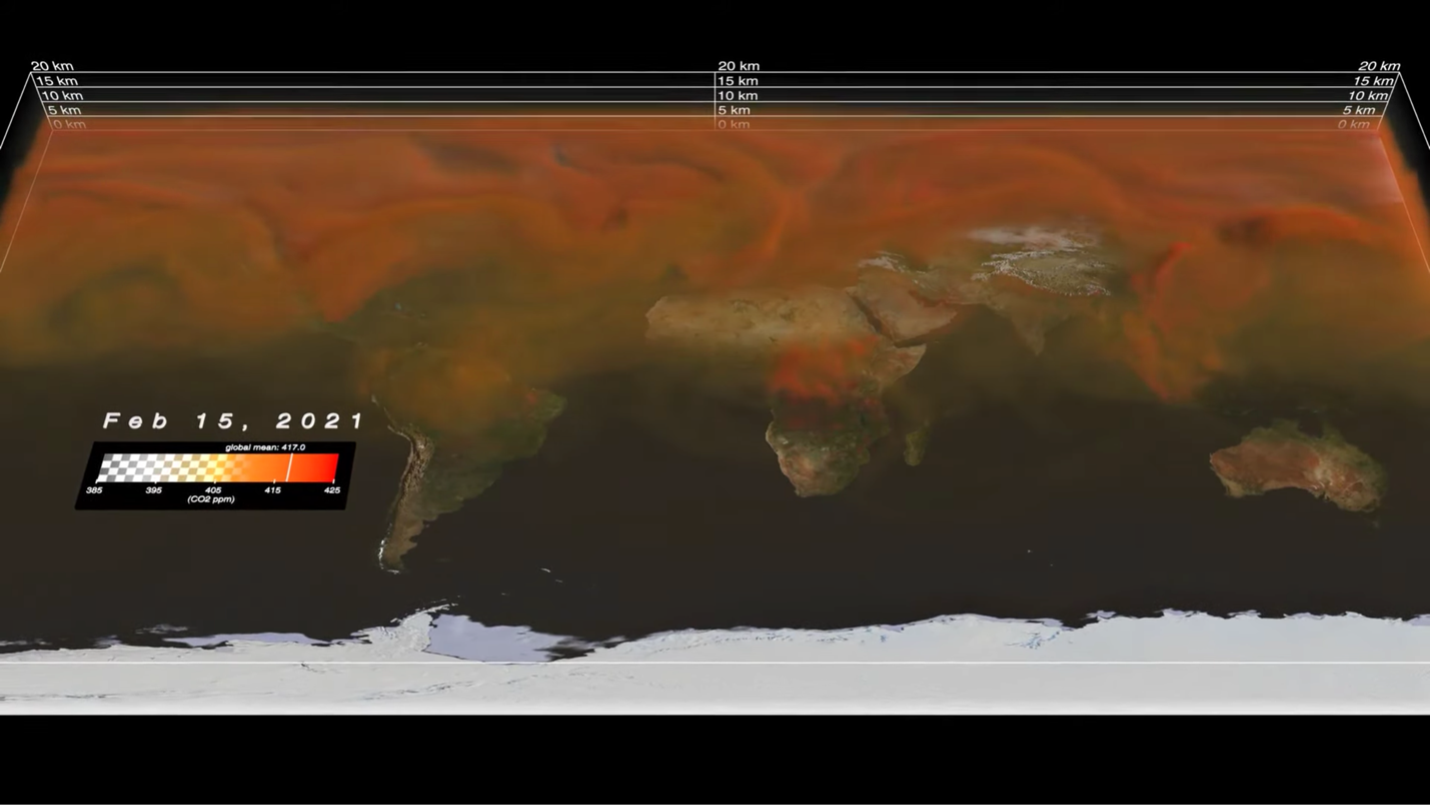
In February the northern hemisphere enters spring and the weather warms, yet CO2 concentration rises. (Source: NASA)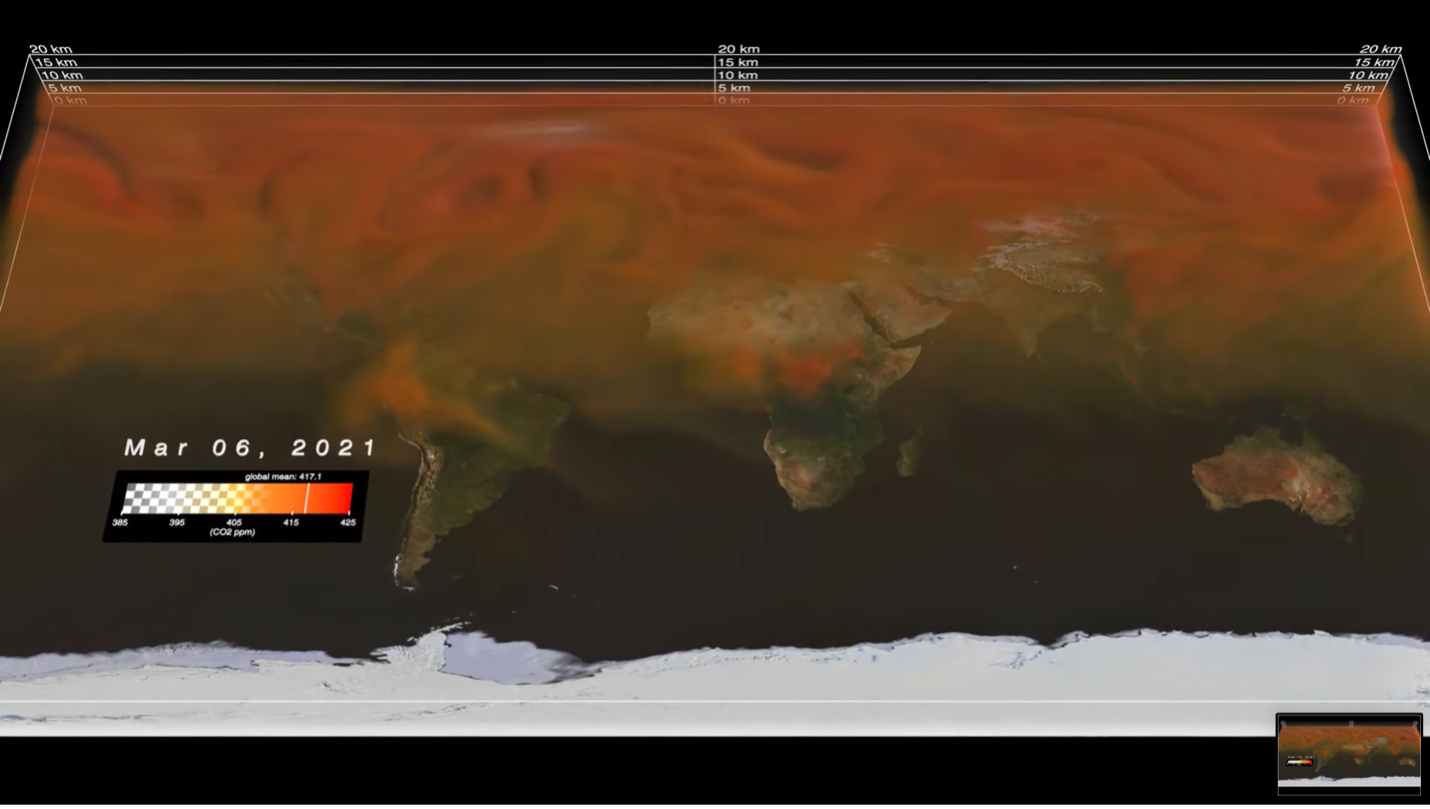
In March it's warmer still, but CO2 concentration keeps rising. (Source: NASA)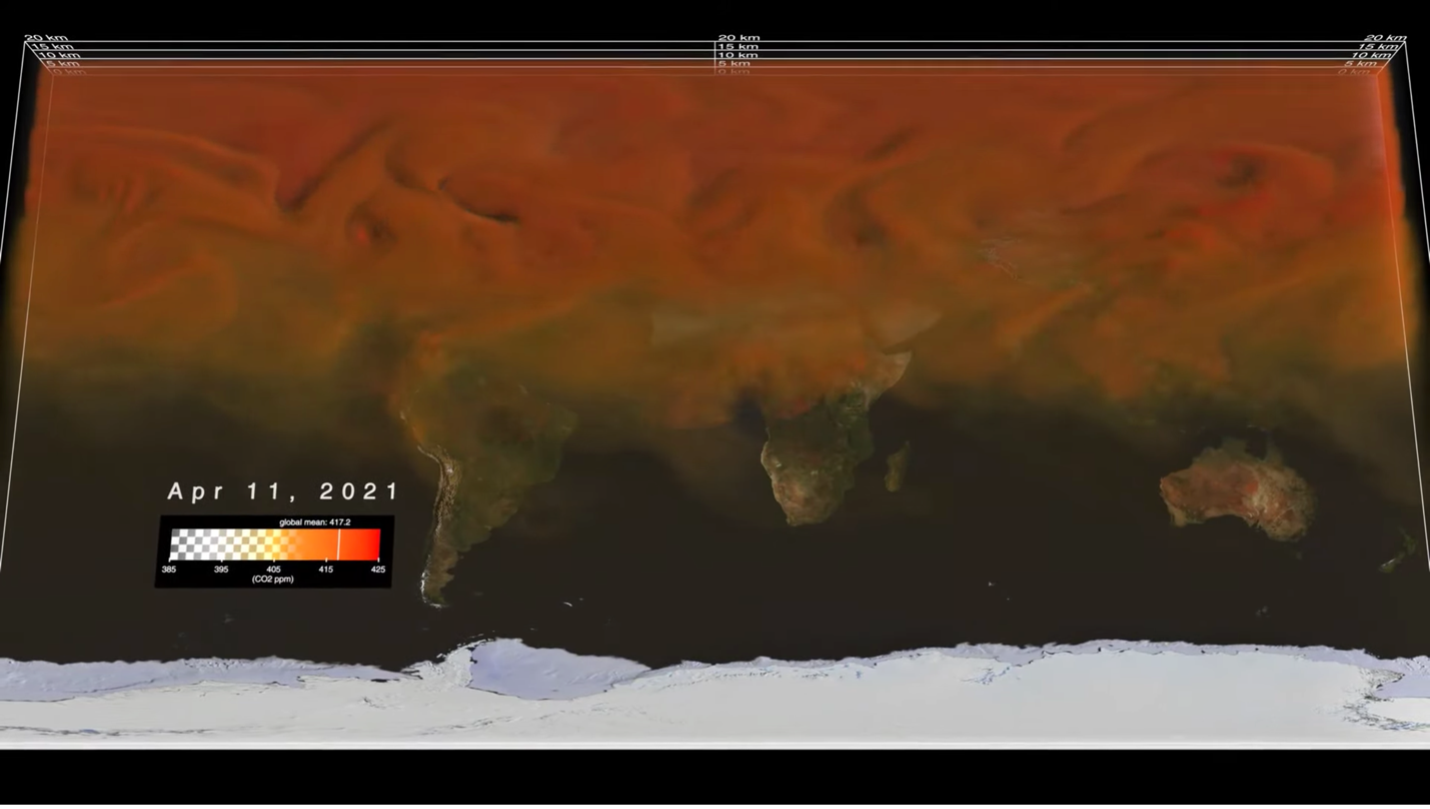
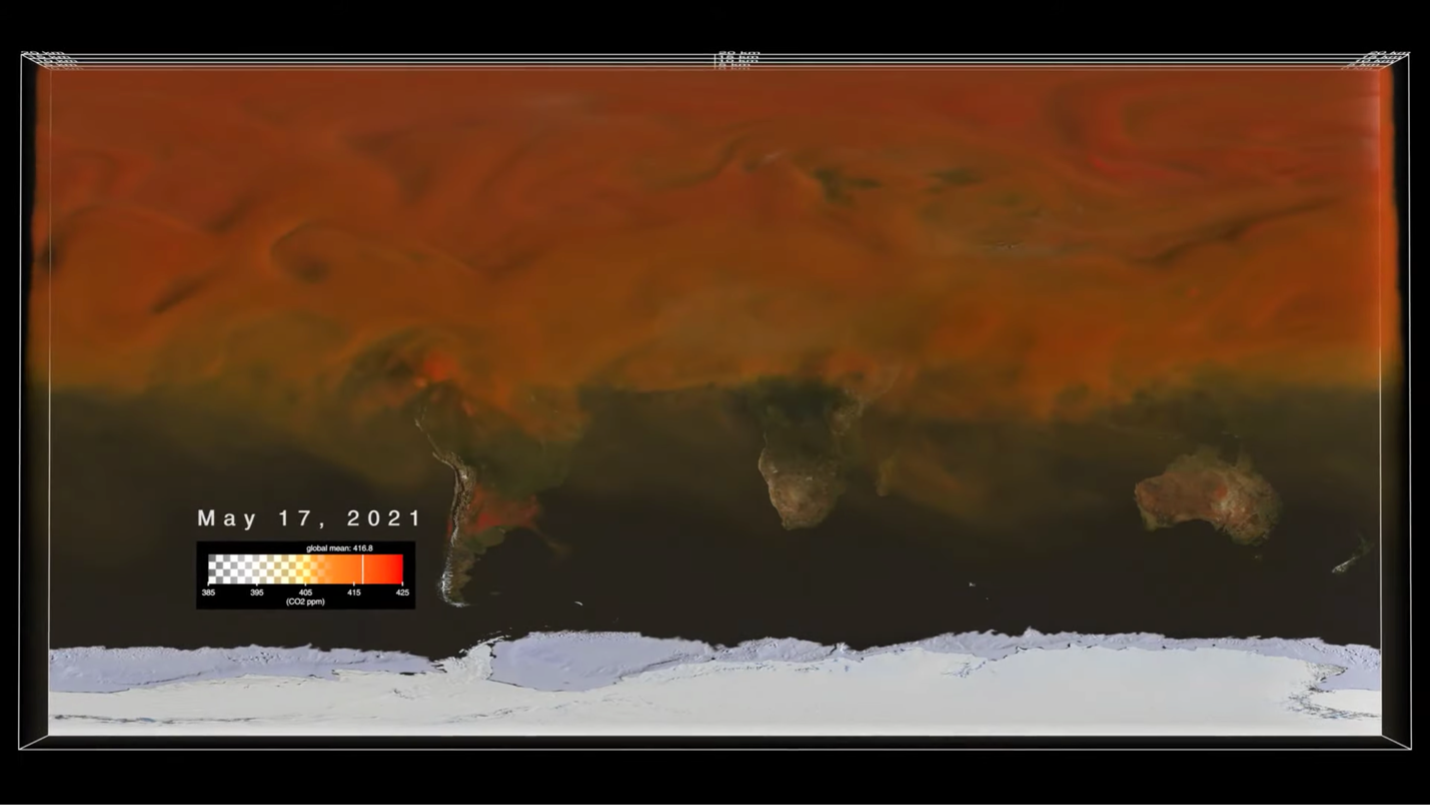
April and May, when farmers are busy ploughing, are when atmospheric CO2 concentration peaks. (Source: NASA)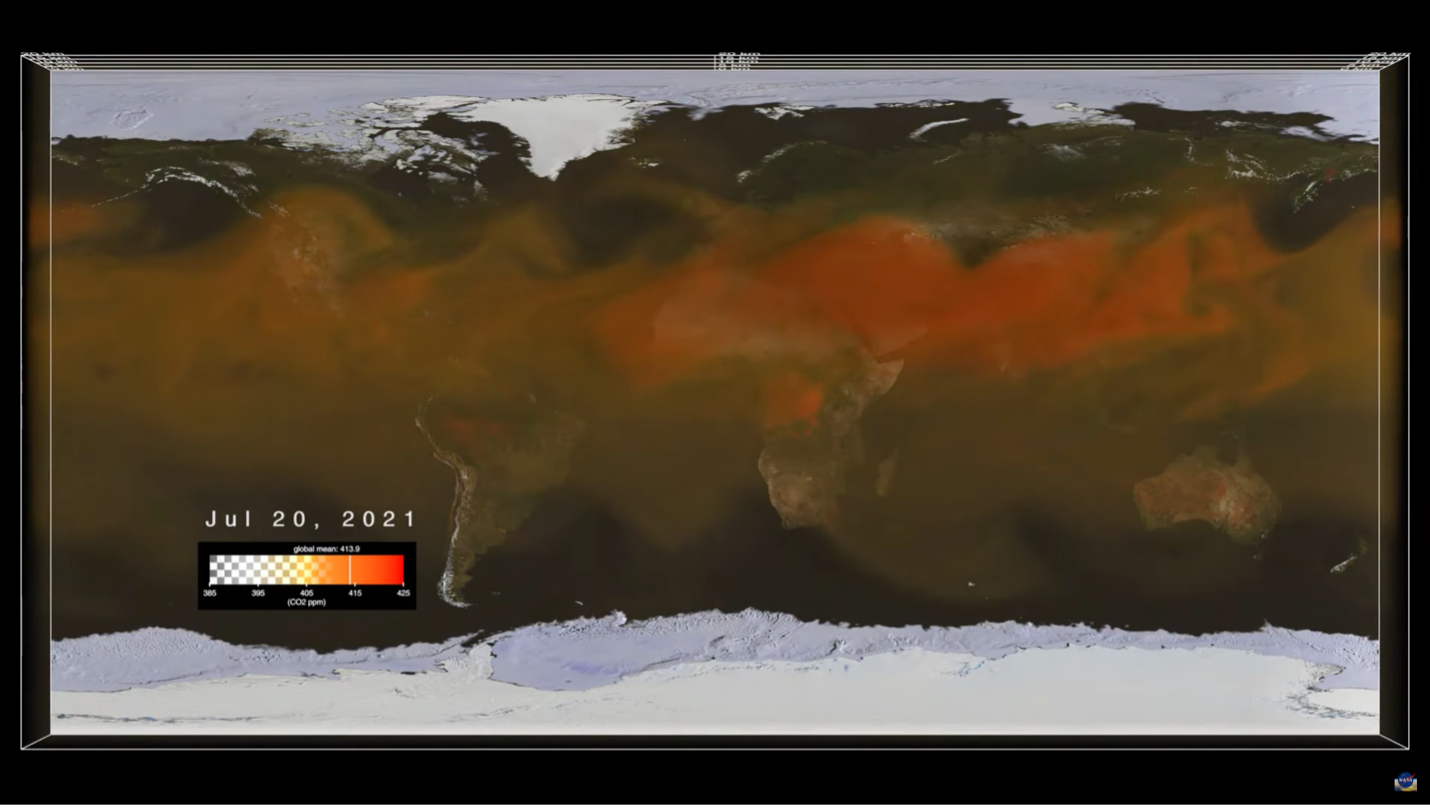
In July, summer, ploughing stops and CO2 concentration gradually falls. (Source: NASA)


