努力小農
本文尚無譯文。
Taiwan's smallholder carbon farming actively responds to the international 4 per 1000 Initiative
Soil is the Earth's largest carbon store. Let's protect soil together and increase soil organic carbon: if soil gains just four per thousand of carbon each year, the excess CO2 emitted by humans can be naturally stored in the soil.
On 8 February 2023 the Taiwan Smallholder Carbon Farming Project formally passed certification under the international voluntary emission-reduction Gold Standard, becoming the world's first smallholder-centred project to increase soil carbon sinks — turning CO2 absorbed by crops through photosynthesis into organic matter; through less tillage, more cover and fewer fertilisers and pesticides, letting soil microbes flourish and storing as much organic carbon as possible in the soil to reduce CO2 in the air; quantified and certified scientifically, and generating carbon credits for international trading.
Soil in peril on all sides
"Our soil has only 60 years left!" goes a saying circulating internationally. Some experts see this as alarmist, but soil loss in some places is already a fact. Large-scale industrial overdevelopment has shrunk forests drastically, and heavy use of pesticides and chemical fertilisers has caused soil loss and robbed soil of its fertility, so it can't feed a growing population. The consequences of the soil crisis are not only famine: soil organic carbon also escapes into the atmosphere, making it a major source of greenhouse gases.
Taiwan's terrain is complex, with abundant, concentrated rainfall and high mountains and fast rivers, unfavourable to accumulating and preserving soil. Part of the rainfall is intercepted and evaporated by ground vegetation and part absorbed by soil; only surplus water becomes surface runoff. As runoff flows over the surface it exerts shear force, detaching, transporting and depositing soil particles — soil erosion. If soil cohesion exceeds the shear force of runoff, no erosion occurs; if it is less, erosion occurs. These are normal phenomena that occur frequently in nature.
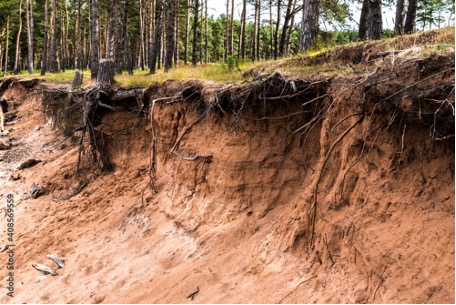
Improper cultivation, deforestation and extreme droughts and floods cause soil loss. Not only does this make agriculture unsustainable, but organic carbon originally stored in the soil escapes into the atmosphere, becoming a major source of greenhouse gases. (Image: licensed from Adobe Creative Cloud)
This natural erosion process recurs all over the world, and Taiwan is no exception. Soil erosion is affected by the surrounding environment; its rate and the amount of soil and water lost vary with the strength of external forces. According to research, soil erosion rates on most of the world's farmland are 1–3.0769 mm (13–40 tonnes) per hectare per year, while on tropical sloping farmland they reach 30.769 mm (400 tonnes) per hectare per year (Pimentel and Kounang, 1998). Without human disturbance, the global average erosion rate isn't high: on flat terrain with good vegetation cover it is 0.0001–0.1538 mm (about 0.001–2 tonnes) per hectare per year, and in mountains with intact vegetation 0.0769–0.3846 mm (about 1–5 tonnes) per hectare per year (Pimentel and Kounang, 1998). (Source: Preventing erosion and protecting soil (https://kmweb.coa.gov.tw/subject/subject.php?id=38704))
Taiwan is an island of complex terrain and abundant rainfall. Long affected by intense human activity and changes in the natural environment, soil loss has been one of its serious environmental problems. According to statistics, Taiwan's land area is about 36,000 square kilometres, of which 23% (i.e. 828,000 hectares) is considered prone to erosion; by this estimate about 220 million tonnes of soil are lost each year on average, causing serious soil and water loss and environmental damage.
With congenital weakness compounded by mistreatment, Taiwan's long-standing overuse of land has led to massive deforestation, hillside farming and construction, worsening bare land and soil and water loss. In addition, excessive fertiliser and pesticide use pollutes, acidifies and degrades soil, further damaging land ecosystems.
To tackle soil loss, the Taiwanese government has taken a number of measures, including vegetation restoration, promoting conservation agriculture, building soil and sand protection works, and strengthening land consolidation. These have eased the problem to some extent, but long-term, active effort and management are still needed to achieve sustainable land use and protection.
International action: World Soil Day and the 4 per 1000 Initiative
5 December each year is World Soil Day (WSD), which focuses attention on the importance of healthy soil and advocates the sustainable management of soil resources.
The International Union of Soil Sciences (IUSS) recommended an international day for soil in 2002. Under the leadership of Thailand and within the framework of the Global Soil Partnership, the FAO supported the formal establishment of World Soil Day as a global awareness-raising platform. The FAO Conference unanimously endorsed World Soil Day in June 2013 and requested its official adoption at the 68th UN General Assembly. In December 2013 the UN General Assembly responded by designating 5 December 2014 as the first official World Soil Day.
A year later, at the 21st Conference of the Parties to the UN Framework Convention on Climate Change in Paris, the French agriculture minister proposed the "4 per 1000 Initiative": if humanity increased soil carbon by four per thousand each year, the excess carbon emitted by humans could be balanced back into the soil.
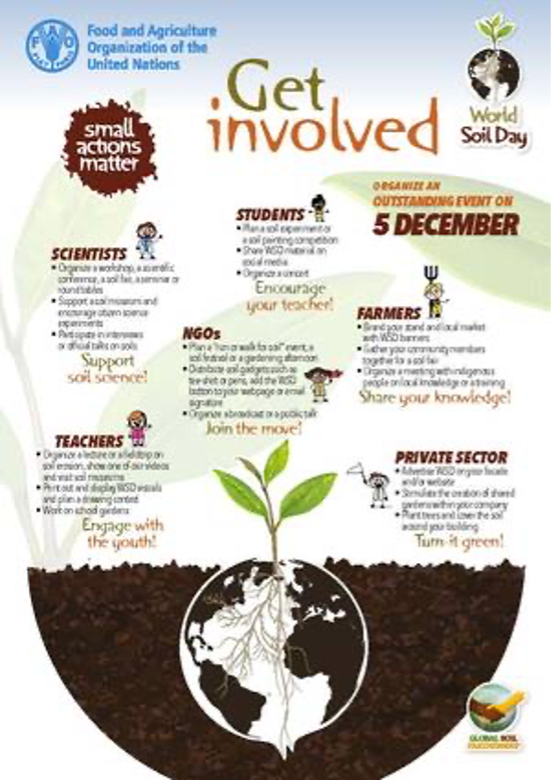
UN World Soil Day poster
Why are we talking about the "4 per 1000" Initiative?
The international "4 per 1000" Initiative encourages stakeholders to engage in a transition towards regenerative, productive, highly resilient agriculture, based on appropriate land and soil management, creating jobs and incomes and hence ensuring sustainable development.
It aims to show that agriculture can provide concrete solutions to the challenges of climate change, while meeting the challenge of food security through implementing farming methods adapted to local conditions: agroecology, agroforestry, conservation agriculture, landscape management and more.
The Initiative helps carry out concrete actions on the ground, benefiting farmers and herders who are first affected by land degradation, as well as the wider world population.
The executive secretariat of the international "4 per 1000" Initiative is hosted by the Alliance of Bioversity International and CIAT in Montpellier, France.
The 4 per 1000 Initiative: soils for food security and climate
Soils for food security and climate. Human activities release large amounts of carbon dioxide (CO2) into the atmosphere, intensifying the greenhouse effect and accelerating climate change. Each year, plants recover 30% of this CO2 through photosynthesis. Then, when plants die and decompose, soil organisms such as bacteria, fungi and earthworms transform them into organic matter. This carbon-rich organic matter is essential for human food because it holds water, nitrogen and phosphorus, which are essential for plant growth.
The world's soils contain two to three times more carbon than the atmosphere. Increasing this carbon stock by 0.4% a year — four per thousand of carbon in the top 30 to 40 cm of soil — would halt the increase of CO2 in the atmosphere. This is the proposal of the 4 per 1000 Soils for Food Security and Climate Initiative.
So increasing carbon storage in soils not only helps stabilise the climate but also helps ensure food security — enough food for everyone. Policy measures must be put in place to reduce deforestation and encourage agro-ecological practices that raise soil organic matter content and reach the target of four per thousand a year: for example, avoiding leaving soil bare to limit carbon losses, restoring grasslands and degraded forests, planting trees and legumes capable of fixing atmospheric nitrogen in the soil, using manure and compost to feed the soil, or letting water collect at the base of plants.
The targets are the world's 570 million farms and more than 3 billion people living in rural areas, who can implement these practices. Restoring agricultural soils would cost a few tens of dollars per hectare, though agroforestry and reforestation require more investment. Carbon storage in soils will continue for 20 to 30 years after good practices are implemented, as long as they are maintained under the 4 per 1000 Initiative. Researchers are working with farmers' associations, economic stakeholders, regions and states to achieve food security.
Taiwan's smallholders are also part of the international effort to increase soil carbon sinks. We need to work together to spare future generations from the catastrophe of global climate change. Acting now can give us organic soil, good agriculture and safe food.
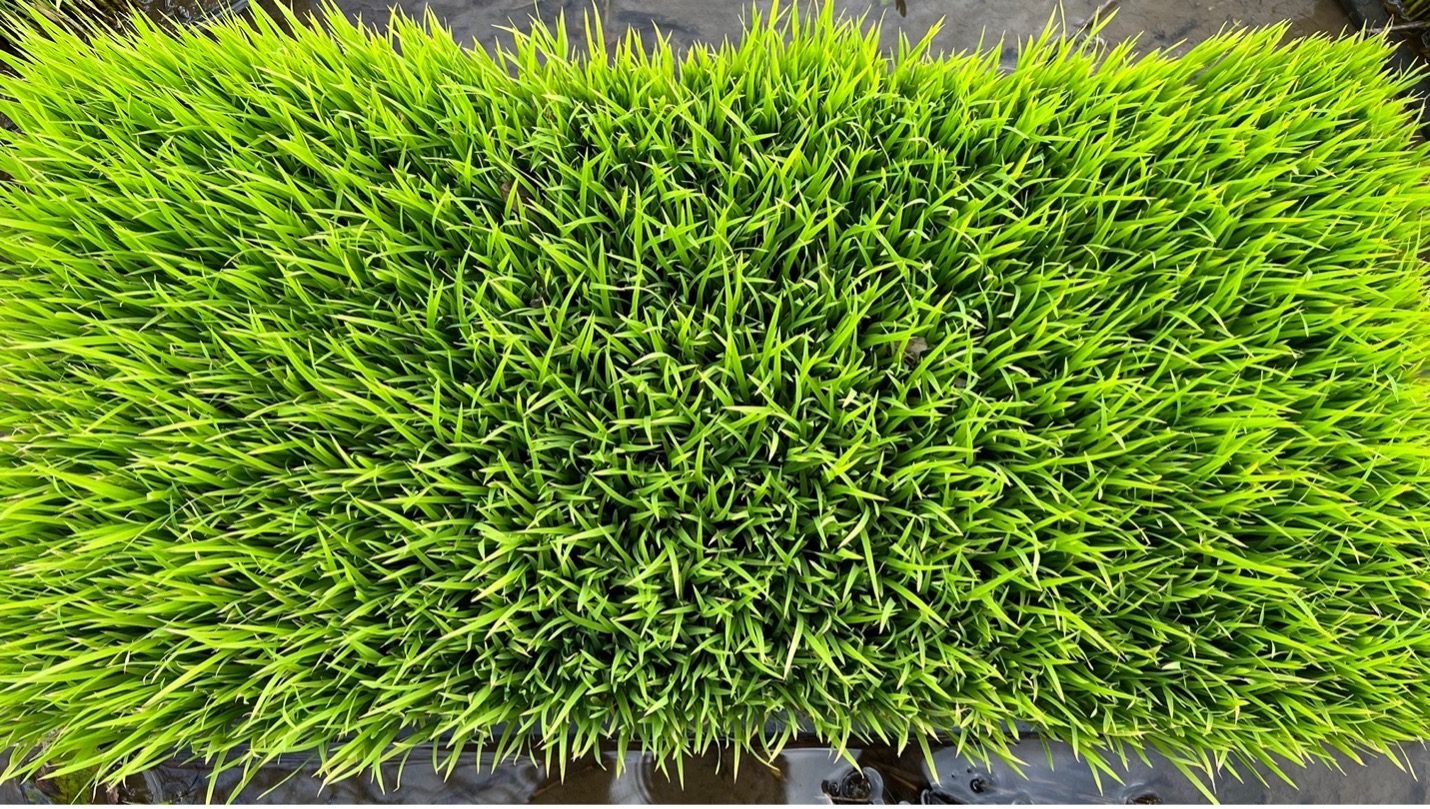
Plant photosynthesis has been the Earth's best way of reducing carbon for over a billion years: it absorbs atmospheric CO2 so the Earth doesn't overheat, and turns CO2 into food for animals, nourishing the land. Today we must return to the most basic and most important action: farming carbon back into the soil. (Photo: Jay Fang)