努力小農
本文尚無譯文。
Soil's thousand-year bond
A beautiful, poignant Zen story may be the thousand-year wish of every grain of soil beneath our feet.
Ananda said to the Buddha: "I have fallen for a woman." The Buddha asked Ananda: "How much do you love her?"
Ananda said: "I would become a stone bridge and endure five hundred years of wind, five hundred years of sun and five hundred years of rain, just so that she might walk across it."
The story also inspired Hsi Mu-jun's poem "A Tree in Bloom", in which the speaker is turned by the Buddha into a tree beside the road the beloved must pass, carefully covered in blossoms that carry the longings of a past life.
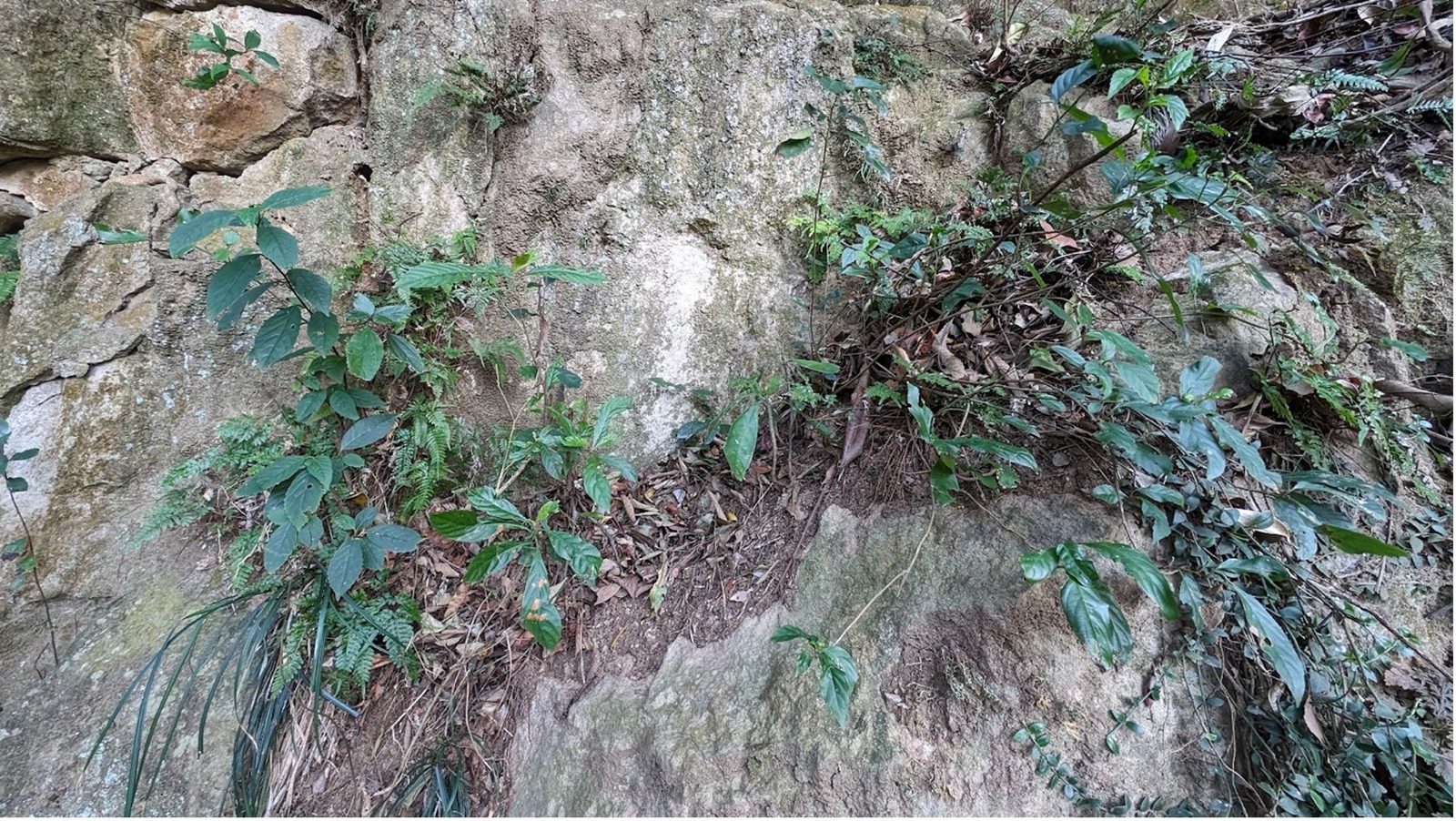
A green sapling bursting from the andesite of Yangmingshan grows on a thin layer of soil. That centimetre of soil took at least a thousand years of rock weathering in symbiosis with microbes, mosses and ferns — just as the stone bridge endured 1,500 years of wind, sun and rain to earn its bond with the little tree. (Photo: Jay Fang)
How did precious soil become a bad thing?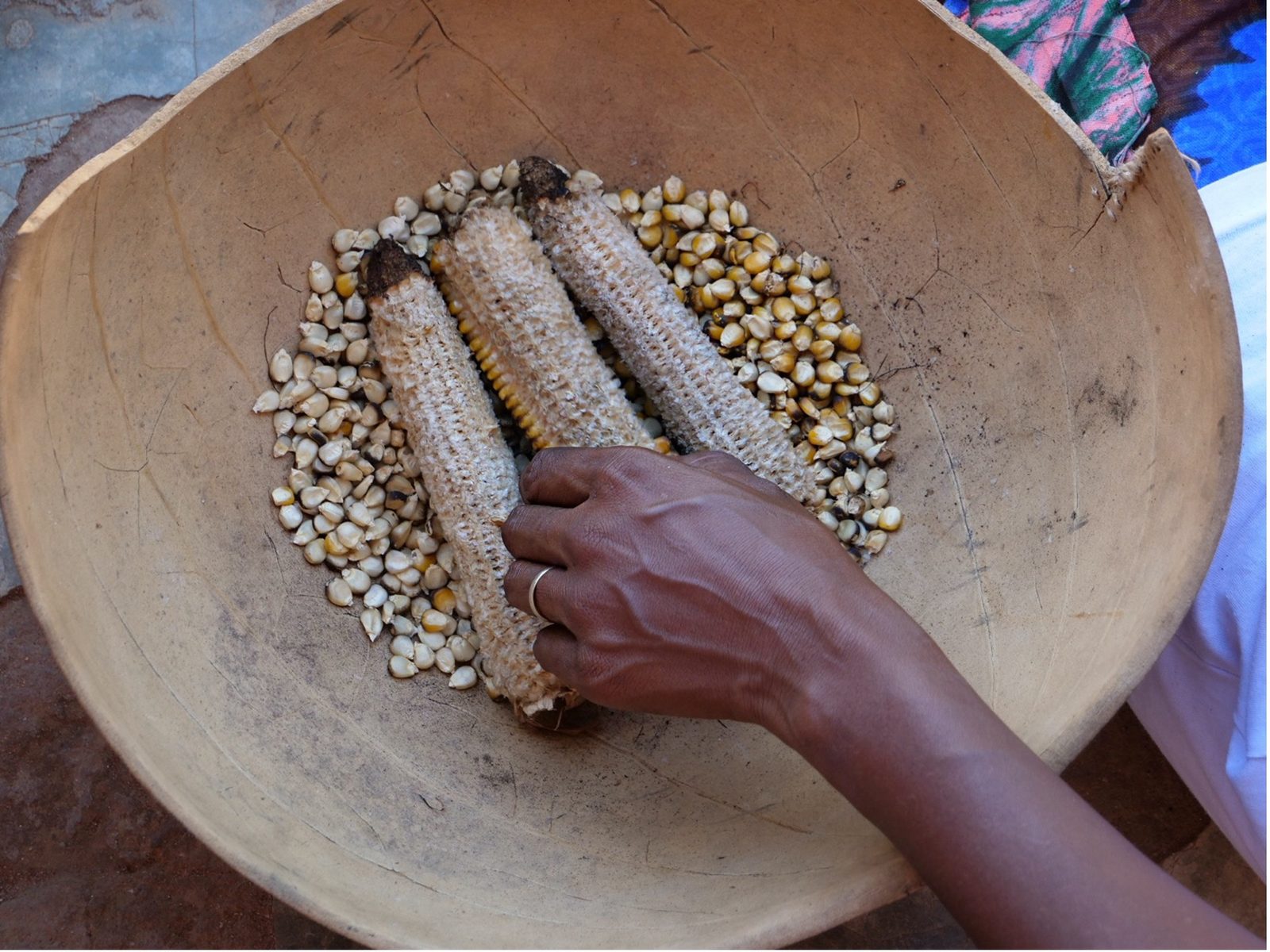
In rural Kenya, the Soil Doctors programme helps local farmers grow maize and improve food production. © FAO/Eva Gilliam.
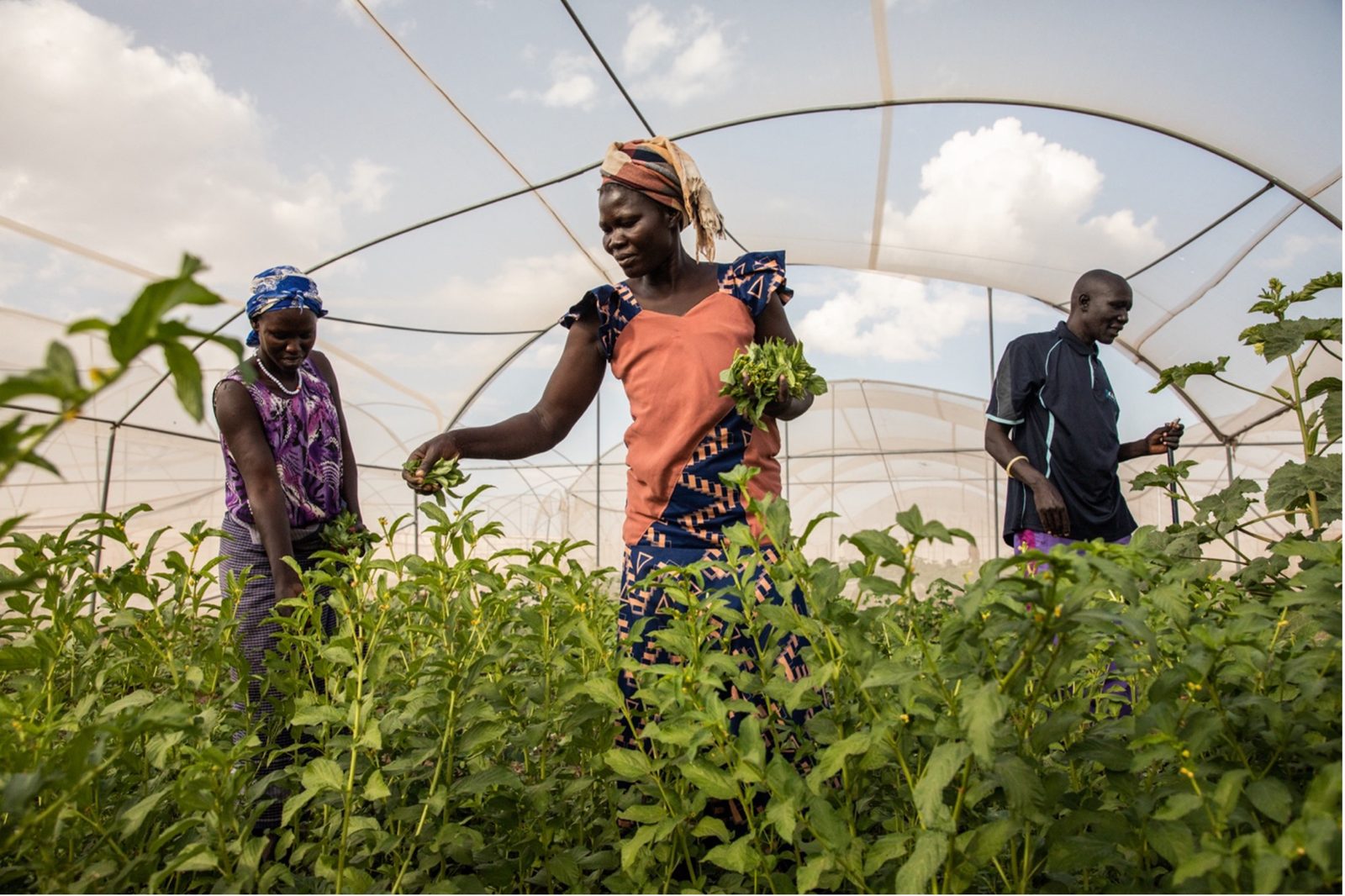
The FAO's Global Soil Doctors Programme helps refugees in Kenya address food security in their local communities. © FAO / Vincent Tremeau
Soil is the most familiar thing of all, and the source that nurtures life on land, yet we treat it as filth — dirty, teeming with germs and full of frightening things. If food falls from a child's hand onto the ground, the mother immediately tells the child not to pick it up and eat it.
Yes, this is our attitude to soil: we don't care about it, we look down on it, we take no notice of it at all, and we heap discriminatory language and insults on it. Even Confucius said, "A wall of dung and earth cannot be plastered." Being called a "clod" or "earthy-headed" is never a compliment.
Yet in the Five Elements, earth's status is far from low. Although it comes fifth after metal, wood, water and fire, in directions and colours it is noble: east is green wood, south red fire, west white metal, north black water, and the centre yellow earth. Earth occupies the central core position and has the imperial colour yellow — supremely noble. In the cycle of the Five Elements, earth is born of water and wood is born of earth; it is also a source of life.
From July this year we will run the FAO's Global Soil Doctors Programme, helping farmers communicate with, learn from and grow with one another, starting from the soil. In four years of dealing with farmers, most have focused on physical and chemical means — equipment, chemicals — to control pests and diseases and increase yields; few mention soil. Even among organic or eco-friendly farmers, if you ask for their soil fertility test reports for the past five years and their organic matter content, few can tell you, or the data have been lost.
Soil forms extremely slowly. Scientists estimate that turning the basalt of a bare volcano into soil takes 61,500 years; in an ordinary forest it still takes a thousand years. On the andesite of Taipei's Yangmingshan volcano, 20 cm of humus takes 20,000 years. Soil is in fact a crystallisation of the essence of heaven and earth, the wellspring of survival and development for life on land.
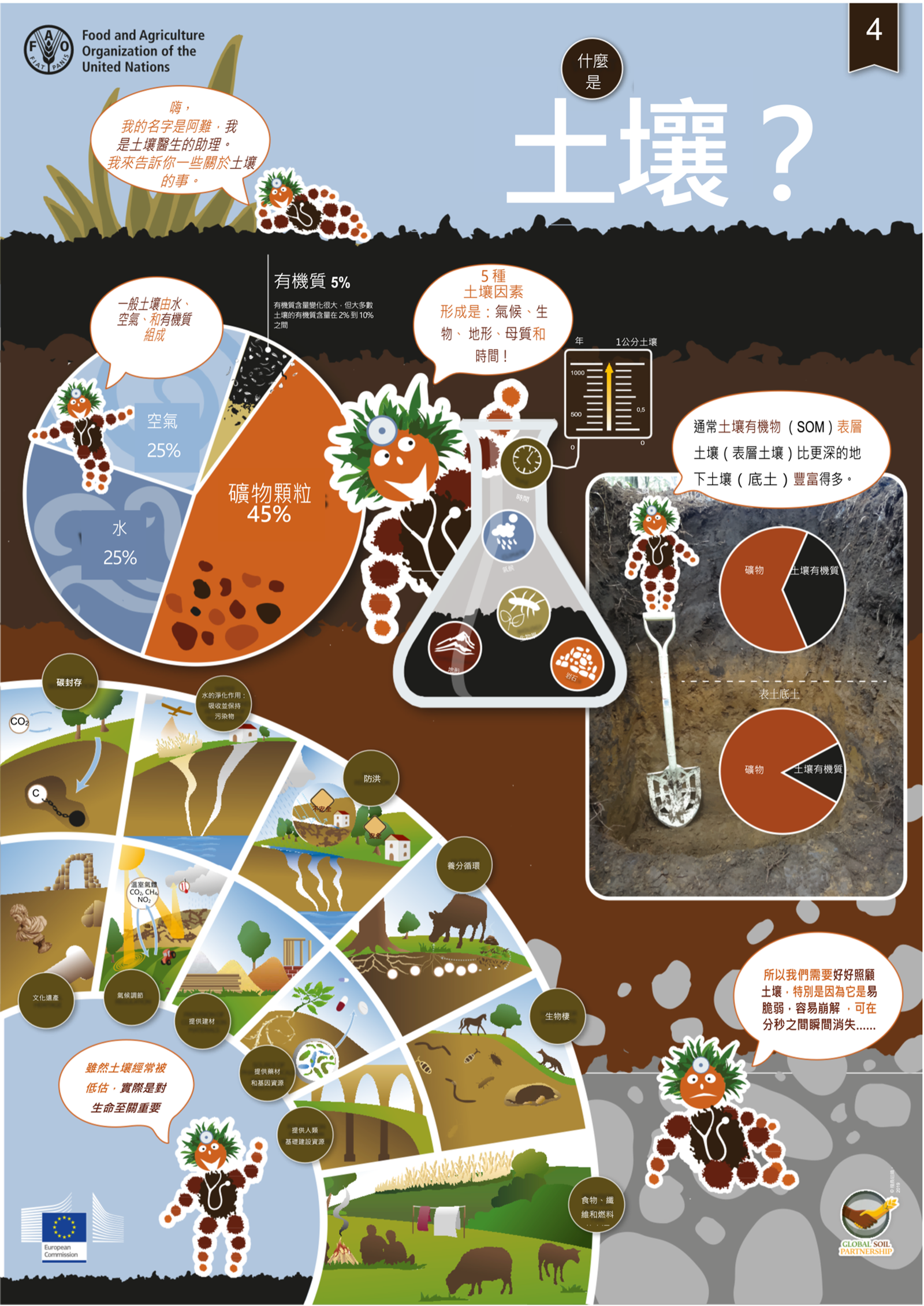
The first lesson of the Global Soil Doctors Programme, "What is soil?", introduces soil's composition: in general, air makes up 25% of soil, water 25%, mineral particles 45% and organic matter 5% (usually between 2 and 10%). Five factors are needed to form soil: 1) climate, 2) organisms, 3) topography, 4) parent material (the original rock) and 5) time.
It took Taiwan three million years to develop today's rich variety of soils
Taiwan lies at the junction of the Eurasian, Pacific and Philippine Sea plates and was uplifted by the pressure of these three plates. It is generally thought to have emerged from the sea about three million years ago and is rising by about 4 cm a year. Its geology is young and fragile with many faults. Under the US soil taxonomy, the Earth has 12 soil orders; Taiwan has all of them except permafrost soils — eleven in total.
| Name | Overview | Main distribution |
| Taiwan's eleven soil orders | ||
|
Histosols |
Mostly peat or muck soils, strongly acidic, poorly drained | Humid high-mountain primeval forests, around high-mountain lakes |
|
Spodosols |
Have a layer of organic matter combined with iron and aluminium; strongly acidic, poor aeration and permeability | High mountains |
| Andisols (volcanic ash soils) | Soils with volcanic-ash properties, strongly acidic and rich in aluminium |
Yangmingshan |
| Oxisols | Long leached and weathered, rich in iron and aluminium oxides, kaolinite and quartz; low fertility | Alluvial terraces (Yangmei, Puli, etc.) |
| Vertisols | Igneous rock mixed with mudstone; retains nutrients and water, high clay content, poor permeability | East |
| Ultisols |
Found in hot, rainy places; weakly acidic, low base reserves, poor fertility |
Hills and terraces (Zhongli, Linkou, Dadu Mountain, Luye, etc.) |
| Mollisols |
Rich in organic matter and base cations, well-developed structure, fertile | Coastal terraces of the eastern Coastal Mountain Range (Fengbin in Hualien, Chenggong and Changbin in Taitung, etc.) |
| Alfisols | Less leached than ultisols, with higher base-cation content | Western alluvial plains (Xinying, Liuying, Shanhua in Tainan, etc.) |
| Inceptisols |
Slightly to moderately developed soils |
Western alluvial plains (Zhunan, Changhua Plain, Chianan Plain, Kaoping Plain, etc.) |
|
Entisols |
Newly formed mineral soils of about 30 cm; fertile |
Steep slopes, river mouths |
| Aridisols |
Main soils of arid areas, rich in salts and clay, dense and hard |
Southwest (saline coastal areas of Chiayi, Tainan, etc.) |
Soil science is a complex, multidisciplinary science. Beyond the basic sciences of biology, chemistry and physics, it carries much human value — as the saying goes, each place's water and soil raise its own people. The black mollisols of the north are very fertile and the people there are tall and big, while the south's land is relatively poor and people tend to be shorter. Different soils nurture different crops and livestock, giving rise to distinctive local food cultures — all closely tied to soil. Even though Taiwan is only three or four hundred kilometres long and a hundred kilometres wide, the Central Mountain Range and hills separate different landforms and soils, creating differences in ingredients and seasons from north to south and east to west, and naturally evolving different food cultures.
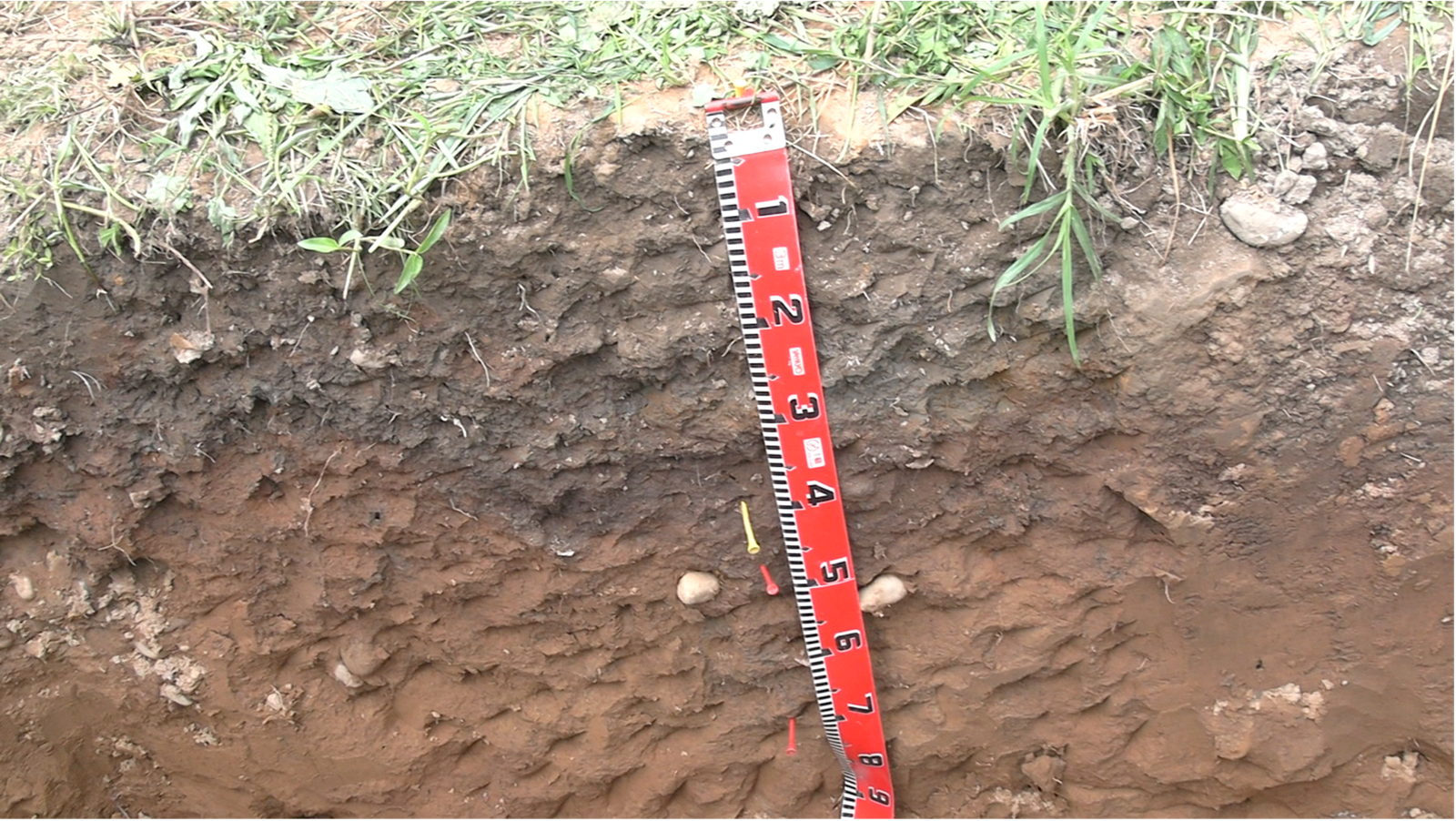
Dig into the ground: the top 20 cm is topsoil, looser and rich in organic matter; the subsoil below is harder, with stones. (Photo: Jay Fang)
Most ordinary lowland farmland in Taiwan was deposited by rivers. In Hualien and Taitung, crustal compression is intense, earthquakes are frequent and large, and landslides and debris flows often wash rocks from the high mountains downstream. So land in the Huadong Rift Valley along Provincial Highway 9 is stony with thin soil, and soil has to be brought in from elsewhere; the coast along Highway 11 is even narrower, making rich soil still harder to form. Interestingly, though, the most fertile mollisols are found on the east side of the Coastal Mountain Range — though reportedly they are no longer intact. The geology of the western Chianan Plain is relatively stable and its soil layer thicker; because rivers have been depositing sediment there longer, the soil is more fertile. On the other hand, because the Central Mountain Range blocks the afternoon sun, land in the west is more productive than in the east.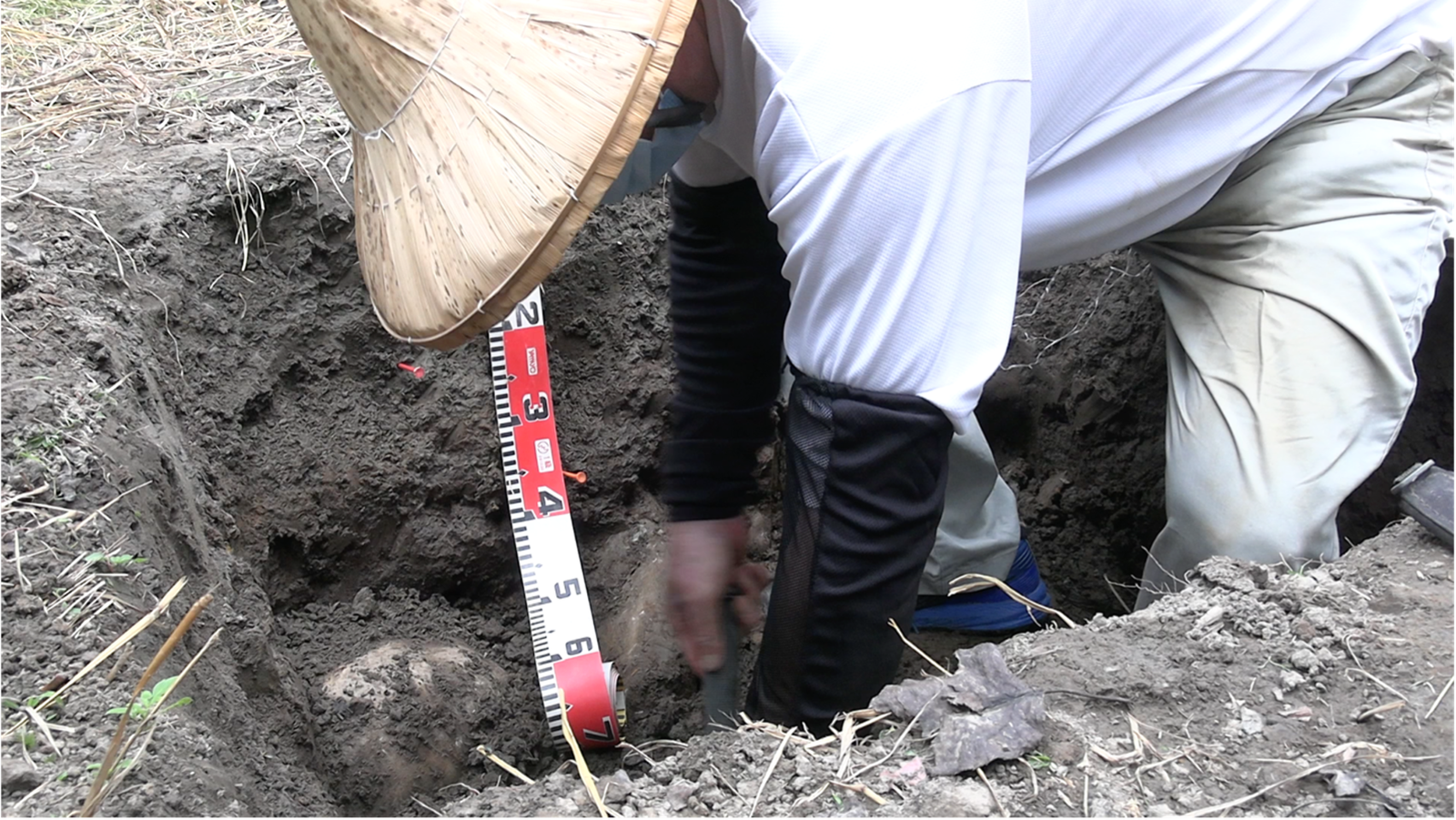
Professor Chen Tsun-hsien has surveyed soils around the world for decades and knows Taiwan's soils inside out. At an orchard in Dongshi he explains how soil forms and its benefits; the pebbles 50 cm down are the former riverbed of the Dajia River. (Photo: Jay Fang)
Witnessing together how soil makes trees bloom
I once watched soil science doyen Professor Chen Tsun-hsien dig three feet into the ground in Dongshi, Taichung, and explain in detail how the soil formed. In many parts of Dongshi, 50 cm down is all pebbles from the former bed of the Dajia River — a deep sense of how seas become mulberry fields, of Taiwan's geographical miracle, of the toil of the pioneers who cleared the land by hand, and of today's farmers' hard-working spirit as they contend with heaven and earth. Of two adjacent plots, one farmed organically for many years and the other conventionally with chemical fertilisers and pesticides, the lower layers were not very different, but the organic plot's topsoil was dark with organic matter, with abundant crumb structure tightly bound to the crops' roots and lively earthworms wriggling through it, full of life; the conventional plot's soil was paler and lifeless. The organic orchard's harvest already exceeds the conventional one's, its prices are considerably higher, and the fruit tastes noticeably richer.
Soil organic matter is an important indicator of soil quality. After years of chemical fertilisers, pesticides and heavy machinery, soil is seriously depleted, and no amount of fertiliser can bring back its former fertility, because constant physical and chemical disturbance wipes out the microbes, earthworms and other small creatures in the soil. These living organisms are the important source of soil organic matter, because they break down and absorb organic matter from plant metabolism and the remains of animals and plants, forming long-lasting organic matter such as humic acids and humus.
On the other hand, organic matter is neutral or weakly alkaline, a good soil "buffer": whether soil is acidic or alkaline, it moderates and neutralises it, keeping soil pH from swinging wildly and harming crop growth.
Organic matter is like a sponge, absorbing and retaining water well. It can store water and prevent floods, and also ease water shortage in the dry season — an irreplaceable lifesaver in the face of today's global climate change.
We hope the coming Soil Doctors programme will help smallholders understand the properties of their own soil better — not only increasing yields and output value, but also contributing to net-zero carbon and reducing the harm climate change does to them.