努力小農
本文尚無譯文。
Back to the soil to rescue the future: fulfilling our duty as global citizens, starting with the Global Soil Doctors Programme
Soil is the source of life on Earth's land, yet we know less about soil than about outer space. (Photo: Jay Fang)
We humans are the Earth's "disease"
We often hear people say "the Earth is sick!" or "the Earth has a fever" to describe the human-made problems facing the planet we live on. Everyone wants "high-tech" solutions — nuclear power, carbon storage, green energy, pumping CO2 deep into the Earth's crust — which mostly cost a fortune, carry high risks and cannot last: troubles of our own making.
CO2 is not a "pollutant" in the usual sense, but a metabolic gas produced by every breathing creature — by ourselves. It is just that too much is emitted, which "harms" the Earth; it is not a "poison". It is like treating cancer — surgery, chemotherapy, radiotherapy, immunotherapy — where what we face is our own body's tissue multiplying uncontrollably.
To face this problem, we must consider how the 4.6-billion-year-old Earth became today's ecology, which for the past tens of thousands of years has been "fit for human" survival. In fact it is the result of photosynthesis, which appeared 1.5 billion years ago. Starting with prokaryotes with chlorophyll-like pigments such as blue-green algae, photosynthesis absorbed the dense CO2 in the atmosphere into the soil, and sealed the remains of animals and plants in the Earth's crust as solid coal, liquid oil and gaseous natural gas.
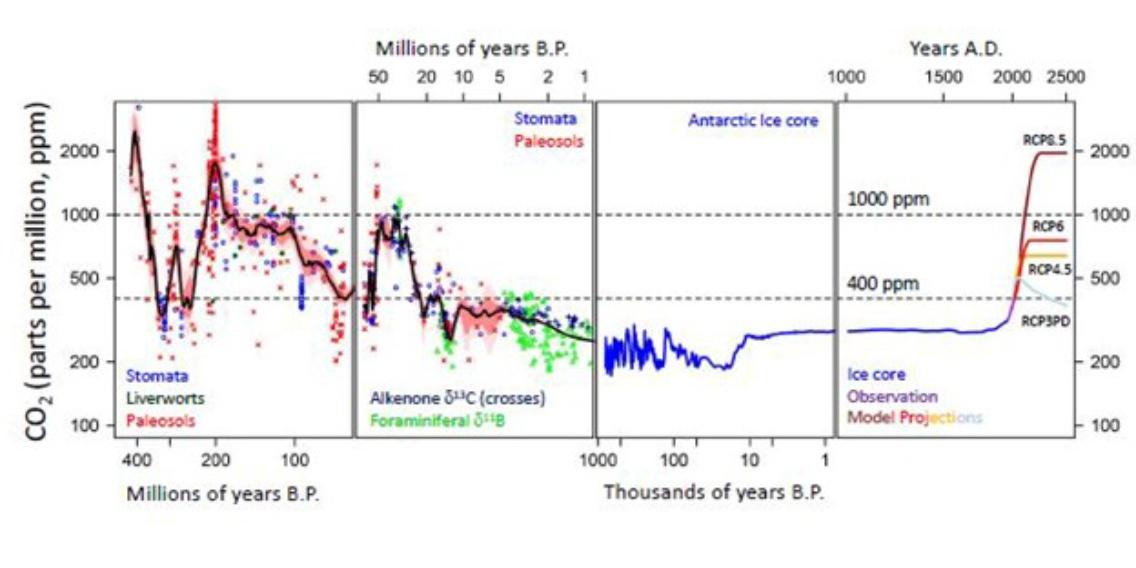
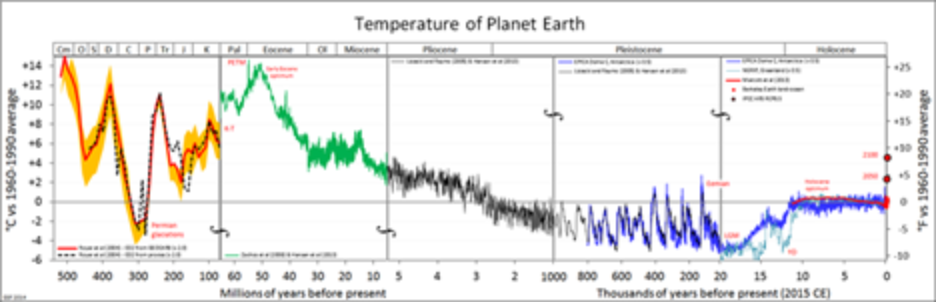
Scientific data showing changes in CO2 concentration and temperature over the past 400–500 million years. (Source: https://reurl.cc/MjddMm)
After the Industrial Revolution more than 200 years ago, massive extraction of fossil fuels burned the carbon sealed in the crust tens of millions of years ago back into CO2, causing the greenhouse effect, as everyone knows.
We know less about soil than about the universe
Over the past 10,000 years, agriculture has also released organic carbon from the soil. Soil organic carbon is estimated at 1.5 trillion tonnes — organic matter from hundreds of millions of years of plant photosynthesis and metabolism combined with microbes in the earth to form soil. Research has found that a gram of soil contains millions of species of microbes, numbering up to a hundred billion (varying enormously between soils), and fungal hyphae alone may stretch a kilometre. These endlessly reproducing microbes, passed down generation after generation, really are the carriers that keep soil organic matter alive — almost unimaginable, like the way we may never know how many stars there are in the universe.
Many people overlook organic matter in the soil. Over the past four years I have visited hundreds of smallholders, many of them believers in organic farming, but when I ask them how much organic matter their soil contains, they often cannot answer.
The amount of organic matter in soil can be said to be proportional to the soil's sustainability. Primeval forest may have over 20% organic matter, while ordinary farmland has only 2%. More organic matter is not always better, but soil without organic matter (under 1%) can grow crops and give good harvests only with heavy artificial fertilisation.
Because the Taiwan Smallholder Carbon Farming Project must provide participating farmers with at least six hours of training a year, we applied to the UN Food and Agriculture Organization (FAO) to become the Taiwan advocacy body for the Global Soil Doctors Programme of the Global Soil Partnership. In March this year we were given approval to use the programme's Global Soil Doctors (GSDP) lesson plans, teaching materials and assessment methods, to report results to the FAO GSDP, and to obtain certificates.
The programme is very popular in the developing world because it is low-cost, the materials are simple and easy to implement, and it is "farmer-to-farmer dialogue", adapted to people and places so that it works well.
Especially in Taiwan, where land varies enormously, it is hard to explain soil properties clearly without long-term observation and research. The Global Soil Doctors Programme uses simple posters and easy-to-understand content to teach farmers how to observe and understand their own soil, in three parts — physical, chemical and biological — with 28 posters in total. The lesson plans, practical tests, performance assessments and report formats were all built over many years by FAO experts and smallholders in various regions.
I am not an agricultural professional, still less someone who could teach farmers how to grow crops or raise animals. But I believe that whatever farming method farmers use (and there really is a bewildering variety, far more than the classic "eight schools"), they can all use the most basic methods to identify their own soil's characteristics — a science-based help to all kinds of farmers.
The Global Soil Doctors Programme is the redemption of the UN's Green Revolution
We hope this will be a free course, so that all farmers — and even non-farmers — can understand the soil beneath our feet. Soil is the wellspring of our life; without adequate knowledge of soil, we cannot manage farming.
Sustainable soil management (SSM) has been FAO's mainstream for the past 20 years. Don't forget that when the UN was founded in the 1950s, a wave of "Green Revolution" swept the world, bringing the war industries "demobilised" after World War II into farming — "land for returning soldiers" — and introducing war industry into agriculture. Tanks became tillers, poison gas became pesticides, and the nitric acid used to make bombs became nitrogen fertiliser, poured onto farmland by the hundreds of millions of tonnes. It was like an agricultural myth of bodybuilders raised on antibiotics, vitamin pills, steroids and gym machines. Seventy years later, humanity collectively faces a sustainability crisis of climate, population and food. (In fact Taiwan's population is shrinking — perhaps the only cruel and realistic "solution", which we are thoroughly implementing.)
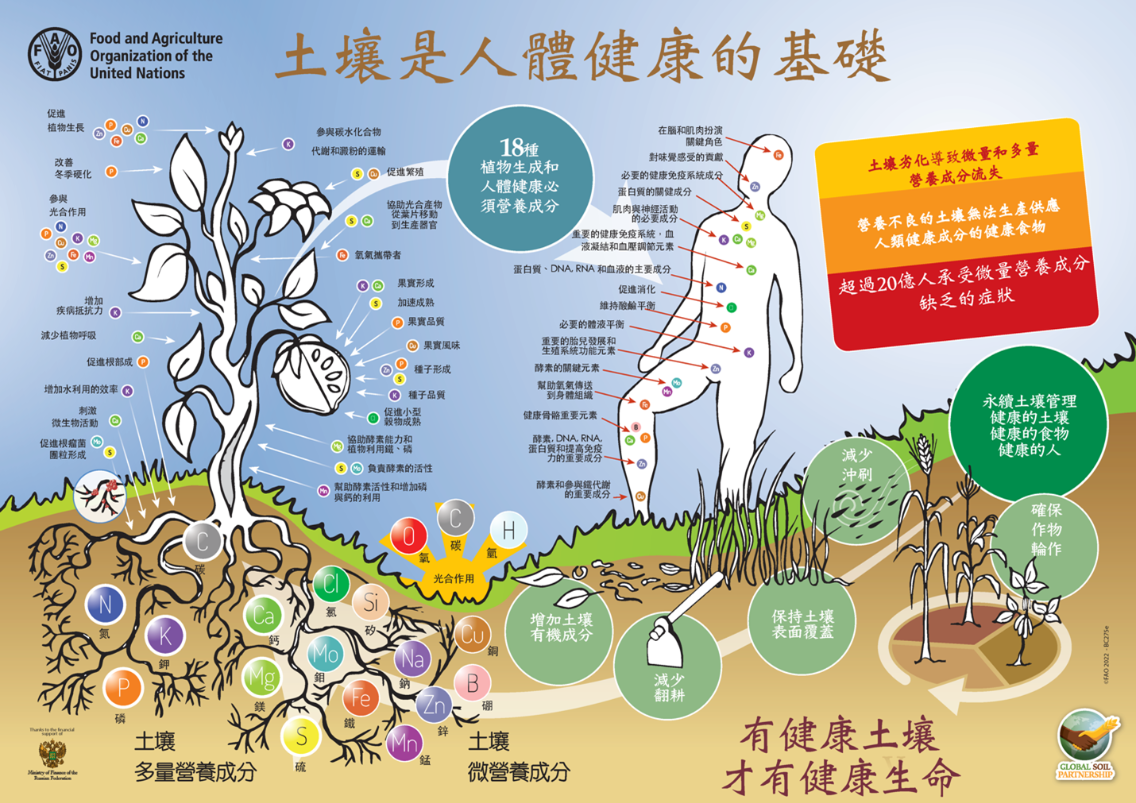
Rather than "you are what you eat", it's "you are your soil". Almost every element in our bodies comes from soil, because over 95% of food originates in soil. Only by protecting soil can we protect our "body and land". (Image: UN Global Soil Partnership)
We believe starting from soil is a good way to strengthen the foundations. While researching, we happened to find that the source of it all is the FAO's Global Soil Partnership strategic plan, of which Global Soil Doctors is just one important tactical programme. So we applied to the FAO to become a member. Because Taiwan is not a member state, it took four or five months of negotiations before, in March this year, we were authorised to use its materials, logo and name to develop the programme in Taiwan according to its guidelines — perhaps the beginning of fulfilling our duty as global citizens.
We hope Soil Doctors can give farmers in smallholder carbon farming a common set of teaching materials. Farmers outside smallholder carbon farming are also very welcome to join, because soil is the crystallisation of the life, death, rise and fall of all living things on Earth since time immemorial, and the property of our future descendants; we must look after it well and pass it on.
To sign up as a Global Soil Doctors Taiwan advocate / seed teacher / soil doctor
please fill in the registration form: https://reurl.cc/ey88DQ
Facebook: facebook.com/mihumisang.org
LINE group link: https://line.me/ti/g/sFJHD42dx_
YouTube video of the first information session:
For details see the following pages:
Global Soil Partnership
Global Soil Doctors Programme
Note:
Translation of the 28 Global Soil Doctors posters is complete; please review them and suggest improvements. They can be downloaded from cloud storage:
Microsoft OneDrive
Google Drive
Taiwan Smallholder Carbon Farming Global Soil Doctors information: https://reurl.cc/Dl66lR
Source: CM Media ( https://www.cmmedia.com.tw/home/articles/48477 )