 努力小農

本文尚無譯文。
Can a big clean-up of the carbon market solve the global crisis?
Several research institutions affirm that agricultural carbon reduction — especially soil carbon sinks — will be a redemption for reducing industrial emissions and should be promoted. (Image: Akil Mazumder @ pexels)
Just as Taiwan has recently been carrying out a "big clean-up" against corruption, organised crime and fraud, with many god-like big shots falling from their pedestals overnight, the international carbon trading market — long notorious for crime — has spent the past two years seriously dealing with fraud and falsehood, hoping to clear out the problem of bad money driving out good in the future emission-reduction market. How effective this will be remains to be seen.

With global climate change, many people are seizing the chance to profit from disaster. Weather and climate are inherently changeable, and with human greed added, many people can't be optimistic about the future of global warming. (Photo: Jay Fang)
Big trouble in carbon trading!
On 6 August, the Integrity Council for the Voluntary Carbon Market (ICVCM) issued a statement saying that carbon credits under current renewable-energy methodologies will not receive the high-integrity CCP® (Core Carbon Principles) label. Some 236 million unretired carbon credits issued under existing renewable-energy methodologies — nearly a third of the voluntary carbon market — will not be able to use its high-integrity CCP® label. (Note: one carbon credit is one tonne of CO2 reduction.)
Since COP27 at the end of 2022, the UN Secretary-General has committed to anti-greenwashing and to driving large amounts of poor-quality carbon credits lacking integrity out of the market. That year the voluntary carbon market reached a peak of US$2 billion, with a market size of 516 million tonnes of CO2 equivalent, and the outlook seemed rosy — but it was full of bad credits driving out good.
The UN's anti-greenwashing call did take effect. In early 2023 the UK's Guardian revealed that rainforest projects in South America certified by Verra, the largest carbon credit certifier, had turned out worse than doing nothing. This caused the international nature-based carbon sink market to collapse: global warming has now reached an irreversible point, and if these emission-reduction certifications are false, it is not only fraud but condemns humanity's future.
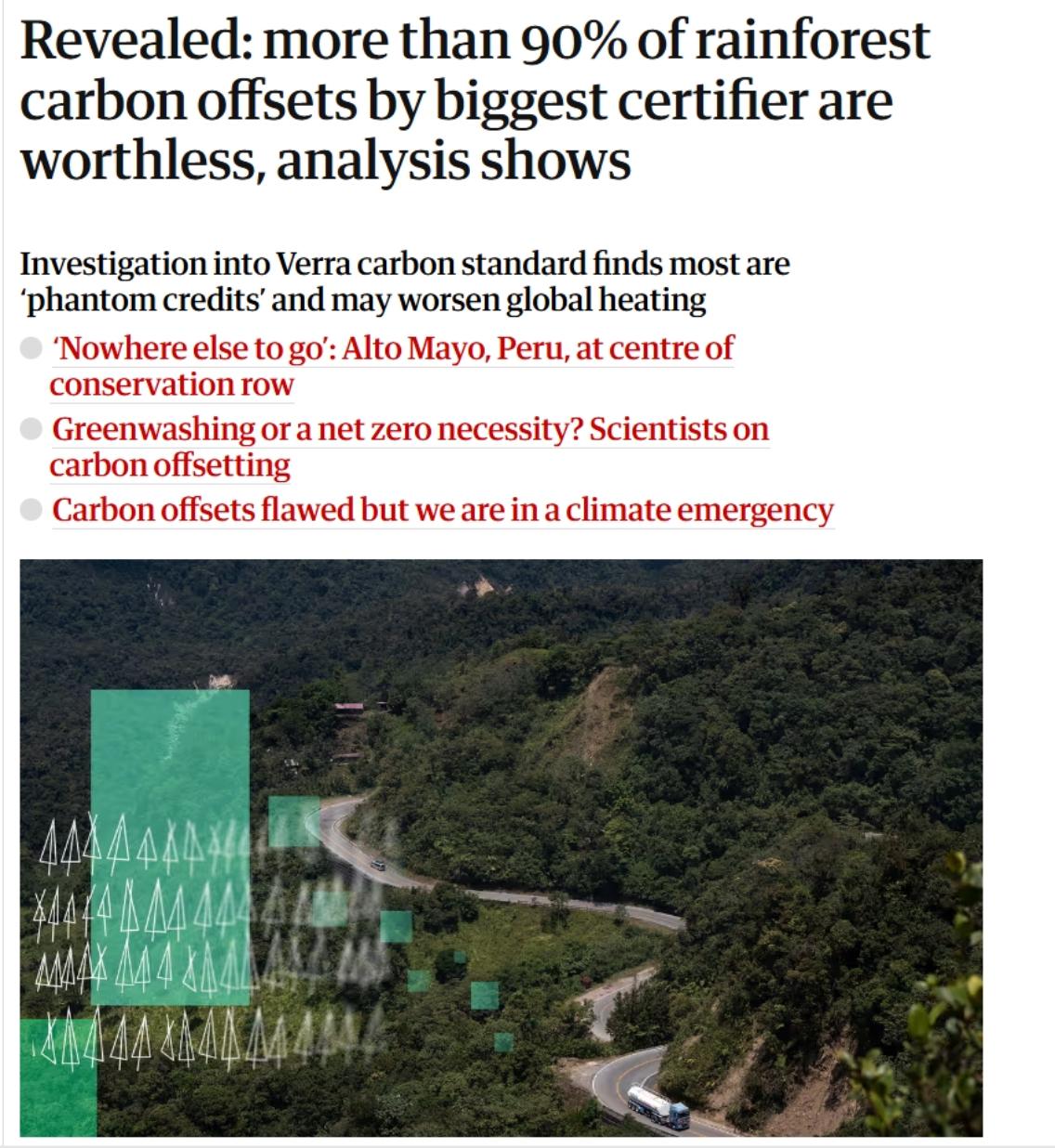
The Guardian revealed analysis showing that more than 90% of rainforest carbon offsets by the biggest certifier are worthless. (Source: The Guardian website)
Verra's CEO later stepped down and its board was reorganised, but this dealt a heavy blow to the voluntary carbon market. Over the next two years global voluntary-market volumes plummeted, halved and halved again to only a fifth of their former level — very grim, but well deserved.
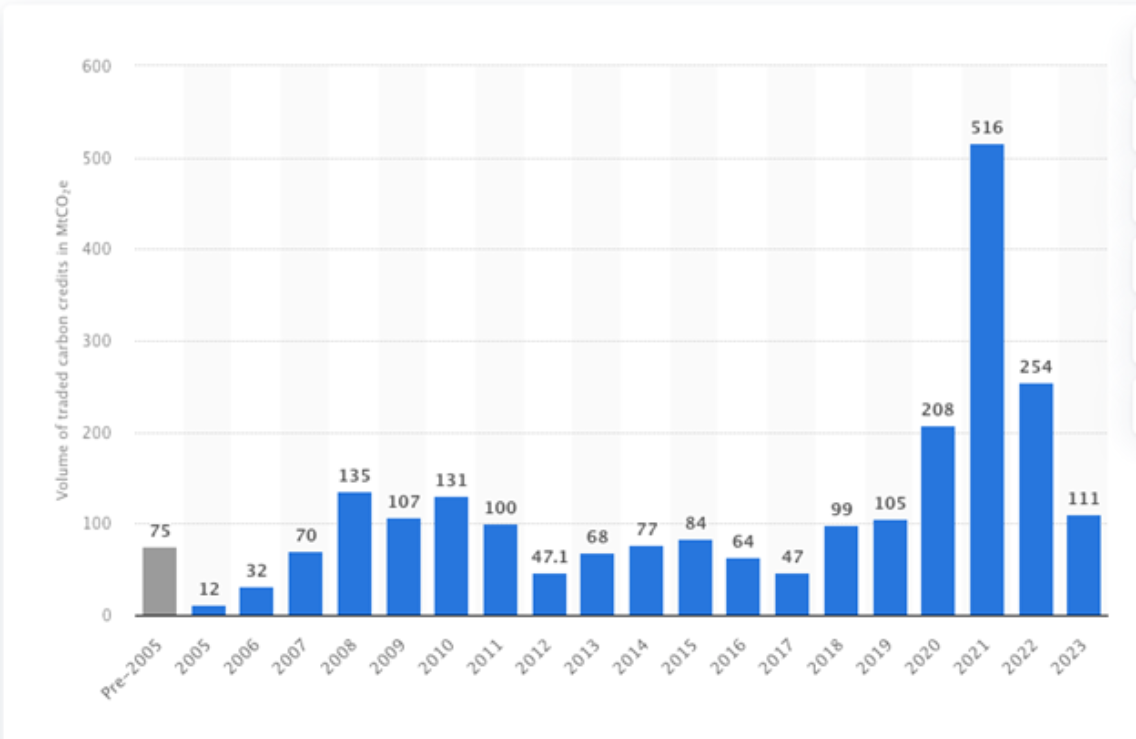
Changes in the voluntary carbon market from 2005 to 2023. (Source: Statista, Annual total voluntary carbon market (VCM) transaction volume worldwide from pre-2005 to 2023)
Can great destruction and great construction rescue the future?
Without great destruction there can be no great construction. The earlier carbon trading system, the UN Clean Development Mechanism (CDM), launched in 2005 and was for a time hugely popular, but too much fraud led to a collapse of credibility and its end in 2012 — a cautionary precedent.
Since 2015 the Paris Agreement has set new mechanisms for carbon markets, because mandatory emission reduction through law alone can sometimes cause bigger problems, especially in agriculture with its vast numbers of smallholders (over 80% of the agricultural population). In recent years the Netherlands and New Zealand imposed mandatory measures on agricultural emissions, causing political storms, which has made governments everywhere even more cautious.
Smallholders are vulnerable; lacking knowledge and resources, they cannot be targets of mandatory emission cuts. Forcing it would be punishing without teaching — tyranny fiercer than a tiger — and would provoke farmer backlash. So for agriculture the emphasis is on guidance and support, which makes the voluntary carbon market especially important: several research institutions affirm that agricultural carbon reduction, especially soil carbon sinks, will be a redemption for reducing industrial emissions and should be promoted.
In ICVCM's latest set of assessments on renewable energy, the total number of unretired credits approved to use the CCP label is estimated at 27 million, 3.6% of the market. The board also approved other methodologies:
· approved methodologies for methane leak detection and repair projects in the natural gas sector, covering about 19 million unretired credits, 2.6% of the market;
· approved a further version of a previously approved methodology for capturing methane from landfills;
· rejected a methodology for reducing sulphur hexafluoride (SF6) emissions in the magnesium industry, because it did not meet additionality requirements. Relatively few credits use this methodology.
The eight renewable-energy methodologies denied the CCP label include:
Grid-connected renewable energy
· ACM0002 – Grid-connected electricity generation from renewable sources – versions up to 21.0
· ACM0006 – Electricity and heat generation from biomass – versions 16.0 and below
· ACM0018 – Electricity generation from biomass in power-only plants – versions 6.0 and below
· AM0036 – Use of biomass in heat generation equipment – versions 7.0 and below
· AM0072 – Fossil fuel displacement by geothermal resources for space heating – versions 3.0 and below
· AMS-ID – Grid-connected renewable electricity generation – versions up to 18.0
Mini-grids
· AMS-IL – Electrification of rural communities using renewable energy – versions 4.0 and below
Renewable energy (off-grid)
· AMS-IA – Electricity generation by the user – versions up to 19.0
As well as Verra's own methodology for avoiding SF6:
· AM0065 – Replacement of SF6 with alternative cover gas in the magnesium industry v2.1
Note: some emission-reduction projects use a combination of methodologies. If any one of them is rejected, the credits they generate cannot use the CCP label.
Is the future an inscrutable party?
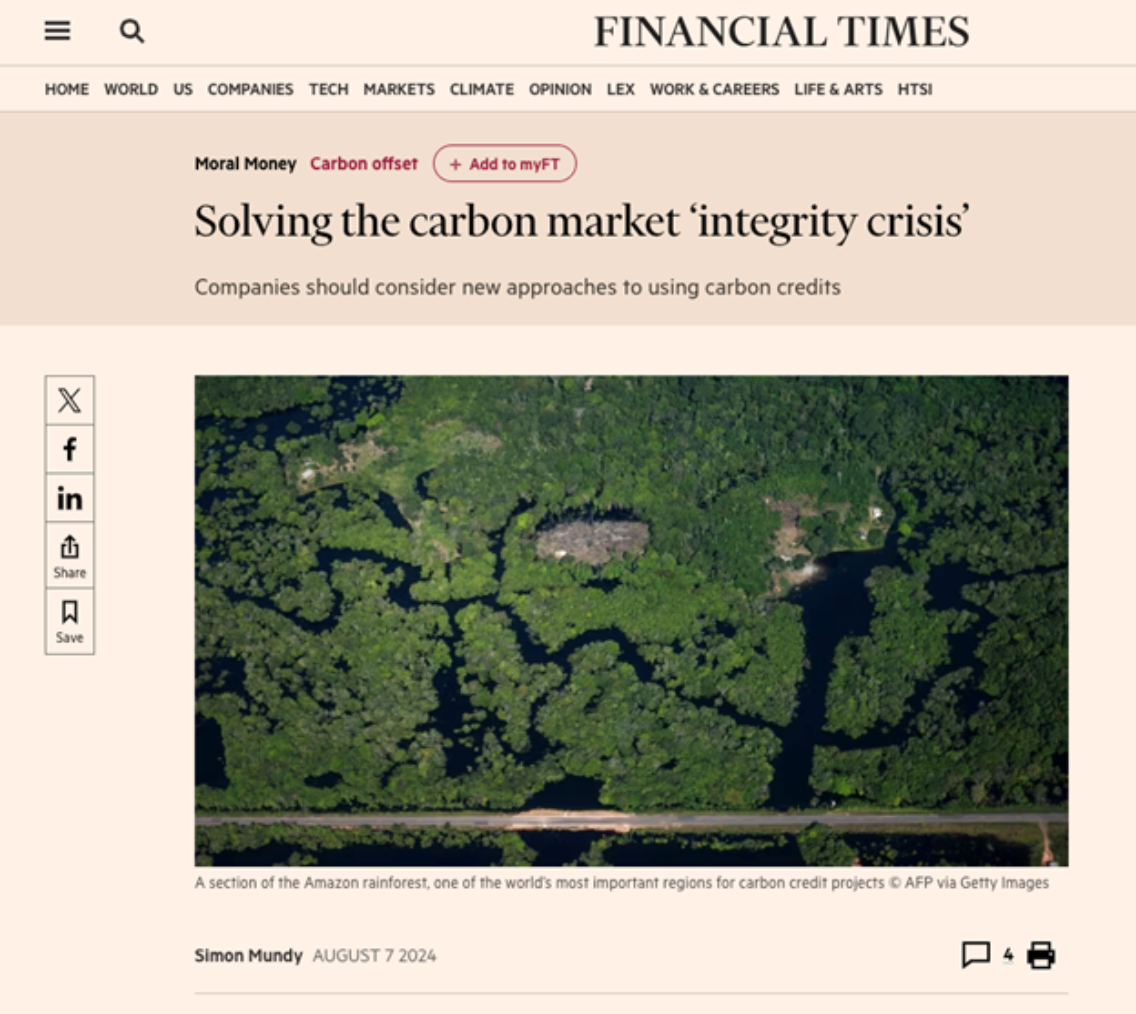
The UK's Financial Times ran a column echoing ICVCM's action. (Source: Financial Times website)
In its 7 August column "Solving the carbon market's "integrity crisis"", the Financial Times noted that Brazil's environment minister warnedthe market may be channelling money to criminal gangs, and that these criminal groups are allegedly selling carbon credits obtained from land stolen in the Amazon. For many companies, such controversies make it hard to see any reason to buy credits issued by projects meant to protect nature.
Because the future of the carbon market is so murky, the Financial Times commentary was equivocal, quoting
Tommy Ricketts, chief executive of the carbon credit rating agency BeZero Carbon, who argued that carbon credits are an imperfect asset rather than a pure, interchangeable commodity, and are better thought of like securities such as stocks and bonds — markets that price risk and, in his view, allocate capital exceptionally well.
Still, the Financial Times remains positive on nature-based carbon sinks: despite the many controversies around avoidance-based credits, they could still prove a powerful tool for channelling capital into protecting natural carbon sinks — the key perhaps being to stop treating them as offsets.
The world was never perfect. Global warming continues to be a focus of international attention, and all the scientific evidence shows the Earth really is getting hotter year by year. That may be true — but can it stop humanity's "party at the end of the world" mentality?
ICVCM has called the carbon market a "Wild West", as if entering the era of American cowboys. Indeed, as the weather gets hotter every year, everyone is starting to believe the end of the world is coming — only some people are thinking: "If it's the end anyway, why not party?"
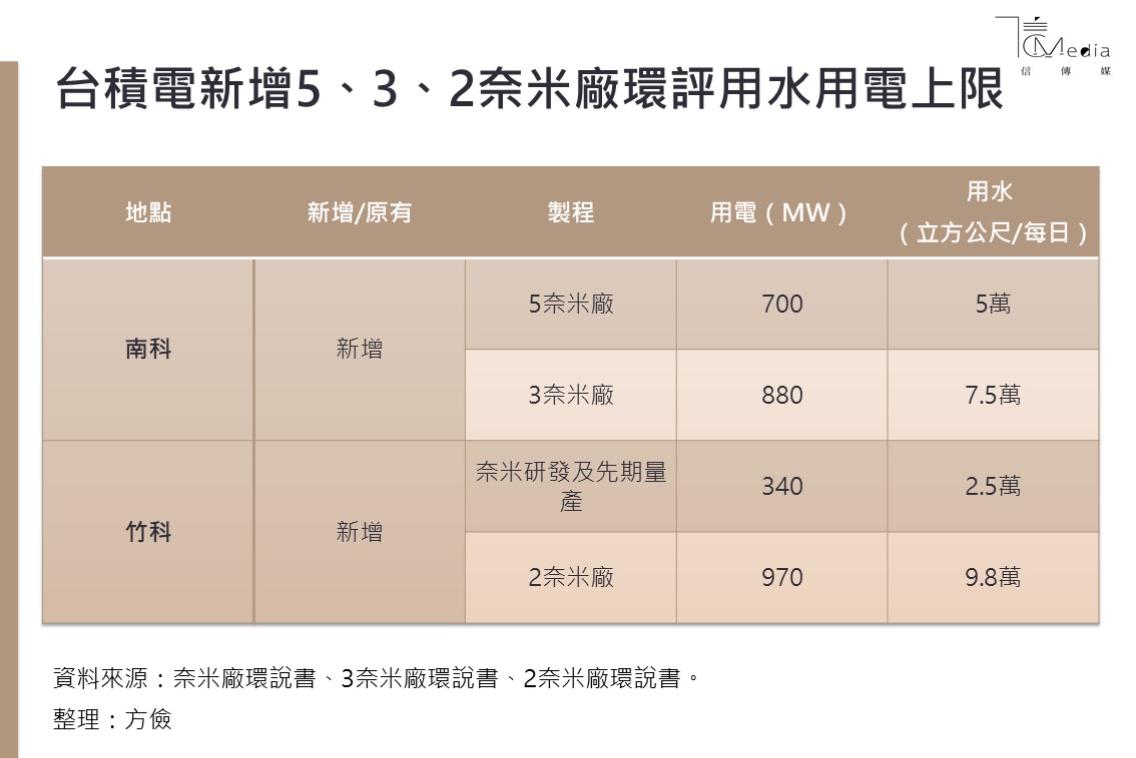
Given the caps on water and electricity use recently disclosed in TSMC's environmental impact assessment, who cares about Taiwan's greenhouse gas emissions or water shortages? "Hurry up and buy TSMC shares! Go! Go! Go!"
Source: CM Media ( https://www.cmmedia.com.tw/home/articles/48760 )


