努力小農
本文尚無譯文。
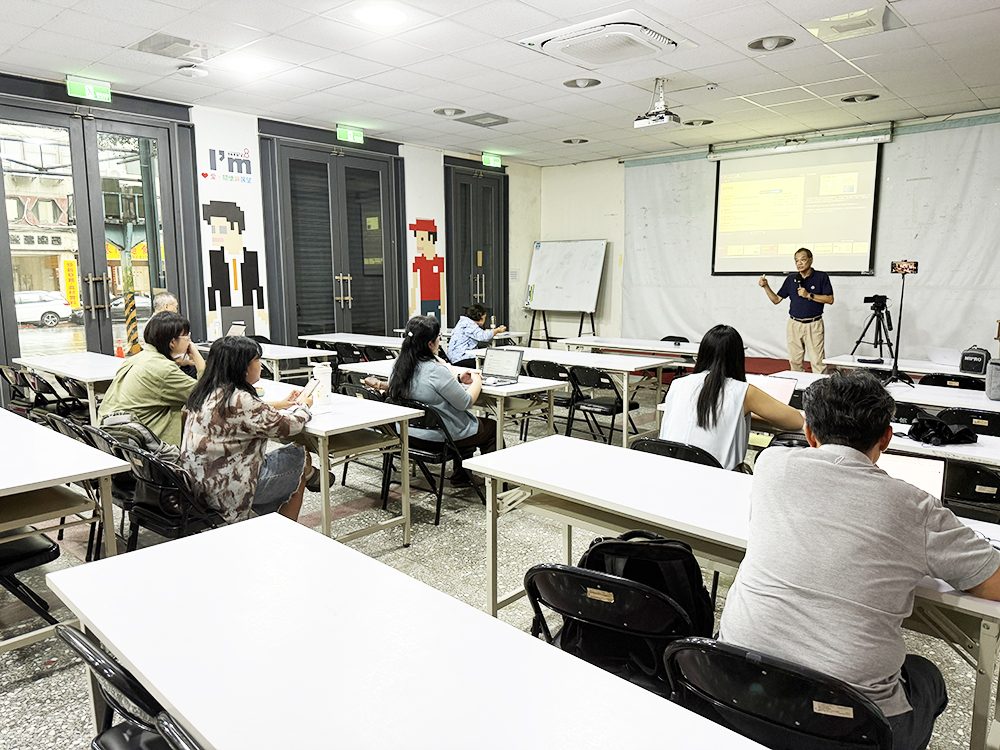
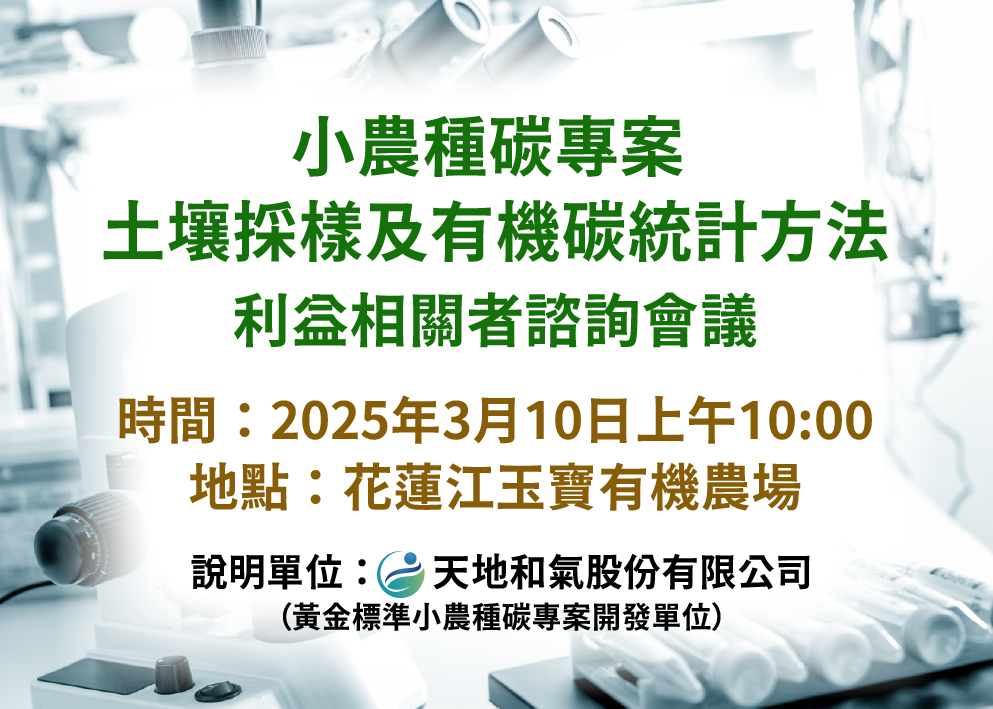
Stakeholder consultation meeting on soil sampling and organic carbon statistics for the Taiwan Smallholder Carbon Farming Project
Time: Monday 10 March 2025, starting 10:00 a.m.
Venue: Jiang Yu-bao Organic Farm, Hualien (No. 49, Siwei Rd, Shoufeng Township, Hualien County)
Registration form here 》》https://forms.gle/DwqkpUYuWa7SKTPh7
Invited organisations and expert representatives (online/in person; in order of stroke count)
Smallholder project owners in smallholder carbon farming
Mr Chao Jui-kuang, researcher, Tainan Community University (representing Taiwan NGO professional environmental monitoring)
Professor Ling Yong-chien, Green Mass Spectrometry Laboratory, Department of Chemistry, National Tsing Hua University (Taiwan's leading authority on mass spectrometry testing)
Mr Hsu Shuai-chun, head of Tanchen Consulting Co., Ltd. (representing senior third-party testing and certification professionals)
Food Safety Research Laboratory, I-Mei Foods (a benchmark food safety laboratory among Taiwan's food companies)
Taitung District Agricultural Research and Extension Station, Ministry of Agriculture (government agricultural advisory agency for Taitung)
Hualien District Agricultural Research and Extension Station, Ministry of Agriculture (government agricultural advisory agency for Hualien)
Taiwan Agricultural Research Institute, Ministry of Agriculture (government body that sets the testing method for agricultural soil organic carbon)
Other experts (invitations in progress)
Presenting organisation:
Eco-affinity Inc. (developer of the Gold Standard smallholder carbon farming project)
Online registration form; the online meeting link will be sent three days before the meeting (by the end of the working day on 7 March)
About:
At the first expert stakeholder consultation meeting on soil organic carbon testing for smallholder carbon farming on 19 February, experts asked about soil sampling methods. In line with the Gold Standard's requirements for stakeholder consultation meetings, the project developer is inviting experts to explain the relevant Gold Standard certification requirements.
The project developer must follow the Gold Standard's certification principles and requirements and its land use and forestry activity requirements, and prepare a "project design document" according to their technical specifications. This is reviewed by the Gold Standard and verified by a validation/verification body to confirm that it meets the certification rules and the requirements of ISEAL and the ICVCM, and complies with the voluntary carbon trading rules under Article 6 of the UNFCCC Paris Agreement. Sustainable development performance and carbon credit certification are then issued and become part of the nationally determined contribution (NDC).
The project developer can only implement the existing latest methodologies and certification rules. For differing technical or academic views or suggestions, please contact the Gold Standard, ISEAL or the ICVCM directly; the project developer has no authority to change the relevant rules on its own.
The main relevant rules are as follows:
Gold Standard Certification Principles and Requirements: https://globalgoals.goldstandard.org/100-principles-and-requirements/
Gold Standard Land-use & Forests Requirements: https://globalgoals.goldstandard.org/203-ar-luf-activity-requirements/
A protocol for modeling, measurement and monitoring soil carbon stocks in agricultural landscapes: https://www.cifor-icraf.org/publications/downloads/Publications/PDFS/TM11192.pdf
Programme:
10:00 Explanation of the relevant Gold Standard certification content and how the "sampling" and "statistics of test results" parts of the project design are implemented (other parts are outside the scope of discussion)
11:00 10-minute break; move to the local "Wu Go Nong" field for a sampling demonstration
11:10 Sampling activity and explanation at the "Wu Go Nong" field
Note: if it rains that day and on-site sampling is not possible, a video will be used instead.