 努力小農
本文尚無譯文。
Not yet low-carbon — the world has entered an age of high sighs
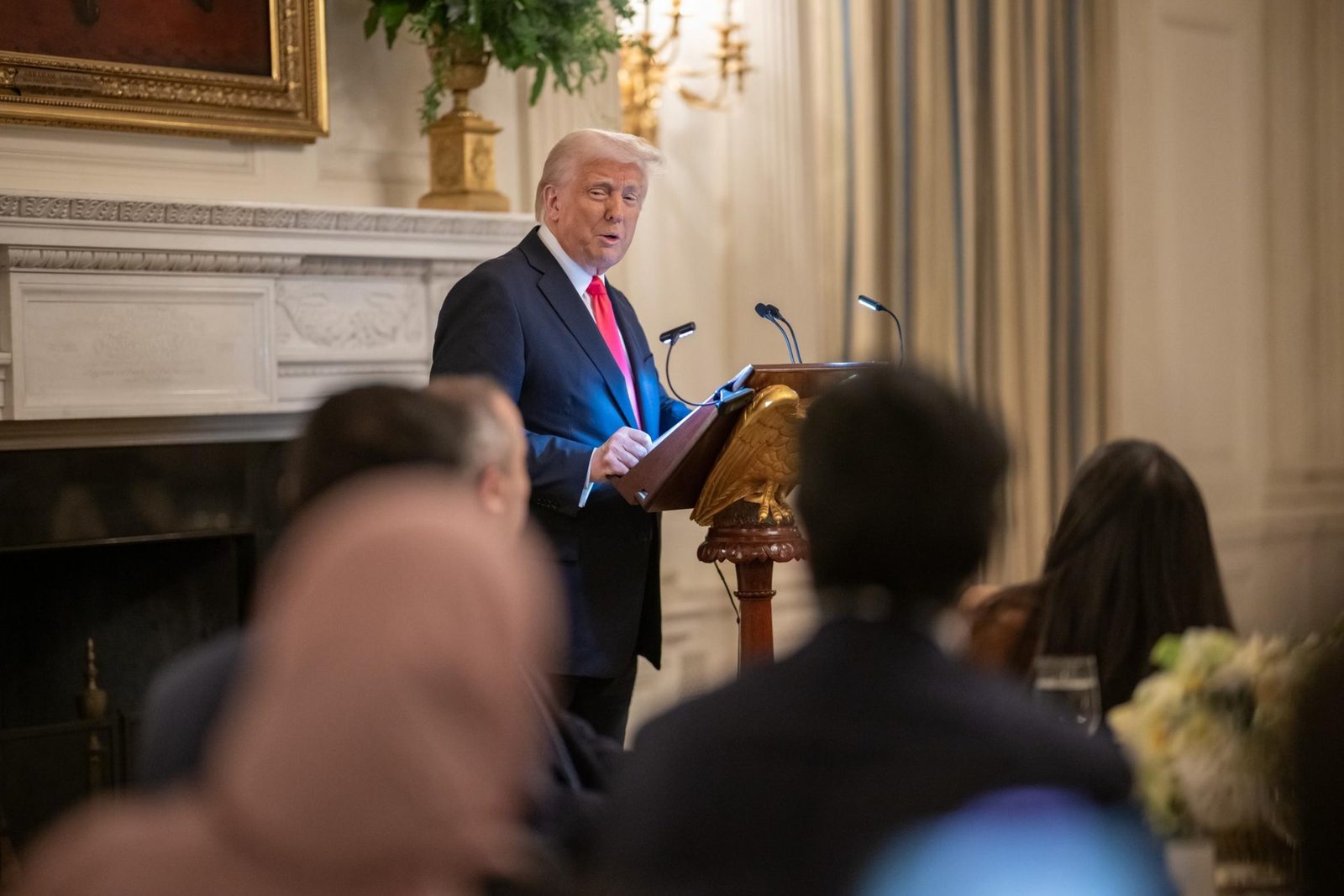
How many people around the world will lose their jobs, or suffer inflation, recession or even depression, because of Trump's daily surprise policy changes? Climate change seems trivial by comparison. (Image: FB@The White House)
The age of high sighs is at the gates
Since last November the world has been like Trump's personal reality show. "Tariffs" have been weaponised into the US president's tool against the world (America included) in politics and the economy. On 20 January he signed executive orders withdrawing from the Paris Agreement under the UN climate convention and ending DEI (diversity, equity and inclusion), among dozens of others — but those were mere appetisers. On 2 April he went further, declaring an economic emergency, imposing a 10% tariff on all countries and adding "reciprocal tariffs" based on each country's trade with the US. These "reciprocal tariffs" defy all economic and fiscal logic and simply reflect the Trump administration's impulsiveness and ignorance (though some believe Trump is fully prepared and playing a bigger game).
Trump's actions overturn 50 years of free-market globalisation built on American values of liberty, equality and democracy. My career includes 36 years of globalisation experience, and I took part personally in America's supply-chain deployment and global sourcing programmes in Asia-Pacific after both sides of the Taiwan Strait joined the WTO around 2000. Watching Trump's tariff and trade war, I feel it all the more deeply.
In the summer of 1989, as a reporter for the China Times Express, I visited more than a dozen environmental organisations in the US with Taiwanese anti-pollution groups, arranged by the Asia Foundation. Just then the organisers of America's 1970 Earth Day were preparing a global Earth Day for 1990, and almost by accident I came back and launched Taiwan's Earth Day in 1990. Because of this I took part in the 1992 Earth Summit and saw world leaders sign Agenda 21, the climate convention, the biodiversity convention and the forest principles. I believed then that this was the embryo of a future world of great harmony, so on returning to Taiwan I immediately set up the Green Consumers' Foundation, hoping to pursue the global environmental movement from the consumer's side, using consumers' purchasing power to change industrial structures and production processes.
Through the green consumer movement I realised how little I knew about industry. In 1994 I happened to meet Reg Shaughnessy, chair of ISO Technical Committee TC 176. TC 176 was set up after the General Agreement on Tariffs and Trade (GATT, the WTO's predecessor) called in 1978 for "quality standards" to reduce global non-tariff trade barriers; it is the progenitor of the ISO 9000 family of international management system standards. (Note: the foreword of every ISO standard states that it is meant to address technical barriers to trade (TBT); when we follow ISO standards, we become part of globalisation. By contrast, American companies don't pay much attention to ISO standards and have their own — for instance, the US still uses imperial units rather than ISO's metric system.)
From 1994 I learned about management and standardisation from Reg Shaughnessy. At the end of 1996 he recommended me to the global supply-chain quality systems working group of America's Big Three car makers. In 1997 I began working on the global rollout of QS-9000, the purchasing quality system of GM, Ford and Chrysler, responsible for auditor certification at third-party certification bodies in Asia-Pacific and for supplier development, and I became the American Society for Quality's (ASQ) chief representative for Greater China.
The corners of the smile curve droop
I lived through the changes before and after both sides of the Strait joined the WTO. I remember that around 2000 the "smile curve" of Acer's founder was in vogue in Taiwan — a competitive strategy Stan Shih proposed in his 1992 book Reengineering Acer: Start-up, Growth and Challenge. It set off a wave of "de-Sinicisation" in Taiwan's industry, even as Taiwanese businesses rushed to invest and build factories in China after the 1989 democracy movement. Then came the clash between KMT chairman Lee Teng-hui's "no haste, be patient" policy in 1996 and the DPP chairman's "bold westward advance".
From my modest industry experience, I have never agreed with the "smile curve". In the process of "product realisation", manufacturing is the most important "cost centre" and the core of the value chain made concrete; it also creates the most jobs. Patents and technology (R&D) and brand services (marketing) create relatively few jobs and must rely on manufacturing quality, or the whole thing becomes top-heavy. Capitalists make the biggest profits by outsourcing the cost centre — which was my main job in global sourcing. TSMC clearly did not succeed through the "smile curve": by focusing on manufacturing and striving for excellence, it built long-term profitability on high yields and beat rivals like the famous Intel and the sprawling Samsung. Focusing on its core manufacturing business is clearly TSMC's real secret.
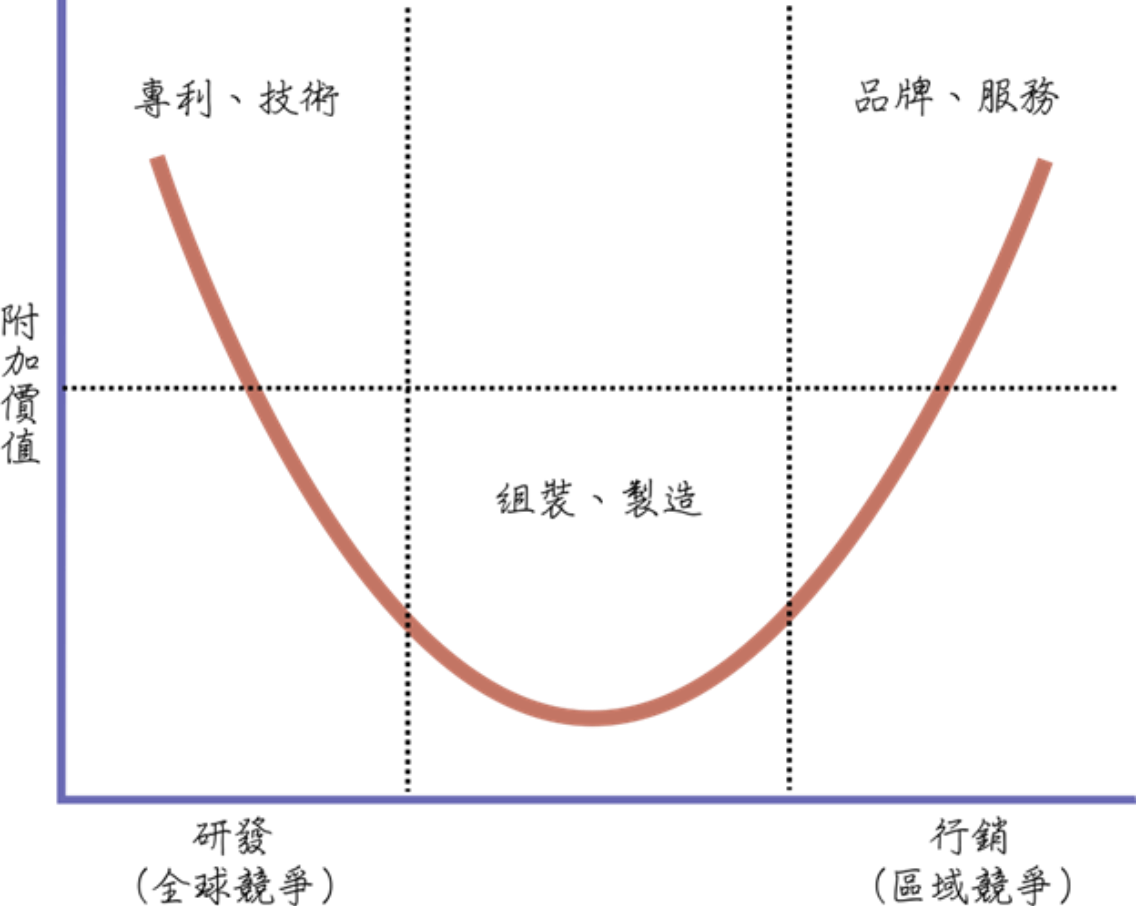
The smile curve is divided into three parts — left, middle and right. The left is technology and patents, the middle is assembly and manufacturing, and the right is brand and services. The curve represents added value: lower in the middle and higher at both ends, so the whole curve looks like a smile. (Image: Wikipedia)
While working for the Big Three and the American Society for Quality, from 2002 I constantly had to answer and deal with doubts from American companies, civil society groups and unions about developing supply chains in China — worries about leaks of technology and patents, human rights issues (forced labour, worker safety, union rights), and American workers losing jobs. Some even questioned whether my bringing quality standardisation and personnel certification into China might harm the US. (Details cannot be given because of lifelong confidentiality obligations.)
Our surveys at the time showed that what China took was mainly capacity and output from suppliers in Eastern Europe, India, Asia-Pacific and Mexico; it did not affect the jobs of workers in the US car supply chain. The rise of Chinese suppliers greatly lowered global sourcing costs and gave American companies better profits and benefits. American companies were then practitioners of the "smile curve", and with capital operations on top, a bubble boom formed. Japan, Europe and Taiwan all profited from China's entry into the WTO.
That was the situation in the early 2000s. But later the clever Chinese, through reverse engineering and a down-to-earth understanding of Chinese consumers' needs — and with China becoming the mainstay after the 2008 financial crisis triggered by the US, plus its world-leading e-commerce and mobile payment systems — staged grand shows like "Amazing China" and "Made in China 2025". The world was shocked by the impact of China's rise, and a "new cold war" of containment emerged.
Before 2020, I asked many Western investors who built factories in China why. Besides the Chinese market, their main reasons were China's political stability, its focus on attracting investment and its leniency towards foreign investors. They didn't much care about China's strong social control and surveillance — some even saw it as a basis of stability. But all this fell apart with the 2020 COVID-19 lockdowns. Foreign companies were stunned by China's unrestrained, limitless lockdowns, an unbearable weight for businesses used to freedom. Politics once thought stable became an extremely unstable variable; add the changing international situation and the strict guard against China — fear that its excess capacity would cause another "yellow peril" — and foreign companies began to leave.
Now the main theme of Trump's "Make America Great Again (MAGA)" is to bring manufacturing back to America, putting manufacturing above everything else. Can the smile curve keep smiling?
We are swimming in a cesspit of lies
Judging Trump by his words and deeds, I am full of distrust. So I took the lazy route and asked Grok, the AI developed by Musk: "How many false or misleading statements did Trump make during his presidency?" Surprisingly, it took 56 seconds to give an answer drawing on 26 sources. Grok recommended Wikipedia's entry,False or misleading statements by Donald Trump. At the top of the article the Wikipedia editors note that the article may be too long to read easily — showing that the list is truly endless. During his four-year term Trump made 30,573 false or misleading statements. In 2017 he averaged 6 a day, with 492 in his first 100 days; in 2018, 16 a day; in 2019, 20 a day; in 2020, 39 a day, peaking on 2 November that year with 500 in a single day.
This is an astonishing record. Normally if a US president tells one or two lies it causes weeks of uproar or even forces him out, as with Nixon's Watergate or Clinton's Lewinsky affair. Trump's lies come one after another, each bigger than the last, and no one can keep up. AsGerman YouTuber Lao Lei put it, lies are like poop: when an ordinary person has one or two, they are roundly condemned, but now we are all swimming in the cesspit Trump has made, and everyone is lost, not knowing what to do.
I think this is an apt description. As the saying goes, when debts pile up you stop worrying, and with enough lice you stop itching: Trump is completely immune. Even today 45% of Americans still support and believe Trump, and claim that "tariffs are paid by the exporting countries". If that were true, car prices in Taiwan would be a third lower. Of course all taxes are borne by consumers; exporting countries, exporters and importers don't bear them, while the importing country's government grows rich through extortionate levies. Even such a simple fact gets twisted.
Trump never accepted that he lost the November 2020 election; he simply left the White House, and now he is back. His "bend the truth to win" is the best example for politicians worldwide. At the same time, Trump's irresponsible statements — as if he had a circus in his mouth — have, through the power of the media, created a huge "global climate change" in politics, economics, finance and culture, made of untrue, uncertain and irresponsible statements. By comparison, the climate change we face seems trivial. How many people around the world will lose their jobs, or suffer inflation, recession or even depression, face desperate lives, blocked access to education and a widening gap between rich and poor, because of Trump's daily surprise policy changes?
Some commentators say Trump will cause a global economic "nuclear winter". Perhaps this will plunge all industries into depression and downgrade consumption worldwide — especially manufacturing, travel and transport — even reducing household energy use, so that global carbon emissions fall sharply. This might unexpectedly achieve the Paris Agreement's 1.5°C goal. At least companies won't have to sigh hypocritically every day in "carbon anxiety", because now survival and quality of life are being forced down, and there's no time left for pretence.
With my limited insight I cannot predict whether Trump will succeed or whether America will be great again. But I believe that uncertain, unstable policies built on lies harm people all over the world. Everyone will have to endure it, and the one with the most endurance will last to the end. On this I believe the Chinese can endure far more than Americans: three years of pandemic lockdowns were a rehearsal. Which other economy in the world could do that?
Source: CM Media ( https://www.cmmedia.com.tw/home/articles/53797 )


