 努力小農
本文尚無譯文。
Be a hard-working, brave and honest smallholder
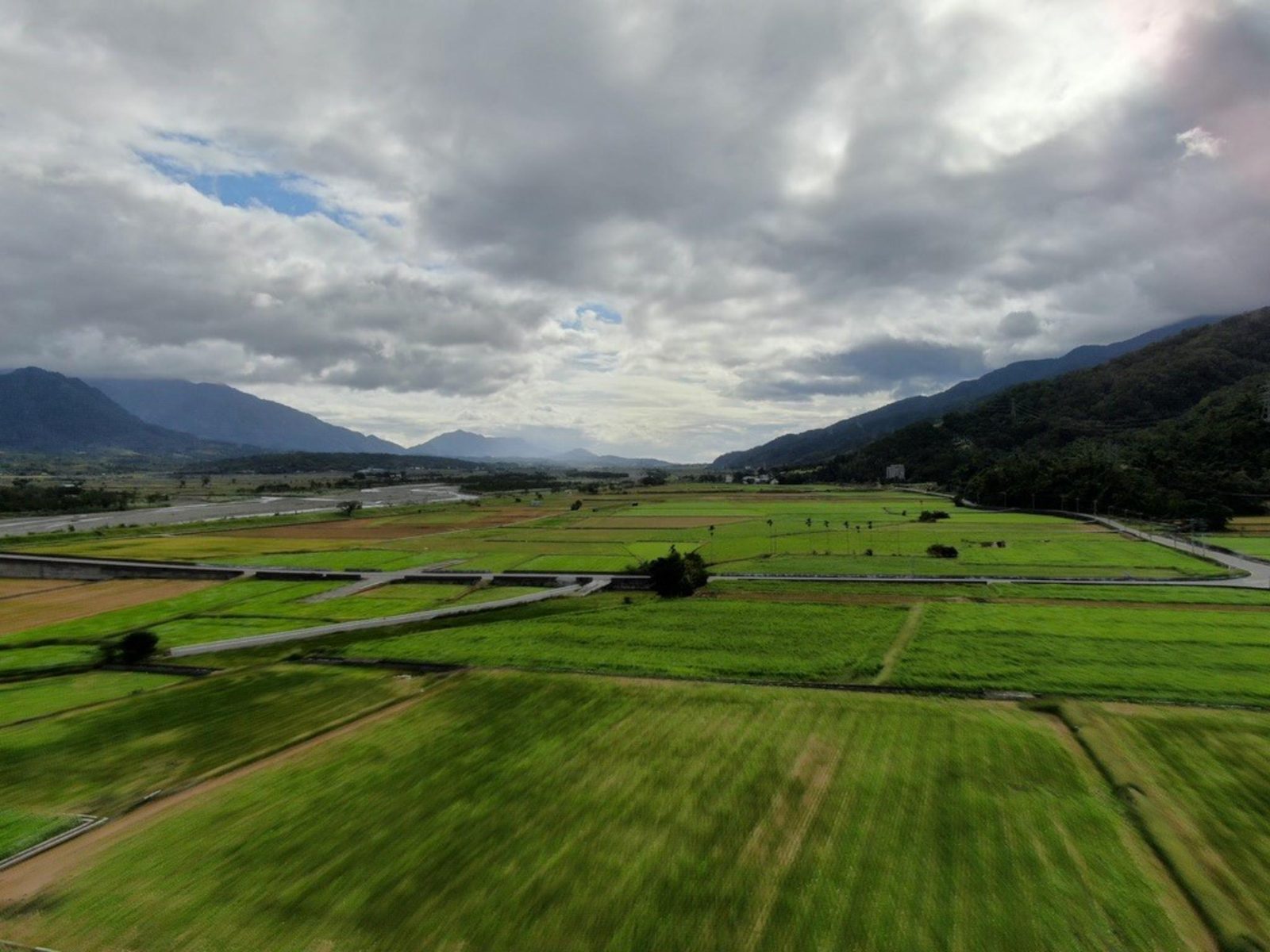
The Taiwan Smallholder Carbon Farming Project is the world's first international agricultural soil carbon project. Every step ahead is a "first step", taken as if on the edge of an abyss or on thin ice. (Image courtesy of Jay Fang)
Smallholder carbon farming: world first by accident
After the on-site audit by Re Carbon, the Gold Standard-approved validation and verification body, in late April and early May, we took a fresh look at the Taiwan Smallholder Carbon Farming Project and the Soil Organic Carbon Framework Methodology and gained many new insights. The project has been in research for three years; its official start date was 1 January 2023, so it is now two years and four months old — about a quarter of its 10-year term. In short, over these nearly 30 months we have faced unprecedented challenges, and the challenges ahead will only be greater. Because we are the world's first project to formally enter international certification for soil organic carbon emission reductions, we will certainly attract attention and challenges from all sides.
In May and June, farming in the northern hemisphere disturbs the topsoil, releasing large amounts of CO2 stored in the soil, and concentrations reach their peak — the spring carbon peak that comes every year. The latest daily atmospheric CO2 concentrations published on the official website of the US National Oceanic and Atmospheric Administration (NOAA) break past records every day, setting new world records daily.
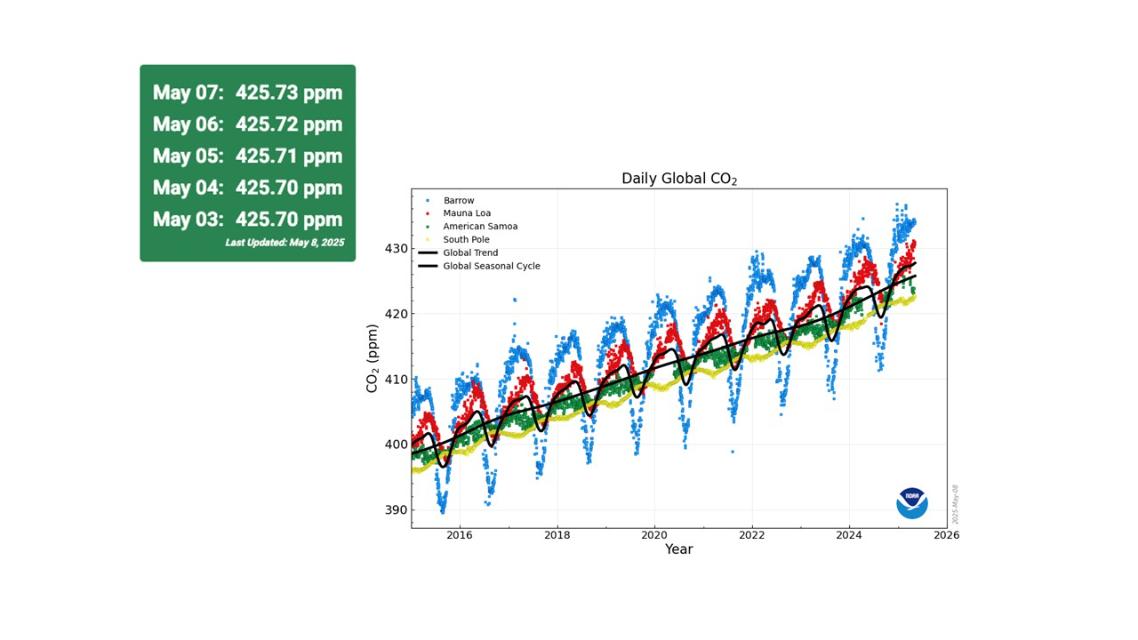
This chart shows CO2 data from four global atmospheric baseline observatories: daily average CO2 at Alaska (blue), Mauna Loa, Hawaii (red), American Samoa (green) and the South Pole, Antarctica (yellow). The thick black lines represent the smoothed seasonal curve for each record and the average of the smoothed deseasonalised curves. These lines give a good estimate of the global average CO2 level. For details on how the smoothed seasonal cycle and trend are calculated from daily data, see here. (From the NOAA website)
Trump pulls out the Earth's thermometer
We don't know how much longer this public data will remain available, because US President Trump has ordered cuts to government budgets for this observational research in the near future. Large amounts of climate change data are now moving to EU countries that still take global climate change seriously. Trump really will have solved the problem of climate change: in future people will no longer have credible evidence of warming built from large volumes of real-time data, and no evidence means it never happened.
It's like pulling out the Earth's thermometer — without a thermometer, does that mean there's no fever?
Each smallholder's effort is tiny. Can such efforts make a difference?
I believe we can make a difference, because the main contributors to the Earth becoming what it is today were not humans but invisible microbes — the "grassroots" of life on Earth. Plants fix CO2 through photosynthesis; animals eat plants (and other animals); their excreta and, after death, their remains become biomass for bacteria (decomposers). The total biomass of bacteria is proportional to soil organic carbon. That the Earth has not yet overheated is thanks entirely to these invisible "micro-friends".
If bacteria can contribute "their own small part" — sustaining life, reproducing and fulfilling their life's mission — then smallholders, together with the microbes they live in symbiosis with, can surely fulfil their mission of storing soil organic carbon. And if smallholders can, then companies and governments with more resources, knowledge and capacity certainly can.
From at least three rounds of accumulated data, I can find theoretical and empirical grounds to believe that, over the long term, the organic carbon accumulated in our smallholders' soils will rise year by year, like the sawtooth curve of atmospheric CO2. If everyone did this, it would offset the rising CO2 concentrations and achieve "carbon neutrality".
Forgive me for not being able to provide the data before certification, but I will continue to discuss it semi-publicly with experts and stakeholders to make sure the data are rigorous and complete. In the past, whenever we had data we published it, and outsiders often criticised it based on imagined scenarios without looking into the content. Personally I can calmly face criticism from all sides, but for some smallholders it caused great distress — some even gave up taking part. As project developer, this is a risk I must avoid.
Carbon credits are only extra value on top of produce's carbon rights
Whether soil organic carbon stocks start high and fall or start low and rise, if smallholders follow the carbon farming methodology they will achieve something. We shouldn't rejoice or despair over a high or low year or two, but take it calmly. For farmers, the most important thing is not cutting carbon but their produce: the produce is the farmer's real "carbon right", while the emission-reduction performance produced by certification — the "carbon credit" — is an "additional" by-product of growing crops.
I strongly dislike how some people, eager for quick gains, think "carbon credits" are the same as "carbon rights". That's buying the box and returning the pearl. From the SDG sustainability perspective, certified carbon credits are just the extra "wrapping paper" of sustainable value. Beautifully wrapped produce can fetch a good price, but looking only at the wrapping and not the product puts the cart before the horse and only leads to fraud. It loses the "additionality" of every emission-reduction project — like a student who can't do the work and only cheats to pass exams and win high marks — and plunges humanity's effort to save the climate into an even greater crisis of integrity.
In fact carbon trading already has a negative image in the world, because its harms outweigh its benefits — which is why CO2 concentrations keep rising and climate disasters keep happening.
I once reminded the verification body that when they interviewed smallholders, they should ask how climate change had affected them over the past 5–10 years. This is the best question, because the carbon-farming smallholders I know have all told me about the painful climate disasters they've suffered over the past five years, which convinced them they had to join this programme.
Our project has more than 50 project participants, representing more than 300 farmers and their family members involved in farming. Over the next two or three months we will build a sub-project file for each participant — in effect writing a biography of each smallholder — to form the project report.
Faking it for certification?
The project report uses the Sustainable Development Goals as its framework to tell the stories and changes of each smallholder and their family or collaborators in the project, along with their hopes and visions.
I have worked in certification and testing for nearly 30 years. I once told suppliers I was buying from, publicly: bring me your ISO 9000 certification reports and let me audit them once — which one of you is genuine? If I find one, I can retire.
When I used to run supply-chain quality system certification training, I would ask the participants — company employees and auditors from certification bodies alike: "What is done most often in certification?"
The answer was always: "Faking." Faking harms companies, damages supply chains and leaves no value chain at all. I loathe it. But as we grew up, we sat exam after exam, always trying to guess the "model answer", meeting its demands insincerely. We developed the habit of faking and lost the ability to solve problems and work together with colleagues.
The amount of carbon reduced is definitely not the model answer; overall SDG performance is the path to solving problems together. The Smallholder Carbon Farming Project is a remarkable journey — not about how much carbon is reduced, but about how much value of sustainable impact it provides.
-----------------
Source: CM Media ( https://www.cmmedia.com.tw/home/articles/54286 )


