努力小農
本文尚無譯文。
Smallholders salute the Paris Agreement and the 4 per 1000 Initiative — we need your help
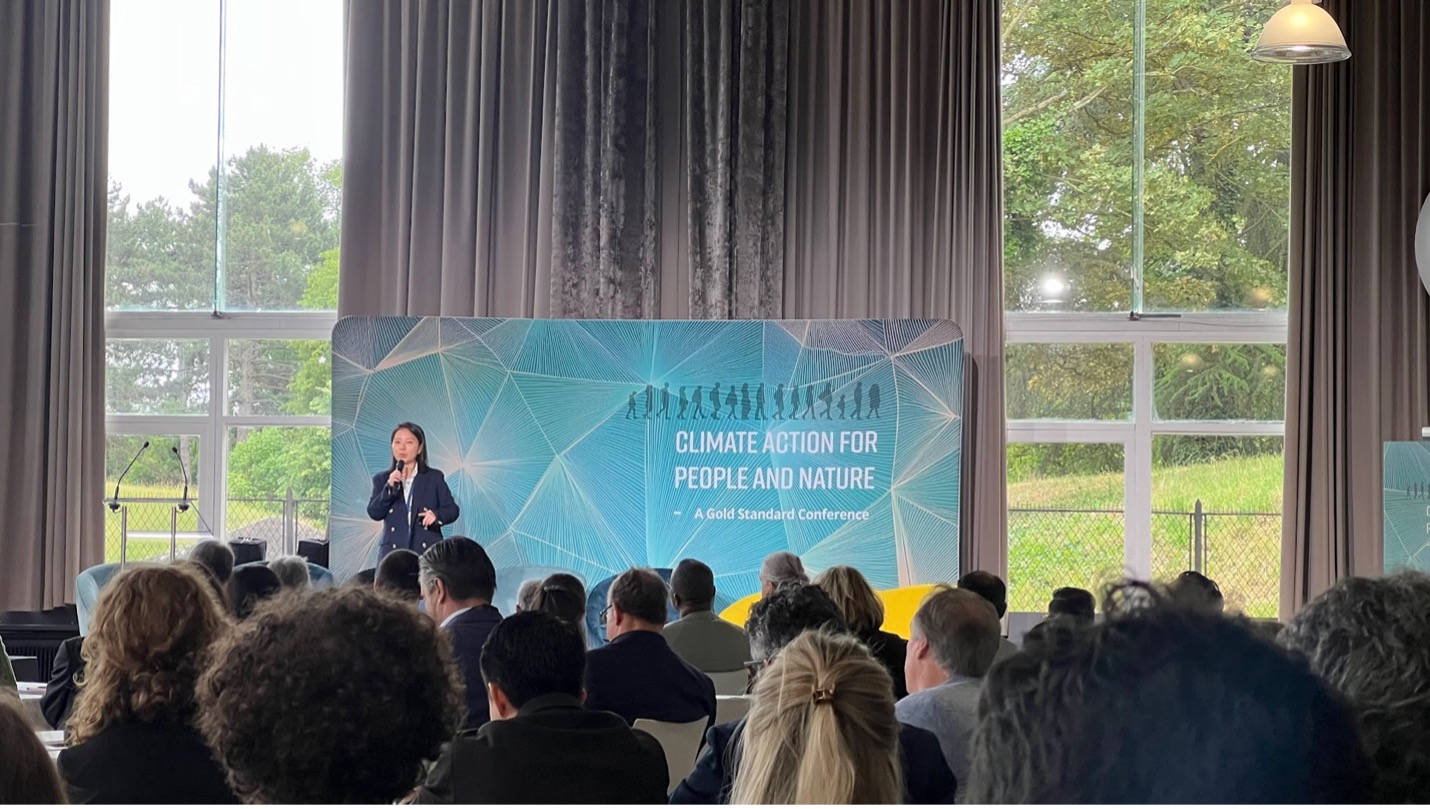
The voluntary carbon standard Gold Standard for the Global Goals held its biennial conference in Paris on World Environment Day, 5 June, bringing together carbon standards, project developers, verifiers and corporate sustainability departments from around the world to discuss the future of emission reductions. (Photo: Jay Fang)
From Stockholm and Rio to Paris: a 53-year journey
I was delighted to be in Paris on 5 June 2025 for the two-day Gold Standard for the Global Goals conference, discussing the prospects and future of voluntary emission reductions with representatives of governments and the private sector from around the world. We attended on behalf of only a small group of smallholders, to learn and to share how smallholders hit by climate disasters are doing their part to slow global warming and climate disaster.
Geopolitics, war and conflict, and international tariff wars, along with man-made and natural disasters worldwide, make the state of the world all the more worrying.
5 June marks the day in 1972 when the United Nations held its first conference on the environment in Stockholm. It was designated World Environment Day, and it is now 53 years since that opened the international sustainability agenda (later carried forward by Our Common Future). At the Earth Summit in Rio de Janeiro, Brazil, in early June 1992, world leaders signed Agenda 21 (the forerunner of today's Sustainable Development Goals, SDGs), the United Nations Framework Convention on Climate Change (UNFCCC), the Forest Principles and the Convention on Biological Diversity (CBD).
Because these documents are not legally binding, countries treat them as important in words, secondary in deeds and dispensable when busy. So the climate finance goal pledged years ago — US$100 billion a year to support developing countries — has never been met.
Smallholders' climate awakening
Yet a small group of smallholders in Asia, after suffering climate disasters, has launched a "climate awakening movement". In them we can see both the crisis and the turning point for voluntary emission reductions by smallholder farmers.
At the start of the COVID-19 pandemic in 2020, to develop a mobile app for smallholders' production and sales records, we began visiting smallholders all over Taiwan intensively. We found that many dedicated smallholders spoke of the climate changes they had observed over nearly ten years, which had seriously affected their livelihoods — to the point of giving up farming.
For Taiwan this is a visible but unfelt crisis, like a frog in slowly boiling water. In 1990 Taiwan was still a food exporter, but on joining the World Trade Organization (WTO) around 2000, Taiwan sacrificed agriculture for industry. Today it is a major exporter of the world's semiconductors and has also become a food importer: Taiwan can now supply only 30% of its own food and must import 70%, or Taiwanese could go hungry.
Taiwan's problems with agriculture, farmers and produce are a microcosm of developing countries becoming developed — like a farmer who wins the lottery, throws his hoe into the river, then realises the ticket was tucked into the hoe's handle: he lost both the ticket and the hoe.
In 2022, as we looked for ways to use the MiHuMiSang App to help smallholders, we found that at COP 21 in Paris in 2015, the French agriculture minister had proposed the "4 per 1000 Initiative". It holds that soil is the Earth's largest carbon store and that past farming practices released soil organic carbon into the atmosphere, making it a major source of greenhouse gases. If farming practices change, storing soil organic carbon can offset CO2 emissions from other human activities. The FAO also recognises this as a good way to solve both the climate and food crises at once.
We found the Gold Standard's Soil Organic Carbon Framework Methodology, which can turn the 4 per 1000 Initiative into a system of climate and sustainability certification and voluntary carbon trading that gives farmers an economic incentive. When we told farmers this story, they were half-believing, half-doubting — even experts and scholars had plenty of question marks about the initiative — but a small number of smallholders were willing to try with us.
Every smallholder tells their story
▶ All of Taiwan and Kinmen
Chiu Chui-chuan, a smallholder in Changliang Village, Yuli Township, Hualien County, was the first to join the smallholder carbon farming project and invited village chief Chen Wen-hua and fellow villagers to join too. "Anyway, things can't get any worse for us!" said Huang Cheng-hsien, one of the first Changliang smallholders to join, encouraging others in the village. Thanks to them, the Taiwan Smallholder Carbon Farming Project got a lifeline. Together we held two years of radish festivals, with parent–child radish pulling and sweet-potato roasting, giving everyone hands-on experience of how farmland soil fixes carbon.
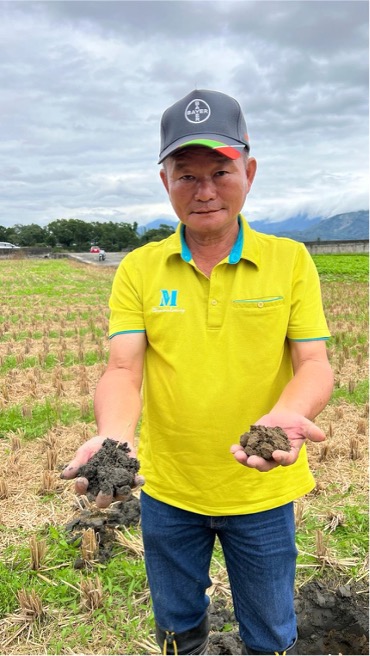
Changliang village chief Chen Wen-hua joined smallholder carbon farming with villagers at the end of 2022. He believes that over these two years both soil health and yields have improved. (Photo: Jay Fang)
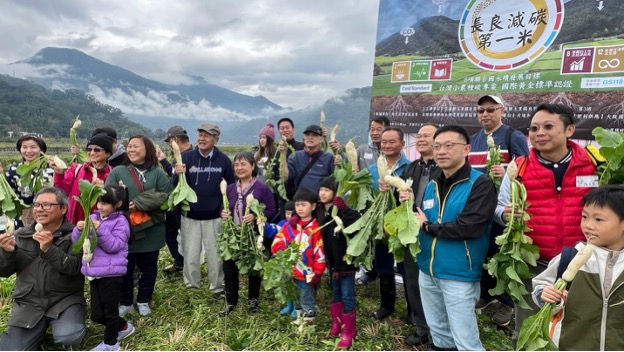
We insist that smallholders join for free. Once carbon trading succeeds, they are first in line for a guaranteed purchase price of at least US$10 per tonne, and if there is profit, we promise to share 50% of it with smallholders. All this is written into a standard contract to encourage smallholders to take part.
▶ Noto satoyama
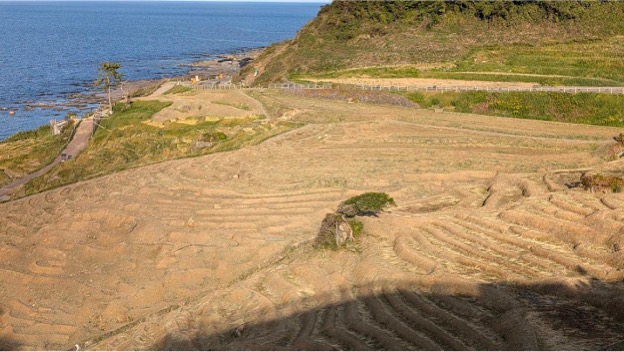
Shiroyone Senmaida, the most iconic site of Japan's Noto Peninsula satoyama initiative, saw 85% of its terraces damaged in the great earthquake of 1 January 2024. Local farmers are working hard to restore them and, with sponsorship from the Tzu Chi Foundation, have joined smallholder carbon farming. (Photo: Jay Fang)
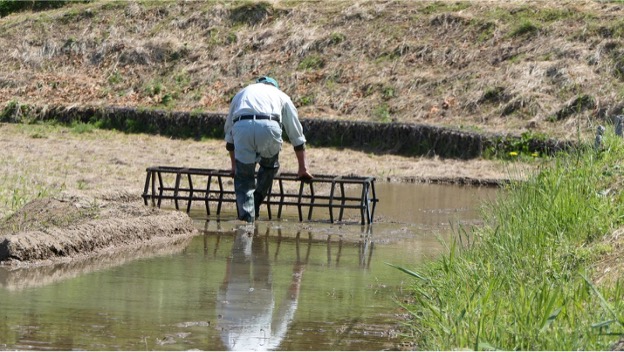
Shiroyone Senmaida still keeps up 400 years of traditional terrace farming. It is a national agricultural heritage site in Japan and one of the birthplaces of the FAO's 2011 satoyama initiative. (Photo: Jay Fang)
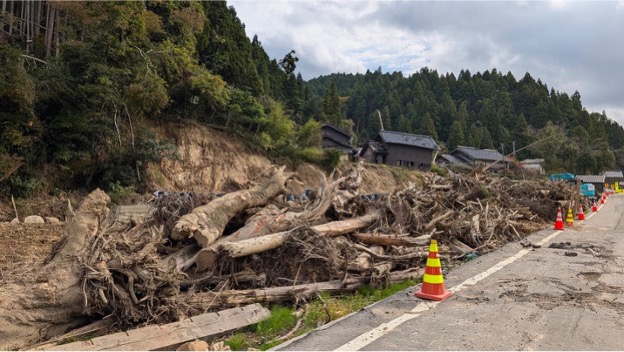
The Machino area of Noto Town was hit by three days of continuous torrential rain from 20 September 2024, damaging large areas of terraces. (Photo: Jay Fang)
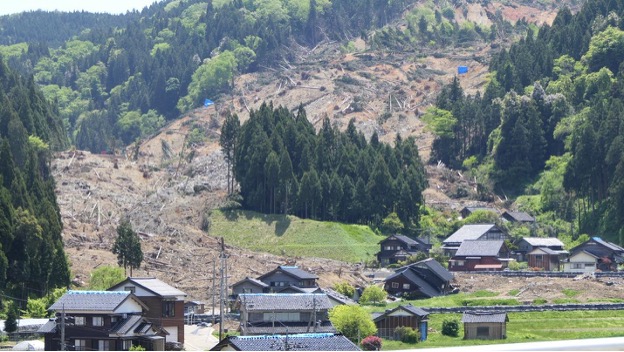
The farming and villages of the Noto Peninsula satoyama initiative, where people and nature live together sustainably, are being tested by natural and climate disasters. (Photo: Jay Fang)
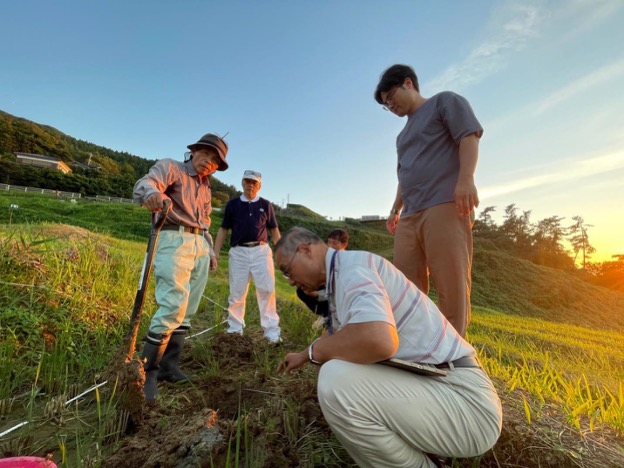
With sponsorship and ESG investment from the Tzu Chi Foundation, Noto smallholders learn soil sampling, establish a baseline and join smallholder carbon farming. (Photo: Yang Ching-hui)
It wasn't easy: the average Taiwanese smallholder farms less than a hectare. In the first year we found more than 100 smallholders with 159 hectares; in the second year (2023) it grew to more than 300 hectares, with nearly 300 smallholders. This caught the attention of the Tzu Chi Foundation's international disaster-relief partners. Hsieh Ching-kuei, adviser to the Tzu Chi Foundation's CEO, joined the relief effort after Japan's great Noto earthquake in early 2024. He found that Noto, a birthplace of the UN satoyama initiative and historically a model of human farming integrated sustainably with the natural environment, risked losing its historic agricultural and cultural base of sustainable satoyama farming because of the earthquake and that September's torrential rain. So he invited us to develop a smallholder carbon farming project for Noto's satoyama smallholders.
Based on the shared conviction that the Earth is one family, we signed smallholder carbon farming contracts with the satoyama smallholders. Because the area is only about 60 hectares, not enough to sustain ongoing development, the Tzu Chi Foundation is sponsoring the early development — the beginning of ESG sustainable investment in this project. We are honoured to be part of carrying on the spirit of the satoyama initiative.
▶ Wuchang, China
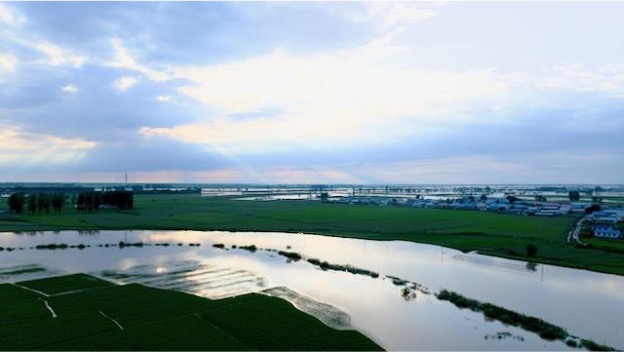
In August 2023 Wuchang, China's best rice-growing area, suffered a once-in-a-century flood. Farmers in Yongzheng Village felt the climate crisis and joined smallholder carbon farming a year later. (Photo: Zou Zhi-zhong)
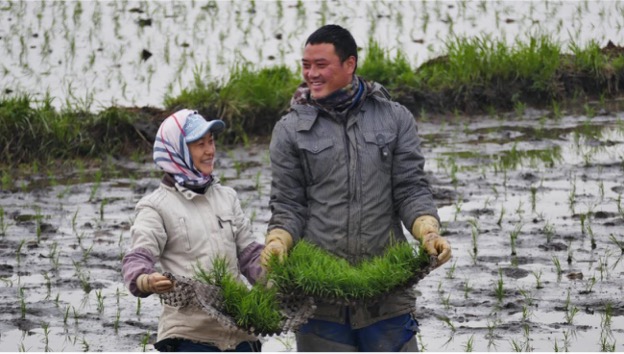
Wuchang smallholder Zou Zhi-zhong and his wife Shan Hong-mei have grown Wuchang rice by hand for many years. Deeply aware of the climate crisis, they encouraged the village committee to join smallholder carbon farming. (Photo: Jay Fang)
By coincidence, China's best rice-growing area, Wuchang in Harbin, Heilongjiang, was also hit by once-in-a-century torrential rain in 2023. Zou Zhi-zhong, a farmer in Xiaowangjiatun, Yongzheng Village, Zhiguang Township, Wuchang, contacted us. He quickly discussed it with his neighbours and the residents' committee, and in October 2024 they too signed a smallholder carbon farming project contract with us, trying to do their part. Zou said: "We may not understand much, but what we can do, we should try."
▶ Chishang, Taitung
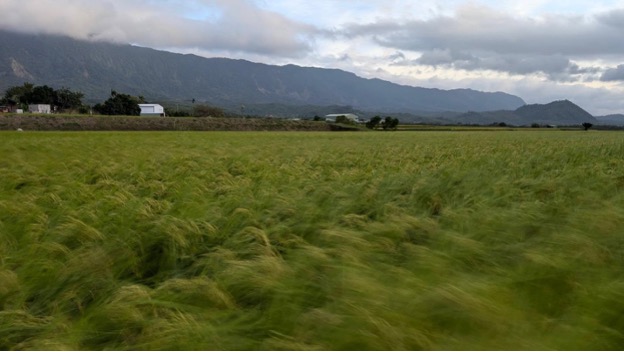
Two typhoons in October and November 2024 badly hit Chishang's rice production, and also spurred farmers' willingness to join smallholder carbon farming. (Photo: Jay Fang)
Then there is Wan'an Community in Chishang Township, Taitung County, which produces Taiwan's best and most valuable rice. Last year, after being named a "Gold Medal Village", it was hit by an unprecedented November typhoon, losing 30–50% of its rice crop and becoming one of the worst-hit areas. Having experienced climate disaster first-hand, they deeply felt that the climate crisis could wipe out a rice industry nearly a century old. Wan'an Community chairman Chen Cheng-hung and general secretary Hsiao Jen-yi mobilised the community to join smallholder carbon farming. "After all, we're all part of the Earth — when the nest is overturned, no egg stays whole!" This Hakka community has also joined the ranks of climate action.
Only by working together do we stand a chance
Persuading smallholders to take part is hardest of all — and harder still is getting the cooperation of a validation and verification body (VVB). After all, soil organic carbon is a new international method for agricultural emission reductions. Compared with forestry, renewable energy or energy-efficiency projects, our projects are very small, and the framework methodology has many complex variables and high uncertainty, so the verification risk is greater. As the first project developer to enter the Gold Standard certification system, we must also bear more risk, responsibility and pressure.
Fortunately we have many smallholders who believe in us and support from all sectors of society, so we have come this far — and we will keep going.
At this Gold Standard conference in Paris we hope to review ten years of the feasibility and opportunities of the 4 per 1000 Initiative and voluntary emission reductions, and how the voluntary mechanism under Article 6 of the Paris Agreement can help smallholders — and to seek the attention and participation of international organisations and companies.