 努力小農
本文尚無譯文。
In search of sustainable landscape landmarks
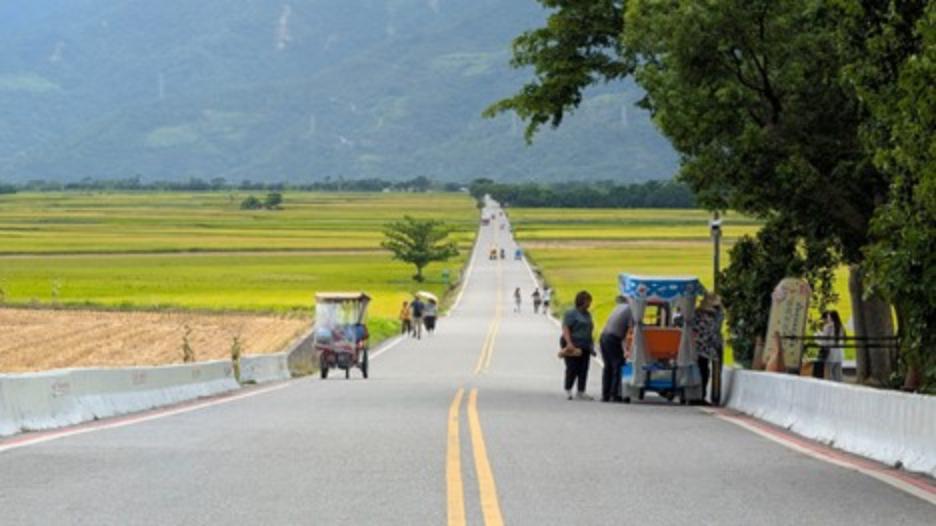
Chishang's Wan'an Community joining smallholder carbon farming is a powerful boost, because its cultural landscape area is a centrepiece of Taiwan's agricultural landscape. (Photo: Jay Fang)
The old gardener helps the young gardener towards sustainability
This week I accompanied senior landscape architect Tsai Hsiu-chiung to visit carbon-farming smallholders in Hualien and Taitung, hoping to give carbon farming a visual presence through landscape — so that local residents and visitors can understand what carbon farming is, and so that the idea, the action and the results of carbon farming ripple outwards. Carbon farming is the climate action smallholders are taking in the face of the global climate crisis, and it generates sustainability performance under the UN Sustainable Development Goals (SDGs).
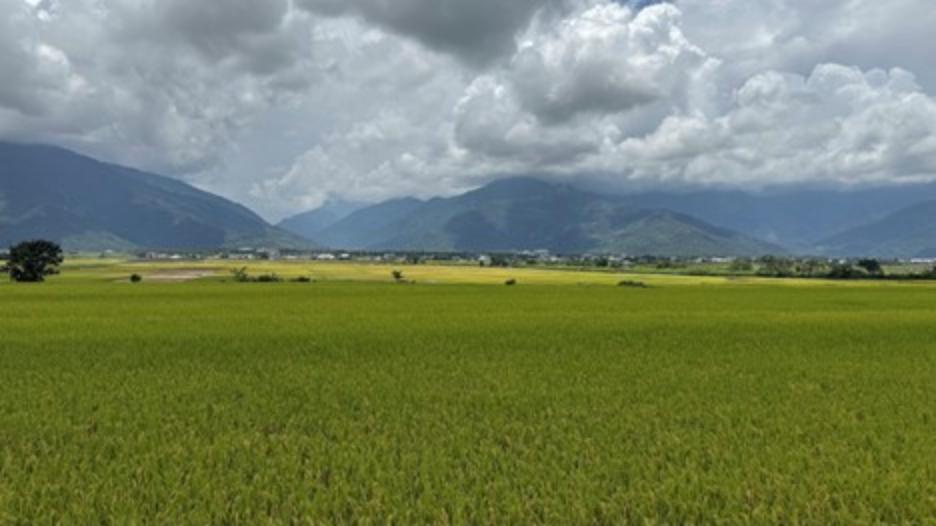
Mountains, rivers and fields — great landscapes are priceless. Turning the four seasons' scenery into sustainable landscape landmarks is smallholder carbon farming's next major task. (Photo: Jay Fang)
Luckily, the English name of Laopu Landscape Architecture Company, founded and run by Tsai Hsiu-chiung, is "Old Farmer Landscape Architecture Company". In the Analects ("Zilu"), when Fan Chi asked to learn farming, Confucius said, "I am not as good as an old farmer"; when he asked to learn gardening, Confucius said, "I am not as good as an old gardener" — the origin of the name Laopu ("old gardener"). Laopu's philosophy: "What Laopu cultivates is not only the land but also the human spirit; what Laopu holds to is not only loyalty, diligence and dedication, but also a service philosophy of carrying on culture and sustainable innovation."
This happens to coincide with the spirit of smallholder carbon farming. Laopu has 45 years of history; smallholder carbon farming is only three. "The old gardener must help the young gardener (smallholder)." We have no buildings; what we provide is food for people's spirit and body. Laopu generously agreed to visit smallholders in Hualien and Taitung — a journey of learning and exchange.
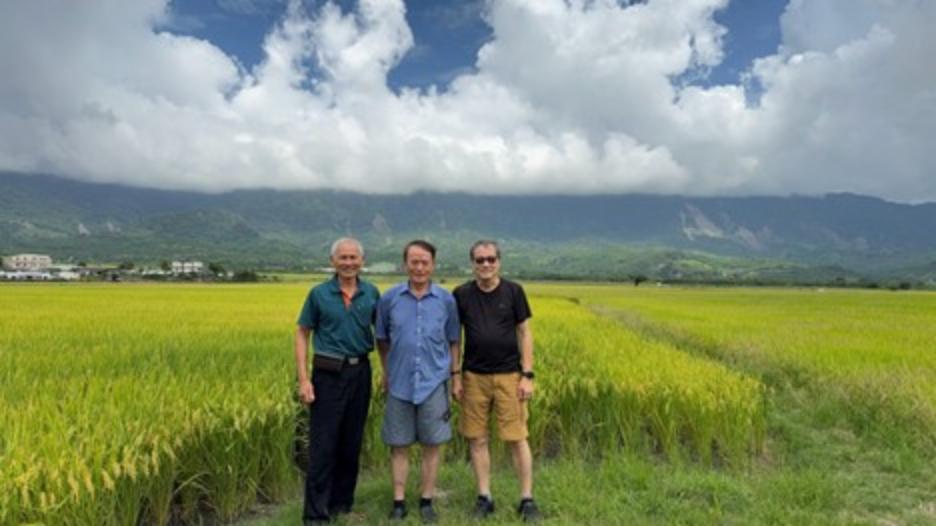
In search of Taiwan's sustainable landscapes — from left: Hsiao Jen-yi, general secretary of the Wan'an Community Development Association; Tsai Hsiu-chiung, chairman of Laopu Landscape; and the author, Jay Fang.
The CO2 from our breathing, and from coal-fired power stations, can spread to every corner of the globe within seven days. Whether the world globalises or closes itself off, the Earth's ecosystem is inseparably connected. When Taiwan's smallholders farm carbon, they gather carbon from all over the world, so their contribution is global.
In the three years since carbon farming began, the public remains full of puzzlement and doubt about how carbon is "planted" into the soil, because it spans macro and micro knowledge and observation in Earth biology, physics and chemistry that most people find hard to grasp. Only through obvious, visible examples can we explain what carbon farming is.
Carbon farming happens in the fields, so we must go back to the fields. And fields, changing with the seasons and solar terms, may seem unchanging but are in fact endlessly varied.
Without people, there is no sustainability
In mid-June in Yuli and Fuli in Hualien and Chishang and Guanshan in Taitung — eastern Taiwan's rice bowl — the rice is ripening, the early varieties already golden. The air is filled with the scent of ripening rice flowers and grain, something few people ever experience. In another month the first-crop harvest will be in full swing, and most fields will be left with only stubble.
At the end of July and in early August, farmers begin preparing for the second rice crop. The paddies are flooded again, and tiny seedlings grow hard under the blazing sun, beginning the next life cycle and providing Taiwan's main staple.
The countryside is like a "Four Seasons symphony" playing non-stop 24 hours a day, 365 days a year. Besides the visual scenery, you can close your eyes and listen quietly to the music composed by wind, rain, grass, insects, trees, mountains and water.
All along the way, Mr Tsai asked questions about everything, making the farmers and us look afresh at these "everyday" things. How can we express the spirit and value of smallholder carbon farming in this everyday life? From a landscape perspective, carbon farming is a world-class action, so what it presents must also be world-class and replicable everywhere, gathering into smallholders' collective action against global climate change — no longer a few smallholders like a mantis trying to stop a chariot, but the greatest force for balancing the Earth's carbon cycle.
He also lamented that Taiwan as a whole needs more aesthetic literacy; Taiwan today should not just rely on the makeshift "spirit of overcoming hardship", cobbling things together to eat and make money. Smallholder carbon farming, now undergoing international certification, has an even greater responsibility to bring sustainability into the countryside. The simple, unspoilt scenes of rural villages and the changes of nature are undoubtedly the best match for sustainable landscapes.
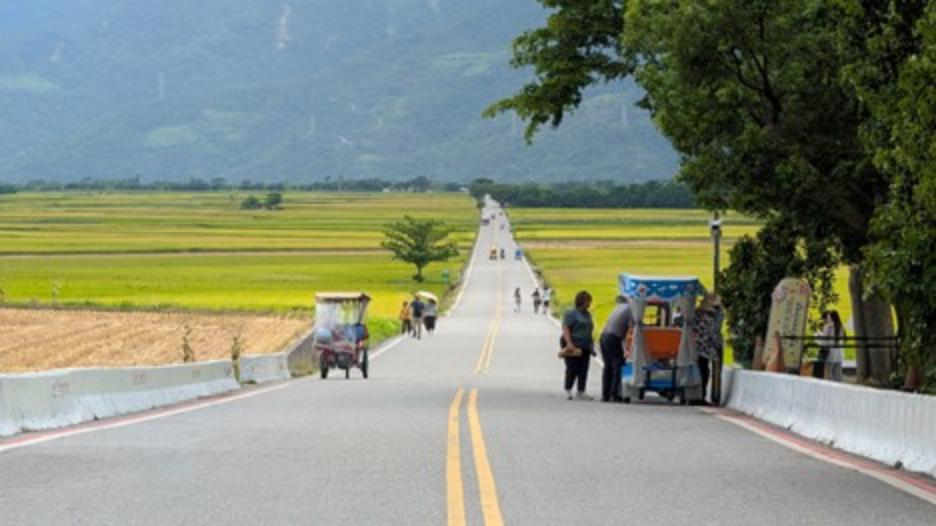
Chishang's Wan'an Community joining smallholder carbon farming is a powerful boost, because its cultural landscape area is a centrepiece of Taiwan's agricultural landscape. (Photo: Jay Fang)
First came the open view without utility poles, then the Takeshi Kaneshiro Tree
Chishang's Wan'an Community joining smallholder carbon farming is a powerful boost, because its cultural landscape area is a centrepiece of Taiwan's agricultural landscape, praised not only in Taiwan and Asia but worldwide — from the "Mr Brown Avenue" that grew out of the King Car Mr Brown coffee advertisements, to the "Takeshi Kaneshiro Tree" from EVA Air's 2013 "I see you" campaign, under which Takeshi Kaneshiro drank tea beneath a large Bishop wood tree (note: since 2024, after the end of Kaneshiro's 10-year partnership with EVA Air, it has been renamed the "Tea-Offering Tree"). Some estimate that a small tree once used for tethering cattle became the "Takeshi Kaneshiro Tree" that once generated NT$700 million of economic value in a single year。
. And in July 2015 this nameless tree was uprooted by Typhoon Matmo. Had it not been boosted by the advertisements and the star, it would probably have disappeared long ago, because some farmers dislike trees — or even street lights — next to paddy fields, as the light affects the growth of nearby rice. Today the tree is like a critically ill old man on life support, propped up to cling to life and receive visitors from all over the world every day. Local residents think that if things go on like this, one day the tree really will fall again and never come back.
If there were a vote, both the "Tea-Offering Tree" and the "Takeshi Kaneshiro Tree" would rank near the top of Chishang's landscapes or landmarks — but can they be sustained?
By contrast, more than 30 years ago Wan'an Community stopped 44 utility poles from "invading" its fields, creating a unique "grand open vista" found nowhere else in Taiwan. That is the true benchmark of sustainability — sustainability in the realm of "emptiness". Had those 44 poles gone in, no one would have come to shoot the adverts that created the later commercial legend.
This is just one example. Taiwan has so many beautiful landscapes and landmarks that could be sustained, yet cannot last.
According to Wikipedia's entry on sustainable landscape design (Sustainable Landscaping), design must be "functional, cost-effective, visually pleasing, environmentally friendly and maintainable", bringing lasting benefits such as saving energy and water and using less fertiliser and pesticide, while also sequestering carbon.
The carbon sequestration process of smallholder carbon farming itself changes the landscape. In Tzu Chi's Da Ai TV report "The power of four per thousand", in mid-January this year, during the fallow season, a drone flies from neighbouring fields to the north into Changliang's smallholder carbon farming area: from a stretch of bare yellow earth, the view suddenly turns lush green.
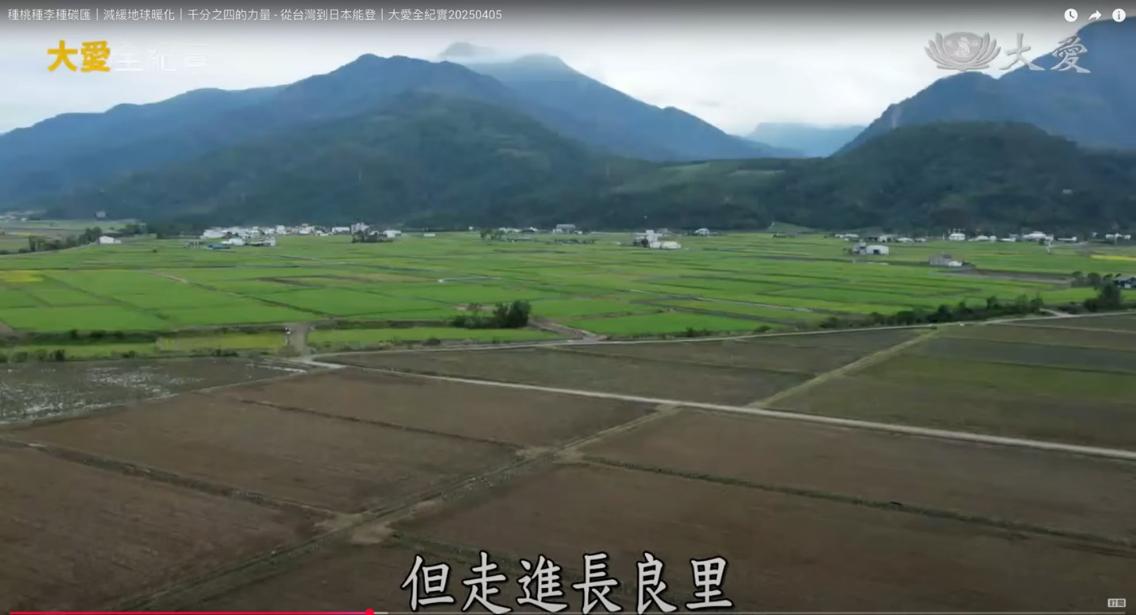
Changliang is a sea of green, a striking contrast with the lifeless neighbouring fields — a huge difference in the landscape. (Image from "Planting peaches, plums and carbon sinks | Slowing global warming | The power of four per thousand – from Taiwan to Noto, Japan | Da Ai Documentary 20250405")
This is the visual impact of smallholder carbon farming — anyone can see the difference at a glance.
We believe smallholder carbon farming will become a sustainable landscape landmark around the world. Japan's Noto Senmaida — a UN Globally Important Agricultural Heritage System site, a sacred place of Japanese agriculture and a landmark of the sustainable-agriculture "satoyama initiative" — suffered a once-in-a-millennium earthquake in 2024 and once-in-a-century rain, floods and debris flows, facing an "unsustainable" crisis under climate change. We will also discuss with local farmers how to establish local sustainable landscape landmarks, with smallholder carbon farming showing the sustainable value of leading the area towards sustainable recovery and revitalisation.
Source: CM Media ( https://www.cmmedia.com.tw/home/articles/55067 )


