努力小農
本文尚無譯文。
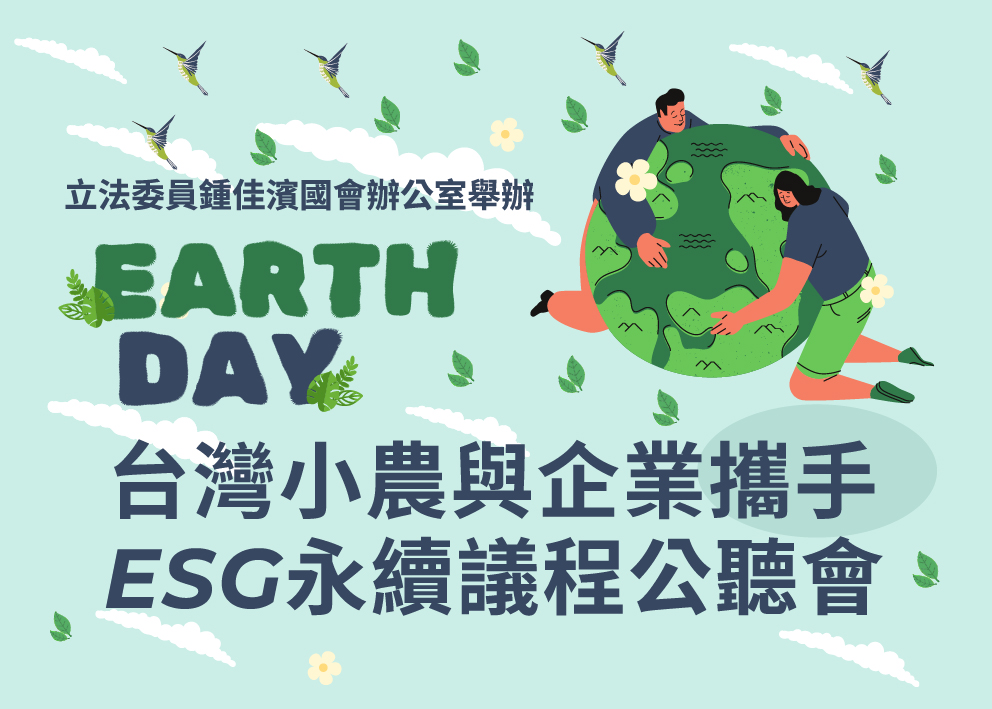
21 Apr 2026: Earth Day public hearing — Taiwan's smallholders and companies joining hands on ESG sustainability
About:
In response to the impact of extreme weather on smallholders in Hualien and Taitung, and to help companies meet ESG evaluation and IFRS S1/S2 mandatory disclosure rules, this meeting has been organised to promote a "smallholders cut carbon, companies buy" model, advancing agricultural transformation and shared prosperity for town and country. We sincerely invite your organisation to take part and contribute ideas, joining hands to create a sustainable future for companies and smallholders together.
- Time: Tuesday 21 April 2026, 14:00–16:30
- Venue: Room 101, Red House, Legislative Yuan
- Chairs: Legislator Chung Chia-pin and former legislator Chen Man-li
- Theme: Earth Day: Taiwan's smallholders and companies joining hands on an ESG sustainability agenda
Invited organisations:
- Government agencies: Ministry of Environment, National Development Council, Ministry of Agriculture, Financial Supervisory Commission
- Civil society groups: Homemakers United Consumers Co-op, Homemakers United Foundation, Taiwan Fair Trade Association, Environment and Animal Society of Taiwan (EAST), National Union of Taiwan Women's Associations, Taiwan Environmental Protection Union, Taiwan Watch Institute, Mom Loves Taiwan (mothers' climate action alliance), Consumers' Foundation, Fubon Cultural and Educational Foundation, Landscape Association, Environmental Quality Protection Foundation… (invitations continuing)
- ESG investors and companies: Tzu Chi Foundation, TSMC Charity Foundation, Delta Electronics Foundation, Fubon Financial, E.SUN Financial, Chunghwa Telecom, Taiwan Mobile, MediaTek
- Smallholders and local representatives: Chishang Township Office (Mayor Lin Chien-hung), Chishang Wan'an Community Development Association (Chishang project owner Hsiao Jen-yi), Changliang Village production and marketing group and community development association, Yuli Township (Taiwan project owner Chu Yen-lun), Mitian Sharing Cooperative (chairman Hsieh Ching-kuei), Food Safety Agricultural Cooperative (manager Hu Keng-feng)
- Professional assurance firms: Chien Yeh Law Offices, KPMG, PwC, EY, Deloitte
- Co-initiators of the sandbox action: Dawushan Cultural and Educational Foundation, Eco-affinity Inc.
>> Meeting materials: https://docs.google.com/document/d/e/2PACX-1vQDuZ3Mzc4dqJ76Y59e-_fxQdgMKOTdrL8x_xyJ2fUFXpPiOJ5jrOSbudh25fw6Q4NPB35-EkRzhiF8/pub
Earth Day: Taiwan's smallholders and companies joining hands on an ESG sustainability agenda
1. Background and purpose
Through policy recommendations on "sustainable farm produce and ESG investment", this initiative aims to turn companies' supply-chain pressures into payment for ecosystem services (PES) for Taiwan's smallholders, solving the economic crisis smallholders in Hualien and Taitung face from climate change, while helping listed companies meet the 2026 ESG evaluation and IFRS S1 and S2 mandatory disclosure requirements.
Global climate change has intensified in recent years, and smallholders in Hualien and Taitung bear the brunt. Year after year, rice smallholders' autumn and winter harvests have been hit by typhoons and extreme weather, slashing yields of rice and other crops. With costs exceeding income, they have lost their prospects for sustainability.
At the same time, the Financial Supervisory Commission requires listed companies to apply IFRS S1 and S2 in phases from 2026, and companies urgently need "verifiable and financially material" Scope 3 (supply chain) emission-reduction data. This public hearing aims to build a mechanism in which "buying produce from ESG smallholders is investing in sustainability", letting companies earn ESG evaluation points and climate-resilience assets by supporting "ESG smallholders", while ensuring smallholders receive 70% or more of the proceeds, achieving shared prosperity for town and country.
2. Core agenda issues
- Practical case analysis: assessing the concrete models and sustainability evaluation estimates of the Tzu Chi Foundation (e.g. charitable donations to the Zhenshanmei Foundation, the Noto satoyama project) and the TSMC Charity Foundation's support for disaster victims in Guangfu, Hualien, and its empowerment programme.
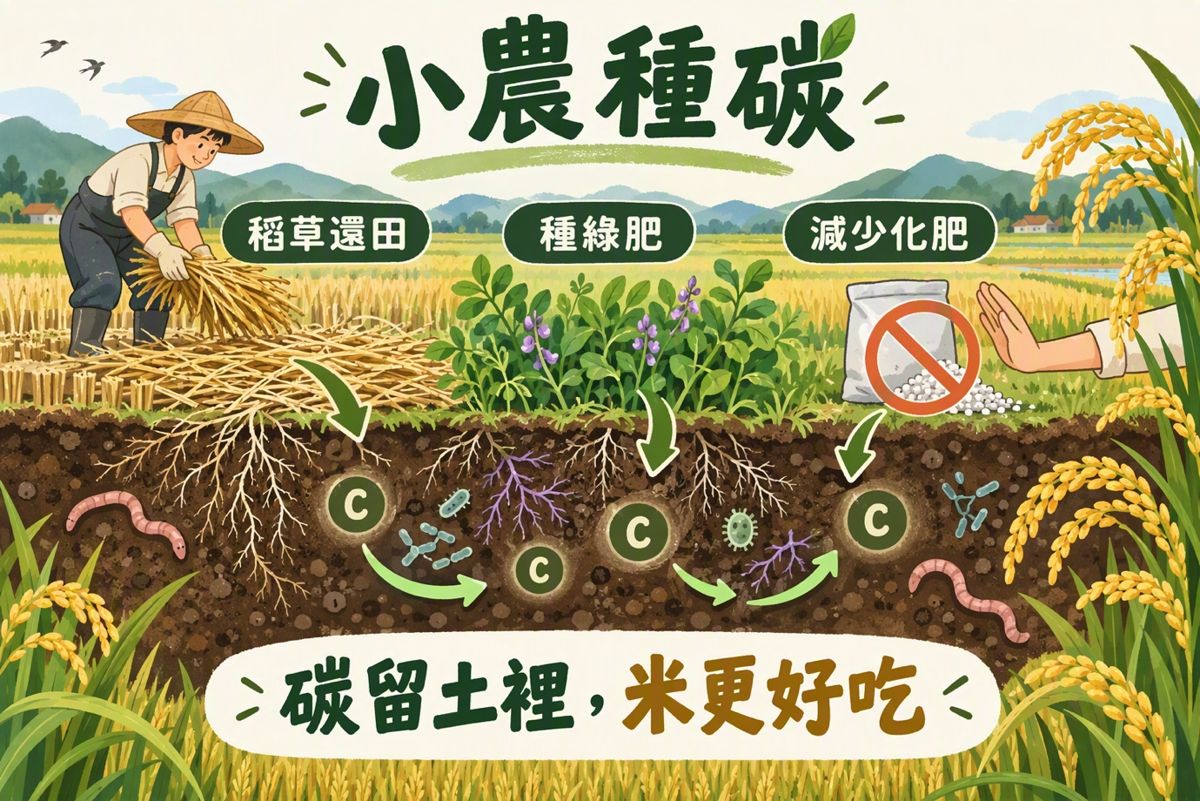
- Policy alignment and evaluation points: exploring how smallholders' emission-reduction performance (an estimated 4 tonnes of CO2e per hectare) can be aligned with the 2026 ESG evaluation indicators E-15 (natural carbon sinks) and S-3 (community development).
- Verifying financial materiality: the feasibility, under IFRS S2, of turning PES purchasing into companies' "climate transition assets" or "nature-based solutions (NbS)".
- Distributive justice mechanism: establishing transparent "ESG due diligence" and "accountant assurance" processes to ensure corporate budgets genuinely benefit the land and producers.
3. Event overview
- Theme: Earth Day: Taiwan's smallholders and companies joining hands on an ESG sustainability agenda
- Chairs: Legislator Chung Chia-pin, Chen Man-li
- Time: 21 April 2026, 2:00–4:30 p.m. (coinciding with World Earth Day on 22 April 2026)
- Venue: Red House meeting room, Legislative Yuan
4. Invited organisations
- Government agencies
- Ministry of Environment: explaining trading of agricultural voluntary reduction credits and carbon pricing policy.
- National Development Council: linking the national 2050 net-zero transition "natural carbon sink" strategy with regional revitalisation.
- Ministry of Agriculture: explaining the stacked payment scheme for ecosystem services and transition support for smallholders.
- Financial Supervisory Commission: guidance on including the PES purchasing ratio in sustainability report disclosures.
- Civil society groups
- Mom Loves Taiwan, Homemakers United Foundation, Homemakers United Consumers Co-op, Environment and Animal Society of Taiwan (EAST), Consumers' Foundation, Taiwan Environmental Protection Union, Fubon Cultural and Educational Foundation, Environmental Quality Protection Foundation, Taiwan Watch Institute, National Union of Taiwan Women's Associations, Taiwan Fair Trade Association, Earth Watch Association.
- ESG investors and companies
- Tzu Chi Foundation, TSMC Charity Foundation, Delta Electronics Foundation, Fubon Financial, E.SUN Financial, Chunghwa Telecom, Taiwan Mobile, MediaTek… (invitations continuing)
- Smallholders and local representatives
- Chishang Township Office (Mayor Lin Chien-hung), Chishang Wan'an Community Development Association (Chishang project owner Hsiao Jen-yi), Changliang Village production and marketing group and community development association, Yuli Township (Taiwan project owner Chu Yen-lun), Mitian Sharing Cooperative (chairman Hsieh Ching-kuei), Food Safety Agricultural Cooperative (manager Hu Keng-feng).
- Professional assurance firms
- Chien Yeh Law Offices, KPMG, PwC, EY, Deloitte.
- Co-initiators of the sandbox action
- Dawushan Cultural and Educational Foundation, Eco-affinity Inc.
5. Key indicators of the five-layer ripple effect
Level of impact |
Recommended actions |
Corresponding 2026 evaluation indicators |
1. ESG smallholders |
Practise Gold Standard-certified carbon farming and quantify performance on 6 SDGs. |
E-15 (natural carbon sinks) |
2. Corporate purchasing |
Use ESG smallholder rice across staff canteens and catering, implementing the PES model. |
G-32 (sustainability performance), E-16 (supplier management) |
3. Internal engagement |
Run food-and-farming education courses for staff, turning catering budgets into welfare investment. |
S-16 (employee benefits), S-21 (employee training) |
4. Lifestyle consumption |
Organise staff eco-tourism and volunteer trips to contract farms in Hualien and Taitung. |
S-3 (community development and engagement) |
5. Supply chain |
Ask upstream and downstream suppliers to join ESG purchasing, reducing Scope 3 emissions. |
E-3 (Scope 3 emissions) |
6. Expected outcomes
- Promoting legislation and guidance: prompting the Financial Supervisory Commission to issue a code of practice on "corporate purchasing of sustainable farm produce to support financial disclosure".
- Protecting farmers' incomes: establishing a 70% price-return mechanism so that smallholders in Hualien and Taitung receive a stable basic income of about NT$400,000 per hectare.
- Aligning with international standards: helping Taiwanese companies use local project data to respond to IFRS S2 climate-related disclosure requirements to a high standard.
- Raising food self-sufficiency: using commercial power to support domestic low-carbon food, protecting biodiversity and food security (SDG 2).
7. Agenda
Earth Day: Taiwan's smallholders and companies joining hands on an ESG sustainability agenda
- Time: Wednesday 22 April 2026, 14:00–17:00
- Venue: Red House meeting room, Legislative Yuan
- Chair: Legislator Chung Chia-pin
- Theme: Turning climate pressure into resilience value: linking Taiwan's smallholder carbon farming with corporate sustainability value chains
--------------------------------------------------------------------------------
Part 1: Opening remarks and background (14:00–14:15)
- Speaker: Legislator Chung Chia-pin
- Key points:
- Revealing the survival dilemma smallholders in Hualien and Taitung face from extreme weather (autumn and winter typhoons): rice costs about NT$320,000–340,000 per hectare, and climate-driven yield losses mean costs exceed income.
- Citing the Financial Supervisory Commission's 2026 ESG evaluation and IFRS S1/S2 mandatory disclosure roadmap, stressing the policy urgency of linking companies with smallholders, which can also provide employees with high-quality food, ensuring food safety and supporting health.
--------------------------------------------------------------------------------
Part 2: Practical case analysis — from food supply chain to sustainable value chain (14:15–15:00)
- Project results report: quantified SDG performance of the Taiwan Smallholder Carbon Farming Project (GS11818) and the Chishang project (GS23490) (4 tonnes of carbon reduced per hectare, biodiversity, soil doctor training).
- Corporate support case studies:
- Tzu Chi Foundation: integrating charity and sustainable agriculture (e.g. white rice for the Zhenshanmei Foundation's charitable donations, and lessons from supporting the Noto satoyama smallholder carbon farming project after Japan's great Noto earthquake).
- TSMC Charity Foundation: how local purchasing with Gold Standard certification delivers Scope 3 emission reductions and social impact, and empowers Guangfu smallholders to revitalise through natural organic farming.
- Financial materiality: explaining how a company's "food supply chain" can be turned into a "value chain of climate and sustainability assets".
--------------------------------------------------------------------------------
Part 3: Cross-ministry policy dialogue — building "ESG investment in sustainable farm produce" (15:00–15:45)
- Ministry of Environment: linking agricultural voluntary reduction credits with carbon credit offset mechanisms.
- FSC Securities and Futures Bureau: including the PES (payment for ecosystem services) purchasing ratio in the 2026 evaluation indicators (S-3, G-32) and sustainability report disclosure guidance.
- Ministry of Agriculture: the stacked payment scheme for ecosystem services and transition support policy for smallholders.
- National Development Council: linking regional revitalisation strategy with key natural carbon sink programmes.
--------------------------------------------------------------------------------
Part 4: Discussion of key issues — assurance mechanisms and distributive justice (15:45–16:30)
- Smallholder and local voices: representatives of Chishang Township Office, Wan'an Community and the Yuli Changliang production and marketing group describe their need for economic resilience under climate risk.
- Civil society perspectives: recommendations on responsible production and fair distribution from groups such as the mothers' climate alliance, Homemakers United and the Taiwan Fair Trade Association.
--------------------------------------------------------------------------------
Part 5: General discussion and conclusions (16:30–17:00)
- Discussion focus: a feasible timeline for issuing a code of practice on "corporate purchasing of sustainable farm produce to support financial disclosure".
- Chair's summary: calling on government agencies to integrate cross-ministry resources and use market forces to give back to agriculture, benefiting employees' health and pride, and achieving a triple win of ESG value-added compliance for companies, smallholder income and food security.