 努力小農
本文尚無譯文。
Why Companies Need Agricultural Carbon Sinks More Than Ever Now That Taiwan's Carbon Fee Has Arrived
Carbon Farming Digest No. 2 · In-depth feature · Minor Heat 2026
2026 is the first year Taiwan's carbon fee really bites. For the past two years most companies treated the carbon fee as a distant concept — 2025 was only a trial reporting year with nothing to pay. That buffer is over. From 2026, power and manufacturing companies whose annual emissions (direct plus indirect) reach 25,000 tonnes or more must pay a carbon fee based on their actual 2025 emissions. The Ministry of Environment estimates that about 500 emission sources at 281 companies fall within this scope, 141 of them listed companies. For these firms the carbon fee is no longer a policy debate but a real cost that has to be budgeted every year.
The standard rate is NT$300 per tonne. A company that submits a "voluntary reduction plan" and is confirmed by the authorities to have met its reduction target can apply for a preferential rate of NT$50 or NT$100 per tonne — a gap of up to six times. Even more important is the timeline: the Ministry has publicly planned to raise the rate to NT$1,200–1,800 per tonne by 2030. In other words, today's carbon fee is only the flattest part of the future cost curve. The reduction and offset strategy companies put in place now will decide their carbon costs for the next five to ten years, not just this one bill.
The carbon fee system also leaves a door open for companies to offset part of the fee with voluntary carbon credits: foreign credits can offset at most 5% of chargeable emissions, while the deduction ratio for domestic voluntary reduction and offset projects — including agricultural soil carbon sinks — will be announced separately by the Ministry of Environment. This means two things. First, although the deduction ratio for domestic agricultural carbon sinks has not yet been set, the system has clearly brought them into the scope of eligible offsets; companies that secure a position and obtain verified credits early will be able to use them as soon as the details are announced. Second, looking only at "using carbon credits to knock a little off the fee" actually underestimates the value of agricultural carbon sinks. They can also address three other pressures companies face: ESG disclosures that need a "reasonable and supportable" calculation basis (explicitly required by IFRS S2), the trend towards localised supply chains, and the needs of employee benefits and employer branding.
This is why more and more companies are no longer content to buy international carbon credits of unclear origin and with no local context. On a report, one tonne of credits is one tonne, but agricultural carbon sinks come with local content that can be explained clearly, verified and told as a story: which field, which farmer, what method was used, how much emissions were cut, and what ecological and social benefits were added. That is exactly why the Dawushan Cultural and Educational Foundation and Eco-affinity Inc. jointly launched the "ESG Green Shinkansen" sandbox programme — to turn the carbon farming of smallholders in Hualien and Taitung into ESG assets companies can directly buy, verify and disclose, rather than a one-off charity event.
Specifically, by investing in ESG carbon-farming smallholders in Hualien and Taitung, a company gets not only credits to offset its carbon fee, but also Gold Standard–certified emission reduction credits, six quantifiable SDG performance indicators, and a three-layer anti-greenwashing evidence chain — "real-time records in the MiHuMiSang App → audit by a third-party VVB (validation and verification body) → public registration with Gold Standard" — so every investment can withstand scrutiny by accountants and external auditors. And under the PES (payment for ecosystem services) contract, more than 70% of the investment goes directly into the accounts of the participating smallholders — not a subsidy that goes round in circles, but real income on the ground.
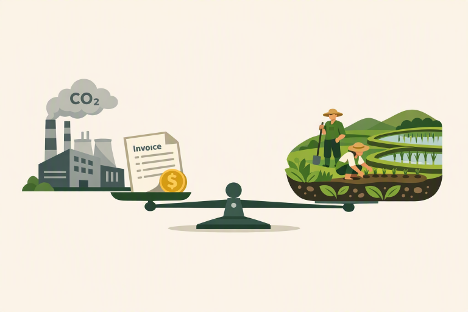
The carbon fee is pressure, but it is also an opportunity for companies to take stock of their decarbonisation toolbox. Rather than treating the carbon fee as a pure cost, it makes more sense to turn that budget into an investment in domestic, verifiable agricultural carbon sinks with stackable benefits — the most practical and most defensible choice for companies at this stage. To learn more about how the "ESG Green Shinkansen" programme can help your company prepare for the carbon fee and ESG disclosure, please contact Eco-affinity Inc.: [email protected], 0906 892 567.
A joint initiative of the Dawushan Cultural and Educational Foundation × Eco-affinity Inc.
Turn your carbon fee budget into a verifiable agricultural carbon sink investment with stackable benefits.
→ Learn about the "ESG Green Shinkansen" sandbox programme
Contact: Eco-affinity Inc. [email protected] 0906 892 567


