 努力小農
本文尚無譯文。
Knowledge Corner: How the Carbon Fee Is Calculated and Where Agricultural Carbon Sinks Fit In
Carbon Farming Digest No. 2 · In-depth feature · Minor Heat 2026
"How much carbon fee does our company actually have to pay?" is the question corporate sustainability teams are asked most often in 2026. The answer depends on three things: emissions, whether there is an approved voluntary reduction plan, and whether the company is willing to put offset tools in place early. This article explains, in one go, how the carbon fee is calculated and how agricultural carbon sinks plug into a company's decarbonisation toolbox.
First, who pays. The carbon fee targets power and manufacturing companies whose annual greenhouse gas emissions (direct plus indirect) reach 25,000 tonnes or more. The Ministry of Environment estimates that about 500 emission sources in Taiwan meet the threshold, belonging to 281 companies, 141 of them listed. If your company is not within this scope it does not currently have to pay, but it is still worth understanding the system early, because the threshold may be adjusted as policy is reviewed.
Next, the rate. The standard rate is NT$300 per tonne. For example, a manufacturer emitting 100,000 tonnes a year would pay NT$30 million a year at the standard rate. But if the company submits a "voluntary reduction plan" and meets the reduction target approved by the authorities — by switching to low-carbon fuels, adopting negative-emission technologies, improving energy efficiency, using renewable energy or improving its processes — it can apply for a preferential rate of NT$50 or NT$100 per tonne. The same 100,000-tonne emitter at the NT$50 rate would pay NT$5 million, just one sixth of the standard-rate bill. This gap is why "having an actionable, verifiable reduction plan" shows up directly in the financial statements.
As for timing, 2025 was a trial reporting year: companies only had to report emissions, not pay. The obligation to pay starts in 2026, calculated on actual 2025 emissions. That is why 2025 emissions accounting and reduction efforts were in effect already deciding how much would be paid in 2026. Looking ahead, the Ministry has signalled that the rate will rise to NT$1,200–1,800 per tonne by 2030, four to six times today's standard rate. The buffer time gained by building reduction and offset capacity early will only keep shrinking.
Besides voluntary reduction, the carbon fee system also lets companies offset part of the fee with voluntary carbon credits. Two sources must be distinguished here: foreign credits can offset at most 5% of chargeable emissions, and anything above that cannot be used; for domestic voluntary reduction and offset projects (including forest management, bamboo forest management and agricultural carbon sinks), the deduction ratio will be announced separately by the Ministry of Environment and has not yet been set. Note also that early-action projects (reduction projects that began before the formal system took effect) can only deduct emissions for 2024 and 2025 and cannot be backdated indefinitely.
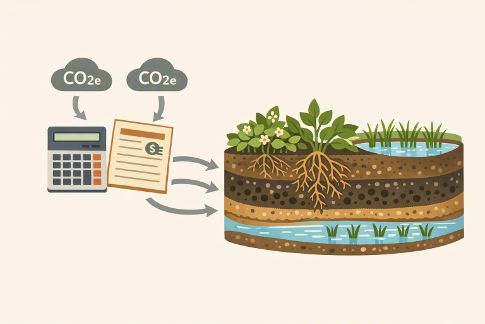
So how exactly do agricultural carbon sinks "plug into" this system? The methodology already approved by the Ministry of Agriculture is "improved agricultural soil management" — increasing the amount of soil organic carbon stored by improving how farmland is managed. Another methodology focused on organic cover cropping, applied to certified organic tea gardens, orchards and sugarcane fields, reduces bare soil and conserves water through conservation tillage and is currently under review. Approval of these methodologies is the precondition for agricultural emissions to be quantified and registered as carbon credits.
It is worth stressing that at present only "companies and government agencies" can apply for carbon credits; individual farmers cannot apply themselves. That is why, in practice, smallholders who want to take part in the agricultural carbon sink market have to do so by working with companies — the company applies for the reduction project, farmers carry out the work in the field, and part of the carbon credit revenue is returned to the participating farmers through contract farming or a PES (payment for ecosystem services) contract.
This is precisely the missing piece filled by the "ESG Green Shinkansen" sandbox programme jointly promoted by the Dawushan Cultural and Educational Foundation and Eco-affinity Inc. By investing in smallholder carbon farming in Hualien and Taitung through this platform, companies obtain Gold Standard–certified emission reduction credits, quantifiable SDG performance, and a three-layer verification chain — "MiHuMiSang App records → third-party VVB verification → public registration with Gold Standard" — turning agricultural carbon sinks from a "concept" into an asset that can withstand an accountant's assurance opinion and IFRS S2 disclosure review. To find out how your company can use the "ESG Green Shinkansen" to prepare for the carbon fee and invest in agricultural carbon sinks, please contact Eco-affinity Inc.: [email protected], 0906 892 567.
A joint initiative of the Dawushan Cultural and Educational Foundation × Eco-affinity Inc.
Turn your carbon fee budget into a verifiable agricultural carbon sink investment with stackable benefits.
→ Learn about the "ESG Green Shinkansen" sandbox programme
Contact: Eco-affinity Inc. [email protected] 0906 892 567


