 努力小農
本文尚無譯文。
The Sandbox Programme's Legal Framework: An Introduction to the ESG Green Shinkansen Four-Party Cooperation Agreement
Carbon Farming Digest No. 2 · Sandbox programme overview · Minor Heat 2026
The "ESG Green Shinkansen Four-Party Cooperation Sandbox Agreement" (draft, version of 20 June 2026) is the legal framework of this action plan. It turns "smallholder carbon farming × corporate ESG investment × payment for ecosystem services (PES)" into an enforceable, auditable contractual relationship. The agreement is built on the framework of the Gold Standard for the Global Goals and is designed to meet IFRS S1/S2 disclosure requirements and the ESG evaluation criteria of Taiwan's Financial Supervisory Commission and Stock Exchange.
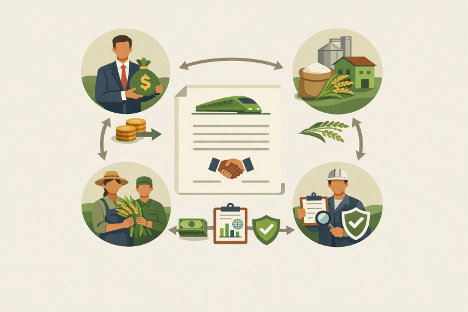
The agreement is signed by four parties. Party A is the listed company investing in smallholder carbon farming. Party B is the smallholder groups that actually practise carbon farming, including the Mitian Sharing Cooperative in Hualien, the second and third high-quality rice production and marketing groups of Changliang Village in Yuli, and the Wan'an Community Development Association in Chishang Township. Party C is the agents linking smallholders to the market, such as Tianzu Sustainable Agriculture and the Chen Hsieh-ho rice mill, responsible for production and sales records and for grading and pricing the rice. Party D is Eco-affinity Inc., responsible for due diligence and project development, together with the Dawushan Cultural and Educational Foundation, a member of the international 4 per 1000 Initiative.
At its core, the SDG/ESG performance obtained through Party A's investment belongs to the company itself and can be used directly in its sustainability report. Party B or Party C supplies high-quality rice with a taste value of 65 or above, worth NT$100,000 at market prices, for the company to use as employee benefits. All parties also sign a PES contract ensuring that more than 70% of the payment goes directly to smallholders rather than being a subsidy eroded by layers of commissions. The agreement also sets out a "five-layer impact framework": layer 1 (ESG smallholders) and layer 2 (corporate procurement) are mandatory, while layers 3 to 5 (employee education, eco-tourism and supply chain expansion) are optional according to the company's needs.
To prevent greenwashing, the agreement requires claims to follow the six integrity principles of the Gold Standard Claims Guidelines and provides for prior review, annual self-assessment, third-party VVB verification and whistleblower protection. If a party breaches the agreement and fails to correct it after notice, the other parties may terminate the agreement and hold it accountable. The agreement is still a draft, and the signing date awaits final confirmation by all parties.
A joint initiative of the Dawushan Cultural and Educational Foundation × Eco-affinity Inc.
Turn your carbon fee budget into a verifiable agricultural carbon sink investment with stackable benefits.
→ Learn about the "ESG Green Shinkansen" sandbox programme
Contact: Eco-affinity Inc. [email protected] 0906 892 567
The "ESG Green Bullet Train Four-Party Cooperation Sandbox Agreement" (draft, dated 20 June 2026) is the legal backbone of this initiative, turning "smallholder carbon farming × corporate ESG investment × Payments for Ecosystem Services (PES)" into an enforceable, auditable contract. Built on the Gold Standard for the Global Goals framework, it is designed to align with IFRS S1/S2 disclosure requirements and Taiwan's FSC/stock exchange ESG evaluation criteria.
Four parties sign on: Party A is the listed company investing in smallholder carbon farming; Party B comprises the farmer groups practicing the carbon-farming methods — the Hualien Rice Field Sharing Cooperative, the 2nd and 3rd Rice Production Teams of Changliang Village in Yuli Township, and the Wan'an Community Development Association in Chishang Township, Taitung; Party C are the intermediary agencies connecting farmers to the market, such as Tianzu Sustainable Agriculture Co. and Chen Xiehe Rice Mill, handling production records and rice grading/pricing; Party D handles due diligence and project development — Eco-affinity Inc. and the Dawushan Cultural and Educational Foundation, Taiwan's 4 per 1000 initiative body.
Under the core mechanism, the SDG/ESG performance generated belongs to Party A for direct use in sustainability disclosures, while Party B/C supply NT$100,000 worth of premium rice (taste score 65+) for employee benefits, under PES contracts guaranteeing farmers receive over 70% of the payment. A "five-tier impact framework" makes farming and procurement mandatory tiers, with employee education, eco-tourism, and supply-chain diffusion as optional add-ons.
Anti-greenwashing provisions require all claims to meet Gold Standard's six integrity principles, backed by pre-review, annual self-assessment, third-party VVB verification, and whistleblower protection; uncorrected violations allow other parties to terminate the agreement and pursue damages. The agreement remains in draft form, with signing date and contract term pending final confirmation.


