 努力小農
本文尚無譯文。
Floods in the Desert, 50°C in India, Europe Scorched: One Runaway Atmospheric Circulation, and Mitigation Is Already Too Late
Carbon Farming Digest No. 2 · Climate watch · Summer Solstice to Minor Heat 2026
As spring turned to summer in 2026, three seemingly unrelated stories hit the international pages at the same time: floods broke out in the driest corner of China, the Taklamakan Desert in Xinjiang; much of India was baked by heat approaching or even exceeding 50°C; and on the other side of the continent, Europe was gripped by one of the deadliest heatwaves on record. Flooding in one place and scorching heat in two others look like three different kinds of extreme weather, but they are really three symptoms of the same disordered atmospheric circulation playing out in different corners of Eurasia.
Even the desert is flooding: a warning for infrastructure in arid regions
Take the desert floods first. The Taklamakan is China's largest desert, with average annual rainfall normally below 100 mm, yet it saw two waves of flooding in June. The first desert flood of 2026 came around 9 June. From 8 a.m. on 19 June to 8 a.m. on 21 June, all 201 weather stations across Hotan Prefecture recorded rain, 113 of them accumulating 24.4–94.9 mm, and Hotan national station recorded 64.7 mm in a single day, breaking the local record since observations began. Rain was not the only cause: local temperatures shot up early to 38°C, 7.3°C above normal for the time of year, melting large areas of snow and glaciers in the Tianshan and Kunlun mountains. Meltwater poured down the valleys into the Tarim River, which rose sharply, burst its banks and flowed into low-lying parts of the desert, producing the spectacle of a "desert flood". In Jiashi County, Kashgar Prefecture, the Tuhe Expressway was cut by flash floods and mudslides on 20 June, halting traffic. Experts note that such desert floods have recurred since 2021, but in the past they mostly came in August, the hottest month; arriving more than a month early this year is itself a warning sign. The more fundamental problem is that roads, water works and public facilities in Xinjiang's deserts and gravel plains were designed for a climate of "drought, strong winds and large day–night temperature swings", with no margin at all for rainfall on this scale.
India's heatwave: heat and humidity together magnify the risk of death
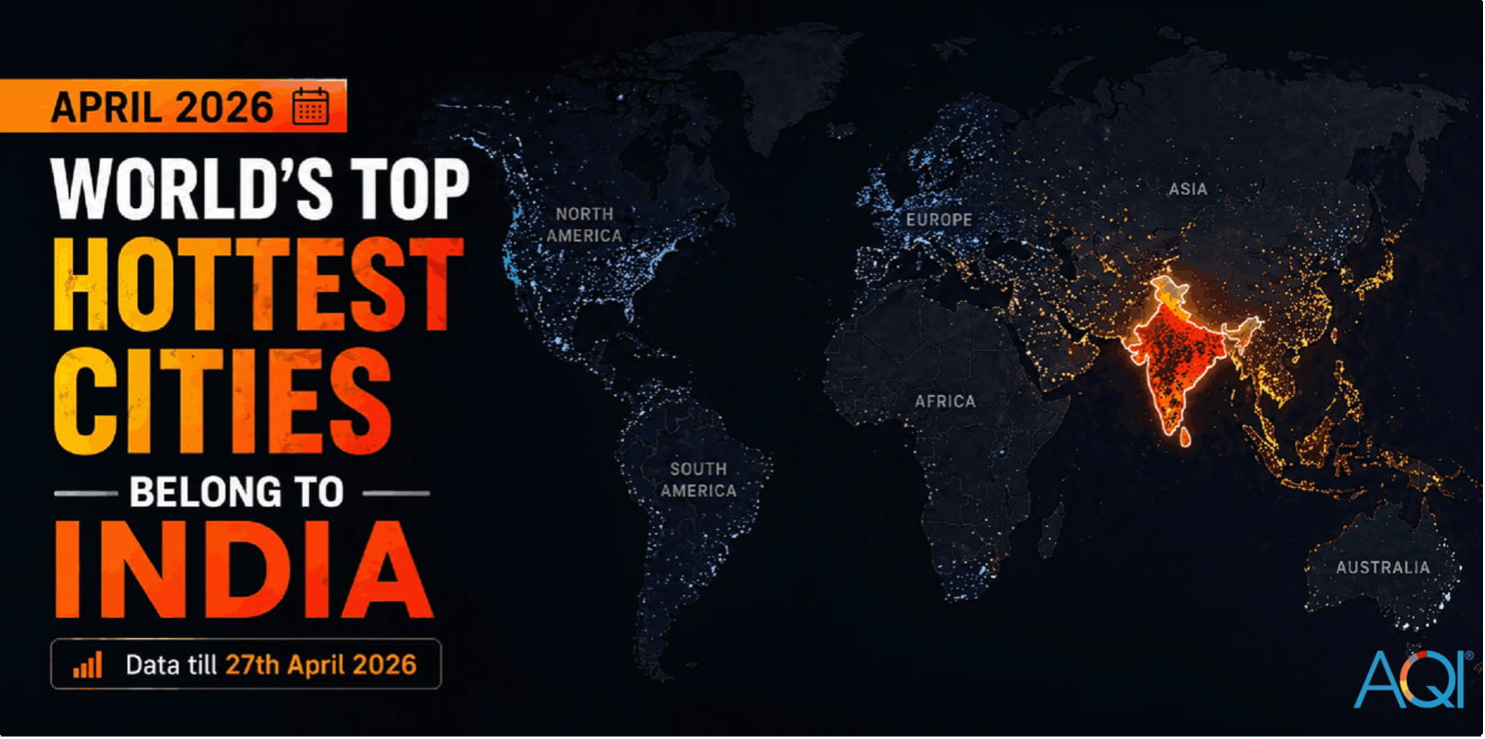
At the same time, India was going through even deadlier heat. Between March and June, 37 cities nationwide topped 45°C. Churu in Rajasthan recorded 50.5°C, India's highest temperature in eight years, and Mungeshpur in the capital New Delhi recorded 49.9°C, a seasonal high for the city. At the peak of the heat, the world's 50 hottest cities were all in India, 26 of them in Uttar Pradesh alone. Even more shocking than the temperatures is the death toll. Studies estimate that a single extreme-heat day causes about 3,400 excess deaths nationwide, and a five-day heatwave nearly 30,000, with about 8,100 in Uttar Pradesh alone over five days. Yet India's official annual heatwave death toll is only 500 to 1,500, which experts call a severe underestimate. Rising humidity makes matters worse: India's average relative humidity has risen from 67.1% in 2015–2019 to 71.2% in 2020–2024. Combined heat and humidity make it hard for sweat to evaporate and cool the body, so the same temperature becomes harder to bear, and even deadly.
The same stalled jet stream: the common root of extreme weather across Eurasia
The European heatwave was caused by a huge high-pressure system known as an "Omega block", which sat over western and central Europe in the shape of the Greek letter Ω and trapped the heat in place for weeks. Behind such blocking is the fact that the Arctic is warming much faster than the equator (Arctic amplification), weakening the north–south temperature difference that drives the jet stream. With a smaller temperature difference, the jet stream becomes slower and wavier, prone to getting knotted and stalling in one place for weeks, creating long-lasting high- or low-pressure systems. Europe's heatwave, India's early and prolonged heat, and the unusual rain in the Taklamakan are all essentially products of this "slower, wavier jet stream" leaving the atmosphere stuck for long periods: places stuck under high pressure keep baking (Europe, India), places stuck where moisture converges keep getting rain (Xinjiang), and both the dry and wet extremes are amplified to record-breaking levels. Three extreme events thousands of kilometres apart happening one after another in almost the same month is itself evidence of a structural imbalance in atmospheric circulation, not a series of independent coincidences.
Mitigation is no longer enough: climate response must shift to adaptation
This is exactly why "mitigation" — reducing greenhouse gas emissions — alone can no longer keep up with reality. Even if the whole world reached net zero tomorrow, the warming already accumulated and locked into the atmosphere and oceans, and the already weakened jet stream, would not reverse within a few years. "Stuck atmosphere" events like desert floods, India's extreme heat and Europe's heatwaves will only become more frequent over the next decade, rather than declining in step with emission cuts. This means the focus of climate response has to widen from simply "meeting carbon targets" to "how to survive and keep functioning under extreme weather that is already happening and will become ever more frequent" — that is, adaptation.
From cities to farmland: adaptation in practice
Adaptation is not an abstract slogan; there are already concrete examples to follow. Around Singapore's Marina Bay, a district cooling system combined with surrounding green space lets buildings and their surroundings cool each other — a model of "technology + landscape" dual-track adaptation. The World Resources Institute (WRI) launched its Cool Cities Lab platform in March 2026, mapping urban heat-island risk down to the city-block level; it now covers more than 25 cities on five continents and helps local governments prioritise tree planting, light-coloured roof retrofits and public cooling centres in the most vulnerable neighbourhoods. On the infrastructure side, many parts of Xinjiang have begun reviewing drainage design standards for arid areas to prepare for "low-probability, high-intensity" rainfall rather than only defending against drought and strong winds. And in agriculture, carbon farming practices that improve soil structure and raise organic matter content can improve both water retention and drainage, giving farmland greater resilience at both extremes of drought and heavy rain. This is the adaptation question Taiwan is trying to answer, starting from smallholder carbon farming in Hualien and Taitung: when mitigation can no longer keep pace with climate change, the land's own capacity to adapt will decide who makes it through the next record-breaking weather.
Sources
- Desert flood: Xinjiang's Taklamakan Desert hit by first flood of 2026 – Central News Agency
- Xinjiang desert's first flood comes early; extreme floods feared this summer – The Epoch Times
- Record rainfall on the southern edge of the Taklamakan Desert triggers local flooding – China News Service · Xinjiang
- Drowning desert: how Xinjiang's infrastructure could fail under record rain - South China Morning Post
- China's largest desert floods after record rainfall - Dialogue Earth
- India's Deadly New Heatwaves - Down To Earth
- Heatwaves are killing tens of thousands in India. Officials are barely counting them - Euronews
- India's Heatwave Is a Warning for the Future - Carnegie Endowment for International Peace
- Europe 2026 Heatwave: Omega Block & Climate Risks - KPIAS Academy
- Jet stream: Is climate change causing more 'blocking' weather events? - Carbon Brief
- RELEASE: New Global Platform Maps Urban Heat Risks Block by Block - World Resources Institute
- Heat-Resilient Urban Design - Building Cooler, Smarter Cities - North Capitol Crossroads


