 努力小農
本文尚無譯文。
A super El Niño is coming — how did we get lucky? 2026's climate warnings and Taiwan's nature-based solutions
Carbon Farming Digest No. 3 · Major Heat | Climate outlook
In 2026 the Pacific is brewing what could be a record-breaking “super El Niño”. The US National Oceanic and Atmospheric Administration (NOAA) officially declared El Niño conditions on 11 June, forecasting an 89% chance of a strong El Niño by December and a 62% chance of it becoming a “super El Niño”. This means that from the second half of 2026 into early 2027, extreme weather around the world could become noticeably more intense and frequent.
Europe: more than 1,300 heat-related excess deaths in a month
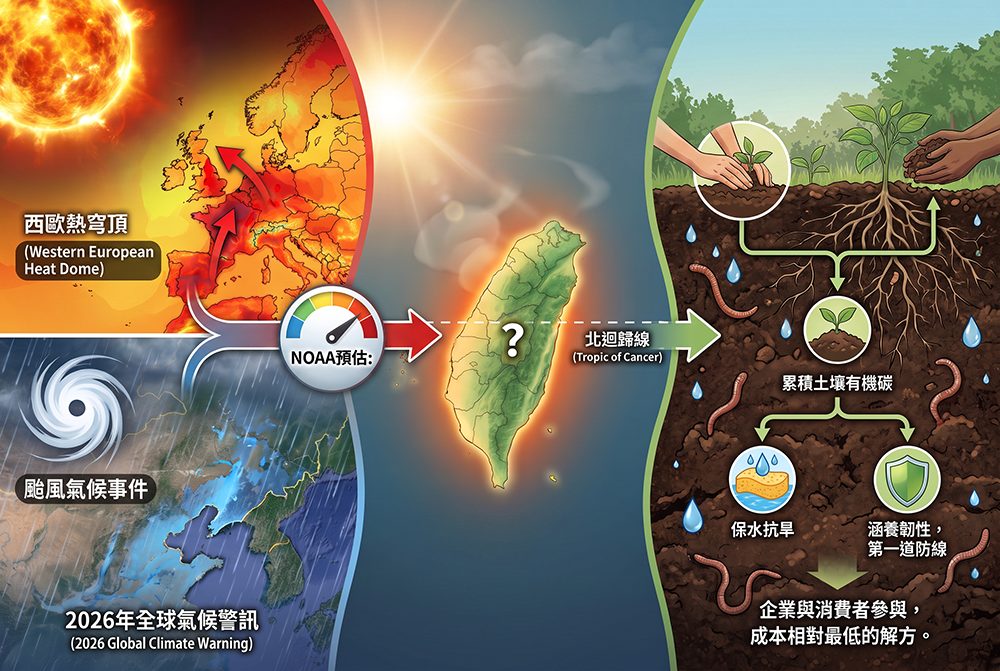
Since June, western Europe has endured an unprecedented early-summer heatwave. Météo-France confirmed 22 June as the hottest day on record in France, with temperatures above 44.3°C; more than 100 stations in Spain recorded over 40°C at the same time, and parts of Portugal approached 45°C. The heatwave formed because El Niño weakened and distorted the jet stream from the Atlantic to Europe, so weather systems stalled in place and created a “heat dome” that locked in hot air. Within a few weeks Europe had recorded more than 1,300 excess deaths linked to extreme heat. Scientists stress that what is really pushing temperatures up is climate change itself, not El Niño's cyclical influence — in other words, this is not “bad luck this year” but the “new normal” arriving early.
Typhoon Bavi: stalled over China for 60 hours, then hit North Korea again after six years
In mid-July Typhoon Bavi made landfall in Zhejiang, China, and moved north, combining with cold air to bring record rainfall to north and north-east China. Shenyang in Liaoning received 268.1 mm in a single day and Fushun 277.9 mm; two-day totals reached 450 mm — about half a year's normal rainfall — causing severe flooding. Bavi lingered over land in China for more than 60 hours, which is very unusual, before turning to strike North Korea, six years after a typhoon of the same name last hit.
Taiwan: lucky, not safe
Compared with Europe and north-east China, Taiwan, which sits on the Tropic of Cancer, has had a hot summer but has not yet faced a public-safety crisis on the same scale. To some extent that is luck — but climate change will not stop because we dodged it for now, and the next extreme weather event may not always veer away.
Faced with this uncertainty, building up soil organic carbon is one of the lowest-cost nature-based solutions that both companies and consumers can take part in today. According to estimates under the UN-backed 4 per 1000 Initiative, if the organic matter stored in the top layer of the world's agricultural soils increased by 0.4% a year, it could in theory store 200 to 300 million tonnes of carbon annually — enough to offset 20% to 35% of global human-caused greenhouse gas emissions. Healthy soil holds water, resists drought and builds resilience; in an age of extreme climate, it is the first line of defence we can build in advance for ourselves and the next generation.
No one can predict the weather. May we only ever need to prepare before the rain, and never have to mend the fence after the sheep are gone.
#ElNiño #ExtremeClimate #SoilCarbonSinks #NatureBasedSolutions #CarbonFarmingDigest


