 努力小農
本文尚無譯文。
From the UN-backed 4 per 1000 Initiative to Taiwan's Smallholders: How Carbon Farming Becomes a Genuine ESG Highlight for Companies
Carbon Farming Digest No. 3 · Major Heat|Corporate action feature
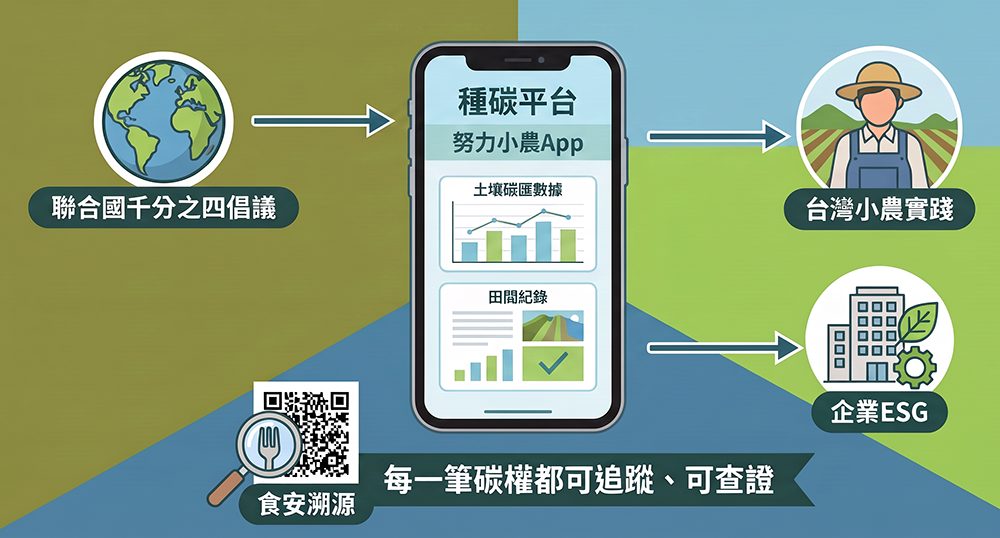
The "4 per 1000 Initiative" (4‰ Initiative) points to a simple but powerful number: if the organic matter stored in the topsoil of the world's farmland increased by four per thousand each year, it could in theory sequester 200–300 million tonnes of carbon a year, enough to offset 20–35% of global human-made greenhouse gas emissions. Soil carbon sequestration is seen as a key solution that can buy precious time for low-carbon technologies to develop over the next ten to twenty years, and the greatest potential lies in exactly the farmland worked day after day by countless smallholders. This also echoes the "One Health" framework: healthy soil stores carbon dioxide, healthy crops improve food quality and immunity, and healthy people tackle food safety and zoonotic disease risks at the source — the environment, crops and human society are all interlinked.
Local action in Taiwan: interdisciplinary research on soil carbon sequestration
The soil carbon sequestration research promoted in Taiwan by the carbon farming platform breaks with the past domestic focus on "organic matter from fertiliser" alone. It is the first integrated field study combining soil management, biochar and crop health, simultaneously testing soil organic carbon (SOC), trace elements, microbial communities and farming and climate conditions. Field practice has expanded from Hualien and Taitung to central and southern Taiwan, covering Changliang Village in Yuli, Hualien (144 hectares of rice), communities such as Wan'an and Fuxing in Chishang, Taitung (200 hectares of rice), and vegetable, grain, tea, coffee and fruit tree fields in Chiayi, Yunlin and Taichung. In 2023 the Changliang project was estimated to have cut more than 5,000 tonnes of emissions, and carbon credits and verified SDG performance are expected in the second half of this year.
The key barrier to scaling up: testing costs smallholders cannot afford
On the road to the 1,000-hectare goal, the biggest bottleneck is not land or farmers' willingness, but the capacity and cost of soil total organic carbon (TOC) testing. The international laboratory quality standard (ISO 17025) sets very high demands on data accuracy, and testing currently costs NT$16,000–20,000 per sampling point. Given that Taiwanese smallholders farm only 0.3 hectares on average and earn only about US$60 per hectare from emission reductions, it would take all the carbon credit income from at least 10 hectares to pay for a single test — ordinary smallholders simply cannot take part, let alone share in the revenue.
The way out: a civil-society TOC testing hub for Taiwan
Only with independent, transparent testing capacity that meets international standards can Taiwan's agricultural carbon sinks truly reach the international Gold Standard. We plan to launch a civil-society TOC testing hub in Taiwan with NT$5 million (about NT$3.5 million for a precision TOC analyser plus annual operating costs of about NT$1 million). On a five-year depreciation model testing 10,000 samples a year, the cost per sample can fall from NT$16,000 to under NT$600, a drop of 87%. Operations follow an "iron triangle" of industry, academia and international certification: Eco-affinity Inc. initiates the project and handles quality assurance, a civil organisation or university provides space and a testing team of teachers and students, and a Gold Standard VVB carries out independent review, ensuring results meet the standards for issuing carbon credits.
For companies: an ESG highlight closely aligned with international standards
The testing hub is a non-exclusive, open ecosystem that can take on commissions from other organisations as capacity allows. Investing in this project can be counted directly towards the performance of the "Taiwan Smallholder Carbon Farming Project" and become a verifiable highlight in a company's annual ESG report: it complies with ISEAL standards and can be quantified with the Gold Standard SDG Impact Quantification Tool. The project expects to train 2,000 farmers and 100 students in ISO 17025 testing techniques every year, contributing to SDGs 2, 4, 8, 9, 13 and 15, among others.
From the 4 per 1000 Initiative to a single field in Wan'an, Chishang, what the carbon farming platform wants to prove is this: climate solutions can start from the soil beneath every smallholder's feet — and every company willing to make its ESG real is welcome to join.
#CorporateESG #4per1000 #SoilCarbonSink #TaiwanSmallholderCarbonFarmingProject #MiHuMiSangApp #CarbonFarmingDigest


