 努力小農
本文尚無譯文。
Carbon farming around the world: key soil carbon credit developments in 2026, from Indian farmers to new EU rules
Carbon Farming Digest No. 3 · Major Heat | International briefing
In 2026 the global soil carbon market is moving fast from proof of concept to institutionalisation. This month, from Indian farmers and American ranchers to EU lawmakers, people everywhere are setting clearer rules of the game for soil carbon sinks.
India: the first step towards climate-smart agriculture
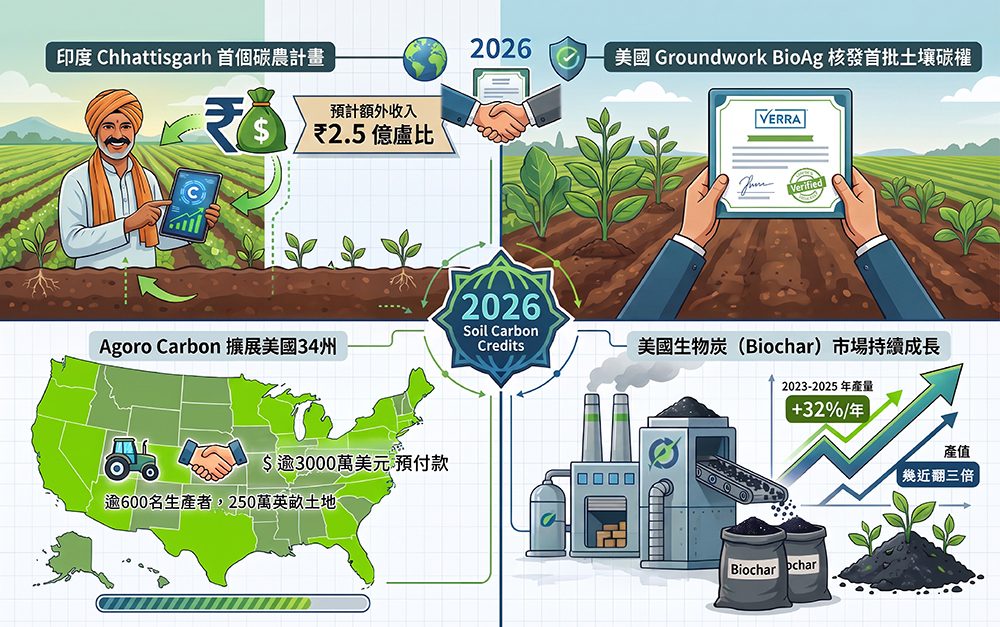
Dhamtari district in Chhattisgarh, India, has launched its first carbon farming programme, converting conventional farmland into an ecosystem that also sequesters carbon. The aims are to improve soil health and conserve water while opening a second income stream for farmers through international carbon credits. Over the life of the programme, local farmers are expected to earn an additional 250 million rupees from carbon credits.
United States: measurement is being reshuffled
The US soil carbon market saw landmark progress this year. Groundwork BioAg issued the first soil carbon credits on US farmland under Verra's VM0042 standard — 19,568 units, verified by SCS Global Services. Earlier, at the end of 2025, Indigo Ag's Carbon by Indigo programme became one of the first agricultural credits to receive the Integrity Council for the Voluntary Carbon Market's (ICVCM) Core Carbon Principles label. Behind these developments is a market moving towards direct measurement, traceability and stricter verification. Meanwhile, the large carbon farming company Agoro Carbon has expanded to 34 US states, covering more than 600 producers and 2.5 million acres (about 70% rangeland, supporting 150,000 cattle), and has paid farmers and ranchers more than US$30 million in advance payments. The biochar market also keeps growing: output rose 32% a year from 2023 to 2025, and its value nearly tripled.
European Union: the CRCF framework moves into implementation
The EU's Carbon Removals and Carbon Farming Certification Framework (CRCF) is the first government-backed certification standard for soil carbon credits in the EU, and 2026 is the year it moves from paper to the farm. On 3 February the European Commission adopted the delegated act on methodologies for permanent carbon removals; the carbon farming certification methodologies were open for consultation until 19 February and are expected to be adopted this summer, with the scope widened to include certification of emission reductions from better fertiliser use. Notably, the CRCF requires every certified project to improve soil health and biodiversity at the same time, rather than just counting tonnes of carbon; the first official certified units are not expected until after the 2027 harvest.
Divisions remain: two camps on measurement
Despite the progress, the market still has no consensus on how to measure. The gap between the laboratory-sampling camp and the AI/remote-sensing modelling camp keeps widening, directly affecting the credibility and pricing of credits. That is why more and more buyers and regulators are making third-party verification and direct measurement the minimum bar for credit quality.
For Taiwan, these international developments are especially instructive: we face the same challenges of small farm plots and relatively high testing costs. The international market's shift towards rigour and traceability is exactly why the carbon farming platform is building local TOC (total organic carbon) testing capacity in Taiwan and pushing for institutionalised verification — something we discuss in detail in the corporate action feature.
The road to standardising the global soil carbon market is not finished, but the direction is clear: direct measurement, third-party verification and traceability will be the common language of every market from here on.
#InternationalCarbonSinks #SoilCarbonCredits #CRCF #CarbonMarkets #CarbonFarmingDigest


