努力小農
本文尚無譯文。
From the 47-year shadow of rice bran oil: why the Chung Lien benzo[a]pyrene case was not an accident but inevitable
The salad oil tragedy:
from the 47-year shadow of rice bran oil,
why the Chung Lien benzo[a]pyrene case was not an accident but inevitable
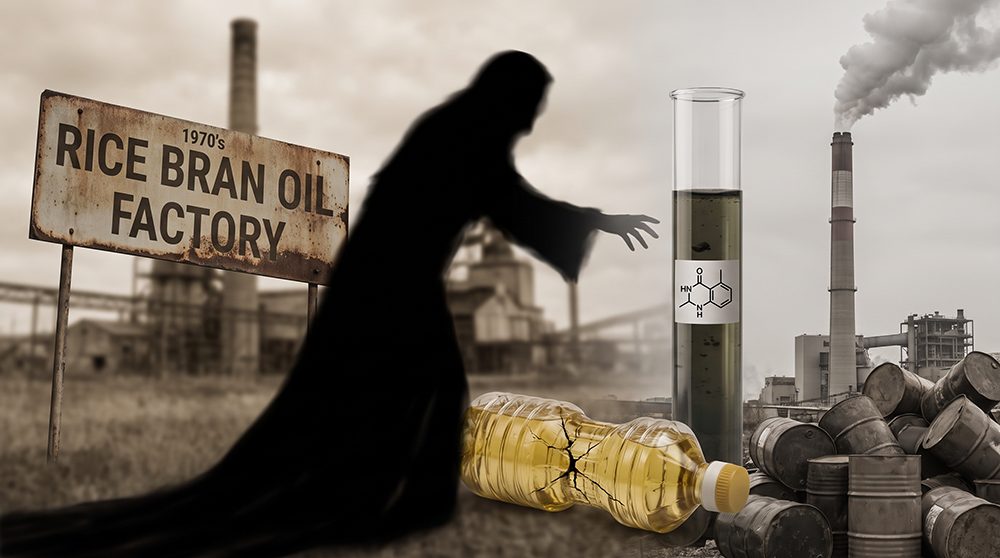
In 1979, during deodorisation in rice bran oil production at Changhua Oil, a pipe cracked after repeated heating and cooling. Polychlorinated biphenyls (PCBs) used as the heat-transfer medium leaked into the oil and, through repeated heating, broke down into even more toxic polychlorinated dibenzofurans. At least 2,000 people across Taiwan were poisoned, with central Taiwan worst hit; more than a hundred teachers and students at the Huiming School for the Blind were affected. Forty-seven years later, in July 2026, a 1,300-tonne batch of soybean salad oil from Chung Lien Oil was found to contain the Group 1 carcinogen benzo[a]pyrene at four times the limit. It went to more than 360 downstream businesses and over 400 products, reaching lunches at more than 1,300 schools and countless convenience-store fresh foods and restaurant chains. Chung Lien was fined NT$165.2 million for concealing reports and misstating production — the largest fine in the history of Taiwan's food safety.
PCB contamination
more than 2,000 people poisoned
benzo[a]pyrene four times the limit
largest fine ever
The two incidents are nearly half a century apart; the substances, scale and context differ. But placed side by side, they reveal a clear common thread: the risk in Taiwan's edible oil industry has never been an occasional slip by a single company, but a structural problem in which every link of a low-price, essential-goods supply chain can come loose. This article is about that structure, and how consumers can understand and respond to it.
01 A scar hidden by a new name: rice bran oil never really came back
The fate of rice bran oil is often simplified to “the product disappeared from the market”, but strictly speaking it was not that clean. After the poisoning, the very name “rice bran oil” — oil refined from the bran removed when brown rice is milled into white rice — almost vanished from Taiwan's consumer market. In its place came “genmai oil”: the same raw material and the same oil, simply repackaged under the Japanese word for brown rice.
Even with a new name, the category never truly recovered. Most genmai oil on the market today comes from imported brands — Tsuno, Ajinomoto and Nisshin from Japan, Olitalia and Giurlani from Italy — while very few local producers mass-produce oil from Taiwan's own rice by-products. Wikipedia's entry on rice bran oil says plainly that its refining is complex and costly, so it has never become widespread. In other words, 47 years on, the oil that suffered most has been neither truly forgotten nor truly accepted again by consumers. It lives on the margins of the market as a niche, imported, not-so-cheap “healthy oil”, rather than the everyday cooking oil it once was in ordinary kitchens.
This gives us an important reference point: once trust in a category of edible oil is structurally shattered, even if it does not vanish from the shelves completely, it struggles to return to mainstream tables. That is the situation soybean salad oil may now face.
02 The Chung Lien case is not about which link failed, but that any link could fail
The Food and Drug Administration is still requiring Chung Lien to clarify its process and has not announced whether the benzo[a]pyrene formed when the soybeans were dried and roasted, built up during later refining, or both. I do not intend to draw conclusions for the authorities or the company before the cause is clear. But the fact that no single breach can be found is itself the strongest testimony: it points not to an isolated case of a careless worker or a broken machine, but to risk control along the whole production chain so loose that no one can tell where the breach actually is.
Note that benzo[a]pyrene is only one of the indicator substances found this time. SGS tests on the same batch also detected benz[a]anthracene, benzo[b]fluoranthene and chrysene — three polycyclic aromatic hydrocarbons (PAHs) classified by the International Agency for Research on Cancer (IARC) as Group 2B carcinogens. Their levels did not exceed current monitoring guidance, but the presence of several PAH congeners in one batch points to a simple fact: benzo[a]pyrene was never the only problem; it is just the member of this chemical family that happens to have a legal limit and happened to exceed it. Focusing only on whether benzo[a]pyrene exceeded the limit is like diagnosing systemic inflammation with a thermometer — the reading may look normal while the inflammation goes on.
From raw material to table, this supply chain has at least six structural risk points: pesticide residues and variety disputes in imported soybeans; mycotoxin risk during international shipping and storage; solvent removal after hexane extraction; bleaching and deodorisation, refining steps that require heating above 200°C; and, after purchase, frying and deep-frying at home, plus restaurants and night-market stalls using oil “to the very last drop” at high temperatures again and again. I am not saying any one of these was “definitely” the culprit. My point is this: precisely because every link can go wrong, and because salad oil is the cheapest essential cooking oil, producers under cost pressure have never had much room to invest full quality-control resources at every step. This is not a moral accusation but a structural economic fact: when the market judges a bottle of oil only by price, investment in quality control is naturally the first cost to be cut.
Tellingly, after the scandal broke the Food and Drug Administration called in Taiwan's four big oil processors — Chung Lien, TTET Union, Taiwan Sugar Corporation and Changhui — and required them to step up benzo[a]pyrene testing of soybean shipments, cargo by cargo and batch by batch, and to review critical monitoring points in their processes. This amounts to an indirect admission that the problem is not Chung Lien's alone but a structural risk shared by the whole bulk oil-processing industry.
03 The raw-material debate: not “toxic or non-toxic”, but dose and cumulative exposure
When it comes to the soybeans used for salad oil, most consumers' first reaction is “GMO”, but that framing does little to help us understand the real risk. From a toxicological point of view, no substance can simply be labelled toxic or non-toxic; the real questions are dose, route of exposure, and whether long-term accumulation could approach or exceed the threshold the body can tolerate.
The soybeans used for Taiwan's soybean salad oil are almost entirely imported, mostly glyphosate-tolerant (Roundup Ready) varieties, and spraying glyphosate to desiccate the crop before harvest is common practice, so residues may indeed be present on the beans. International risk assessments of glyphosate have still not converged: the WHO's International Agency for Research on Cancer classified it in 2015 as Group 2A, “probably carcinogenic to humans”, while regulators including the European Food Safety Authority (EFSA) and the US Environmental Protection Agency, using different risk-assessment models, tend to conclude that exposure within approved residue limits poses no significant risk. The gap reflects a fundamental methodological difficulty in assessing chronic low-dose exposure: extrapolating from animal-study doses to real long-term, low-dose human exposure is inherently highly uncertain.
In my view, this is the real question this incident should raise: what exposure assumptions are current residue limits based on, and do they still match consumers' actual long-term, multiple exposures? This is not to claim that the soybeans are “toxic”, but to point out that at the raw-material end our scientific grasp of long-term low-dose cumulative risk has grey areas — and grey areas are exactly where oversight most easily slackens and corporate self-management is most easily diluted.
04 The cheap-versus-safe dilemma: after tighter controls, will salad oil still be the budget oil?
After this storm, the foreseeable policy direction is to require producers to test raw materials batch by batch more often, monitor critical process points more closely and use third-party verification more frequently. These are all reasonable and necessary reforms, but they have an economic consequence that is rarely discussed openly: all these controls cost money, and in the end someone has to pay.
Soybean salad oil has long been the main cooking oil of Taiwanese households, restaurants and night-market stalls because it is cheap. Its market position rests on low-cost, bulk, large-scale production. Once the costs of batch testing and process improvement are truly reflected in the price, whether salad oil can keep its place as the budget oil is an open question. And if the price advantage disappears, consumer behaviour is likely to split: some will switch to imported oils such as olive, sunflower and avocado, others to single-origin, traceable cold-pressed oils from small farms, and the market share of locally processed bulk soybean oil will shrink structurally. This path differs from rice bran oil, which was abandoned by the market through stigma, but the destination is similar: when the cost of trust is passed on through prices and consumers have alternatives, the category may not “disappear” but gradually retreat from mainstream tables to the margins.
In other words, under the current structure of the salad oil industry, “cheap” and “safe” may be in fundamental tension. Unless there are policy subsidies, industrial upgrading at scale, or consumers collectively accept higher prices, that tension will not resolve itself — it will simply resurface as the next food-safety storm.
05 How consumers can understand the risk, and what to do
First, a core idea: carcinogen risk is determined by dose, route of exposure and how often exposure accumulates over time — not a yes-or-no matter of “touch it and you get cancer”. There is no need to panic and throw away oil you have already bought; what matters is reducing long-term, high-frequency cumulative exposure from now on.
When buying and storing oil, avoid relying on one brand or one type of oil for a long time. Spreading your sources and rotating different oils itself lowers long-term exposure from any single contamination source. Choose oil by cooking method: high smoke-point oils for deep-frying and stir-frying at high heat, and lower smoke-point oils that keep more nutrients for dressings and low-heat cooking. Prefer clearly labelled brands with traceable batch numbers, and avoid unlabelled bulk oil. Use opened oil quickly and store it in a cool, dark place to reduce oxidation and rancidity.
When cooking at home, control the oil temperature and don't let the pan smoke — smoke means the oil has started to break down and may release harmful substances. Don't reuse frying oil for the next batch, and never mix it with fresh oil. Fry at high heat less often and steam or boil more. Always switch on the range hood and keep the kitchen ventilated to reduce inhaling cooking fumes; this matters especially for people who cook often, since long-term exposure to kitchen fumes is itself a known risk factor for the airways and lungs.
When judging where to eat out, check whether the oil looks dark, cloudy or black, and whether foam on the surface is heavy and slow to disappear — usually signs of old, degraded oil. Prefer stalls where fried items sell quickly and business is brisk, as they usually change oil more often, and avoid stalls where food sits for a long time and one pot of oil lasts all day. Notice whether the shop is willing to disclose the brand and source of its oil — often an indirect sign of self-discipline. You can also use official tools such as the Food and Drug Administration's dedicated Chung Lien oil page to check whether places you visit or products you buy are on the affected list.
- Spread your sources and rotate different oils
- Choose oil by cooking method: high smoke point for high heat
- Choose clearly labelled brands with traceable batch numbers
- Use opened oil quickly; store cool and dark
- Control the temperature; don't let the pan smoke
- Don't reuse frying oil or mix it with fresh oil
- Fry less; steam and boil more
- Use the range hood and keep the kitchen ventilated
- Check whether the oil looks dark, cloudy or black
- Choose stalls where fried items sell fast
- Notice whether the shop discloses its oil source
- Check the FDA's Chung Lien oil page
06 Conclusion
Rice bran oil has shown us over 47 years that once a category of edible oil loses consumers' trust, it struggles to return to mainstream tables even under a new name. The Chung Lien benzo[a]pyrene case is not an isolated accident. It is a supply chain long squeezed by the logic of price and run through by slack oversight and slack self-management, finally splitting open — at a link we still cannot name — along the crack that was bound to open.
The question has never been only whether this batch of oil is safe to eat, but whether Taiwan's edible oil industry is willing to face honestly that, under the current production structure, cheap and safe may be mutually exclusive. If it is not, sooner or later the next headline will rewrite this article under another brand's name.