努力小農
Crime and punishment
本文尚無譯文。
Crime and punishment: what we need is a “national accountability team”
Food crime is a serious international offence, not an “administrative oversight”
The first two articles looked at structure — the 47-year shadow of rice bran oil, and the supply chain behind the Chung Lien benzo[a]pyrene case in which “cheap” and “safe” are mutually exclusive. This one asks a sharper question: when structural risk finally explodes, who should be responsible, for what, and can our legal system actually reach the people it should?
The Food Crime Strategic Assessment 2024, published jointly by the UK Food Standards Agency (FSA) and the Scottish Food Crime and Incidents Unit (SFCIU), defines food crime as “serious fraud and related criminality within food supply chains” and breaks it down into seven types — theft, unlawful processing, waste diversion, adulteration, substitution, misrepresentation and document fraud. It stresses again and again that food crime is almost never a single technique but a combination of methods, and that false reporting and falsified documents are often the key link that covers other crimes.
Looked at against this international baseline, the Chung Lien case becomes clearer: it is not simply “one batch of oil tested over the limit”, but five things stacked together — problem raw materials, a problem process, a known exceedance, delayed reporting and misreported output. These are precisely the hallmarks of food crime as defined internationally, with an element of concealment — not an accident that can be brushed off as an “administrative oversight”.
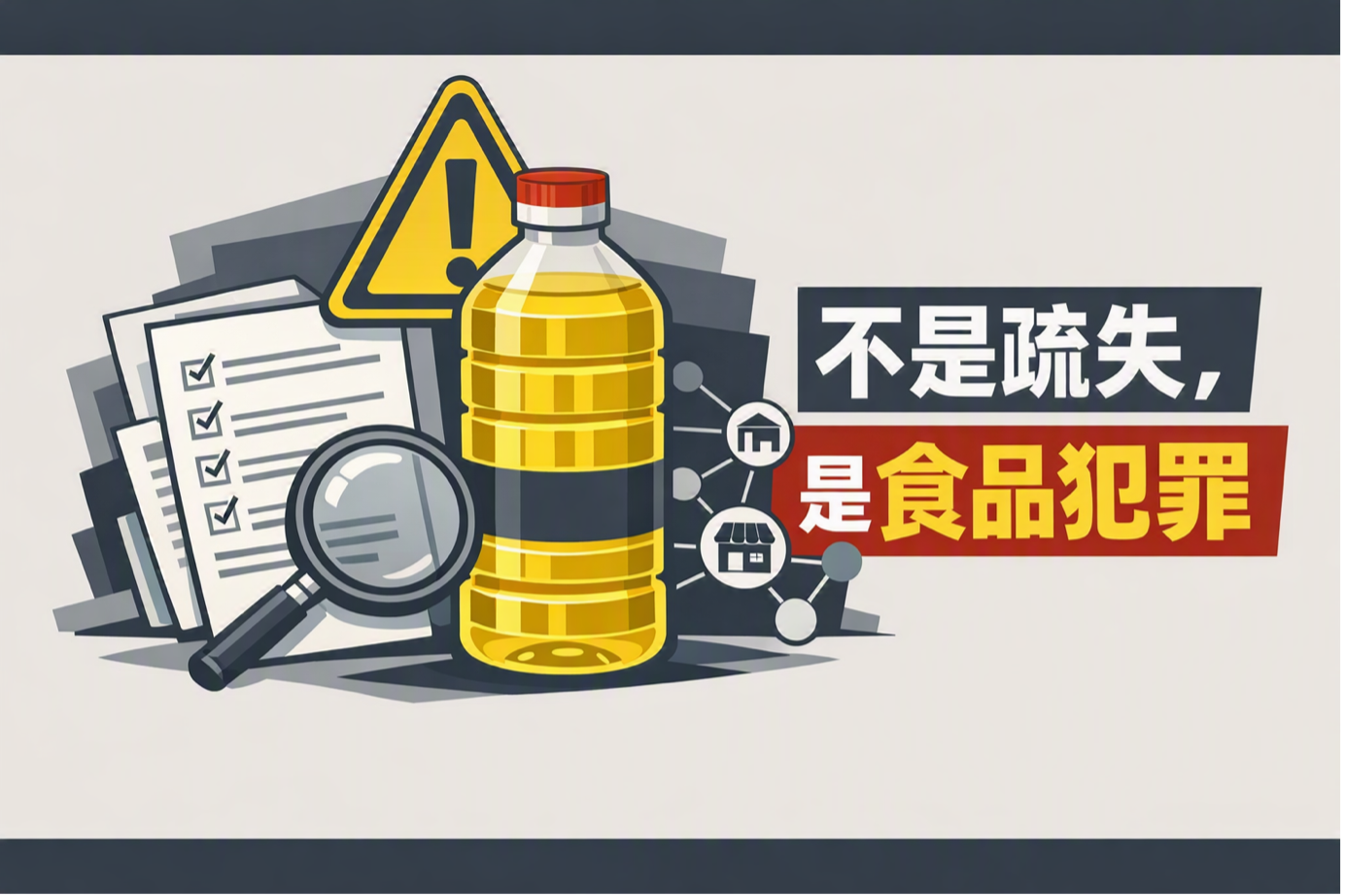
The illusion of the “record fine”: Taiwan is not governed by law, but by fines
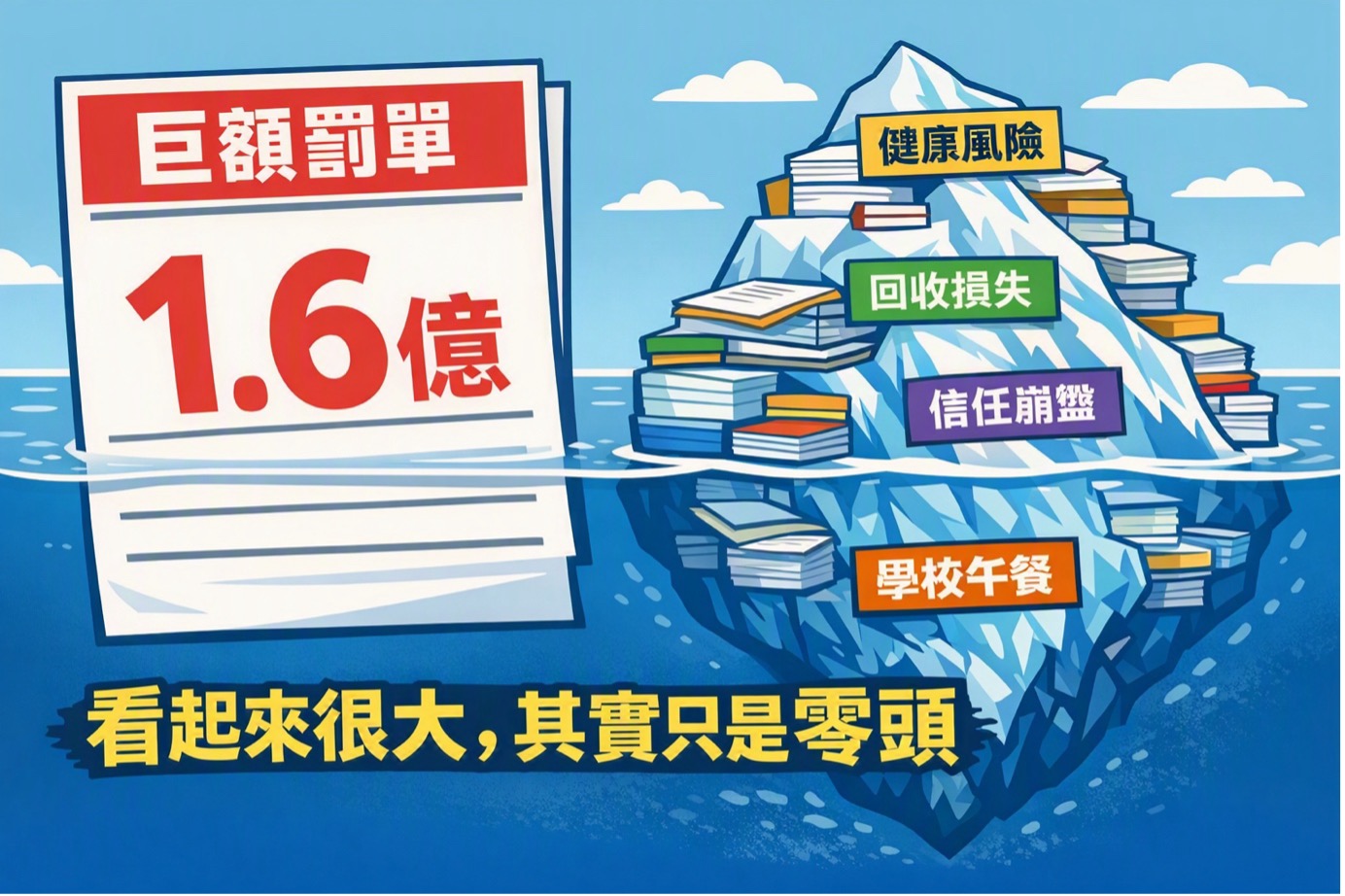
The most common headline was “largest fine in the history of food safety”: the Food and Drug Administration fined Chung Lien NT$165.2 million (NT$115.2 million under Article 15 of the Act Governing Food Safety and Sanitation, plus NT$50 million for breaching the duty to report under the same Act and the Administrative Penalty Act). The number sounds impressive, but set against the real cost of this incident, this “astronomical” fine has no deterrent effect.
The 1,300 tonnes of problem oil (and the batch count is still rising) went to more than 360 downstream businesses and over 400 products, reaching lunches at more than 1,300 schools and countless convenience-store fresh foods and restaurant chains. The result: health risks from a Group 1 carcinogen, the collapse of trust in the whole soybean oil category, recall losses for over a thousand downstream businesses, and panic in countless households. These external costs far exceed NT$160 million. When a fine is far lower than the potential gain from wrongdoing plus the external harm, it stops being a deterrent and becomes just an entrance ticket to misconduct.
The deeper problem is the Taiwanese government's administrative logic: in every food-safety storm, the standard move is to impose a heavy fine and push all responsibility onto the business. As if, once the ticket is big enough and the number sensational enough, the government has done its job and can shed responsibility. This is not rule of law but rule by fines — using one large ticket after another to cover up the failure of regulation itself.
Most absurd is the position of downstream businesses. Food processors, restaurants and caterers that legally bought from big suppliers and had no way of knowing the raw oil exceeded limits are now having products pulled, recalled and even fined for “selling processed food containing carcinogens”. They are victims treated as perpetrators.
This violates a most basic principle: the government should ensure that goods people buy legally are basically safe. If even raw materials bought from properly registered major suppliers may be toxic, yet every downstream layer must run its own “layer upon layer” of tests to escape liability, then the government's responsibility for checks at source is being shifted onto the whole supply chain as endless, impossible testing costs. Follow that road to the end and you get not food safety, but everyone going down together.
For businesses, the law can in fact reach them
First, the facts so far (as of mid-July 2026, investigations ongoing):
- Administrative penalties: Chung Lien NT$165 million (a record); for delayed reporting downstream, Taisun was fined NT$6 million by Changhua County's health bureau, Namchow NT$3 million by Taipei City's health bureau, Fwusow NT$9 million in total and Formosa Oilseed NT$3 million.
- Criminal: the Taichung District Prosecutors Office searched six major oil plants belonging to Chung Lien, Fwusow, Formosa Oilseed and Taisun and named 11 senior executives as defendants; Chung Lien's general manager Yu Ling-chung was detained incommunicado, and the others were released on bail of NT$500,000 to NT$20 million.
- Charges: negligently manufacturing or processing food that is toxic or contains substances harmful to health; food that may endanger health; and using false entries in business documents.
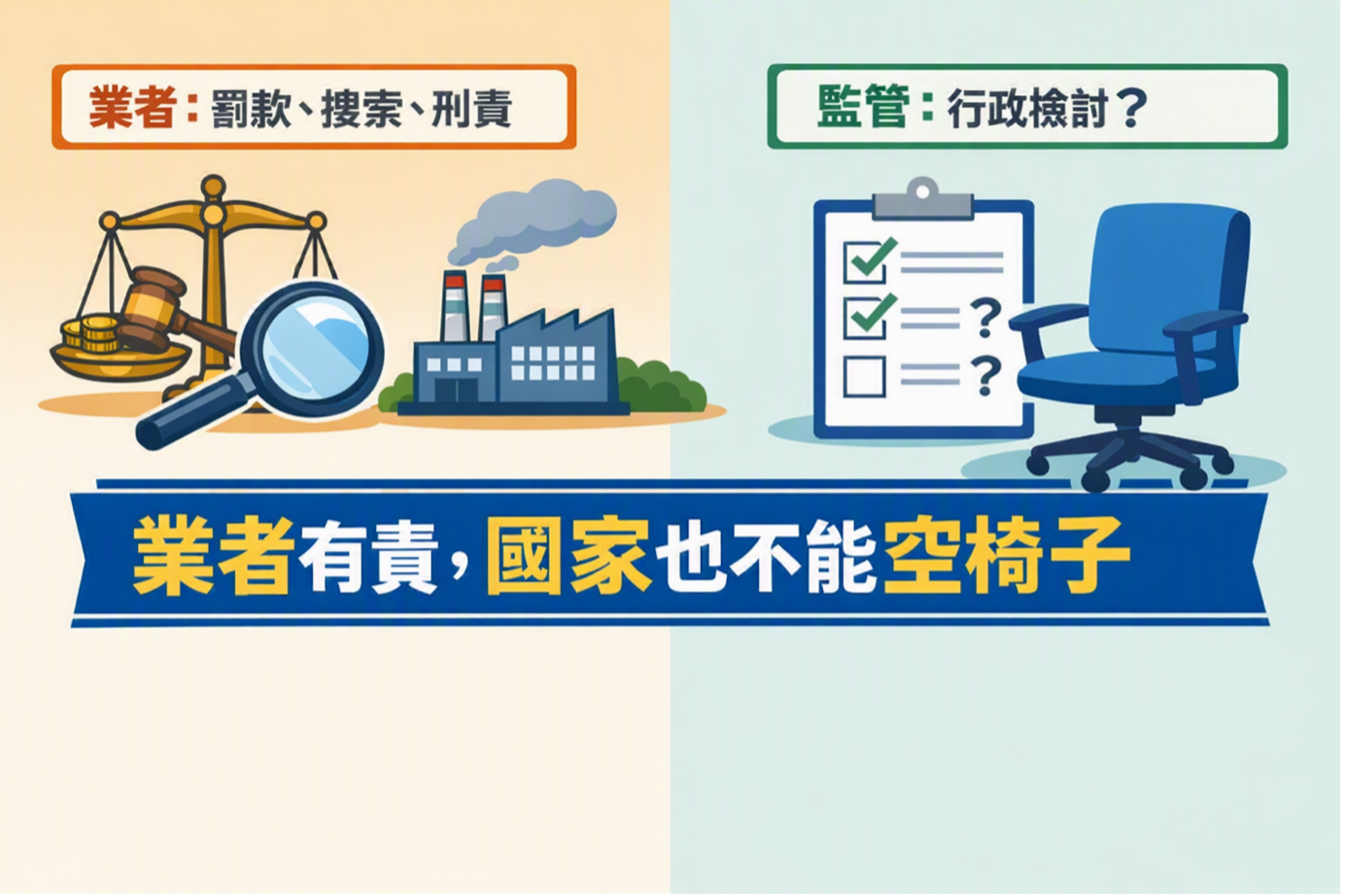
It is worth pausing on one thing: for businesses, Taiwan's current legal system can in fact reach them. Record fines, detention, multiple charges — both the administrative and criminal tracks have moved. The real gap is not that penalties on businesses are too light; it is in the accountability of civil servants, discussed next.
Prevention over patching: the hollowed-out Food Safety Council of Article 2-1
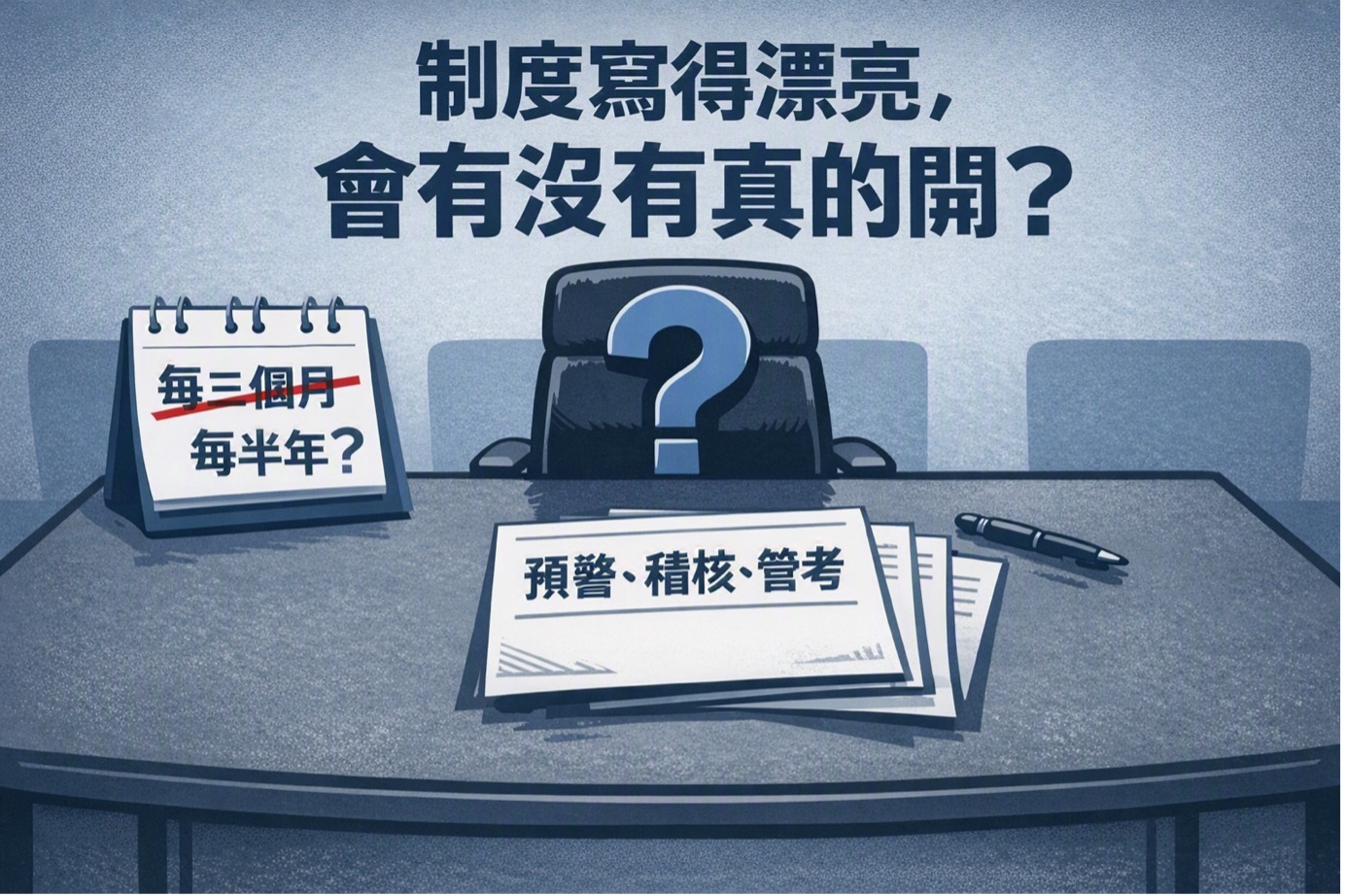
The key to solving food-safety problems has always been prevention before the event rather than testing and patching afterwards — and prevention is the very heart of the Act Governing Food Safety and Sanitation.
Article 2-1 of the Act states in black and white (summary):
The provision is watertight: the top executives (the Premier, mayors and county magistrates) convene it personally, it meets every three months, and resolutions are followed up and published every quarter. It writes cross-ministry coordination, early warning and auditing into law — the very spirit of “prevention over cure”.
This is exactly what needs public scrutiny. According to the Food and Drug Administration's own description of the Executive Yuan Food Safety Council, it is convened by the Vice Premier, with the Minister of Health and Welfare as executive secretary, and meets every six months — clearly different from the parent law's “convened by the Premier, every three months”. Its published minutes show that in 2024 the council also met at a half-yearly rhythm, labelled “1st meeting” and “2nd meeting”.
If this is confirmed — the law says “Premier convenes, every three months, quarterly follow-up published” while practice is “Vice Premier, every six months” — the problem is very clear: the law is not incomplete; it has been hollowed out. If even the top official who should preside in person does not convene a law this thorough on prevention at the statutory frequency, then all the “five rings of food safety” and “food cloud” amount to patching holes downstream.
Every Premier, mayor and county magistrate should take note: Article 2-1 imposes a duty to act — the head “shall” establish the council, “shall” convene it and “shall” publish quarterly follow-up. When these “shalls” are not done and a major disaster like the Chung Lien case reaches the lunches of more than a thousand schools, it is no longer only a political question of whether the head should resign; it may open the door to discussion of Article 130 of the Criminal Code, “dereliction of duty causing disaster”, and related offences.
In other words, this grand-sounding law has already laid the groundwork for legal liability for officials who fail to implement it. If the law is amended in future, the focus should not be another expansion of powers or budget, but harder accountability — clearly defining the levels and posts responsible at every tier and department, so that “the head did not convene the council or follow up as the law requires” has concrete consequences. The logic is simple: only when the top takes it seriously will those below have to.
Bad decisions are worse than corruption: the report card of the five rings of food safety and the food cloud
With every storm, the government calls for new laws and new systems. But how well have these expensive systems worked? On 15 July 2026 — while the Chung Lien case was still raging — a food-safety briefing to the Legislative Yuan's Finance Committee delivered an embarrassing report card.
According to the National Audit Office, the “five rings of food safety” are budgeted and implemented by the Ministries of Health and Welfare, Education, Agriculture, Environment and Economic Affairs. In 2025 the budget totalled about NT$4.753 billion, of which about NT$3.498 billion was spent — an implementation rate of only about 73.6%. The Audit Office explained that the main reason was repeated failed tenders for the FDA's National Food and Drug Laboratory Building. Absurdly, the three key figures look almost identical across several years — year after year, the same shortcomings going round in circles.
Looking at the overall scale in recent years, central government food-safety spending (including special forward-looking infrastructure budgets) grew from NT$5.53 billion in 2019 to NT$9.533 billion in 2023 — an increase of more than 70%. There is more money every year.
More money, same problems. This time the Audit Office listed eight shortcomings in the five rings of food safety, including:
- Businesses not proactively reporting
- Third-party verification not obtained as required
- Too few border food inspectors, with high turnover
- International food alerts not handled properly
- Three-tier management of school food needing improvement
- Poor execution of the laboratory building project
The harshest line came during questioning. Legislator Kuo Kuo-wen said bluntly that “the Audit Office has raised and found all these problems before, but the executive branch has failed to fix them; three months later they are written up again, and the problems are still the problems.” He also pointed to a long-standing shortage of inspectors:
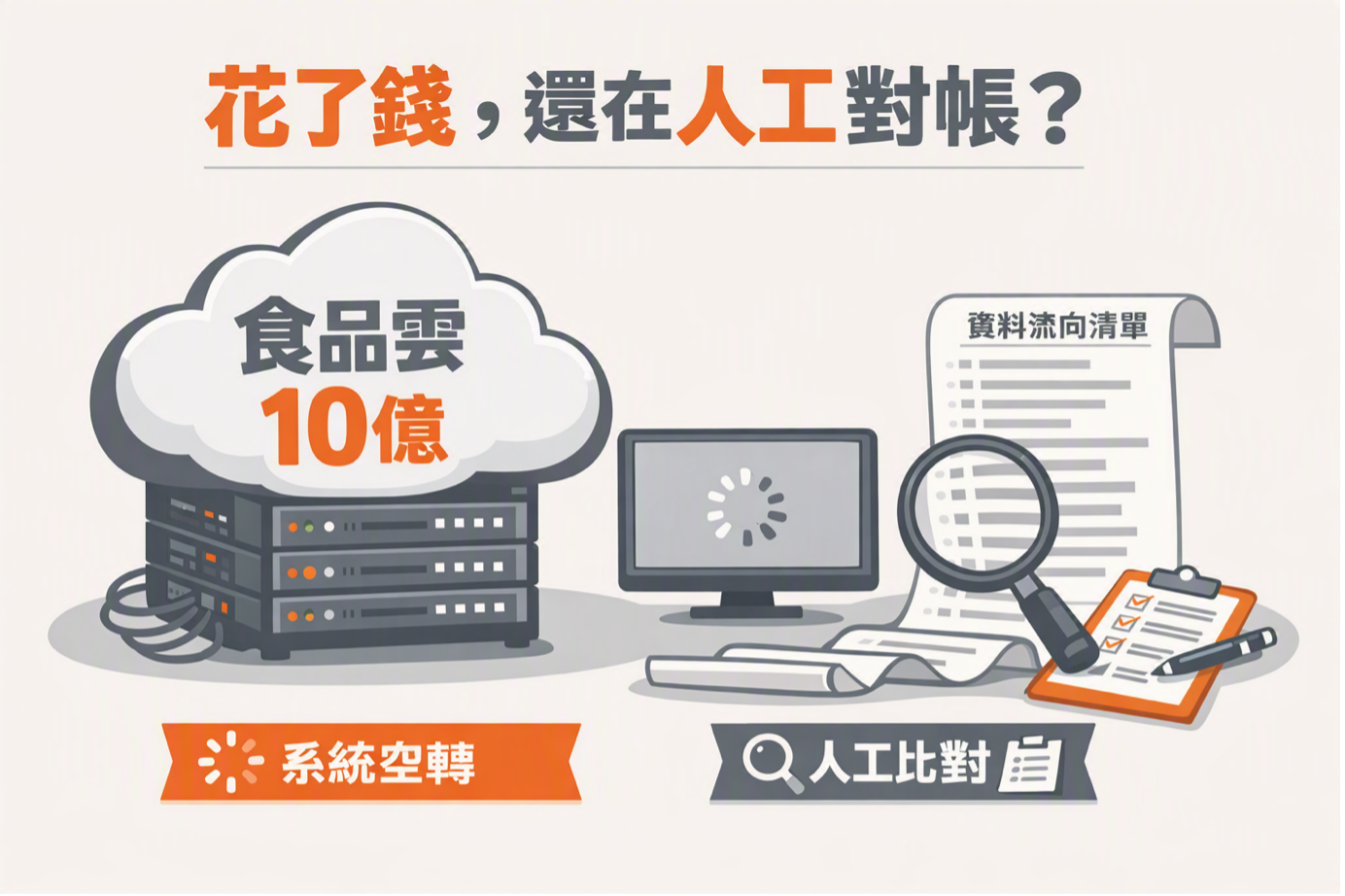
As for the “food cloud”, which cost about NT$1 billion, it was again criticised for failing to work in real time; downstream distribution still had to be cross-checked by hand. The Control Yuan had already issued an investigation report back in 2020 saying the food cloud's data cross-checking was “not adequately designed”. Five years later, the same problem remains.
Put all this together and the conclusion is harsh and clear: the problem is not that the law is incomplete, but that existing policies, systems and budgets are not being carried out. Until old debts are paid, there is no point talking about new ones.
The state's three kinds of liability: administrative, criminal and state compensation
For civil servants and officials to fear the law like a furnace too, we have to spell out the liability the state may bear. Under Taiwan's current law there are at least three tracks:
International comparison of legal systems: built on prevention, or patching holes afterwards?
To sum up this section in one sentence: what advanced legal systems have in common is making prevention a legal obligation businesses cannot escape — which is exactly the spirit of Taiwan's Article 2-1, hollowed out in implementation.
Taiwan has a civil-law system: the parent act sets general principles and delegates the details to executive regulations (enforcement rules, guidelines, limits and so on). The design itself is fine. The problem is that when the executive “has the delegated power but does not act”, the parent act can punish businesses but can hardly touch the administrative links that failed to set standards properly, failed to inspect, or sat on reports. In this case a limit for benzo[a]pyrene (2.0 μg/kg) did exist, and so did mandatory testing obligations. The gap is not a lack of law, but that the law was not enforced, and there is no leverage over those who fail to enforce it. Each amendment rewards the executive with more budget and more posts. Under this perverse incentive, the more food-safety problems there are, the more money and power the regulators get — with no accountability at all. Why wouldn't they?
The backbone of EU food law is the 2002 General Food Law (Regulation (EC) No 178/2002), which establishes three things: traceability along the whole chain (Article 18 — businesses must be able to trace one step back and one step forward), primary responsibility of food business operators (Article 17), and the creation of the European Food Safety Authority (EFSA) and the Rapid Alert System for Food and Feed (RASFF). RASFF lets any member state that finds a problem product alert the whole of Europe within hours and withdraw it across borders. Japan combines its Food Sanitation Act with the Food Safety Basic Act of 2003, enacted in response to BSE, which wrote risk analysis into law, set up the Food Safety Commission and pushed HACCP into the system across the board.
What they share is Taiwan's most painful lesson: “find the problem → report immediately → withdraw across jurisdictions” is written into the system as a heart driven by public authority, rather than relying on businesses' conscience. Compared with the Chung Lien case — a known exceedance in mid-May, but reports trickling in only at the end of June and early July, a gap of nearly twenty days — the EU's “report within hours” is exactly the system Taiwan needs to add.
The 2011 FDA Food Safety Modernization Act (FSMA) is the most useful reference for Taiwan in this comparison, because it represents a paradigm shift: moving the centre of gravity of food law from inspection and recall after the event to prevention. Its core tools include:
- Hazard Analysis and Risk-Based Preventive Controls (HARPC): businesses must have preventive control plans based on hazard analysis.
- Foreign Supplier Verification Program (FSVP): importers must verify every ingredient they import.
- Mandatory recall authority: gives the FDA power to order recalls directly (previously it could only ask businesses to recall voluntarily).
The lesson for the Chung Lien case is direct: Taiwan's problem soybeans are almost all imported. If, in the spirit of FSVP, importers and oil processors had a legal duty to verify overseas raw materials, then “there was a problem with the raw material and I didn't know” would no longer be an excuse but the starting point of responsibility. This converges with the EU's “primary responsibility of operators”: both make prevention a legal obligation businesses cannot escape, rather than something pursued only after things go wrong.
Most Taiwanese think China's food safety is poor, but compare: in China, a food-safety incident of this scale often brings action not only against the businesses but against the regulators themselves — and criminal liability at that.
- For businesses: China's Food Safety Law is known for clear and very heavy penalties, including punitive damages such as “pay ten times for a fake”; in the melamine milk powder scandal, principal culprits were even sentenced to death.
- For officials (the key difference): Article 408-1 of China's Criminal Law creates a specific offence of “dereliction of duty in food and drug regulation”: state employees responsible for food and drug safety who abuse their power or neglect their duties, causing serious consequences, face up to five years in prison or detention, and five to ten years in especially serious cases. Published cases include the head of an animal health inspection station convicted under this offence for relaxing oversight and tipping off offenders, letting large amounts of meat from diseased pigs into the market.
- Political accountability (written into law): the “legal liability” chapter of China's Food Safety Law even writes “resignation to take responsibility” into its provisions. In the 2008 Sanlu milk powder scandal, Li Changjiang, head of the General Administration of Quality Supervision, the Party secretary of Shijiazhuang and other officials left their posts, in what became a famous “accountability storm”.
These regulatory and certification bodies earn money from this work in normal times, so of course they share liability. But the comparison forces a question Taiwan cannot avoid: when the other side of the Strait has a specific criminal offence and a statutory resignation mechanism even for derelict officials, why does Taiwan have only a “dereliction of duty causing disaster” offence that is almost never used, so that regulatory failure always stops at “administrative review” with almost no accountability?
Political donations: open, legal donations should be encouraged; under-the-table red envelopes are the problem
The question has never been whether political donations were made, but whether they were above or below the table.
Under the Political Donations Act, donations that companies make through legal channels, in their own name, reported to the Control Yuan and open to public search, are part of the normal working of democracy. They are in the sunlight, open to scrutiny and accountability. Such political participation should not be stigmatised; it is exactly what we should encourage.
| Company (tax ID) | Reporting period | Total amount | Number of donations |
|---|---|---|---|
| Namchow Oils (52610685) | Several elections, 2018–2024 | About NT$6 million | 40 |
| Fwusow Industry (56192402) | Several elections, 2018–2024 | About NT$310,000 | 14 |
Source: the Control Yuan's public political donations database. Cross-party, named donations, reported as required by law and publicly searchable.
The opposite of donations in the sunlight is the anonymous, unreported, under-the-table “red envelope” tied to specific administrative actions. That is what may constitute bribery under the malfeasance chapter of the Criminal Code, and the cancer most in need of removal from food-safety governance — because what it buys is usually not political support, but an inspection where someone looks the other way, a permit that should not have been granted, a report that gets buried.
So when people ask whether other companies in the case had political donation ties, the right question is not the rhetorical “who believes they didn't?”, which pre-empts the courts. It is this: if public records show no reported donations from a company, we should ask all the more whether there were any dealings with the officials concerned that were not in the sunlight. Aim at what is under the table, not at legal donations above it.
On 14 July 2026 Taisun chairman Liu Wei-lung announced that, besides stopping all sales of soybean oil, the company would donate NT$30 million to be managed by “a professional, credible and suitably qualified body commissioned by the competent authority” to expand food-safety testing equipment and staff. Measured with two yardsticks — proportion and roles — the donation looks awkward:
- Proportion: polycyclic aromatic hydrocarbons such as benzo[a]pyrene can only be detected with high-end mass spectrometry. For building complete high-end testing capacity, NT$30 million may not even buy one decent set of equipment — more symbolic than substantive.
- Roles: the money is being paid during a criminal investigation by the regulated business and handed to the regulator overseeing it. Even if entirely legal and well-meant, an arrangement where “the regulated pays and the regulator spends” carries an unavoidable confusion of roles and a problem of perception: is it a genuine contribution to food safety, or a public-relations move in the middle of a storm?
The authorities should answer that question head-on — whether they will accept it, how it will be ring-fenced and how it will be fully disclosed — rather than glossing over it.
First, make the state fear the law like a furnace
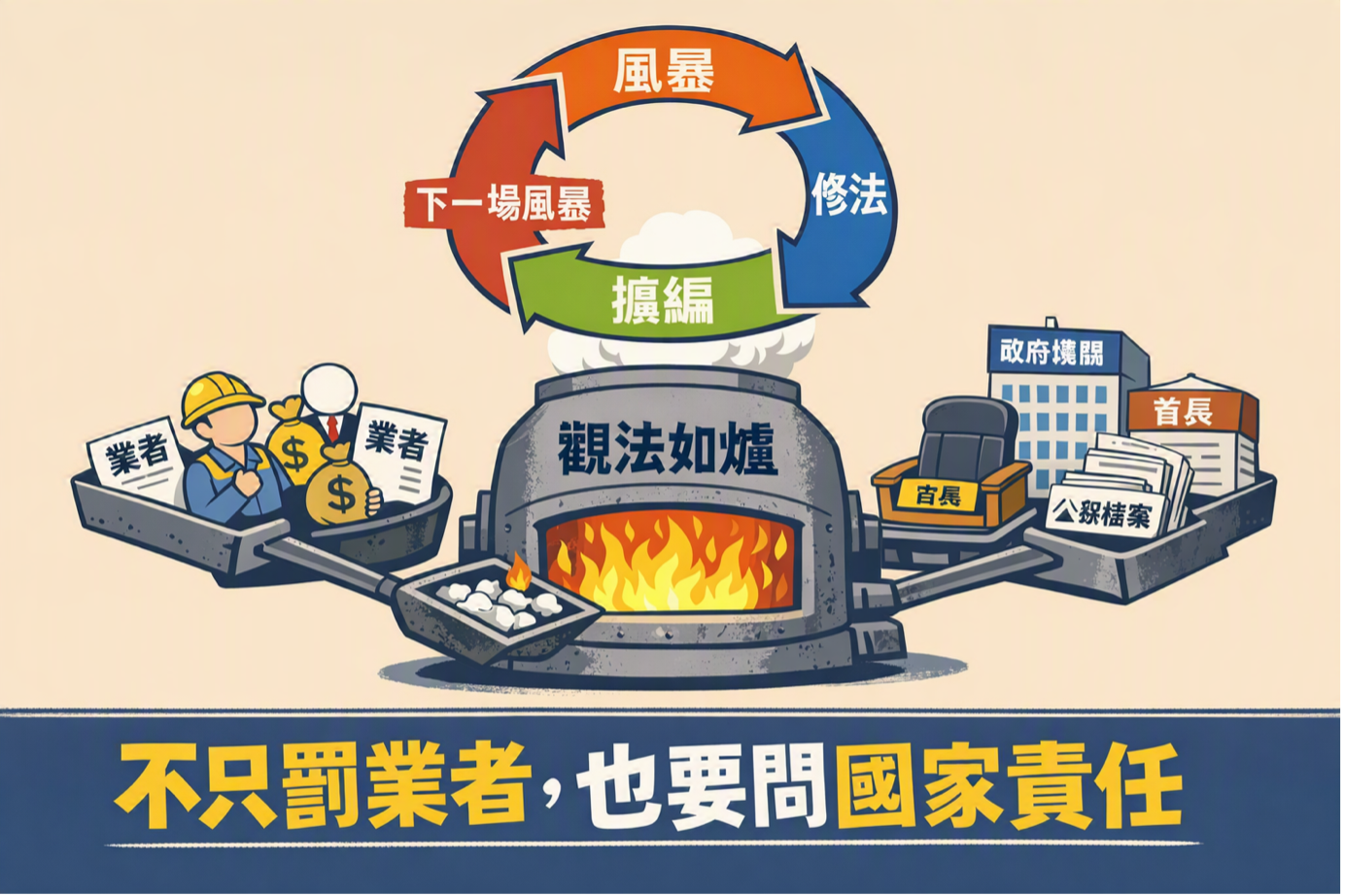
Taiwan's food-safety governance has long been trapped in a cycle: storm → amend the law → more money and posts → next storm. Each time we are told the law is incomplete, and each time penalties on businesses get heavier, yet the responsibility of the state's own regulatory links is almost never touched. This article argues something simple:
- Businesses must fear the law like a furnace — record fines, detention, multiple charges: this direction is right. Prosecute where it is warranted.
- Civil servants and officials must fear the law like a furnace too — regulatory failure cannot forever stop at “administrative review”. If the law is to be amended, the point should not be more power or more budget, but clearly defining the responsible levels and posts at every tier and department in the food-safety chain (including the Premier, ministers and local heads), so that every link where “standards weren't set, inspections weren't done, reports were buried, the council wasn't convened” has a specific person who can be held accountable, and a penalty.
- Old debts must be paid first — the implementation rate of the five rings of food safety, the same shortcomings the Audit Office repeats every year, the billion-dollar food cloud spinning its wheels: until these accounts are settled, any new law or new budget only pushes the problem on to the next administration.