 努力小農
本文尚無譯文。
Traceability is what makes sustainability real: how the Carbon Farming ESG Green Shinkansen rules out black boxes
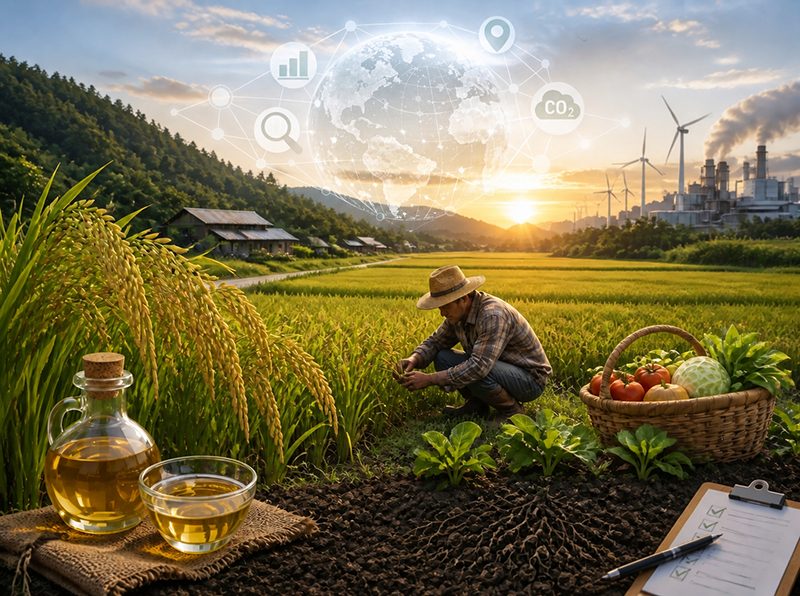
The reason this toxic-oil storm keeps repeating is not a lack of certification, but that there is no truly open, verifiable data chain behind the certificates. From organic labels to sustainability reports, Taiwan has no shortage of paper proofs of compliance. What it lacks is a mechanism that lets “who grew it, where and how” be checked and held to account at any time. That is exactly the problem the Carbon Farming ESG Green Shinkansen was designed to solve from the start.
From purchasing to long-term investment
The first key to this model is turning the relationship between companies and smallholders from “purchasing” into “investment”. In conventional purchasing, a company pays for goods whose production it cannot see; once the deal is done, so is its responsibility, and the cost is booked as an operating expense on the income statement. In carbon farming, a company invests in smallholders' carbon farming projects through payment-for-ecosystem-services (PES) contracts, and records them on the balance sheet as climate-transition assets. This change in accounting treatment is not just a formality; it changes the incentive structure. Since the company treats the money as an asset rather than an expense, it must — and has every reason to — really understand what happens behind the investment, rather than walking away after a one-off transaction.
A three-layer chain of evidence that rules out black boxes
The second key is the three-layer chain of evidence. In the first layer, a validation and verification body (VVB) recognised by Gold Standard verifies emission reductions on site using international methodologies, and the data are registered on the publicly searchable GS Registry. In the second layer, an ESG due-diligence body that charges no fees and is independent of both companies and farmers goes to the farms in person to confirm that production is genuine and that the revenue share actually reaches smallholders' accounts. In the third layer, the company's certifying accountant issues a limited or reasonable assurance report based on the first two layers, meeting the highest standard of disclosure quality under IFRS S1/S2. The three layers are independent and check one another; each leaves auditable records open to public scrutiny, rather than a certificate full of adjectives that anyone can interpret as they like.
The third key is full transparency: who grew it, where, how and when, where and how it was processed, and the changes and test data for soil organic carbon are all open, traceable and accountable. Take the per-hectare investment model: a company invests about NT$100,000 per hectare per year, corresponding to about 4 tonnes of CO2e in certified emission reductions with an internal-carbon-price financial value of NT$12,000 to 36,000, while guaranteeing smallholders an annual income of over NT$400,000 — an increase of NT$100,000 to 170,000 — and a social return on investment (SROI) of between 1:1.3 and 1:2.5. These numbers are not marketing language; every one corresponds to verifiable evidence and records.
The model also responds to the triple regulatory pressure facing listed companies in 2026. From this year IFRS S1/S2 require companies with capital of NT$10 billion or more to disclose climate-related risks, and traditional estimated-factor methods no longer meet the “reasonable and supportable” standard. The 2026 (ROC year 115) ESG evaluation adds indicators such as natural carbon sinks and supplier environmental management. And with carbon fees and the EU's CBAM starting at the same time, companies urgently need voluntary emission reductions of third-party-verified quality. This is not extra charitable spending, but a concrete way to make a company's sustainability investment stand up to scrutiny while reducing greenwashing, reputational and legal risks.
In policy terms, the model also echoes three recommendations legislators put forward at a public hearing: institutionalising the ESG sandbox and clarifying the legal status of PES contracts, so companies gain legal certainty when recognising them as assets; requiring the authorities to provide accounting guidance on recognising NbS (nature-based solutions) assets, reducing compliance uncertainty; and linking agricultural policy with capital markets, making smallholder carbon farming a benchmark case for the natural-carbon-sink indicator in ESG evaluations. If these recommendations are gradually put into practice, more companies will have a framework to follow and be willing to make long-term investments that combine climate, social and governance benefits, instead of each having to find its own way every time.
If the toxic-oil scandal has taught us anything, it is this: sustainability without traceability is just packaging. Whether it is a bottle of cooking oil or a package of carbon credits, only when the question “did this really happen?” can be openly checked and given a concrete answer at any time can it be called a truly sustainable investment.

