 努力小農
本文尚無譯文。
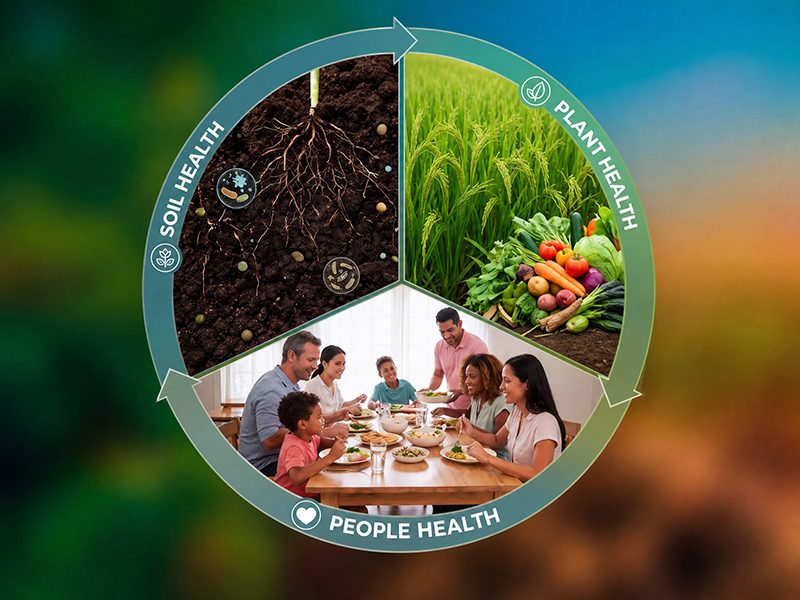
Healthy soil, healthy crops, healthy people: food safety and net zero through a One Health lens
Food-safety storms, soil health and climate governance look like three unrelated things, but they are really different symptoms of the same governance problem. That is the core idea of the One Health framework put forward by the Global Soil Partnership of the Food and Agriculture Organization of the United Nations (FAO) and by the World Health Organization (WHO): human health, animal health, ecosystem health and the health of the food system are inseparable, and a problem in any one of them ultimately shows up on our tables and in our bodies.
Take rice. Taste value is a scientific indicator of the appearance, aroma, texture and flavour of cooked rice, determined by moisture, long-chain starch, protein and other components. Research and practical experience both show that taste value is positively correlated with soil organic carbon: for the same variety, the more organic matter in the soil, the higher the taste value. This shows that healthy soil is not just an environmental issue; it bears directly on crop quality and food safety. It is the simplest of cause-and-effect relationships, yet it is often overlooked in the pursuit of yield and lower costs, or even displaced by short-term thinking that relies on heavy use of chemical fertilisers and pesticides.
Compare this with the opaque structure revealed in the food-safety scandal — raw materials of unknown origin, mixed processing and supply chains passed from hand to hand. Carbon farming crops take the opposite path: a single place of origin, regular soil organic carbon testing, full records of pesticide and fertiliser use, and sampling before harvest to confirm there are no residues. Every step from field to table leaves an auditable record, rather than waiting until something goes wrong to trace back where a batch of raw material came from. A production model that insists on transparency and traceability from the source is, in essence, a preventive mechanism against food-safety risk, not just a tool for cutting carbon.
Food safety, soil and decarbonisation form a single governance value chain
According to the FAO, global agrifood systems account for about 34% of total human-caused greenhouse gas emissions, about 10% of which comes from wasted food. This means food-safety governance, soil health and decarbonisation are essentially different links in the same governance chain: soil health affects crop quality and safety; transparent production and processing lower food-safety risks; and reducing food waste and increasing soil organic matter are also important means of cutting emissions. Dealing with the three separately often means solving one at the expense of another; seeing them as different aspects of one governance logic is how to find truly efficient solutions.
Carbon farming is systemic agricultural governance
That is why carbon farming should not be reduced to the single act of “planting trees for carbon credits”. It should be seen as a systemic project of agricultural governance: from soil testing, cultivation records and pesticide and fertiliser management to post-harvest processing records and final sale, every link affects food safety, ecosystem services and greenhouse gas emissions at the same time. When companies or consumers choose to support this kind of production, what they buy is never just a bag of rice or a batch of emission reductions, but a complete commitment to health that stands up to scrutiny from field to table.
Building the commitment to health from the source
The real solution has never been to step up inspections and penalties at the end of the chain after things go wrong. It is to start at the place of origin and turn “healthy soil, healthy crops, healthy people” into a complete, publicly verifiable story — with data on changes in soil organic carbon, records of the growing process, searchable processing histories, and every link backed by concrete, auditable evidence. When that story stands up to scrutiny, food-safety storms will naturally become rarer, because problems are seen and dealt with at the source rather than being exposed by the media and regulators after consumers have already eaten them.
For companies, this also means that supporting carbon farming projects should not be judged solely from the financial angle of whether carbon credits can offset carbon fees, but seen as a comprehensive risk-management tool that invests in food safety, biodiversity and climate resilience at the same time. When the soil and crops at the source of the supply chain are healthy, food-safety risks downstream naturally fall. That is exactly what the One Health framework reminds us: rather than repairing the damage after a storm, lay a healthy foundation at the source.

