 努力小農
本文尚無譯文。
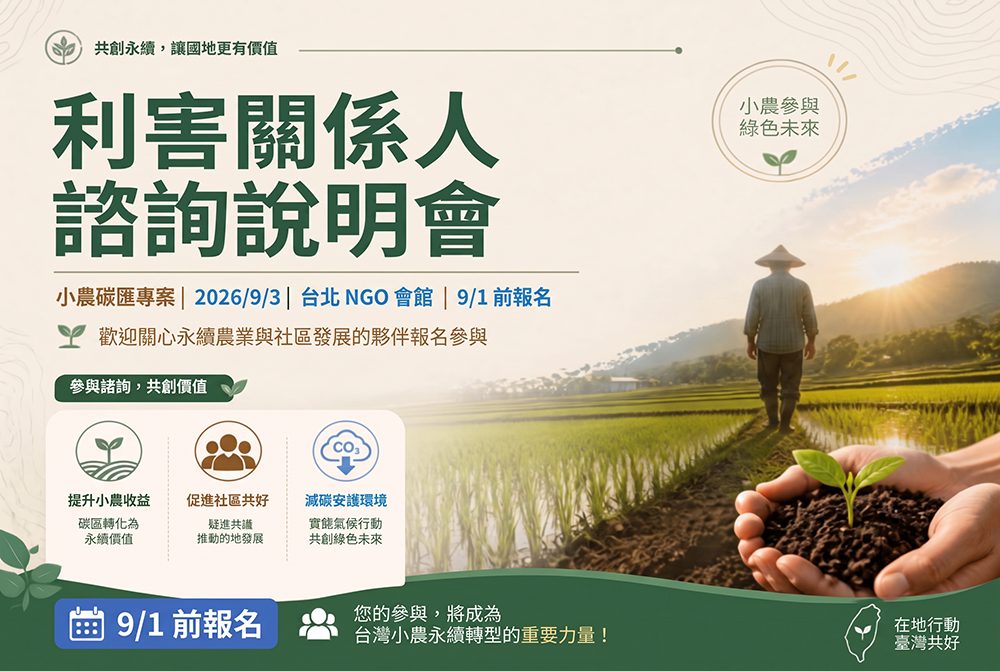
3 September 2026: stakeholder consultation meeting for the smallholder carbon sink projects
Our company, Eco-affinity Inc., is the project developer of the “Small Farmers' Carbon Farming Project in Taiwan (GS11818)” and the “Taiwan Chishang Smallholder Carbon Farming Project (GS23490)”. Both projects are seeking carbon credit certification under the Gold Standard for the Global Goals (GS4GG) Soil Organic Carbon (SOC) methodology. Under the GS4GG Stakeholder Consultation and Engagement Requirements (V2.1), project developers must hold meaningful consultation and communication with stakeholders at every stage of project design, planning, implementation and operation, and establish an ongoing feedback and grievance mechanism.
Our projects have entered the performance verification stage, after which Gold Standard can issue carbon credits and SDG impact certification.
Gold Standard's certification requirements and rules have changed somewhat over the past two years. Our projects were submitted in 2022, and after nearly four years some of the rules from that time have changed; we will explain these publicly and ask for your views.
Whether you are a farmer already in the project or preparing to join, or another stakeholder connected with the project, we hope you will take part and share your views. Written comments are of course also welcome. Please register for the in-person or online meeting.
1. Meeting information
|
Date |
Thursday 3 September 2026, 2:00–4:30 pm |
|
Venue |
NGO House, No. 8 Qingdao East Road, Zhongzheng District, Taipei |
|
Format |
In-person meeting (presentation + Q&A), with a written feedback channel for stakeholders unable to attend in person |
|
Projects covered |
GS11818|Small Farmers' Carbon Farming Project in Taiwan GS23490|Wan'an smallholder carbon sink project, Chishang Township, Taitung County |
|
Feedback period |
Open for written comments from stakeholders for at least 30 days from the meeting date (until 3 October 2026) |
|
Moderator |
Chen Man-li |
|
Contact |
Jay Fang (Chairman, Eco-affinity Inc.) E-mail: [email protected] |
Register here 》》https://forms.gle/iBoqsfggo34fmVzUA
2. About the projects
Both are small-scale farmer soil organic carbon (SOC) carbon sink projects. By helping smallholders adopt regenerative practices (such as applying organic matter, cover cropping and reduced tillage), they raise soil organic carbon, with monitoring, reporting and third-party verification under the GS4GG methodology; the resulting emission reductions can be issued as carbon credits. The projects are also committed to helping smallholders earn a fair living income, and to preventing outside parties from exploiting smallholders' interests in the name of carbon credit development.
• GS11818: Small Farmers' Carbon Farming Project in Taiwan, including smallholder producer groups such as the Mitian Sharing Cooperative in Hualien and the second and third production and marketing groups of Changliang Village, Yuli, with monitoring and farmer engagement through the MiHuMiSang platform.
• GS23490: Taiwan Chishang Smallholder Carbon Farming Project, centred on the Wan'an organic farming community in Chishang Township, Taitung County, jointly run by the community development association and local smallholders.
3. Expected benefits and potential impacts (positive and negative)
• Economic: more carbon credit income for smallholders and stronger incentives to add organic matter; attention is needed to the fair distribution of carbon credit income and farmers' bargaining power.
• Social: strengthening the organisational capacity of rural communities and passing on farming across generations; care is needed to ensure the views of women and disadvantaged groups are fully included in consultation.
• Environmental: improving soil health and increasing farmland carbon sinks and biodiversity; continued monitoring is needed to avoid unintended effects from changes in farming practice.
• Contribution to the UN Sustainable Development Goals (SDGs): including SDG 2 (Zero Hunger), SDG 13 (Climate Action), SDG 15 (Life on Land) and SDG 8 (Decent Work and Economic Growth).
4. Agenda (provisional)
Time |
Item |
|
14:00–14:10 |
Registration and opening remarks |
|
14:10–14:35 |
Project background: the Gold Standard for the Global Goals (GS4GG) Soil Organic Carbon (SOC) methodology, project scope and timeline |
|
14:35–15:00 |
Expected benefits and potential impacts: economic, social and environmental aspects and contribution to the SDGs, including assessment of positive and negative impacts |
|
15:00–15:50 |
Questions and discussion with stakeholders (including gender-sensitive input and views from disadvantaged groups) |
|
15:50–16:15 |
The ongoing grievance and feedback mechanism |
|
16:15–16:30 |
Closing remarks and next steps |
5. How to submit comments
This meeting is open to all; anyone who wishes to attend may do so, with no restrictions. If you cannot attend in person, you can still submit written comments during the feedback period in the following ways:
• E-mail: [email protected]
• In writing: by post or delivered in person to the project contact
• Verbally / by phone: project staff can record your comments and provide written confirmation
All comments will be recorded faithfully. After compiling them, we will explain how they have been taken into account; for comments not adopted, we will give our reasons. The projects also have an ongoing feedback and grievance mechanism, open to stakeholders throughout the project's life.
Register here 》》https://forms.gle/iBoqsfggo34fmVzUA
--------------------------------------------------
Note: registration closes on 1 September; you can choose to attend in person or online.
1) The meeting on 3 September will be livestreamed online; the link will be provided before 1 September.


