 努力小農
本文尚無譯文。
Lay the tracks first, so the Shinkansen can reach the fields: join our smallholder carbon farming stakeholder consultation on 3 September
Carbon Farming Digest No. 5 · End of Heat|Seasonal feature
Lay the tracks first, so the Shinkansen can reach the fields —
join our smallholder carbon farming stakeholder consultation on 3 September
An invitation four years in the making
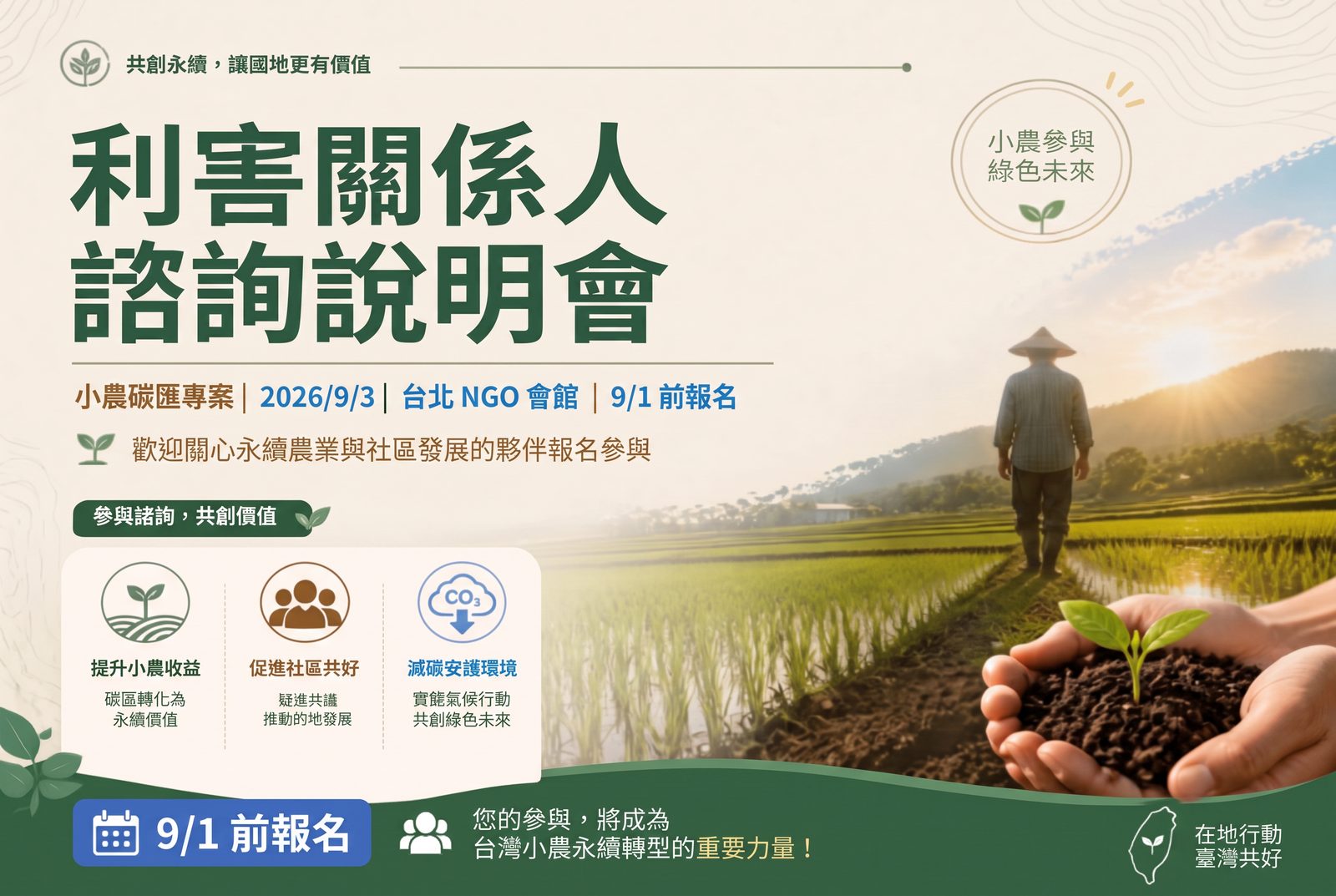
On 4 June 2022 we held a stakeholder consultation at the Legislative Yuan, to put the Small Farmers' Carbon Farming Project in Taiwan (GS11818) in the open from the very start. For the smallholders of Hualien's Mitian cooperative and Yuli's production and marketing groups — people who rarely get to stand in front of a microphone — it was the first time they were formally consulted and had their views formally recorded.
Four years on, that project is in its fourth year, and the Chishang smallholder carbon sink project (GS23490) in Wan'an, Chishang Township, has joined it and is in its second year. Meanwhile, the Gold Standard for the Global Goals (GS4GG) has made major revisions to its Soil Organic Carbon (SOC) methodology and activity modules, directly affecting the next steps in both projects' certification.
So we decided to hold another consultation. Not because the rules require it (although GS4GG does require projects to keep communicating with stakeholders at every stage of design, planning, implementation and operation), but because we believe that if a project goes four years without going back to stakeholders to explain “where we are now and how the rules have changed”, then its so-called openness and transparency is just a slogan on the wall.
Why stakeholder consultation is the real starting point of Gold Standard certification
Many people assume the heart of carbon credit certification is instrument monitoring, soil sampling and complex methodology formulas. These matter, of course, but Gold Standard's logic is actually simpler: for a project to earn the trust of the word “gold”, the first step is not to measure the soil, but to ask the people the project will affect.
Under the GS4GG Stakeholder Consultation and Engagement Requirements, before a project starts the developer must identify everyone who is “local, affected or has a stake” — residents and community representatives, people with land-use rights, local government and elected representatives, local NGOs and women's groups, even Gold Standard's own representatives — and invite every one of them to come and be heard. The process must have at least two rounds: an in-person meeting, plus a written feedback period of at least a month (longer if major methodology revisions are involved). The rules place particular emphasis on gender sensitivity and the participation of disadvantaged groups: the time, place and language of meetings must all take into account whether women and disadvantaged people can actually attend and actually speak.
In other words, what Gold Standard wants is not a beautifully written consultant's report, but a process in which the community really knows, really agrees and can really express its views. That is why we often say stakeholder consultation is the key work that launches Gold Standard certification: without it, all the monitoring data and third-party verification that follow lose their foundation of legitimacy.
Who we want to hear from at this meeting
We have invited a wide range of people to the 3 September meeting: farmers from the Mitian Sharing Cooperative in Hualien and the second and third production and marketing groups of Changliang Village in Yuli; the Wan'an Community Development Association and local smallholders in Chishang, Taitung; local government and elected representatives; civil society groups with a long-standing interest in agriculture, food safety and the environment; and of course companies and investors thinking about their ESG investment strategy and looking for trustworthy sources of agricultural carbon sinks.
We especially want to invite friends from the business world. Over the past few years companies have often asked us, “How are your carbon credits different from anyone else's?” The answer is simple: our carbon credits are designed with farmers genuinely taking part, rather than signing contracts first and only telling farmers afterwards. This meeting is the best proof. You will see with your own eyes how smallholders who usually grow rice and tend orchards stand up to question the project developer on stage, express their views and even challenge our plans. That is what stakeholder consultation should look like — and it is the thing you should most check for yourself when evaluating an ESG investment or carbon credit purchase.
Meeting information
Time: Thursday 3 September 2026, 2:00–4:30 pm (registration from 1:30)
Venue: NGO House, Taipei (No. 8 Qingdao East Road, Zhongzheng District, Taipei)
Format: attend in person or join online (places are limited for both, so please register soon)
Projects covered: GS11818 Small Farmers' Carbon Farming Project in Taiwan; GS23490 Wan'an smallholder carbon sink project, Chishang Township, Taitung County
Moderator: Chen Man-li
Registration: https://forms.gle/HB4e8TYBqqwWNZMfA
The agenda covers the project background and the GS4GG soil organic carbon methodology, expected benefits and potential impacts (including assessment of positive and negative effects), questions and discussion with stakeholders, and — most importantly — the grievance and feedback mechanism. Even if you cannot attend on 3 September, a written feedback period of at least 30 days will be open after the meeting. You can send comments at any time by e-mail, in writing or by phone; we will record them faithfully and, after compiling them, explain how they have been taken into account. For comments not adopted, we will explain why.
An invitation, and a promise
Honestly, holding a meeting like this is not easy: the venue has to be booked, a moderator invited, farmers' travel and time coordinated, livestreaming equipment set up — far more trouble than shutting the door and writing a report ourselves. But we have always believed that a carbon credit project that truly stands up to scrutiny can withstand being questioned in public.
If you care about sustainability, food safety and whether ESG investment really reaches the land, this meeting is worth your time. We look forward to seeing you at NGO House in Taipei, and please forward this invitation to anyone you think should come and hear about it.
We are laying the tracks. It doesn't matter how fast the Shinkansen runs; what matters is that at every station there are people willing to get on board, to speak up and to be heard.


