 努力小農
本文尚無譯文。
2026, the first year of carbon fees: why Taiwanese companies need agricultural carbon sinks more than ever — the first year it gets real
Carbon Farming Digest No. 5 · End of Heat|Seasonal feature
For Taiwan's big emitters, 2026 is the first year the carbon fee system “gets real”. Power and manufacturing companies emitting 25,000 tonnes or more a year must pay carbon fees based on their actual 2025 emissions; about 500 emission sources at 281 companies across Taiwan fall within the scope. This means that “carbon pricing”, which for years remained in policy debates and CSR reports, has for the first time become a real cost on companies' financial statements.
Faced with this new expense, companies' first instinct is often to look for ways to offset or reduce — and agricultural carbon sinks, especially soil organic carbon (SOC), are becoming one of the most closely watched sources in Taiwan's domestic carbon credit market. In recent years the Ministry of Agriculture has actively promoted carbon pricing and carbon credit trading for the farm sector, combined with the Ministry of Environment's two domestic offset mechanisms — “greenhouse gas incremental offsets” and “voluntary greenhouse gas reduction projects”. For the first time, smallholders' regenerative practices — such as applying organic matter, planting cover crops and reducing tillage — can be turned into tradable carbon credits, and companies have a local, traceable option for buying carbon credits.
Buying carbon credits is not buying a certificate
But there is a key point that is easily overlooked. For a company to be compliant and able to show that its carbon credit purchase stands up to scrutiny, the precondition has never been just “has this batch of credits been verified by a third party?” More fundamentally: when the project was designed, were the people it really affects allowed to take part?
That is exactly why the Gold Standard for the Global Goals (GS4GG) makes stakeholder consultation a core certification requirement. Behind every carbon credit certificate is a particular plot of farmland and a particular group of farmers who actually changed how they farm. If farmers were merely passive participants in that change from start to finish — or even entirely unaware of it — then even if the data look good and verification is passed, the “gold content” of the credit is open to question. It cannot support the ESG story the company wants to tell, and if the media or NGOs later ask, “Did these farmers really agree, and do they really benefit?”, the company bears the reputational risk.
In other words, when Taiwanese companies choose agricultural carbon sinks in 2026, the question should not only be “how much per tonne?”, but “how many rounds of stakeholder consultation has this project held? Were farmers' views heard? Is the grievance mechanism sound?” Treat the records of consultation meetings as due-diligence documents before buying carbon credits.
From consultation meeting to purchase list
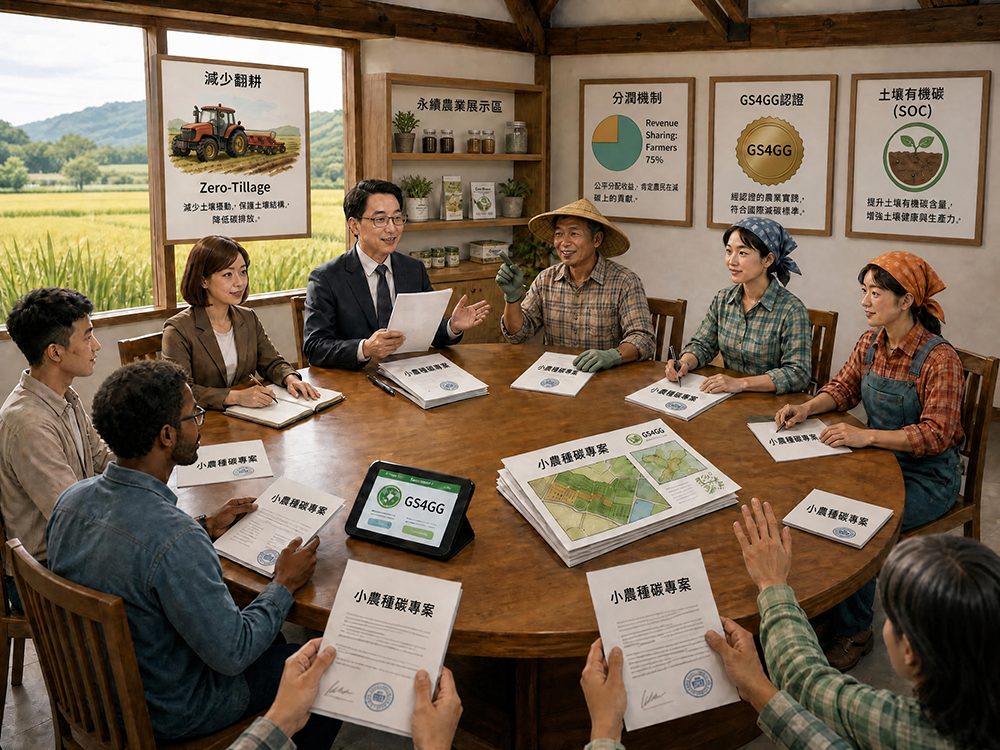
This is one reason we chose the first year of carbon fees to hold another stakeholder consultation. The 3 September meeting is both an account of our responsibility to local smallholders and communities and a chance to lay out our project design process for every company evaluating agricultural carbon sink purchases. Meeting records, how comments were taken up and the grievance mechanism will all be kept in full, becoming documents any company can check directly when doing due diligence on carbon credit purchases in future.
Taiwan's agricultural carbon sink market is just getting started. The global soil carbon market is expected to grow from US$528 million in 2025 to US$1.47 billion in 2030, a compound annual growth rate of 22.7% — the growth momentum is clear. But the faster it grows, the more it needs a governance foundation that stands up to scrutiny. For Taiwanese companies, 2026 should be not only the first year of carbon fees, but also the first year of “choosing carbon credits carefully”. Picking a project that brought stakeholders to the table from day one is far more solid than producing a consultation report after the fact.


